Belt thickness is listed as a spec on some product pages and absent from most. When it does appear, it’s rarely explained — you get the number without the context that makes it useful.
This covers what the difference between 4mm and 5mm actually means in mechanical terms: how each thickness performs under load, where each one is adequate and where it isn’t, and what the number tells you about the belt’s construction when it’s disclosed at all.
The thickness of a belt determines how it responds to load. Every belt is under load when worn — the weight of trousers, the tension of the buckle, and in carry configurations, the additional lateral pull of a holster and its contents. That load tries to bend the belt outward at the point where the holster attaches.
A belt resists that bending through its stiffness — and stiffness in a flat beam scales with the cube of its thickness. This is not intuitive but it’s important: a belt that is 5mm thick is not 25% stiffer than a 4mm belt. It is approximately 1.95 times stiffer. The relationship is non-linear. A relatively small increase in thickness produces a disproportionately large increase in resistance to bending under load.
For a belt worn without carry weight — dress use, casual wear, no holster — this distinction is largely academic. Both 4mm and 5mm leather feels stiff compared to a typical 2–3mm fashion belt, and both will hold their shape through a normal day. The difference becomes structurally relevant when the belt is carrying load beyond its own weight and the weight of trousers: a holster, a heavy work tool, a loaded clip, anything that creates sustained lateral pull on the belt at a fixed point.
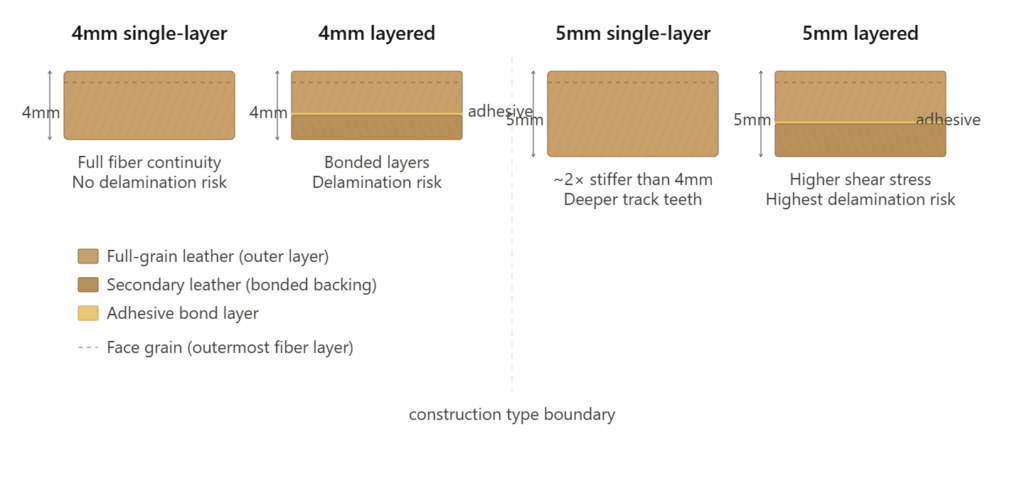
A stated thickness of 4mm should mean the leather strap measures 4mm from face to back at any point along its length. In practice, that qualifier — “should” — matters more than it appears.
Single-layer vs. layered construction: A 4mm single-layer belt is cut from a hide at 4mm thickness. The fiber structure runs continuously from face to back — there are no adhesive bonds, no lamination seams, no internal interfaces that can separate. A 4mm layered belt achieves 4mm total by bonding two or more thinner pieces together. This is common: a 2.5mm face leather bonded to a 1.5mm backing leather produces a 4mm total, and a product listing that says “4mm leather” doesn’t tell you which construction was used.
The difference matters because layered construction introduces a delamination failure mode that single-layer construction doesn’t have. The adhesive bond between layers degrades under heat, moisture, and the repeated flexing of daily wear. Delamination typically starts at the bend point near the buckle and progresses along the strap length over months of use. By the time it’s visible, it’s usually too far advanced to reverse.
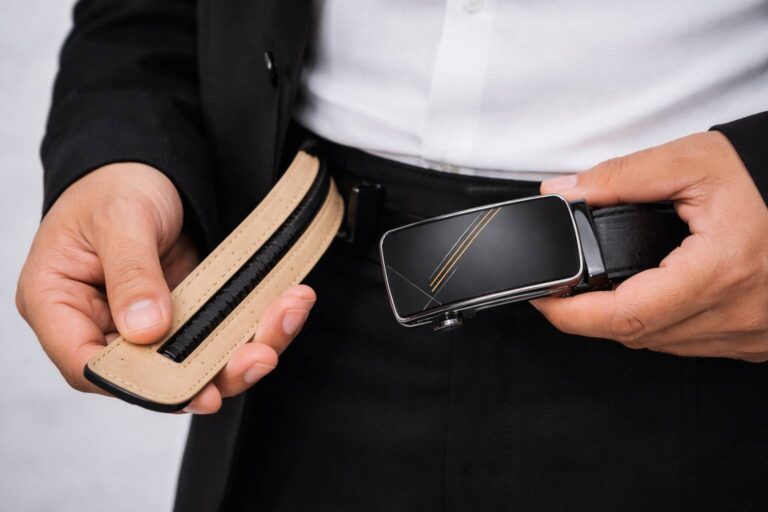
Where 4mm single-layer performs well: 4mm single-layer full-grain leather is a capable belt material for dress use and moderate daily wear without carry load. It’s stiff enough to hold its shape through the belt loops without sagging, flexible enough to buckle and release comfortably, and thick enough to support an integrated ratchet track with adequate tooth depth — provided the track is cut carefully to preserve sufficient material below the tooth root.
For a full explanation of how leather thickness interacts with ratchet track construction, see our [guide to how ratchet belt mechanisms work →]
Where 4mm starts to show limitations: Under sustained carry load — specifically, a holster carrying a firearm or heavy tool creating consistent lateral pull at one point on the belt — 4mm leather deflects measurably. The belt bows outward at the attachment point, which does two things: it changes the holster cant from the angle it was set at, and it creates a fatigue zone in the leather at the edges of the deflection arc. Over time, 4mm leather under this kind of load develops a set — a permanent bend — at the carry point. The belt doesn’t fail catastrophically, it gradually stops holding the holster where you positioned it.

The move from 4mm to 5mm is not incremental. As noted above, the stiffness relationship is non-linear: 5mm leather is approximately twice as stiff as 4mm leather under bending load, not 25% stiffer. That difference is the entire argument for 5mm in carry applications.
Deflection under lateral load: At equivalent leather quality and construction, a 5mm belt deflects roughly half as much as a 4mm belt under the same lateral pull. For a holster carrying a 700–900g compact firearm, this translates to a belt that holds holster position and cant through a full day of movement rather than gradually shifting as the leather fatigues.
Creep resistance: Leather under sustained load deforms slowly over time — this is called creep. The rate of creep is affected by thickness, fiber density, tanning method, and the magnitude of the applied load. Thicker leather creeps more slowly because the load is distributed across a larger cross-section, reducing stress per unit area. A 5mm belt under carry load develops less permanent set over a year of daily wear than a 4mm belt under the same load. For a belt expected to last 5–10 years in daily carry use, this is a meaningful difference in longevity.
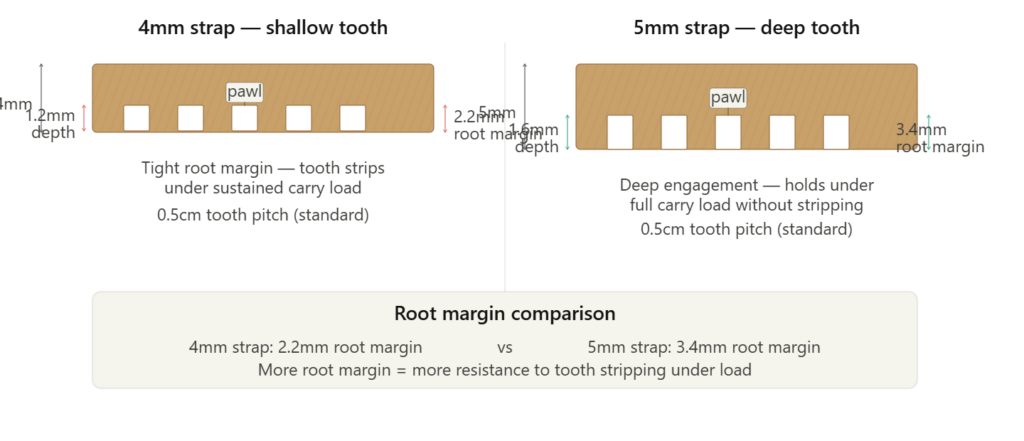
Ratchet track geometry: A 5mm strap supports deeper track teeth than 4mm while maintaining more material below the tooth root. At 5mm, a tooth can be cut to 1.5–1.8mm depth while leaving 3.2–3.5mm of structural leather below — a comfortable margin. At 4mm, the same tooth depth leaves only 2.2–2.5mm below the tooth root, which is adequate but tighter. For carry applications where the belt is under sustained load and the ratchet mechanism needs to hold reliably, 5mm provides more mechanical margin at the track engagement point.
Keeper loop retention: A keeper loop — the loop that holds the belt tail in place — grips the belt through friction and compression. A thicker belt sits more solidly in a keeper loop, with less tendency to shift laterally under movement. At 4mm, a poorly fitted keeper loop allows slight belt migration. At 5mm, the same keeper fits more securely and the belt moves less. For carry use where consistency of position matters, this is a minor but real difference.
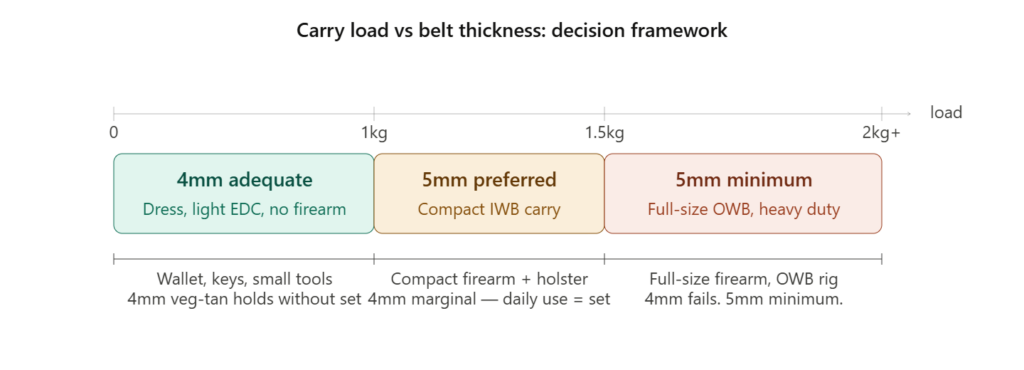
Thickness choice maps to carry load. Here’s how to apply it:
Sub-1kg total carry load — 4mm is adequate: Light EDC: wallet, phone, small multitool, no firearm. Belt tension is primarily trouser support. 4mm single-layer full-grain handles this without deflection or premature fatigue. No structural argument for 5mm at this load level.
1–1.5kg total carry load — 4mm marginal, 5mm preferred: Compact firearm in an IWB holster, or equivalent load from tools and gear. At this weight, a quality 4mm belt holds adequately but begins to show deflection at the carry point over a long day. 5mm eliminates that deflection. If the carry is intermittent — not every day — 4mm is workable. For daily carry at this load, 5mm is the better choice.
1.5kg and above — 5mm minimum: Full-size firearm OWB, multiple carry items, heavy-duty work use. At this load level, a 4mm belt under sustained carry develops set measurably faster and deflects enough to affect holster position and draw consistency. 5mm is the practical minimum. For loads above 2kg or for OWB carry with a retention holster creating additional leverage, some carriers prefer reinforced 5mm construction — a 5mm strap with a stiffening liner — though this adds bulk and reduces flexibility.
For dress wear with no carry load: Thickness is a comfort and appearance consideration rather than a structural one. 4mm has more visual presence and a firmer hand than thinner fashion belts. 5mm is noticeably stiffer and may feel excessive for dress use in lighter trouser fabrics. Most dress belt applications are better served by 4mm.
Two belts at the same stated thickness can have meaningfully different stiffness if they’re tanned differently. This affects how the thickness spec translates to real-world performance.
Vegetable-tanned leather uses plant-derived tannins in a process that typically takes several weeks. The result is a firmer, denser leather with higher initial stiffness. A 4mm veg-tan belt is stiffer than a 4mm chrome-tan belt of equivalent fiber quality, because the tanning process produces a denser fiber structure. Veg-tan also develops a harder patina over time as the surface fibers compress — which can increase effective stiffness further with break-in.
Chrome-tanned leather uses chromium salts and takes days rather than weeks. The result is softer, more supple leather with better moisture resistance but lower initial stiffness. A 4mm chrome-tan belt flexes more readily than a 4mm veg-tan belt. For dress use where suppleness is a virtue, this is fine. For carry use where stiffness under load is the primary performance criterion, equivalent stiffness from chrome-tan leather requires greater thickness — closer to 5mm — to match what veg-tan provides at 4mm.
This means thickness spec and tanning method need to be read together. A “5mm chrome-tan” belt and a “4mm veg-tan” belt may perform comparably under carry load despite the thickness difference. A brand that specifies both tells you considerably more about expected performance than one that lists thickness alone.
The construction method — single-layer vs. bonded layers — affects performance at both 4mm and 5mm, and is arguably more important than the thickness number itself for predicting longevity.
Single-layer at 4mm: The baseline capable construction for daily wear. No delamination risk. Fiber structure is continuous and the belt ages as a single piece of leather. Ratchet track can be integrated directly. Long-term performance is limited primarily by fiber quality and tanning method.
Layered at 4mm: Achieves 4mm total thickness with thinner component leathers bonded together. Initial performance may be indistinguishable from single-layer. Delamination failure mode present, typically manifesting after 1–3 years of daily wear depending on adhesive quality and environmental conditions. Not suitable for carry use.
Single-layer at 5mm: The highest-performance construction for carry and heavy daily wear. Maximum stiffness, no delamination risk, deepest available track tooth geometry. The most demanding spec to source and manufacture — 5mm single-layer hides with consistent thickness and grain quality are more expensive and less available than thinner hides.
Layered at 5mm: Less common than layered 4mm, but exists. Same delamination risk applies, compounded by the greater thickness of each component layer requiring a more robust adhesive bond to resist shear under load. Layered 5mm under carry load is more prone to delamination than layered 4mm because the bending forces at the carry point are higher — which is exactly the condition that stresses the adhesive bond most.
For a full breakdown of leather grain and construction variables that interact with thickness, see our [belt construction guide →]
Most belt product pages either omit thickness entirely or state it without specifying construction method. Here’s how to read what’s available.
What a fully specified belt listing includes:
What to infer when specs are incomplete:
The single most informative spec: If you can get one number, get the thickness. If you can get two, get thickness and construction method. Together they tell you more about how the belt will perform under load than any other combination of specifications.
HoldForm states leather grade, thickness, construction method, and tanning type on every product page. If a belt you’re comparing doesn’t disclose these, the omission tells you something about what’s underneath.
[View full belt specifications →]
For most everyday dress and casual use without carry load, 5mm is stiffer than necessary and some wearers find it uncomfortable at the front fold near the buckle during extended sitting. 4mm is the more practical choice for non-carry daily wear. 5mm is optimized for applications where stiffness under load is the priority — if you’re not carrying weight on the belt, you’re paying a comfort cost for a structural benefit you’re not using.
Flex the belt firmly at the buckle end and examine the fold closely. A single-layer belt folds as one continuous piece — the cross-section shows a uniform material. A layered belt often reveals the seam between layers at the fold edge, particularly as the belt ages and the adhesive bond weakens. You can also look at the cut edge of the strap end: a single-layer belt shows a continuous cross-section; a layered belt shows a visible seam line between the component leathers.
For compact firearms in IWB carry at under 1kg total loaded weight, 4mm single-layer veg-tan full-grain leather is adequate for many carriers. The limitations show up over time — gradual deflection at the carry point and slower development of set compared to 5mm. If you’re carrying daily, plan to replace a 4mm carry belt sooner than a 5mm equivalent. For full-size firearms, OWB carry, or loads above 1.5kg, 5mm is the appropriate spec.
Most fashion belts are 2–2.5mm total thickness, often in layered construction with a thin face leather over a non-leather backing. The difference in hand feel between a 2mm fashion belt and a 4mm single-layer full-grain is substantial — the fashion belt flexes with almost no resistance; the 4mm belt has a firm, structured feel. This is the difference that leads people to describe thick leather belts as “stiff” — it’s not a negative characteristic, it’s the material doing what it’s supposed to do under load.
Yes, in two ways. First, thicker leather takes longer to break in — the initial firmness of a 5mm veg-tan belt softens gradually over months of wear as the fiber structure relaxes under body heat and movement. This break-in period produces a belt that’s slightly more supple than new while retaining its structural stiffness. Second, thicker leather develops a more pronounced patina over time, particularly in veg-tan construction — the surface fiber compression that produces patina is more visible against a thicker cross-section. A well-worn 5mm veg-tan belt looks qualitatively different from a well-worn 2mm fashion belt: one shows age as character; the other shows age as wear.
HoldForm belts are available in 4mm and 5mm single-layer full-grain construction. Leather grade, thickness, tanning method, and construction type are specified on every product page.
[View 4mm belt range →] [View 5mm carry belt range →] [How ratchet track construction interacts with leather thickness →] [Full belt construction guide →]

Practical belt guides, sizing tips, and exclusive offers — straight to your inbox.

Leave a comment