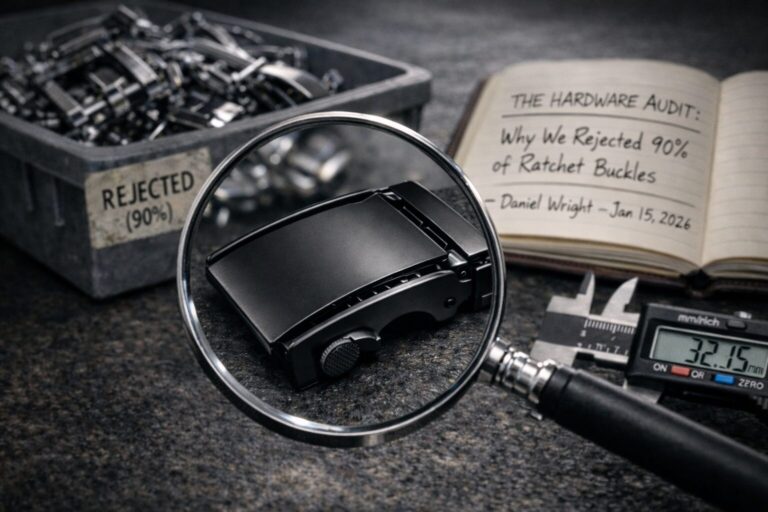
A ratchet belt looks simple from the outside. You feed the strap through the buckle, it clicks into place, you press a lever to release it. Most people stop there.
The mechanics underneath that process — and the specific ways they fail — are what separate a ratchet belt that holds up under daily wear from one that slips, strips, or seizes within a year. This covers the full mechanism: how each component works, what it’s under, and exactly where cheap implementations break down.
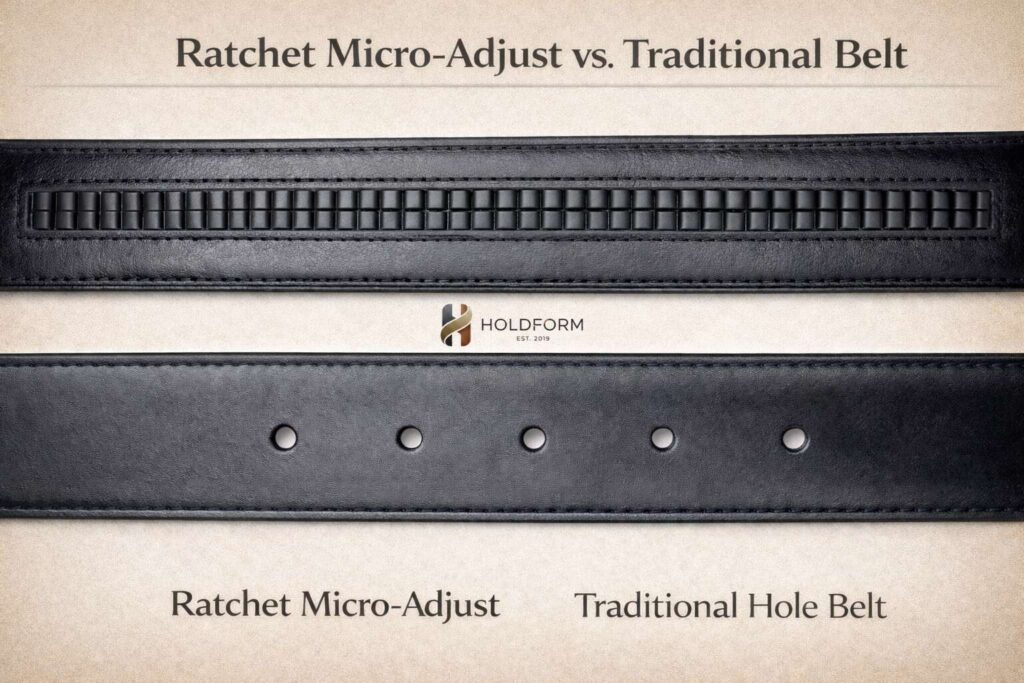
A ratchet belt has two main components that work together: the toothed track built into the leather strap, and the pawl mechanism housed inside the buckle.
The track is a series of teeth cut or molded into the inner face of the leather strap, running along its length. Each tooth is a small ramp with a vertical face on one side and an angled face on the other. The spacing between teeth determines adjustment increment — on well-made ratchet belts, this is typically 0.5cm per tooth. The depth of each tooth — how far it cuts into the leather — determines how much material the pawl has to engage against, which directly affects how much load the mechanism can hold before slipping.
Because the strap locks at every tooth rather than at fixed holes, you get a precise fit at any waist size. You can see the full range in our collection of no-hole ratchet belts.
The pawl is a spring-loaded lever inside the buckle housing. It sits perpendicular to the track and presses against the tooth surface under spring tension. When you feed the strap through the buckle, the angled face of each tooth cams the pawl upward and over, allowing forward movement — that’s the click you hear. When the strap is under tension pulling backward, the vertical face of the tooth locks against the pawl face and the mechanism holds. The spring keeps the pawl pressed into the track so it never loses contact with the teeth.
The release lever on the buckle face connects to the pawl. Pressing it lifts the pawl clear of the track, disengaging the mechanism and allowing the strap to slide freely in either direction.
That’s the complete system: track teeth cut into leather, a spring-loaded pawl that cams over teeth in one direction and locks against them in the other, and a lever that manually disengages the pawl for release.
Everything that can go wrong with a ratchet belt comes back to one of these three components — the track, the pawl, or the housing that holds them in alignment.
The track is where most ratchet belt quality differences originate, and it’s the component least likely to be described accurately in product specifications.
Integrated track vs. bonded insert: On a well-constructed ratchet belt, the track teeth are cut directly into the leather strap itself. The teeth are part of the strap — there’s no separate component and no adhesive bond to fail. This requires leather thick enough to accommodate the tooth geometry without compromising the structural integrity of the strap: 4mm is the practical minimum, 4.5–5mm is preferable for carry use where load is higher.
On cheaper ratchet belts, the track is a separate plastic or thin-metal insert that sits in a channel routed into the leather, held in place with adhesive. This construction exists because it’s cheaper to manufacture — you can use thinner, lower-grade leather and add the track as a component. The failure mode is predictable: the adhesive bond between the insert and the leather channel degrades under heat, body moisture, and the repeated micro-flexing of daily wear. Once the insert starts to move within the channel, the teeth no longer align consistently with the pawl, and the mechanism begins to slip or jam. Full delamination — where the insert separates from the leather entirely — renders the belt unusable.
If a product description doesn’t specify whether the track is integrated or inserted, it’s almost certainly inserted. Brands that use integrated tracks specify it because it’s a meaningful construction differentiator.
Tooth depth and geometry: Tooth depth is a function of leather thickness. On a 4mm strap, a well-cut tooth can extend 1.2–1.5mm into the leather while leaving sufficient material below to maintain strap integrity. On a 2.5mm strap, that same tooth depth would compromise the strap structurally, so tooth depth is reduced — sometimes to the point where the pawl engages only the surface of the tooth rather than seating properly against the vertical face.
Shallow teeth fail in a specific way: under moderate load, the pawl face rides up the shallow vertical tooth face and cams over it, just as it does in the forward-feed direction. The belt slips. This is often described as the mechanism “wearing out,” but it’s more accurately a design tolerance problem — the tooth was never deep enough to hold under the load being applied.
Tooth geometry also determines how the mechanism feels. Well-cut teeth with consistent spacing click with a clean, even resistance. Poorly cut teeth — inconsistent depth, variable spacing — produce an irregular click pattern and uneven engagement resistance. The feel of a ratchet belt under slow, deliberate adjustment tells you a lot about the precision of the track machining.
Leather thickness and track interaction: For a fuller breakdown of how leather thickness affects belt performance across carry and daily wear applications, see our [guide to belt thickness: 4mm vs 5mm compared →]
The pawl is a small component under significant cyclic stress. Every time you adjust or release the belt, the pawl flexes against its spring, cams over a tooth, and reseats. Over the lifetime of a daily-wear belt, this cycle repeats thousands of times.
Pawl geometry: The engagement face of the pawl — the surface that contacts the vertical tooth face under load — needs to be hard, flat, and precisely angled. On well-made mechanisms, this face is machined to a tight tolerance and hardened. On cheap mechanisms, it’s cast to looser tolerances with no secondary hardening. Under sustained load, a soft pawl face deforms at the contact point, rounding off the engagement edge and reducing the effective contact area. As the engagement area decreases, the pressure per unit area increases — which accelerates further deformation. This is a failure mode that compounds itself.
Spring steel quality: The spring that holds the pawl against the track is the most failure-prone component in a ratchet mechanism, and the one that varies most dramatically with manufacturing quality.
Spring steel is specified by its carbon content, heat treatment, and gauge. The combination determines how much force the spring exerts, how consistently it exerts that force across thousands of cycles, and at what point it fatigues and loses tension.
Cheap ratchet mechanisms use thin, low-carbon spring steel. It’s inexpensive, it works adequately in initial testing, and it degrades in a specific and predictable way: after several hundred to a few thousand cycles, the spring loses enough tension that the pawl no longer presses firmly against the track. The pawl starts to float slightly above the tooth surface rather than pressing into it. Under light tension, the belt holds. Under the load of carrying a holster, a full day of movement, or simply bending forward — the pawl lifts clear of the tooth and the belt slips.
This is the most common ratchet belt failure reported by daily wearers, and it’s almost always attributed to the mechanism “breaking” — when what’s actually happened is the spring has fatigued past its functional threshold. The pawl itself may be undamaged. The spring is the weak point.
Higher-quality mechanisms use heavier-gauge, higher-carbon spring steel with proper heat treatment. The difference in tactile feel is immediate — the pawl snaps back against the track with noticeably more authority, and the engagement click is crisper. More importantly, the spring maintains that tension across tens of thousands of cycles rather than degrading after hundreds.
Pawl pivot wear: The pawl rotates on a pin or axle inside the housing. On zinc alloy housings with soft pin material, this pivot point wears oval over time — the pawl develops play in its rotation axis, which translates to inconsistent engagement angle against the track teeth. On hardened steel pivot pins in brass or steel housings, this wear is negligible across any realistic belt lifespan.
The buckle housing is the structural frame that holds the pawl, spring, and release lever in precise alignment relative to the track. It also bears the full tensile load of belt tension — everything the belt is holding against pulls through the housing.
Housing flex and mechanism misalignment: Under belt tension, the housing experiences a bending moment: the strap pulls the front face of the housing forward while the back plate — where the track feeds through — is fixed. On a rigid housing, this load is distributed across the full frame and deformation is negligible. On a thin-gauge zinc alloy housing, this bending moment causes measurable flex at the front plate.
That flex matters because it changes the angle at which the pawl contacts the track teeth. The mechanism is designed for a specific engagement angle — the pawl face perpendicular to the vertical tooth face. When the housing flexes, the pawl tilts relative to the track, reducing the effective contact area and increasing stress concentration at the edge of engagement. The mechanism that held perfectly when new starts to slip under the same load after months of wear — not because any component has worn out, but because the housing has deformed enough to misalign the geometry.
This failure mode is insidious because it’s gradual and load-dependent. The belt holds under light tension. It slips under heavy load. The user adjusts tighter. The mechanism holds for a while. The cycle repeats until the engagement geometry is too far off to function.
Brass vs. zinc alloy vs. steel: These three materials cover the range of buckle housing construction in the market.
Zinc alloy (often described as “alloy” or “metal alloy” in product listings) is the most common. It casts well, finishes well, and is inexpensive. Its elastic modulus — resistance to deformation under load — is lower than brass or steel, which is why it flexes under sustained belt tension. It’s adequate for dress belts worn intermittently. For daily wear, carry use, or any application with sustained load, its flex characteristics create the misalignment problem described above.
Brass is denser and harder than zinc alloy, with a higher elastic modulus. A brass housing of the same dimensions as a zinc housing deforms significantly less under equivalent load. It’s also heavier — which is part of why brands that use brass housings mention it specifically, since the weight difference is perceptible in hand.
Steel is the hardest and most rigid of the three. It’s less common in belt buckle housings because it’s harder to machine to fine tolerances and doesn’t take decorative finishes as readily as brass or zinc. Where it appears, typically in tactical or heavy-duty carry applications, it offers the highest rigidity and lowest deformation under load.
For a comparison of how buckle housing material interacts with overall belt construction, see our [belt construction guide →]
Most ratchet belt listings don’t give you the specs you need to evaluate mechanism quality. Here’s how to read what’s available and what to ask for.
What a good product listing discloses:
What to infer when specs are absent:
Physical evaluation if you have the belt in hand:
The ratchet mechanism is one component in a belt that has to perform as a complete system. Track depth depends on leather thickness. Housing rigidity depends on base metal. Pawl longevity depends on spring quality and pivot precision. These components interact — a high-quality pawl assembly in a flexing zinc housing still fails. An integrated leather track with a weak spring still slips.
For the full picture of how belt construction decisions compound across leather, hardware, and mechanism, see our [complete belt construction guide →]
For a direct comparison of how ratchet buckles and pin buckles differ in load distribution, failure modes, and use-case fit, see our [ratchet buckle vs pin buckle comparison →]
This is the characteristic symptom of either spring fatigue or housing flex. At rest, the pawl is seated against the tooth under spring tension and the geometry is correct. Under dynamic load — bending, movement, carry weight — either the spring isn’t holding the pawl firmly enough against the track (fatigue), or the housing is flexing enough to tilt the pawl off the optimal engagement angle (flex). Both get worse over time. A belt exhibiting this under normal daily wear within the first year is a manufacturing quality issue, not normal wear.
A well-made ratchet mechanism — hardened pawl, appropriate spring steel, brass or steel housing, integrated leather track — should outlast the leather strap. The leather will show wear, develop patina, and eventually crack at flex points before a quality mechanism fails. Mechanisms that fail within 1–2 years of daily wear have a manufacturing defect, typically in the spring or housing material.
It depends on the failure mode. If the spring has fatigued, replacing the spring restores function — but this requires disassembling the buckle housing, which most are not designed to facilitate. If the track has delaminated from a bonded insert, the strap is effectively unusable without professional leather work. If the housing has deformed, the mechanism geometry can’t be restored without replacing the housing. In practice, mechanism failure on a ratchet belt usually means replacing the belt rather than repairing the component.
Uneven click resistance between teeth indicates one of two things: inconsistent tooth depth along the track (a manufacturing tolerance issue in the track cutting), or a pawl that’s not seating perpendicular to the track (a housing alignment or pawl geometry issue). Neither is normal on a well-made belt. Consistent click resistance across the full track length is the baseline standard for a functional ratchet mechanism.
4mm is the practical minimum for an integrated track with sufficient tooth depth to hold under daily wear load. At this thickness, a well-cut tooth can achieve enough depth to resist stripping under normal use. For carry applications with sustained load above 1.5kg, 4.5–5mm provides a more reliable tooth geometry with greater material below the tooth root. Belts using bonded track inserts can function at lower leather thickness, but the delamination failure mode applies regardless of thickness.
Yes. Track length determines the adjustment range of the belt. A short track limits how much you can size the belt up or down from its base length. Most trim-to-fit ratchet belts have tracks long enough to accommodate a range of waist sizes after trimming, but the track has to remain fully within the buckle-to-keeper span when worn — if the track runs out before the buckle engagement point, the mechanism has nothing to engage. When sizing a trim-to-fit ratchet belt, confirm that the track length covers your required adjustment range after trimming to length.
HoldForm ratchet belts use integrated full-grain leather tracks, brass housing construction, and hardened pawl assemblies. Full construction specifications — leather grade, thickness, housing material, and mechanism spec — are listed on every product page.
[View HoldForm ratchet belts →] [See how ratchet and pin buckles compare structurally →] [Full belt construction guide →]

[…] The one for a suit or business-casual. The zinc-alloy automatic ratchet micro-adjusts across the whole strap — no holes to stretch, no landing between sizes after lunch. At 31mm it stays slim enough to read as dressy, and with no pin holes the stress spreads along the track instead of one weak point. New to the mechanism? See how ratchet buckles work. […]
Practical belt guides, sizing tips, and exclusive offers — straight to your inbox.