Most belt guides assume a standard waist range. The specifications change meaningfully for larger waist sizes — not because the belt design principles are different, but because the load is higher, the length requirements are specific, and the construction failures that affect all belts happen faster under higher sustained tension. This guide covers the sizing, width, and construction variables that matter specifically for belts in the 130–170cm range.
A belt worn at a larger waist is under higher sustained lateral tension than the same belt worn at a smaller waist. The leather is stretched slightly further around the waistline, the buckle fold is under more peel stress, and the hole edges on pin-buckle designs carry more load per hole. The failure modes that affect standard-size belts — hole deformation, fold cracking, layered construction delamination — accelerate under higher tension.
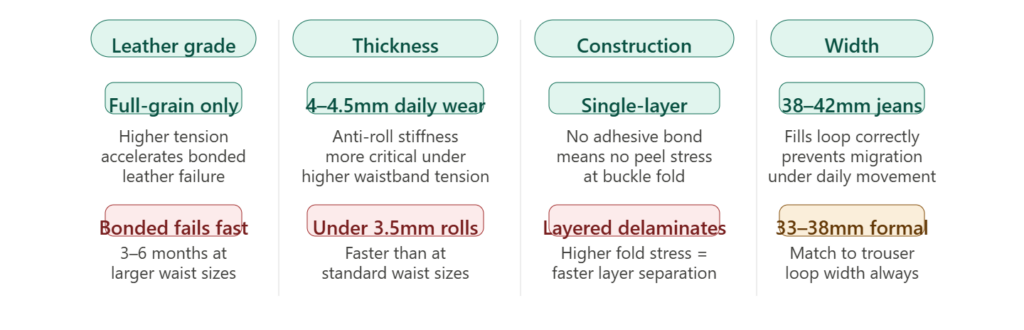
Leather grade: Full-grain single-layer leather at 4–4.5mm is the minimum specification for daily wear at larger waist sizes. The dense fibre structure of full-grain resists deformation under sustained load. Bonded leather and split leather — both common in budget and fashion belts — delaminate faster under the higher tension of a larger waist. The coating dries, the bond weakens, and the belt fails at the buckle fold. For a buyer at a standard waist size, a bonded belt might last 12 months. At a larger waist size, the same belt often fails in 3–6 months.
Belt thickness: 4mm minimum for everyday casual and professional wear. 4.5mm for workwear, jeans, and any context where additional load is being carried. At these thicknesses, the leather has enough bending stiffness to hold a flat profile under higher waistband tension without rolling at the front.
Single-layer construction: A belt built from one continuous piece of leather has no internal adhesive bond to fail. Layered belts with adhesive between layers are under higher peel stress at the buckle fold when the belt is worn at a larger waist — the fold tries to separate the layers with more force. Single-layer construction eliminates this failure point.
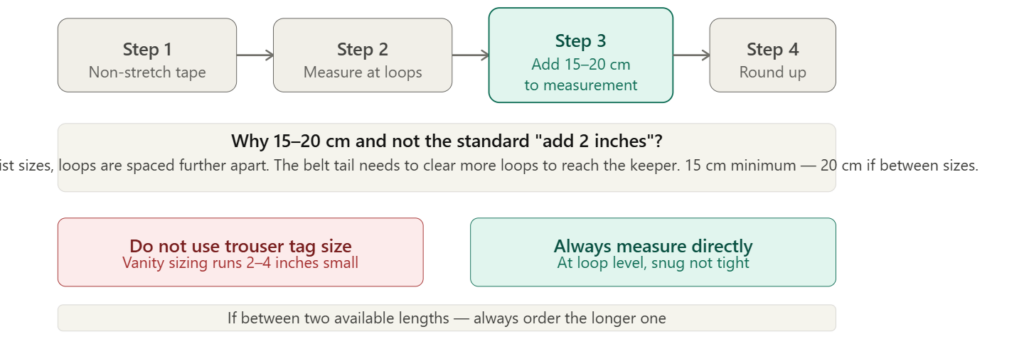
The most common sizing mistake is using trouser size as belt size. Trouser sizes use vanity sizing that runs 2–4 inches smaller than actual waist measurement. A size 44 trouser often has a waist of 46–48 inches. Ordering a belt based on the trouser tag produces a belt that doesn’t reach the correct hole.
The correct measurement method:
Step 1: Use a non-stretch tape measure or a length of non-elastic string. Stretch tape measures and elastic string produce readings 1–2cm shorter than the real measurement.
Step 2: Wrap the tape at the position where you wear your belt — at the trouser waistband, not the natural waist. These are typically 2–5cm apart. Belt loops are the correct reference point.
Step 3: Keep the tape snug against your body — the tension of a correctly worn belt, not loose or tight.
Step 4: Note the measurement in centimetres.
Step 5: Add 15–20cm to this measurement. This provides sufficient strap length after the buckle fold to thread through the belt loops and tuck into the first keeper loop. At larger waist sizes, the loops themselves are spaced further apart, which requires more tail length. 15cm is the minimum addition; 20cm gives more flexibility if you’re between sizes.
Step 6: Round up to the nearest available length. Order the longer size if your calculation falls between two available lengths.
Why 15–20cm rather than the standard “add 2 inches”: The “add 2 inches to trouser size” rule is designed for standard waist belts where the tail length requirement is minimal. At larger waist sizes, the tail needs to clear a greater circumference of loops. 15–20cm (roughly 6–8 inches) above measured waist size is the correct addition for waist sizes above 110cm.
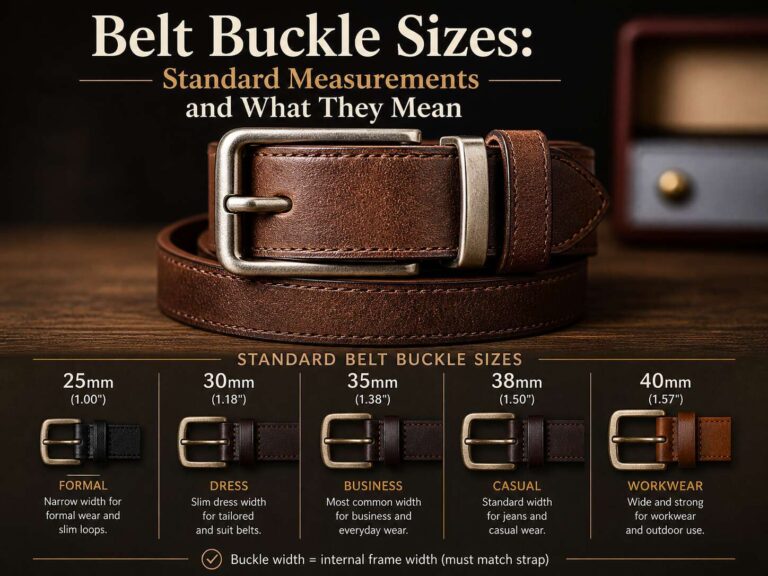
Belt width for any frame is set by the trouser loop width — but larger frames typically wear heavier trousers and workwear that have wider loops, and the visual proportion of the belt needs to match the frame.
Formal and dress trousers: 33–38mm. Tailored suit trousers at larger sizes still have loops in the 33–38mm range. A wider belt stresses the waistband seam and creates visible pulling at loop attachment points.
Business casual and chinos: 35–38mm. The most versatile width that crosses professional and casual contexts at larger sizes.
Jeans and workwear: 38–42mm. This is the most important width correction for larger frames. Standard jeans have loops of 38–42mm. At larger waist sizes, the additional fabric weight means the trouser hangs more heavily and benefits from a wider, stiffer belt that distributes load across a greater waistband contact area. A 35mm belt in a 42mm denim loop has 7mm of lateral play — the belt migrates, the buckle shifts off-centre, and the outfit looks unsettled.
The anti-rolling effect of correct width: A wider belt at the correct width for the loop creates more contact area between the belt and the waistband. This contact area is what prevents the belt from rolling at the front — the waistband surface holds the belt flat. A narrow belt with excessive play in the loop has less contact area and rolls faster under the higher lateral tension of a larger waist.
Both mechanism types work at larger waist sizes. The choice depends on the same factors as for standard sizes, with one additional consideration: waist variation through the day tends to be more significant at larger sizes.
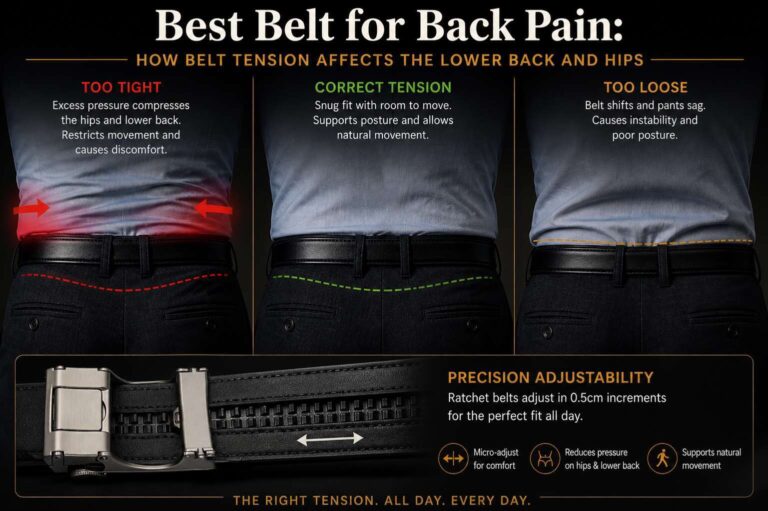
Ratchet mechanism: 0.5cm adjustment increments allow the belt to be set precisely for the current waist state — before and after meals, during desk work versus physical activity, morning versus evening. For anyone whose waist varies 2–4cm through a typical day, ratchet adjustment eliminates the compromise of fixed holes.
The ratchet mechanism also eliminates hole deformation — the most common failure mode under higher belt tension. No holes means no hole edge to deform under the sustained load of a larger waist. The strap lasts as long as the leather, not as long as the weakest hole edge.
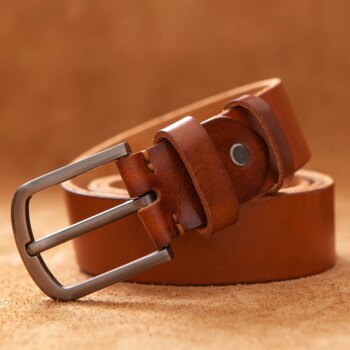
Pin buckle: Correct for heritage, workwear, and casual contexts where the aesthetic of traditional construction suits the outfit. On a quality full-grain strap at 4mm+, hole deformation is slower than on lower-grade leather — but it still occurs. A roller buckle (where the centre bar is a roller rather than a fixed frame) reduces friction at the hole edge and extends hole life significantly. Worth specifically seeking for a pin-buckle workwear belt at larger sizes.
The fit precision difference: A standard pin buckle on a 44-inch waist has holes spaced 25mm apart. If the correct tension falls between holes — which it often does — the choice is between slightly too tight and slightly too loose. At a larger waist size, the difference between these two states is more noticeable both in comfort and in the visual effect on the outfit. Ratchet adjustment resolves this by providing five adjustment points within the same 25mm span.
Measurements in centimetres. Strap lengths are total strap length excluding the buckle.
| Waist measurement (cm) | Waist measurement (inches) | Recommended strap length |
|---|---|---|
| 100–107 | 39–42″ | 120–125 cm |
| 108–117 | 42–46″ | 130–135 cm |
| 118–127 | 46–50″ | 140–145 cm |
| 128–137 | 50–54″ | 150–155 cm |
| 138–147 | 54–58″ | 160–165 cm |
| 148–157 | 58–62″ | 170 cm |
These lengths are strap-only measurements and do not include the buckle. If your waist measurement falls at the top of a range, order the longer length. A belt that is too long can be trimmed or worn at a lower hole; a belt that is too short cannot be extended.
For ratchet belts specifically: Order one size above your calculated requirement and trim to your exact waist length before the first wear. The ratchet mechanism then handles fine adjustment within 15–20cm above and below your trim point.
Ordering based on trouser tag size. Vanity sizing makes trouser tags unreliable. Measure directly and add 15–20cm. This is the single most common reason plus-size belts don’t fit correctly.
Choosing a narrow belt for a wider frame. A 30mm dress belt on a larger frame looks visually narrow relative to the frame and provides less anti-roll contact area. Match the width to the loop width and the visual weight of the outfit.
Choosing a thin belt. A 2.5–3mm fashion belt at a larger waist size rolls faster and fails sooner than at a standard size because the higher tension accelerates every failure mode. Minimum 4mm for daily wear.
Accepting a belt that “kind of fits”. At larger waist sizes, more belt brands use the largest available size as a catch-all rather than extending their range properly. A belt worn at the last hole has no adjustment range, concentrates maximum stress at that hole, and fails faster. The correct fit is at the middle holes of a pin-buckle belt, or comfortably within the adjustment range of a ratchet belt.
Wrap a non-stretch tape measure around your waist at the trouser waistband level — where your belt loops sit, not the natural waist. Note the measurement in centimetres and add 15–20cm. Order the strap length that matches or exceeds this figure. If between sizes, order larger.
Higher waist circumference means higher sustained tension on the belt. The failure modes that affect all belts — hole deformation, fold cracking, layered construction delamination — accelerate under higher load. Full-grain leather at 4mm+ and single-layer construction are more resistant to these failure modes than lower-grade alternatives at any waist size.
For daily wear and comfort, ratchet mechanisms offer two specific advantages at larger sizes: precise adjustment for waist variation through the day, and no hole deformation under higher belt tension. Whether these advantages are worth the different aesthetic depends on the wear context — ratchet for professional and casual daily wear, pin buckle for heritage and workwear.
Match the belt width to the trouser loop width. For jeans and workwear trousers at larger sizes, loops are typically 38–42mm — use a belt in this width range. For formal and dress trousers, 33–38mm. A belt that fills the loop with 1–2mm clearance holds position during movement and distributes load correctly.
Belt rolling at the front is caused by insufficient leather thickness relative to the waistband tension. At larger waist sizes, the tension is higher and rolling happens faster on thin leather. Upgrade to 4mm+ full-grain single-layer leather and the rolling stops. It is not caused by the waist size — it is caused by insufficient belt specification for the load.
HoldForm belts in extended lengths are specified with leather grade, strap thickness, and mechanism type listed on every product page.
[View extended length belt range →] [How to measure belt size correctly →] [Why leather belts fail: construction and material guide →] [Best belt for standing all day: specs for active wear →]

Practical belt guides, sizing tips, and exclusive offers — straight to your inbox.

Leave a comment