Leather belt failure follows predictable patterns. The same four failure modes account for the overwhelming majority of belts that crack, peel, delaminate, or lose structural integrity within months of daily use. Each failure mode has a specific cause, a specific visible symptom, and a specific construction decision that either prevents it or makes it inevitable.
Understanding which failure mode is affecting your belt tells you whether the belt is worth repairing, whether it was ever going to last, and what to look for when buying a replacement.
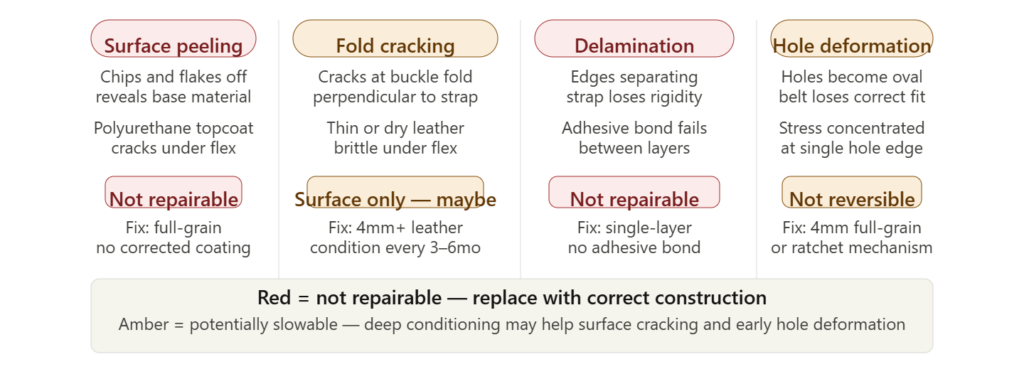
What it looks like: Fine cracks appearing across the surface of the belt, often starting near the buckle and spreading outward. In more advanced cases, the surface peels or flakes in small chips, sometimes revealing a different-coloured base material beneath.
What causes it: Most fashion and budget belts use corrected-grain or bonded leather with a polyurethane topcoat applied to produce a uniform, blemish-free surface. The coating is a plastic layer sitting on top of the leather. When the belt flexes — which happens thousands of times per year — the coating and the leather flex at slightly different rates. The coating cannot sustain the same flex cycling as the leather beneath it indefinitely. Over months of daily wear, fine cracks develop in the coating at the highest-flex points. These cracks deepen and eventually produce visible peeling.
Why full-grain leather doesn’t do this: Full-grain leather without a corrected coating has no separate surface layer to crack and peel. The surface is the leather itself — it develops a patina (gradual darkening and surface wear) rather than cracking and peeling. Patina is ageing; surface peeling is failure.
Is it repairable? No. Once the coating begins to peel, the process accelerates because the exposed leather beneath is not the quality material that would age gracefully — it is corrected or bonded leather that was covered by the coating precisely because it lacked the surface quality of full-grain. Conditioning may slow the cracking but cannot reverse it.
What to look for when buying: “Full-grain leather” without a corrected or painted surface. The grain should be visible and slightly irregular — uniform surfaces are usually coated. Ask specifically whether the leather is corrected grain.
What it looks like: Deep cracking across the strap at the buckle fold — the point where the leather bends tightest around the buckle frame on every wear cycle. The cracking is perpendicular to the strap length and appears on the outer face of the fold. In advanced cases, the leather breaks through completely at this point.
What causes it: The buckle fold is the highest-stress point on the belt. The leather at this point is under compressive stress on the inside of the fold and tensile stress on the outside, cycling every time the belt is fastened and removed. At adequate leather thickness (4mm+), this cycling is sustained for years without failure — the dense fibre structure of full-grain leather maintains flexibility through repeated flex cycles when the natural oils in the fibre matrix are replenished through conditioning.
On thin leather (under 3.5mm), the fold radius is tighter for the same buckle frame, concentrating stress in a smaller fibre cross-section per cycle. On unconditioned leather — where the natural oils have been depleted by sweat, heat, and mechanical cycling without replacement — the fibres become brittle. Brittle fibres under repeated flex stress crack rather than flex.
Why this failure is preventable: Conditioning every 3–6 months replenishes the fibre oils and maintains flexibility at the fold. Combined with adequate leather thickness, fold cracking is unlikely within 8–10 years of daily wear. Most fold cracking that appears within 1–3 years of purchase indicates insufficient leather thickness, lower-grade leather with less intrinsic flexibility, or consistent failure to condition.
Is it repairable? Surface fold cracking that doesn’t penetrate through the leather can be slowed with deep conditioning. If the cracking has penetrated more than the surface layer, the leather at the fold is structurally compromised — continued daily wear will complete the break.
What to look for when buying: 4mm minimum leather thickness stated explicitly. Full-grain specification. Conditioning instructions included or available — a brand that doesn’t mention conditioning is not thinking about the belt’s long-term performance.
For a detailed breakdown of the fold cracking mechanism and the role of leather thickness, see our [why leather belts crack near holes guide →]
What it looks like: The strap edge begins to separate — a thin layer lifts away from the main body of the strap, starting at the buckle fold area where peel stress is highest and progressing along the strap. The strap may ripple slightly or lose its flat profile. In advanced stages, the belt feels flexible and soft where it used to be stiff and the front face lifts noticeably from the back.
What causes it: Most budget and mid-range belts are built from two or more layers bonded with adhesive. A decorative outer face, sometimes a filler layer, and a backing. The adhesive bond between layers is under peel stress at the buckle fold every time the belt is fastened. The fold tries to open the layers apart. Heat, sweat, and mechanical cycling degrade the adhesive over time — the bond softens and the layers begin to separate.
Delamination almost always begins at the buckle fold and progresses outward because this is where the peel stress is greatest. The failure is progressive — once separation starts, the remaining bond area is under higher load and fails faster.
Why single-layer construction doesn’t do this: A single-layer full-grain belt has no adhesive bond to fail. The strap is one continuous piece of leather from front face to back face through the full 4mm or more of thickness. There is no internal layer boundary, no adhesive, and therefore no delamination failure mode. The strap ages as one piece.
Is it repairable? No. Adhesive bond failure in a belt under daily tension cannot be meaningfully reversed. Re-gluing the delaminated edge produces a repair that fails faster than the original bond because the leather surface has already been compromised. Replace the belt with single-layer construction.
What to look for when buying: “Single-layer” or “one-piece” construction explicitly stated. No mention of “reinforced,” “padded,” or “layered” construction. The cross-section of the strap edge at the cut end should show a uniform single-material structure rather than visible layers.
What it looks like: The hole used most often — typically the centre hole — gradually changes from round to oval. The buckle prong no longer seats cleanly in the hole. The belt fits correctly at no available hole — too tight at one, too loose at the next.
What causes it: Every unit of belt tension on a pin-buckle belt is transferred from the buckle frame through the prong into the leather at the hole edge. This creates a stress concentration — a single small area of leather carrying the full load of belt tension. The leather fibres at the hole edge are under cyclical stress, applied in the same direction thousands of times per year. Over time the fibres separate and reorient in the direction of the applied force. The round hole becomes oval.
This is not a failure of the leather generally — the rest of the strap typically remains structurally intact. It is localised fibre failure at a stress concentration point. Full-grain leather at 4mm resists this deformation significantly better than thinner or lower-grade leather, but on a pin-buckle belt, hole deformation is an inherent mechanical consequence of the system. The rate of deformation depends on leather grade and thickness. The endpoint — oval holes, inconsistent fit — is inevitable given enough time.
How ratchet belts eliminate this failure mode: A ratchet belt has no punched holes in the leather face. The adjustment mechanism operates through a track on the back of the strap — the front leather face is unperforated. There is no stress concentration point, no single area carrying the full load, no hole to deform. The strap ages uniformly rather than failing at the most-used hole.
Is it repairable? Minor hole deformation can sometimes be slowed with leather conditioner applied specifically at the hole zone, which partially restores fibre flexibility. Significantly oval holes cannot be returned to round — the fibres have permanently reoriented. Adding a new hole adjacent to the deformed one is a temporary fix. The permanent solution for buyers who want to avoid this failure mode is a ratchet belt design.
What to look for when buying: For pin-buckle belts, full-grain leather at 4mm+ gives the longest hole life. For buyers who want to eliminate hole deformation entirely, a ratchet mechanism is the correct choice.
For a detailed technical breakdown of hole deformation, see our [hole deformation mechanism guide →]
| What you see | Failure mode | Repairable | Construction fix |
|---|---|---|---|
| Surface cracking or peeling | Coating failure | No | Full-grain without corrected coating |
| Deep cracking at buckle fold | Fold fatigue | Surface only | 4mm+ leather, condition regularly |
| Edge separating, strap rippling | Delamination | No | Single-layer construction |
| Oval holes, inconsistent fit | Hole deformation | No | 4mm+ leather, or ratchet mechanism |
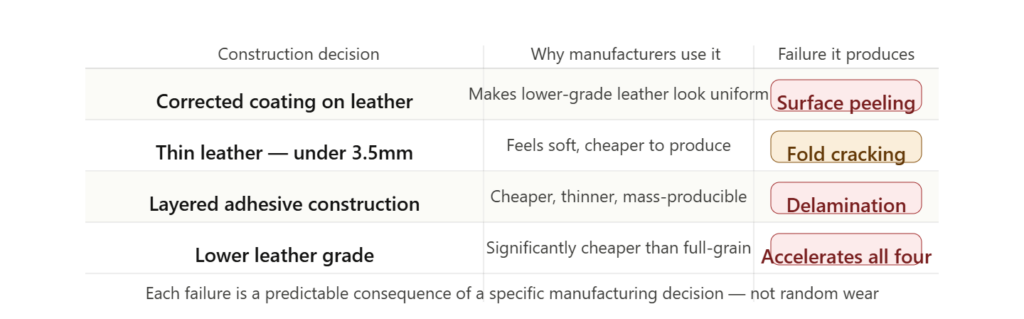
The four failure modes are not random. Each is a predictable consequence of a specific construction decision made at the manufacturing stage.
Corrected coating is applied because it makes lower-quality leather look uniform and premium. It produces failure mode 1.
Layered construction is used because it is cheaper to produce than single-layer full-grain and can be made thinner. It produces failure mode 3.
Thin leather is used because it feels soft and flexible immediately. It accelerates failure modes 2 and 4.
Low leather grade is used because it is significantly cheaper than full-grain. It accelerates all four failure modes.
The construction decisions that prevent all four are correspondingly simple: full-grain leather without corrected coating, at 4mm minimum thickness, in single-layer construction. A ratchet mechanism additionally eliminates failure mode 4.
These decisions cost more to manufacture. They produce a belt that does not need replacing on the timescale that budget construction belts operate on.
Repair is worth attempting when:
The failure is fold cracking that hasn’t penetrated through the leather — deep conditioning can restore flexibility and slow progression. The belt is otherwise structurally intact. The leather is full-grain and has not delaminated.
Replace immediately when:
Surface coating is peeling — the base material is exposed and the failure will accelerate. Delamination has started at any point — the adhesive bond failure is not reversible. Holes are significantly oval — the hole zone fibres have permanently separated. Fold cracking has penetrated through the leather — the strap will break at this point under continued load.
The buckle fold is the highest-flex point on the belt — the leather bends tightest here on every wear cycle. Leather fibres at this point become brittle when the leather is insufficiently thick (under 3.5mm), lower grade, or has not been conditioned regularly. Conditioning every 3–6 months replenishes the fibre oils that maintain flexibility at the fold.
Surface peeling indicates coating failure on corrected-grain or bonded leather. The polyurethane topcoat used to make lower-quality leather look uniform cannot sustain the flex cycling of daily wear indefinitely. It cracks and peels at high-flex points. This is not repairable — the base material beneath is not full-grain leather and will not age gracefully once the coating is removed.
Structural softening indicates delamination — the adhesive bond between layers of a layered-construction belt has begun to fail. The strap loses rigidity as the layers separate. This is most common in belts under 3.5mm that use a thin decorative outer layer over a filler core. Not repairable.
Fold cracking that hasn’t penetrated through the leather can be slowed with leather conditioner. Deeply penetrating fold cracks, surface peeling, and delamination cannot be meaningfully repaired. In these cases the belt needs replacing.
The buckle prong concentrates the full belt tension at a single hole edge. Repeated daily loading causes the leather fibres at the hole edge to separate and reorient in the direction of the force — the round hole gradually elongates into an oval. Full-grain leather at 4mm+ resists this significantly longer than thinner or lower-grade leather. Ratchet belt mechanisms eliminate this failure mode by removing holes from the leather face entirely.
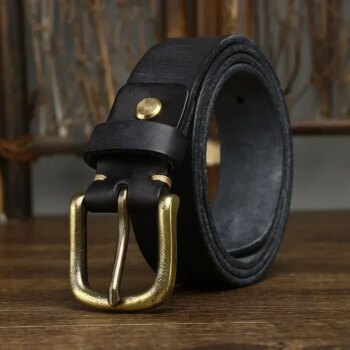
Single-layer full-grain leather at 4mm minimum thickness without a corrected surface coating. This specification has no surface coating to fail, no adhesive bond to delaminate, and enough fibre density and thickness to resist fold cracking and hole deformation under years of daily wear. With conditioning every 3–6 months, this construction should last 8–12 years of daily wear.
HoldForm belts list leather grade, strap thickness, and construction method on every product page.
[Why leather belts crack near holes: hole deformation and fold mechanism →] [How long should a leather belt last: service life by specification →] [How thick should a leather belt be: thickness by use case →] [Full-grain vs top-grain vs genuine leather: what the grades mean →]

Practical belt guides, sizing tips, and exclusive offers — straight to your inbox.



Leave a comment