Belt buckle size refers to the internal width of the buckle frame — the measurement that must match the strap width for the two to work together. A buckle listed as 38mm is designed to accept a 38mm strap. A 35mm buckle will not correctly fit a 38mm strap, and a 38mm buckle will not hold a 35mm strap securely.
This is the measurement that matters most when buying a replacement buckle or pairing a buckle with a strap. Everything else — the external dimensions of the buckle face, the weight, the finish — is secondary to this single compatibility variable.
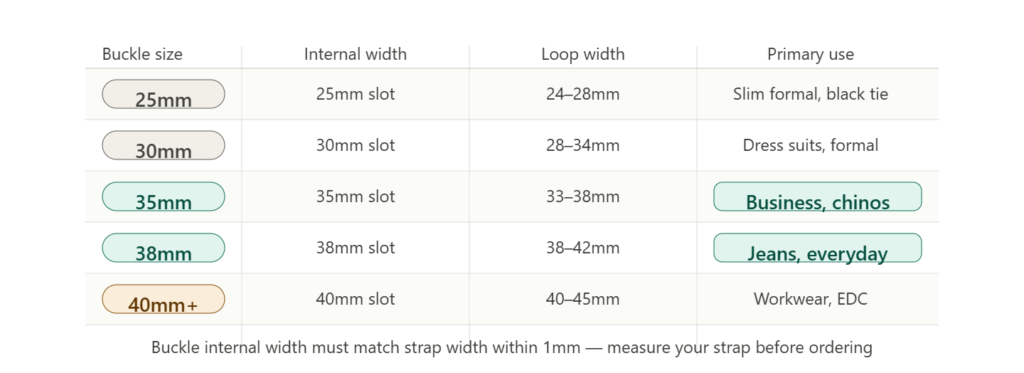
Most men’s leather belts use buckles in one of five standard widths. These correspond directly to the standard strap widths they are designed to fit.
25mm (1 inch): Narrow dress belt width. Used for formal suit trousers with very slim loops. Less common than 30–35mm for suits.
30mm (1.18 inches): Slim dress belt width. Fits the narrow loops of tailored formal trousers. Correct for black-tie contexts and slim-fit suiting where the buckle should be as unobtrusive as possible.
35mm (1.38 inches): Standard dress and business casual width. The most common size for professional and office belts. Fits most dress trousers, chinos, and business casual trouser loops. The versatile width that works across the widest range of trouser types.
38mm (1.5 inches): Standard casual and denim width. Fits most jeans belt loops, which are typically 38–42mm wide. The correct width for everyday casual, denim, and lighter workwear.
40mm (1.57 inches): Heavy casual and workwear width. Fits wider denim and workwear loops. Used for belts intended to carry load — EDC gear, tool pouches, holsters.
50mm+ (2 inches+): Western and tactical width. Western belts, military-style belts, and tactical duty belts use wider frames. Not interchangeable with standard dress or casual belt hardware.
The stated buckle size is the internal frame width — the opening that the strap passes through. This is also called the bar width or the throat width depending on the buckle design.
On a pin-buckle, the internal width is the distance between the two side bars of the frame at the bar where the strap wraps around. The strap must fit through this opening with minimal clearance — 1–2mm on each side is correct. More than 2mm of clearance and the strap has too much lateral play and will migrate during wear.
On a ratchet buckle, the internal width is the width of the housing slot that the strap feeds through. Ratchet buckles are more precisely width-specific than pin-buckles — the track teeth must align exactly with the housing mechanism, so a strap that is even 2mm wider than specified will not engage the mechanism correctly.
The external dimensions of the buckle — the overall width of the buckle face, the height of the frame, the depth of the mechanism housing — vary by design and do not affect strap compatibility. A buckle with a 60mm decorative face plate may have an internal strap width of 35mm. The decorative dimensions are irrelevant to fit.
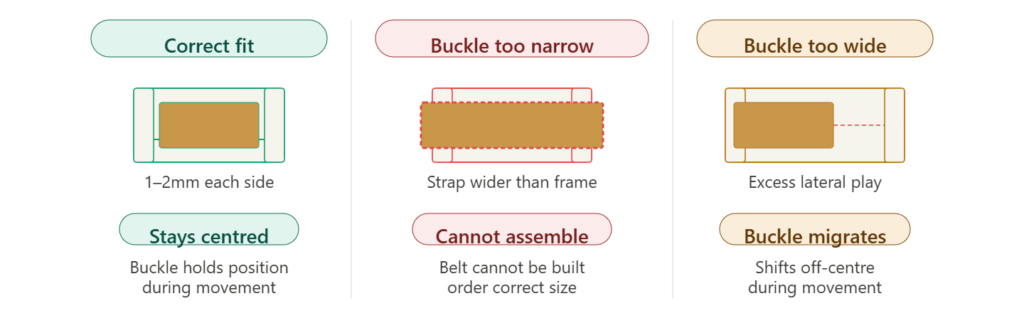
The buckle size must match the strap width exactly, or within 1mm for pin-buckle designs. This is not a preference — it is a mechanical requirement.
Too narrow (buckle smaller than strap): The strap cannot pass through the frame. The belt cannot be assembled.
Correct (buckle matches strap within 1mm): The strap passes through the frame with 1–2mm of clearance on each side. The buckle sits centered on the strap and holds its position during wear.
Too wide (buckle larger than strap by 2mm or more): The strap passes through the frame with excess lateral play. The buckle migrates sideways during movement, the belt sits off-centre, and the fit deteriorates through the day. On a pin-buckle design, excess play means the prong is not supported correctly by the strap and the hole edge experiences additional lateral stress.
For ratchet belts specifically: the strap width must match the buckle housing width exactly. The track teeth on the strap back are spaced to align with the pawl mechanism in the housing. If the strap is too wide, the track is offset from the mechanism. If the strap is too narrow, the mechanism does not engage the track teeth reliably.
Before ordering a replacement buckle, measure the strap at the buckle end where the strap meets the hardware.
Use a ruler or measuring tape. Measure the strap width at the point where it enters or wraps around the buckle — not at the tip, not at the middle, but specifically at the buckle attachment end. This is the measurement that must match the replacement buckle’s internal width.
If your existing strap is worn or slightly irregular at the buckle end, measure at a point 5–10cm along the strap from the buckle where the leather is undamaged. A high-quality strap has consistent width throughout — the measurement should be the same anywhere along the strap.
Note the measurement in millimetres. Round to the nearest standard size (25, 30, 35, 38, or 40mm). If your measurement falls between standard sizes, order the smaller of the two — slight tightness is better than excess lateral play.
If you have a buckle and want to know what strap width it fits, measure the internal frame width — the opening the strap passes through.
For a pin-buckle: place the ruler across the inside of the frame from one side bar to the other, measuring at the bar where the strap wraps. This is the critical measurement.
For a ratchet buckle: measure the width of the strap slot — the opening at the back of the buckle housing where the strap feeds in. This measurement corresponds directly to the strap width the buckle is designed for.
Do not measure the overall external width of the buckle face. A decorative plate buckle or a Western buckle may have an external face significantly wider than the strap it is designed to hold.
Belt buckle size (and strap width) must match two things: the strap it attaches to, and the trouser loops it passes through. These requirements occasionally conflict.
Trouser loops are typically:
The belt strap should pass through the trouser loop with 1–2mm clearance. If the strap is too wide for the loop, it cannot be worn with those trousers. If the strap is significantly narrower than the loop, it will migrate and sit unevenly.
In most cases the trouser loop width determines the correct strap width, which then determines the correct buckle size. The buckle must match the strap; the strap must match the loop.
The one exception: Frame buckles on pin-buckle designs have an external frame that may be slightly wider than the strap — a 35mm strap on a buckle with a 40mm external frame face. This is a design feature, not a mismatch. The strap still measures 35mm at the buckle fold; the external frame width is decorative.
| Context | Loop width | Strap width | Buckle internal width |
|---|---|---|---|
| Black tie, formal | 28–32mm | 28–30mm | 28–30mm |
| Business suits | 30–34mm | 30–35mm | 30–35mm |
| Business casual, chinos | 33–38mm | 35–38mm | 35–38mm |
| Jeans, everyday casual | 38–42mm | 38–40mm | 38–40mm |
| Workwear, EDC | 40–45mm | 38–42mm | 38–42mm |
| Western style | 50mm+ | 50mm+ | 50mm+ |
Measure your existing strap width at the buckle end in millimetres. Your replacement buckle’s internal frame width must match this measurement within 1mm. If you are buying a new strap and buckle together, start with your trouser loop width — measure the loop at its narrowest point and choose a strap that fits through with 1–2mm clearance on each side. The buckle internal width matches the strap width.
35mm is the most common standard size for dress and business belts. 38mm is the most common standard size for everyday casual and denim belts. These two sizes cover the majority of men’s belt contexts. 30mm is used for slim formal dress belts; 40mm for heavier workwear and casual belts.
The strap slot or internal frame width is standardised at common increments — 25, 30, 35, 38, 40mm are the most common — and straps are made to match these widths. However, the external dimensions (face width, frame height, depth) vary by design and are not standardised. Always confirm the internal strap width specification rather than the overall buckle dimensions.
Only if the buckle’s internal strap width matches your strap width, and the attachment system is compatible. A 38mm strap needs a 38mm buckle. A ratchet strap needs a ratchet-compatible buckle housing. A Chicago screw strap needs a buckle with Chicago screw holes. See our [how to change a belt buckle guide →] for the full compatibility and process guide.
Belt size refers to the length of the belt — the distance from buckle fold to centre hole on a pin-buckle belt, or the strap length on a ratchet belt. Buckle size refers to the width of the buckle’s internal strap opening. They are different measurements. A size 36 belt can have a 35mm or 38mm buckle depending on the trouser context it is designed for.
Measure your strap width in millimetres and confirm the buckle’s internal frame width matches. Also confirm the attachment system matches — Chicago screw buckle needs Chicago screw strap holes, ratchet buckle needs ratchet strap. Width and attachment type are the two variables that determine compatibility.
HoldForm belts and buckles list internal strap width on every product page. Straps and buckles are available separately for mixing and matching.
[How to change a belt buckle: compatibility and process guide →] [How to choose the right belt size →] [Types of belt buckles: ratchet, pin, roller and plate →] [Belt size vs pant size: why they differ →]

Practical belt guides, sizing tips, and exclusive offers — straight to your inbox.


Leave a comment