Most belt sizing mistakes come from one assumption: that your trouser size is your belt size. It isn’t. A size 34 trouser can measure anywhere from 34 to 37 inches at the actual waist depending on the brand. Using the trouser tag to order a belt is the reason most belts come back.
This guide covers three ways to measure correctly — using an existing belt, using a tape measure directly, and using a string if you have neither. Each method takes under two minutes. The sizing chart at the end covers both inches and centimetres.
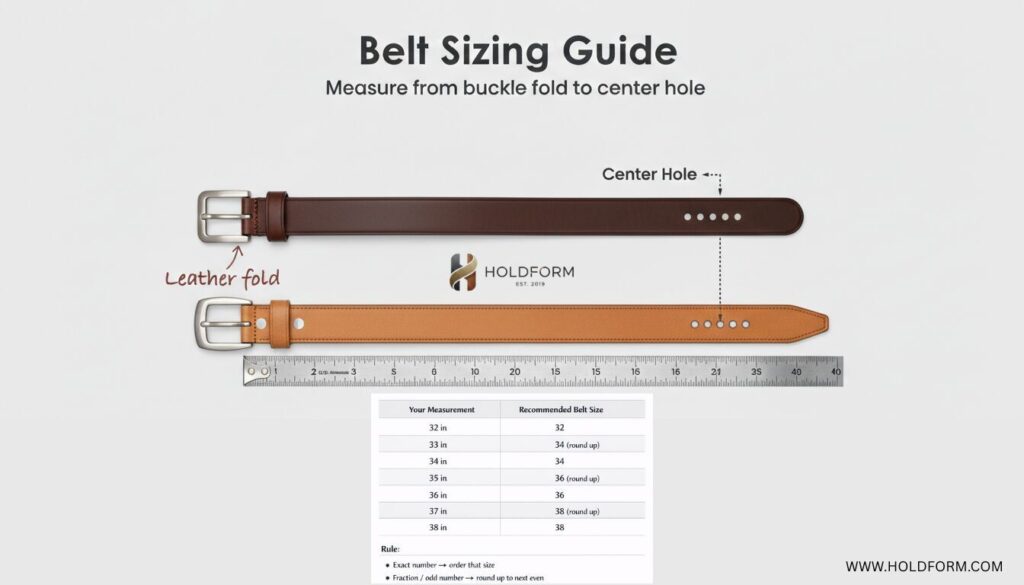
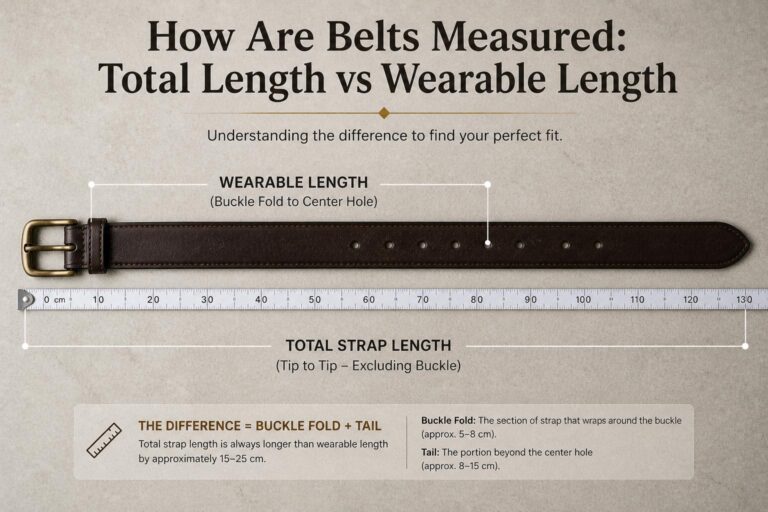
Belt size is measured from the leather fold — the point where the strap wraps around the buckle frame — to the centre hole of the belt. Not tip to tail. Not the full strap length. Not the buckle width.
This is the measurement that determines where the belt fastens on your waist. Every method below measures this distance.
If you take nothing else from this page: buckle fold to centre hole.
If you own a belt that fits, this gives you an exact size in under a minute.
Step 1 — Find your wear hole. Look at the belt and identify the hole you use most. It will have a small stress mark or slight stretching at the edges from the pin. That’s the hole to measure to.
Step 2 — Set your zero point. Place the end of a tape measure at the leather fold — the crease where the strap bends around the buckle. Do not include the buckle itself. Do not start from the tip of the strap. Start from where the leather begins to fold.
Step 3 — Measure to the centre of the wear hole. Run the tape straight along the strap to the centre of the hole you identified. Read the number. That is your belt size.
Step 4 — Round up if needed. If the measurement lands on a fraction or odd number, round up to the next even size. A measurement of 35.5 inches becomes a size 36.
Use this if you don’t own a belt or your current belt doesn’t fit well.
Step 1 — Use a non-stretch string or cord. Cloth tape measures stretch with use and give inaccurate readings. A piece of string, paracord, or thin rope works better. A steel tape measure works best.
Step 2 — Wrap around your waist. Position the string where you normally wear a belt — at the trouser waistband, not the natural waist. Keep it snug but not tight. You should be able to fit two fingers underneath.
Step 3 — Mark the overlap. Pinch or mark the point where the string meets itself after going around your waist.
Step 4 — Measure the string. Lay the string flat and measure from the end to your mark with a ruler or steel tape.
Step 5 — Add 1–2 inches and round up. Belt size runs 1–2 inches larger than waist measurement. If your waist measures 34 inches, your belt size is 36. Round up to the next even number if needed.
If you only have your trouser tag and need a fast estimate:
Add two inches to your trouser size. A size 34 trouser becomes a size 36 belt. A size 32 becomes a size 34.
This works as a baseline because most trouser waistbands run 1–2 inches larger than the stated size due to how trousers are cut. The two-size rule compensates for this.
It is less accurate than measuring directly. Use it when you need a quick estimate and can accept a small margin of error.
Use your measurement from the methods above.
| Waist measurement (inches) | Waist measurement (cm) | Recommended belt size (inches) | Recommended belt size (cm) |
|---|---|---|---|
| 28–29″ | 71–74cm | 32″ | 80cm |
| 30–31″ | 76–79cm | 34″ | 85cm |
| 32–33″ | 81–84cm | 36″ | 90cm |
| 34–35″ | 86–89cm | 38″ | 95cm |
| 36–37″ | 91–94cm | 40″ | 100cm |
| 38–39″ | 96–99cm | 42″ | 105cm |
| 40–41″ | 101–104cm | 44″ | 110cm |
| 42–43″ | 106–109cm | 46″ | 115cm |
| 44–45″ | 112–114cm | 48″ | 120cm |
If your measurement falls between rows, always go to the larger size. A belt that is slightly long can be trimmed or worn at a lower hole. A belt that is too short cannot be worn.
A correctly sized belt fastens in the middle holes — not the first hole, not the last. This is where the leather is under the least stress and where the belt is designed to perform.
On a 5-hole belt, that means the 3rd hole. On a 7-hole belt, the 4th. If you find yourself consistently using the outermost holes in either direction, the belt is the wrong size.
For ratchet belts — which use a continuous track rather than fixed holes — correct sizing means the adjustment range falls comfortably in the middle of the track after trimming to your length. This gives you room to adjust tighter after a large meal or looser with a heavy carry load without running out of track.
For a step-by-step guide on trimming a ratchet belt to your exact size, see our [how to resize a ratchet belt at home guide →]
Measuring length correctly is the main job. Width is a secondary check — but worth confirming before ordering.
Measure the width of your trouser belt loops at the narrowest point. Most dress trouser loops are 32–34mm wide. Most jeans loops are 38–40mm wide. Order a belt that fits through your loops with 1–2mm clearance on each side. A belt that has to be forced through the loop will distort over time.
| Belt width | Best for |
|---|---|
| 30–34mm | Dress trousers, formal suits |
| 35–38mm | Business casual, chinos |
| 38–40mm | Jeans, workwear |
Ratchet belts with a trim-to-fit track require one step beyond standard sizing: you need to trim the strap to your length before the first wear.
Order at least one size larger than your measured size — ideally two. The strap is then trimmed from the buckle end to your correct length, leaving the track intact. The ratchet mechanism then handles fine adjustment in 0.5cm increments within a range above and below your trim point.
The advantage over fixed holes: the belt fits exactly, not approximately. Every size lands precisely where you trimmed it, not between two holes 2.5cm apart.
For the full trim process, see our [ratchet belt resizing guide →]
Trouser size is the nominal size on the label — often 1–2 inches smaller than the actual waist measurement due to vanity sizing. Belt size is a physical measurement: the distance from the buckle fold to the centre hole of the belt. They are different measurements and rarely match. Order your belt size based on measurement, not the trouser tag.
The tip length varies by belt design and has no functional relationship to how the belt fits. The buckle fold is the fixed reference point — it’s where the strap is anchored to the buckle, and it’s always at the same position relative to your waist when the belt is worn. Measuring from the fold to the centre hole gives you the distance that actually determines fit.
If using your trouser size as a starting point, yes — add two sizes. If measuring an existing belt or your waist directly, use that measurement and round up if it lands on a fraction. Leather does not stretch significantly over time with quality full-grain construction, so ordering too small creates a belt you cannot wear rather than one that breaks in.
Snug enough that the belt doesn’t shift during movement, but not so tight that it compresses the waistband. The test: you should be able to slide two fingers under the belt when fastened. If you can’t, it’s too tight. If it shifts laterally when you move, it’s too loose.
Yes — follow Method 2 above. Use a non-stretch string, wrap at the trouser waistband position, mark the overlap, measure flat. Add 1–2 inches and round up to the nearest even size. The main risk is using elastic string or measuring at the wrong position on your waist. Measure where the belt sits, not at the natural waist.
Always round up. A belt one size larger than your measurement will fasten at a lower hole than centre — still functional and comfortable. A belt one size smaller will either not close or close only at the very last hole, placing maximum stress on the leather at that point.
If you’re unsure after measuring, HoldForm’s trim-to-fit ratchet belts remove the sizing margin entirely — order larger and trim to your exact length at home.
[View trim-to-fit ratchet belts →] [How to resize a ratchet belt at home →] [How leather thickness affects belt fit and durability →]

Practical belt guides, sizing tips, and exclusive offers — straight to your inbox.


Leave a comment