Full-grain leather at adequate thickness does not stretch significantly under normal daily wear. The leather itself is structurally stable — the dense collagen fibre network of full-grain hide resists elongation under sustained load. What does deform is the area around belt holes on pin-buckle belts, and the two things are often confused because the result looks similar: the belt no longer fits correctly at the position it used to.
Understanding the difference between leather stretching and hole deformation explains why some belts fail within a year and others hold their fit for a decade.
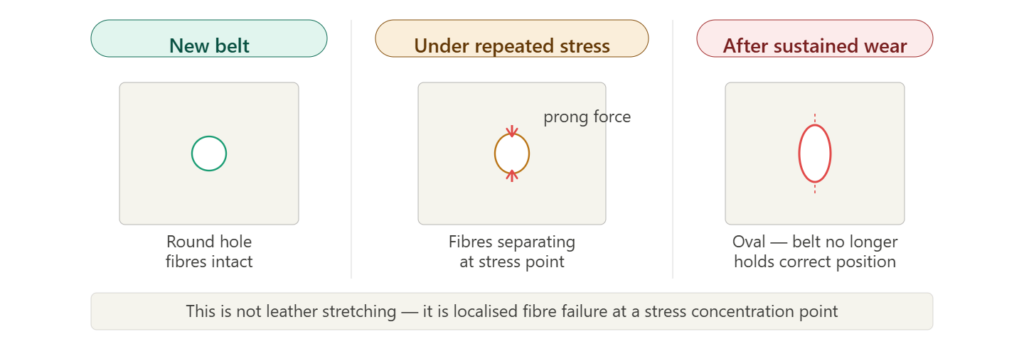
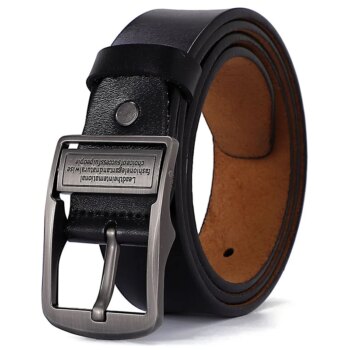
A pin-buckle belt has one point where the prong contacts the leather: the hole. Every time the belt is worn, tightened, and removed, the prong applies lateral force to the leather fibre at the hole edge. When you sit down, the waistband tension increases and the prong pushes harder against the same edge. When you walk, the motion transfers tension to the same point repeatedly.
The fibre structure at the hole edge is under cyclical loading — stress applied in the same direction, thousands of times per year. The leather fibres at the hole edge begin to separate and reorient in the direction of the applied force. The round hole gradually elongates into an oval. Once the hole is oval, the prong doesn’t seat as precisely — it rocks slightly, accelerating the deformation further.
This is not leather stretching. It is localised fibre failure at a stress concentration point. The rest of the strap remains structurally intact. The hole edge fails because the entire tension of the belt is channelled through a single small area of leather rather than distributed across the strap.
On a quality full-grain belt at 4mm, this process is slow — the dense fibre structure resists separation more effectively than split or top-grain leather. On a thin or lower-grade belt, hole deformation can be visible within months of daily wear.
Under normal daily wear: minimally, and not in a way that meaningfully affects fit.
Full-grain leather has tensile strength that resists elongation under the loads of daily belt wear. The total strap length of a belt worn for years will be marginally longer than when new — perhaps 1–2mm — but this is below the threshold that affects which hole the belt fastens at.
What people experience as “the belt stretching” is almost always one of three things:
Hole deformation: The hole the belt used to fasten at has enlarged. The belt now fastens one hole tighter, or the fit at the old hole is loose. This is hole deformation, not strap stretching.
Buckle fold softening: The leather at the buckle fold — the tightest bend point on the belt — softens over years of daily cycling. The fold becomes slightly shorter in radius, which can make the visible strap length appear slightly longer. This is normal ageing behaviour, not failure.
Layered construction delamination: A belt built from multiple glued layers begins to separate at the buckle fold, which changes how the belt sits. The visible symptom is similar to stretching but the cause is adhesive failure between layers. Single-layer full-grain construction doesn’t have this failure mode.
Lower-grade leather under sustained load: Bonded leather and split leather have lower tensile strength than full-grain. Under sustained daily load, these materials can elongate measurably — the strap becomes genuinely longer over months of wear. This is actual leather stretching, but it’s a property of the leather grade rather than leather in general.
The mechanism: all belt tension channelled through one hole edge repeatedly. The prevention: full-grain leather at 4mm+ resists hole deformation significantly better than thinner or lower-grade leather. A ratchet mechanism eliminates the failure mode entirely by removing holes from the equation.
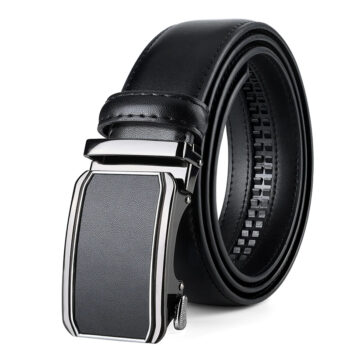
On a ratchet belt, tension is distributed along a track rather than concentrated at a hole. The leather face is unperforated — there is no stress concentration point. The track itself is on the back face of the strap, protected inside the buckle housing. The front leather maintains its flat, smooth profile indefinitely.
The buckle fold is the point of tightest bend on the belt — the leather wraps tightly around the buckle frame or enters the buckle housing every time the belt is worn. Under repeated daily flexing, the leather fibres at this point are under compressive stress on the inside of the fold and tensile stress on the outside.
On adequately conditioned full-grain leather, this cycling is sustained for years without cracking — the oils in the fibre matrix maintain flexibility. On dry, unconditioned, or lower-grade leather, the fibres become brittle and crack at the fold. This is the “belt cracking near the buckle” that is the most visible leather belt failure.
The prevention: conditioning every 3–6 months to maintain fibre flexibility, combined with adequate leather thickness (4mm minimum) which distributes the fold stress across more material.
Many belts are constructed from two or three thin layers bonded with adhesive. A decorative outer face, a filler core, and a backing layer. The adhesive bond is under peel stress at the buckle fold every time the belt is fastened — the fold tries to open the layers apart. Heat and sweat soften the adhesive over time.
Delamination begins at the buckle fold — the highest-stress point — and progresses outward along the strap. Visible symptoms: the strap edge begins to separate, the front face lifts slightly, the belt loses its stiff flat profile and begins to curl and ripple.
Single-layer full-grain construction has no adhesive bond to fail. The fibre structure is continuous from front face to back face through the full 4mm thickness. There is no internal layer separation possible because there are no internal layers.
Many fashion and budget belts use a corrected-grain or bonded leather base with a thick polyurethane topcoat applied to produce a uniform, blemish-free surface. This coating looks identical to genuine leather at purchase and in product photography.
The coating is a plastic layer sitting on the leather surface. It has different flex properties from the leather beneath it — when the belt bends, the leather and the coating flex at slightly different rates. Over months of daily flexing, the coating develops fine cracks. These cracks eventually penetrate deep enough to expose the base material, and surface peeling begins.
Full-grain leather without a corrected coating doesn’t have a separate surface layer to crack and peel. The surface is the leather itself — it develops patina (a gradual darkening and surface change) rather than cracking and peeling.
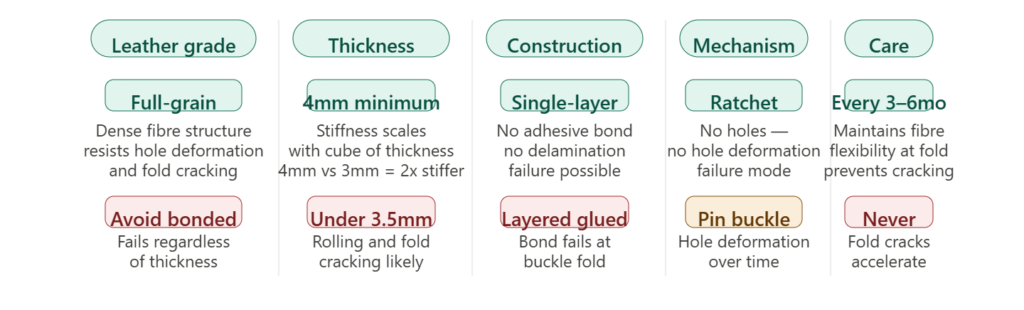
Leather grade: Full-grain at the surface layer of the hide is the most structurally resistant material for belt construction. The dense fibre structure at the outermost hide layer resists both hole deformation and fold cracking better than corrected, split, or bonded alternatives.
Leather thickness: 4mm minimum for daily wear. The bending stiffness of leather scales with the cube of thickness — a 4mm belt is roughly twice as stiff as a 3.5mm belt, which means the fold cycling distributes stress across more material with each flex cycle. Below 3.5mm, fold cracking is likely within 1–2 years of daily wear on most leather grades.
Construction method: Single-layer, unlaminated construction has no internal adhesive bond to fail. The strap ages as one piece rather than delaminating from the inside.
Adjustment mechanism: Ratchet mechanisms eliminate hole deformation entirely. No holes means no hole deformation failure mode. The strap lasts as long as the leather, not as long as the weakest hole edge.
Conditioning: Leather conditioner applied every 3–6 months maintains the fibre oils that keep the leather flexible at the buckle fold. Unconditioned leather is more brittle and cracks faster at stress points. This is the most directly controllable variable in belt longevity — it requires thirty minutes twice a year.
For the full conditioning guide with specific product recommendations and application method, see our [leather belt care guide →]
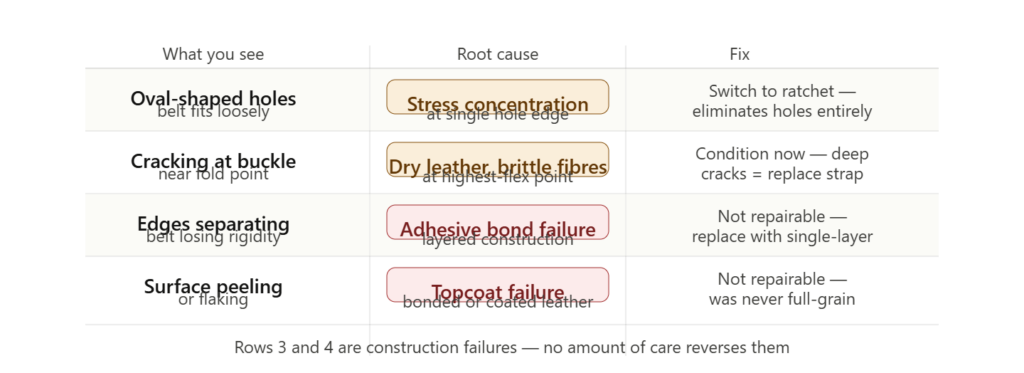
Belt holes are oval-shaped: Hole deformation from pin-buckle wear. The leather elsewhere is likely fine. The fix is either a ratchet belt to eliminate holes, or accepting reduced fit precision as the holes continue to deform.
Cracking at the buckle fold: Fold fatigue, typically caused by insufficient conditioning or leather that was too thin or too dry when purchased. Clean, condition thoroughly, and allow to recover. If the cracks are deep (through more than the surface layer), the leather at the fold is structurally compromised — the belt will fail there under continued use.
Edges lifting or separating: Layered construction delamination. Not repairable. Replace with single-layer construction.
Surface peeling or flaking: Topcoat failure on coated or bonded leather. Not repairable. The base material under the coating is typically inadequate for daily belt use regardless.
Belt feels looser than it used to at the same hole: Hole deformation (the hole has enlarged) rather than strap stretching. Check the hole shape — if it’s oval rather than round, hole deformation is the cause.
Full-grain leather stretches minimally under normal daily belt wear — less than 1–2mm over years of use. What most people experience as stretching is hole deformation on pin-buckle belts: the hole the belt used to fasten at has enlarged, so the belt now fits loosely at that position. Ratchet belts eliminate this because there are no holes to deform.
The buckle prong applies lateral force to the same hole edge every time the belt is worn. The leather fibres at the hole edge separate and reorient in the direction of the applied force — the round hole elongates into an oval. This is localised fibre failure at a stress concentration point, not general leather stretching.
The buckle fold is the tightest bend point on the belt, under the most repeated flexing stress. Leather fibres at this point become brittle when the leather is dry or inadequately conditioned. Conditioning every 3–6 months maintains fibre flexibility and significantly extends the life of the leather at the fold.
Minor hole deformation can sometimes be slowed with leather conditioner, which partially restores fibre flexibility. But a significantly enlarged hole cannot be returned to its original size — the fibres have separated permanently. The practical options are using the adjacent hole, adding a new hole if the strap permits, or replacing the belt with a ratchet design that doesn’t have holes.
Conditioning prevents cracking at the buckle fold and maintains general leather flexibility, but it doesn’t prevent hole deformation — that’s a mechanical failure caused by stress concentration, not by leather dryness. The only way to prevent hole deformation is to eliminate holes with a ratchet mechanism.
A full-grain belt at 4mm thickness, single-layer construction, with conditioner applied every 3–6 months should last 8–12 years of daily wear before the leather reaches end of life. The buckle typically outlasts the strap. The most common reason belts are replaced before this timeline is hole deformation on pin-buckle designs — ratchet mechanisms extend the practical life of the strap significantly by eliminating this failure mode.
HoldForm belts are specified with leather grade, strap thickness, and construction method listed on every product page.
[View ratchet belt range — no holes, no hole deformation →] [Leather belt care guide: conditioning, cleaning, and storage →] [Full-grain vs top-grain vs genuine leather: what the grades mean structurally →] [How belt thickness affects structural performance →]

Practical belt guides, sizing tips, and exclusive offers — straight to your inbox.

Leave a comment