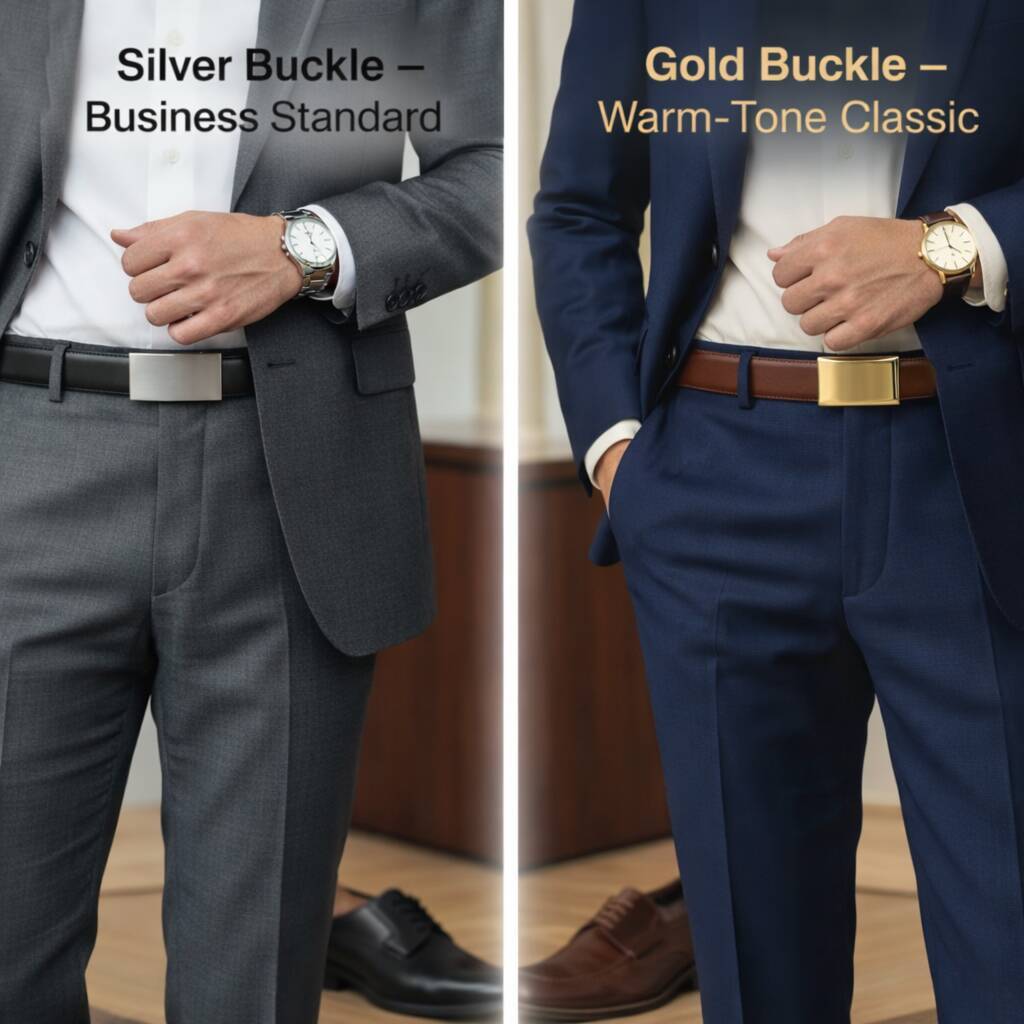
Business suit → Silver
Brown shoes → Gold
Black shoes → Black buckle
Casual jeans → Silver or matte black
Rule: Match buckle metal to your watch or wedding ring.

Buckle color is a coordination problem, not a preference problem. The question isn’t which color you like — it’s which color creates visual consistency with the other hardware you’re wearing. Get that right and the choice is straightforward.
This covers the coordination logic, the finish types that hold up under daily wear, and what the hardware spec actually tells you about how long a buckle will last.
Match your buckle metal to your watch case or your ring — whichever is more visible. Not to your shoes. Not to your belt color.
Shoes are leather. Buckles are metal. Matching leather to metal by color is the wrong pairing. The correct pairing is metal to metal: the buckle at your waist coordinates with the watch at your wrist. When those two metals align, the outfit reads as intentional across its full vertical line.
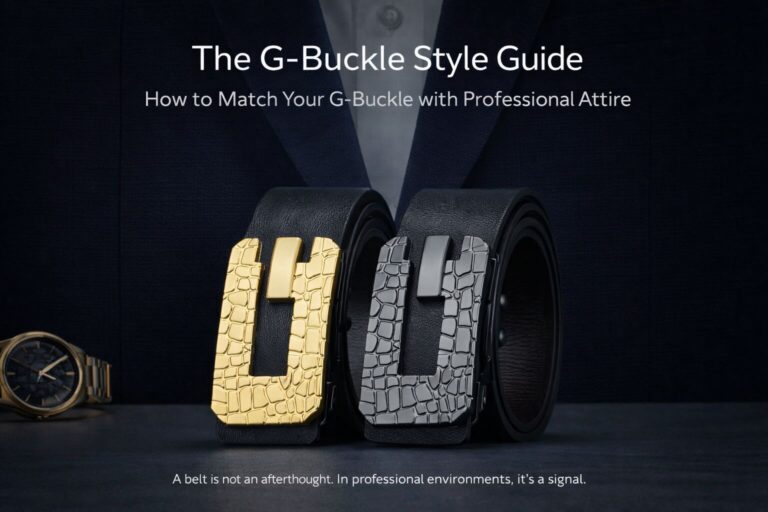
Silver buckle: Pairs with steel, white gold, or platinum watches. Works with black shoes, navy suits, grey trousers, most business attire.
Gold buckle: Pairs with yellow gold or rose gold watches. Works with brown or tan shoes, warm-tone fabrics, classic and heritage styling.
Black or gunmetal buckle: Pairs with black or DLC-coated watches. Works with black shoes, monochrome outfits, modern tailoring. The lowest-contrast option — visually recedes rather than anchors.
If you wear both silver and gold accessories — a steel watch with a gold ring, for example — a brushed dual-tone buckle or a neutral gunmetal bridges the gap without committing to either.
Silver is the default professional choice because steel and stainless hardware dominate men’s watches and cufflinks in business contexts. Most men in office environments are wearing a steel-cased watch, which means a silver buckle is the coordination default without requiring any conscious decision.
Polished silver: High reflectivity, formal signal, shows wear and scratching fastest. Appropriate for formal events. For daily business wear, polished surfaces show micro-scratches within weeks and require regular attention to maintain appearance.
Brushed silver: Mechanically abraded surface that diffuses light rather than reflecting it directly. The directional texture means scratches from daily use blend into the existing surface pattern rather than standing out. This is the appropriate finish for daily-wear business belts — it maintains its appearance through consistent use without the maintenance that polished requires.
Satin silver: Between brushed and polished in both reflectivity and durability. Common on mid-range hardware.
For a full breakdown of how buckle finish affects long-term wear resistance, see our [belt construction guide →]
Gold hardware reads as warmer, more traditional, and more decorative than silver. In menswear it’s associated with heritage styling, classic tailoring, and brown-shoe dressing rather than the grey-suit, black-shoe professional default.
Yellow gold: Traditional. Appropriate when the rest of your accessories lean warm — a yellow gold watch, a gold ring, cognac shoes. In conservative business environments it can read as overstated if worn with grey or navy suits. In classic or heritage contexts it’s entirely appropriate.
Rose gold: Softer and more contemporary than yellow gold. Works across a wider range of outfit tones. Pairs well with mid-brown shoes and earth-tone fabrics.
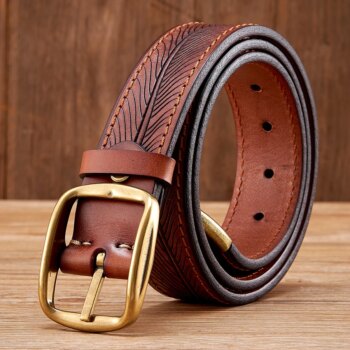
Antique or aged brass: Common on heritage and artisan belts. Has a patinated, pre-worn quality that suits casual and workwear contexts. Less appropriate for formal business use.
Black hardware reduces visual contrast — the buckle doesn’t draw attention to itself. This is either an advantage or a disadvantage depending on what you’re dressing for.
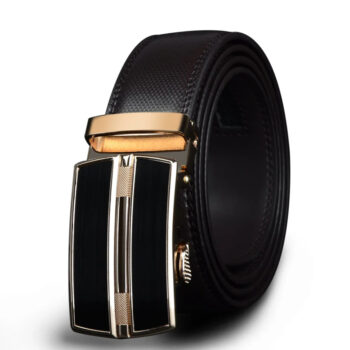
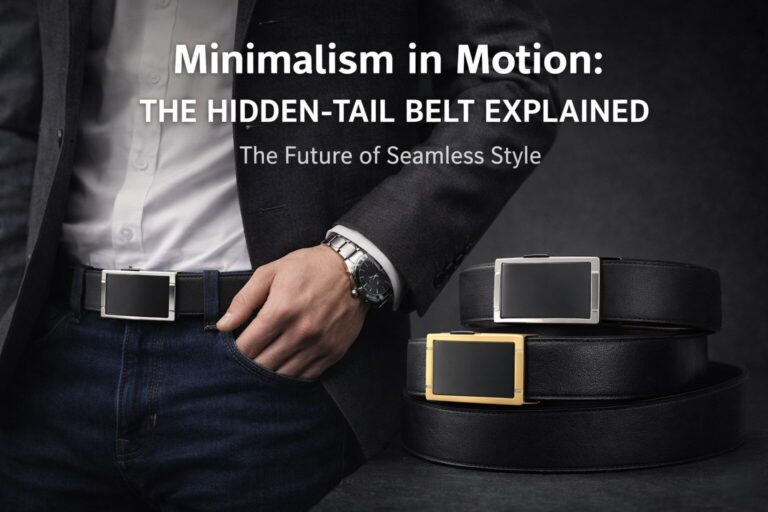
Matte black: Low reflectivity, modern aesthetic, works with monochrome and minimal outfits. Pairs with black shoes and black watches. Common on ratchet belts because the mechanism profile is already clean and a matte black buckle maintains that uninterrupted line.
Gunmetal: Dark grey metallic finish. More versatile than matte black because it carries a metallic quality that reads as intentional hardware rather than painted over. Works with charcoal, dark navy, and cooler-tone outfits. Compatible with both silver and black watch hardware.
Polished black / DLC: High-end finish common on watch hardware. Pairs specifically with DLC-coated or black PVD watch cases. Very specific pairing — works when matched precisely, looks mismatched when the black tones differ.
Avoid bright yellow gold in conservative environments.
The visual finish and the underlying durability are different things. A buckle can look identical in product photography regardless of whether it will hold its finish for two months or two years. The durability is in the plating specification — which most product listings don’t disclose.
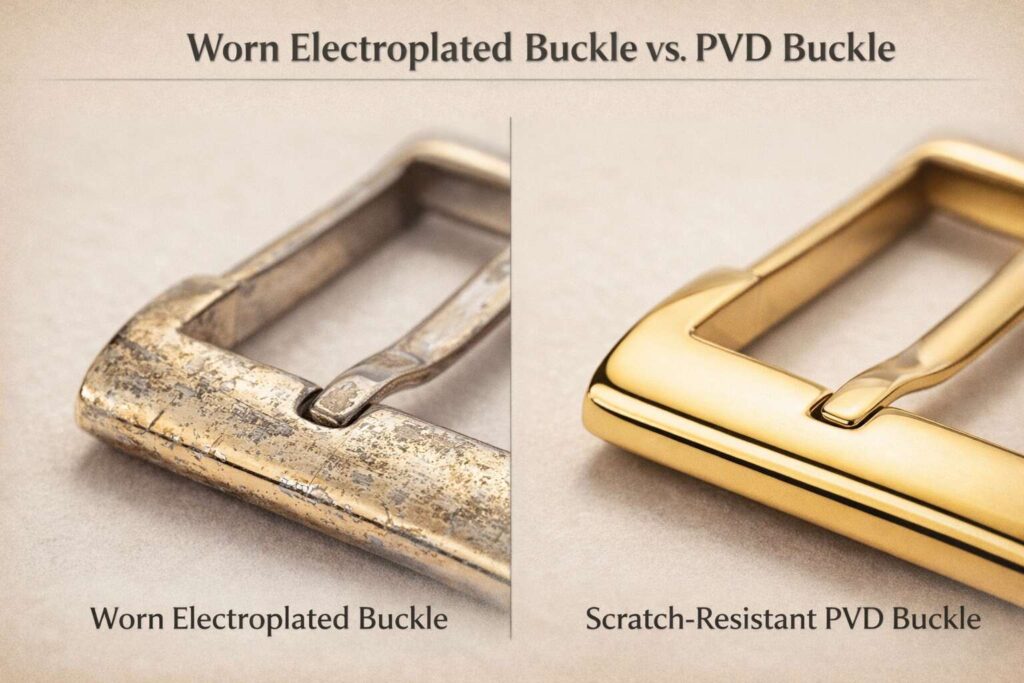
Standard electroplating: The most common process. A thin layer of metal is deposited onto the base metal through an electrical current. Typical thickness is 0.1–0.5 microns. At this thickness, the plating wears through at friction points — the keeper loop contact, the pin housing on pin buckles, the strap guide on ratchet buckles — within 6–18 months of daily wear.
PVD (Physical Vapour Deposition): The same coating process used on high-end watch cases. Metal vapour bonds to the base surface at a molecular level, producing a coating that is harder and more adhesion-stable than electroplating. PVD coatings at equivalent visual thickness outlast electroplating by a significant margin under daily friction. A PVD-finished brushed silver buckle maintains its appearance through years of daily wear where an electroplated equivalent would show wear-through within the first year.
Solid brass: No plating. The base material and the visible surface are the same metal throughout. A solid brass buckle with a brushed finish wears to expose more brass — the appearance changes but never degrades to a different material underneath. The patina that develops on solid brass over years of wear is a genuine material characteristic rather than a coating failure.
When evaluating a buckle, look for: PVD coating specification, solid brass or steel construction, or both. If a listing says “alloy buckle” or “metal finish” without further specification, the plating is almost certainly standard electroplating.
The buckle frame width should match the belt strap width. A narrow buckle on a wide strap looks proportionally wrong and creates a weak point at the strap guide. A wide buckle on a narrow strap looks excessive.
| Belt width | Buckle frame width | Best for |
|---|---|---|
| 30–34mm | 30–34mm | Dress suits, formal trousers |
| 35–38mm | 35–38mm | Business casual, chinos |
| 38–42mm | 38–42mm | Jeans, casual, workwear |
On ratchet belts, the buckle housing is wider than the strap because it contains the mechanism. This is normal — the housing width is part of the visual design. What should match is the strap guide opening width, which should be within 1–2mm of the strap width.
Finish is what you see. Base metal is what determines structural performance — housing rigidity, thread durability at the pin, and resistance to deformation under sustained belt tension.
Zinc alloy: The most common base metal. Casts well, accepts plating well, lightweight. Lower elastic modulus than brass means it flexes more under load — relevant for ratchet buckle housings where housing flex causes pawl misalignment. Adequate for dress and casual use. For carry applications with sustained lateral load, zinc alloy housing flex is a performance limitation.
Brass: Denser and harder than zinc alloy. Higher elastic modulus means the housing deforms less under load. Takes plating well. Heavier — which is noticeable in hand and is often used as a quality signal in product descriptions. The correct base metal for daily-wear and carry-use buckles.
Steel: Highest rigidity. Most common in tactical and heavy-duty applications. Harder to machine to decorative tolerances. Less common in dress and business belts.
For a full breakdown of how base metal affects ratchet mechanism performance, see our [guide to ratchet belt mechanisms →]
| Occasion | Buckle finish | Base metal |
|---|---|---|
| Black tie / formal events | Polished silver or gold | Brass minimum |
| Business / office daily | Brushed silver | Brass or PVD zinc |
| Business casual | Brushed silver, gunmetal, or gold | Brass or PVD zinc |
| Smart casual | Any finish | Brass or zinc adequate |
| Jeans / casual | Matte black, gunmetal, antique brass | Zinc adequate |
| EDC / carry use | Matte black, gunmetal, brushed | Brass — housing rigidity matters |
No — match the buckle to your watch or ring, not your shoes. Shoes are leather, buckles are metal. The relevant coordination is metal to metal across your outfit. A brown shoe with a silver buckle is entirely correct if you’re wearing a steel watch. A brown shoe with a gold buckle is also correct if you’re wearing a gold watch. Shoe color and buckle color are independent variables.
Yes, if your other accessories are gold. The rule is consistency across your metals — if your watch is gold and your ring is gold, a gold buckle with black shoes is coherent. If your watch is steel, a gold buckle with black shoes creates a metal mismatch that draws attention to itself.
A polished black or high-gloss black buckle can work for formal contexts, particularly in evening wear with black shoes. A matte black buckle reads as too casual for formal contexts. Low-profile gunmetal occupies the middle ground — works in most business and smart casual settings.
PVD-coated brass or solid brass with a brushed finish holds up best under daily use. The brushed surface pattern hides micro-scratches, and PVD or solid brass construction means there’s no thin plating layer to wear through. Avoid polished finishes on buckles you wear every day — the reflective surface shows every mark and requires regular polishing to maintain.
PVD stands for Physical Vapour Deposition — the same coating process used on high-end watch cases. Metal is vaporised and deposited onto the base metal surface in a vacuum, bonding at a molecular level. The result is a coating that is significantly harder and more wear-resistant than standard electroplating. A PVD-finished buckle will maintain its surface appearance through years of daily friction where a standard-plated buckle would show wear-through within the first year.
Yes — the buckle frame width should match the strap width within a few millimetres. Mismatched widths look proportionally wrong and can create structural stress at the strap guide. Check the strap width and buckle width specifications before ordering if you’re buying a buckle separately from a strap.
HoldForm buckles are specified by base metal, plating type, and frame geometry on every product page. Finish type and coating specification are listed because they determine how the buckle performs — not just how it looks.
[View buckle hardware specifications →] [How buckle housing material affects ratchet mechanism performance →] [Full belt construction guide →]

Practical belt guides, sizing tips, and exclusive offers — straight to your inbox.



Leave a comment