The G-Buckle Belt for Professional Wear: Mechanism, Width, and Finish Guide
Most belt guides for professional wear focus on colour and style. This one covers the construction variables that determine whether a belt actually works in a tailored context — and explains specifically how the G-Buckle’s friction-lock mechanism addresses the fit and silhouette problems that make most belts unsuitable for daily professional wear.
What Makes a Belt Buckle Appropriate for Professional Wear
Professional wear places specific demands on a belt that casual wear doesn’t. The demands are mechanical, not stylistic.
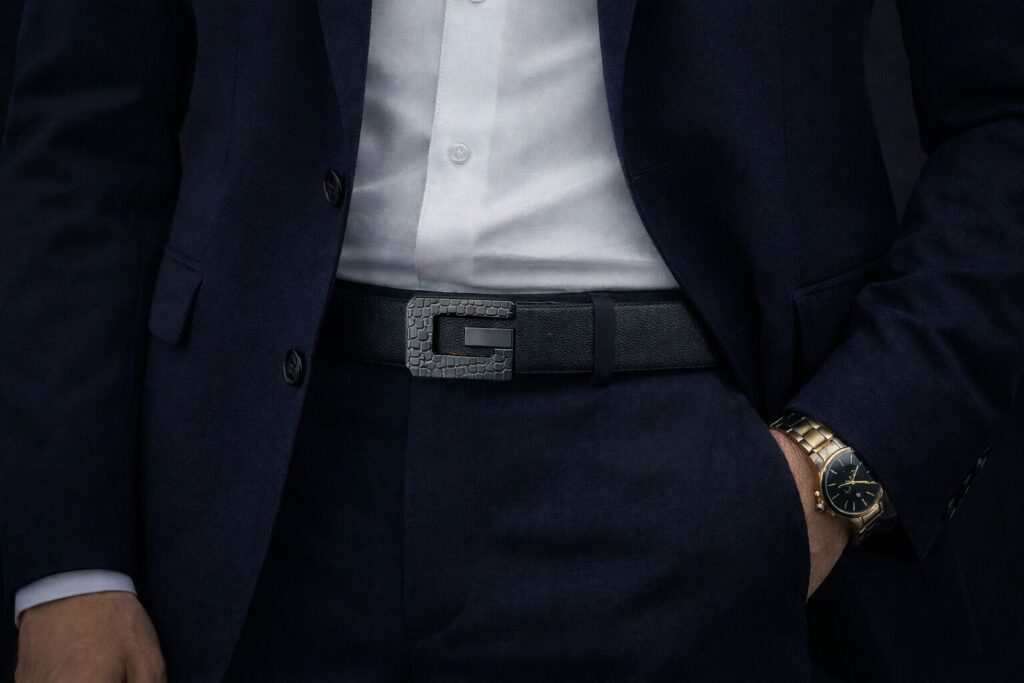
Profile under tailoring. A suit jacket sits over the belt at the front and sides. A buckle with significant physical depth — raised hardware, protruding prongs, or a thick frame — creates a visible bulge under the jacket front. This is not a fit problem with the suit. It’s a buckle depth problem. The correct buckle for tailored wear is flat-profile — the frame sits flush against the belt face, and nothing extends forward enough to push the jacket fabric outward.
Fit consistency through a working day. A pin buckle at a fixed hole has one tension setting per hole, with 25mm between holes. If the correct tension falls between holes — which it often does for desk-based wear where the waist changes slightly between morning and afternoon — the belt is either slightly too tight or slightly too loose for most of the day. For occasional wear this is manageable. For daily professional wear over years, it’s a persistent minor problem that compounds into wear hole damage and eventual strap failure at the most-used holes.
Visual restraint. In professional contexts, the belt should complete the outfit without drawing attention to itself. Hardware that is highly reflective, oversized relative to the trouser loop width, or decorative rather than functional introduces visual noise at the waist — a detail that registers subconsciously even when not consciously noticed.
The G-Buckle is designed around all three requirements: flat profile, micro-adjustable fit, and controlled hardware finish.
The G-Buckle uses a friction-lock system — also called a toothless automatic lock — rather than a ratchet track or pin-through-hole mechanism. Understanding how it works explains why it suits professional wear specifically.
In a pin-buckle system, the prong passes through a punched hole in the leather and rests against the hole edge. The tension is fixed at that hole position. Repeated daily use concentrates stress at the same two or three holes, which gradually enlarge and eventually tear — the most common failure mode on traditionally constructed belts.
In a ratchet system, a toothed track is either embedded in the leather or forms a separate component inside the buckle housing. A spring-loaded pawl engages the track teeth to hold position. Adjustment is in fixed increments — typically 0.5cm — which is more precise than pin holes but still mechanical in the sense that it relies on tooth-to-pawl engagement. Ratchet mechanisms are well-suited to everyday and carry use. The visible track on many ratchet designs can read as casual in the most formal tailored contexts.
The friction-lock mechanism works differently. The strap passes through the buckle frame and is held by internal clamping pressure rather than by a tooth engaging a track or a prong passing through a hole. To adjust, you release the clamp, slide the strap to the correct tension, and re-engage the clamp. The mechanism holds position through friction applied evenly across the strap width rather than at a single point.
The practical advantages for professional wear:
No holes in the leather. The strap surface remains smooth and uninterrupted — there is no visible perforation pattern on the belt face, and no specific position where stress concentrates and failure initiates. The strap degrades uniformly over time rather than at fixed stress points.
Infinite adjustment within the strap range. The tension can be set at any point, not just at 0.5cm increments. For professional wear where belt tension affects how a suit jacket sits, this precision matters — the difference between correct tension and one notch too tight is visible in how the jacket front hangs.
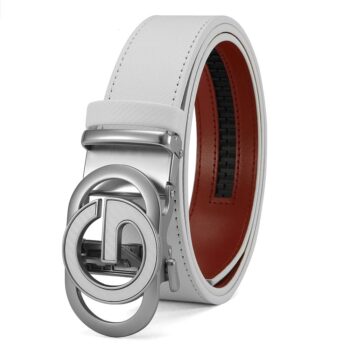
Flat profile. Because there is no prong extending forward from the buckle frame and no ratchet housing adding depth, the G-Buckle sits flush against the belt face. Under a suit jacket, it produces no visible protrusion.
Belt width for tailored wear is not a style preference — it’s a proportion constraint set by the trouser construction.
Suit trousers are cut with belt loops sized to the expected formality of the garment. A well-cut suit trouser typically has belt loops in the 33–38mm range. A 40mm belt through a 35mm loop stretches the loop and pulls the waistband fabric outward at each loop attachment point — visible as small horizontal tension lines when the belt is worn. A 30mm belt in a 38mm loop sits loosely and migrates laterally.
The G-Elite’s 3.3cm (33mm) width sits at the narrow end of the standard tailored trouser loop range. This means it fits correctly in the loops of formal suit trousers without forcing them, and sits cleanly without lateral movement. For business casual trousers with wider loops, 33mm still works — it is never too wide for the loop, though a 35–38mm belt would also be appropriate for less formal constructions.
The width also affects visual proportion under a jacket. A wider belt is more visually present at the waist — appropriate for casual and workwear contexts where the belt is meant to be seen. In a formal context, the belt should sit within the waistband structure without drawing the eye. At 33mm, the G-Buckle occupies the correct visual weight for tailored wear.
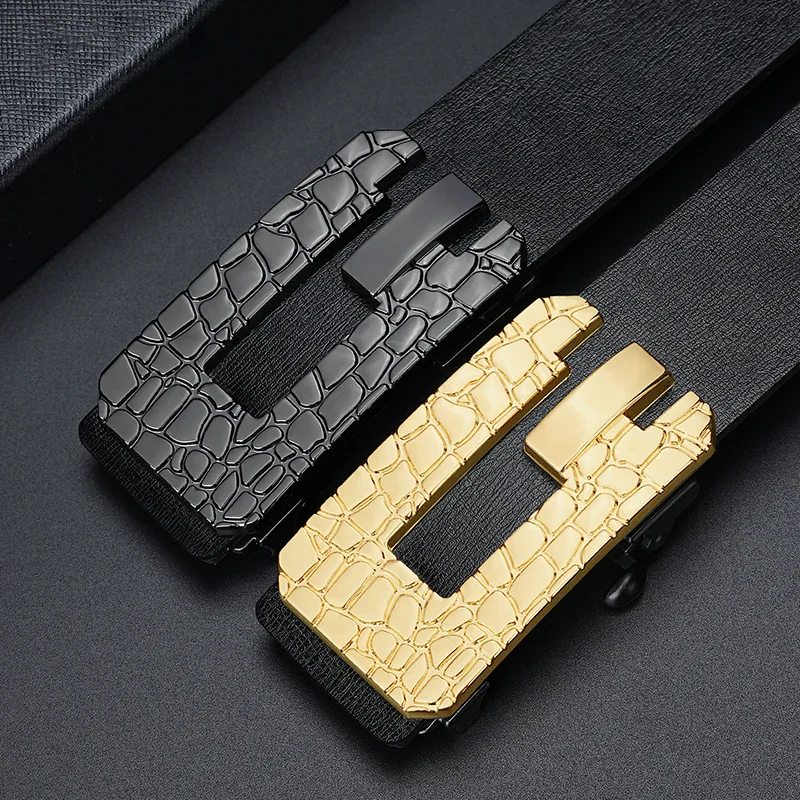
The G-Buckle is available in gold and silver finishes. The choice follows the same logic as any hardware matching decision in professional dress: match the metal family of your dominant accessories, and choose the finish weight that suits the formality of the context.
Silver finish: Silver-tone hardware reads as cooler, more contemporary, and more versatile across a wider range of suit colours. It is the default correct choice for grey, navy, and blue suits, which make up the majority of professional wardrobes. Silver pairs naturally with steel watch cases, platinum or white gold jewellery, and the brushed hardware common on contemporary briefcases and bags.
The G-Buckle’s silver finish uses a controlled texture rather than a mirror polish. This matters for professional wear specifically: a mirror-polished buckle reflects light dynamically — it catches and throws light as you move, which draws attention. A textured or brushed finish absorbs light more evenly and stays visually quiet under office lighting.
Gold finish: Gold-tone hardware introduces warmth into an outfit’s metal palette. It works well with black, charcoal, and deep navy suits where the warm buckle provides controlled contrast against a cool, dark outfit. It requires consistency — wearing a gold buckle with a steel watch and silver cufflinks produces an incoherent metal palette that reads as unresolved rather than intentional.
The correct pairings for the gold G-Buckle: gold or rose-gold watch, warm-metal accessories, white or ivory shirt. The warmth of the buckle should be echoed somewhere else in the outfit — once is a detail, twice is a system.
The decision rule: If your watch is steel and your accessories are silver-tone — silver buckle. If your watch is gold and your accessories are warm-metal — gold buckle. If you wear a mix, silver is the safer default because it reads as neutral rather than as a warm accent competing with cool accessories.

Black suit, black shoes: Silver or gold G-Buckle, depending on watch metal. The black suit is neutral enough to accept both. Silver produces a contemporary, precise result. Gold produces a warmer, more authoritative one. Neither is incorrect.
Charcoal suit, black shoes: Silver G-Buckle. Charcoal is a cool neutral — silver hardware reads as intentional against it. Gold can work but requires consistent warm-metal accessories throughout.
Navy suit, dark brown shoes: Silver G-Buckle. Navy and silver is one of the cleanest combinations in professional dress. The brown shoe introduces warmth at the foot, and a silver buckle keeps the waist cooler — a deliberate warm-cool balance.
Navy suit, black shoes: Silver G-Buckle. Both navy and black are cool tones. Silver completes the cool palette.
Grey suit, black or brown shoes: Either finish works. Grey is one of the most accommodating suit colours for hardware matching. Silver produces a clean, modern result. Gold provides more visual interest for formal occasions where a touch of warmth suits the context.
Business casual — tailored chinos, dress shirt: Silver G-Buckle at 33mm works correctly in this context. The width sits within the loop range of most tailored chinos, and the flat profile means it transitions from business casual to more formal wear without adjustment.

The G-Elite uses a trimmable strap system. The strap ships longer than needed and is cut to the correct length for the wearer’s waist — providing a bespoke fit without requiring size selection beyond a broad range.
The trim procedure: open the rear clamp at the buckle, cut the strap to the correct length from the buckle end, and re-seat the clamp. The cut end is hidden inside the buckle housing — no visible raw edge.
This is mechanically different from the tip-end trimming that some ratchet belts use. Tip-end trimming removes leather from the visible tail end of the belt — the end that exits the keeper. Buckle-end trimming removes leather from the concealed end inside the buckle housing, leaving the tip untouched and the proportions of the visible strap correct regardless of waist size.
For professional wear, where belt proportions are visible under scrutiny, this distinction matters. A tip-trimmed belt on a larger waist has a shorter visible tail than the same belt on a smaller waist. A buckle-end trimmed belt has the same visible tail length regardless of waist size.
The mechanism applies clamping pressure across the strap width rather than at a single point. The internal clamp is released by pressing a lever or button on the buckle rear, the strap slides to the correct position, and the clamp re-engages under spring pressure when released. The holding force comes from the surface friction between the clamp faces and the leather — distributed across several centimetres of strap rather than concentrated at one engagement point.
Yes. The clamp engagement force is set by the spring tension of the mechanism — it doesn’t rely on the wearer to apply the correct closing pressure. Once engaged, the mechanism requires deliberate release to adjust. Accidental release under normal wear movement doesn’t occur on mechanisms with correctly specified spring tension.
Ratchet belts are well-suited to everyday and carry use — the 0.5cm adjustment increments are more precise than fixed holes, and the mechanism is reliable over many years of daily use. In the most formal tailored contexts, the visible track on some ratchet designs reads as more casual than the clean face of a friction-lock strap. For business casual and most office contexts, either mechanism is appropriate. For formal events, board-level professional contexts, and occasions where the belt is under close visual scrutiny, the friction-lock’s clean strap face and flat profile has a marginal advantage.
Full-grain black cowskin at 3.3cm width. Full-grain means the outermost hide layer is preserved — the dense fibre structure of this layer resists surface abrasion and maintains a flat profile under sustained daily wear. The contrast inner lining is visible at the strap edge and provides a detail that reads as considered rather than functional at close range.
Yes, with the caveat that 33mm is at the narrow end of the denim loop range — most denim is constructed for 38–40mm belts. The belt will fit but will have slightly more lateral play in the loop than on a tailored trouser. For smart casual contexts where denim is paired with a blazer or dress shirt, this works well. For heavily casual denim wear, a wider belt at 38mm would be more proportionally correct.
The G-Elite G-Buckle Belt is available in silver and gold finishes. Full construction specifications — leather grade, strap thickness, mechanism type, and width — are listed on the product page.
[View the G-Elite G-Buckle Belt →] [Best belt for office wear: fit system and leather grade guide →] [Silver, gold or black buckle: how to choose →] [How ratchet belt mechanisms work →]

Practical belt guides, sizing tips, and exclusive offers — straight to your inbox.


Leave a comment