A correctly specified full-grain leather belt at 4mm thickness with solid or PVD-coated hardware, worn daily and conditioned every 3–6 months, should last 8–12 years before the leather reaches end of life. The buckle will typically outlast the strap by years.
Most leather belts fail significantly before this timeline. The gap between 8–12 years and the 12–18 months that many buyers experience is not bad luck — it is a predictable consequence of specific construction decisions that are made at the manufacturing stage and visible in the spec sheet if you know what to look for.

The single most important variable. Full-grain leather — the outermost layer of the hide — has a continuous collagen fibre network that gives it tensile strength, flexibility, and the ability to absorb repeated flex cycling without cracking. The fibre density at this layer is highest anywhere in the hide.
Top-grain leather has the outermost surface sanded off and replaced with a polyurethane or pigmented coating. The coating is more uniform in appearance but less durable under sustained flex — it cracks at the buckle fold faster than full-grain.
Split leather is taken from the lower layers of the hide where fibre density is lower. It is structurally weaker and fails faster under load.
Bonded leather is ground leather fibre mixed with polyurethane binder — a composite with none of the fibre continuity that gives genuine leather its structural properties. It measures like leather on a calliper but behaves like a composite under load.
Practical implication: A full-grain belt at 4mm will typically last 5–10 times longer under identical daily wear conditions than a bonded belt at the same thickness.
Thickness determines bending stiffness and the distribution of stress at high-flex points. The buckle fold — where the leather bends tightest around the buckle frame — is under the most repeated stress. Thin leather concentrates this stress in a smaller fibre cross-section with each flex cycle. Thick leather distributes it across more material.
At 3mm, fold cracking typically appears within 2–4 years of daily wear even on quality full-grain leather. At 4mm, fold cracking is unlikely within 8–10 years of daily wear with regular conditioning. At 4.5mm, the fold radius is generous enough that fold cracking is rarely the primary failure mode.
The bending stiffness relationship is cubic: a 4mm belt is roughly twice as stiff as a 3.5mm belt, and the fold stress at the buckle is lower per flex cycle. This is why a 0.5mm difference in thickness produces a measurably longer service life, not just a marginally better one.
Single-layer construction lasts longer than layered construction under identical daily wear. The reason is the adhesive bond in layered construction — the bond between layers is under peel stress at the buckle fold every time the belt is fastened. Heat, sweat, and sustained mechanical stress degrade the bond over time. Delamination begins at the buckle fold and progresses outward.
Single-layer full-grain has no internal adhesive bond to fail. The strap ages as one piece.
The adjustment mechanism determines whether the leather develops hole deformation over time. On a pin-buckle belt, the prong applies repeated stress to the same hole edge — the leather fibres at the edge separate and the hole enlarges. On a full-grain belt at 4mm, this is slow. On lower-grade leather, it can be visible within months.
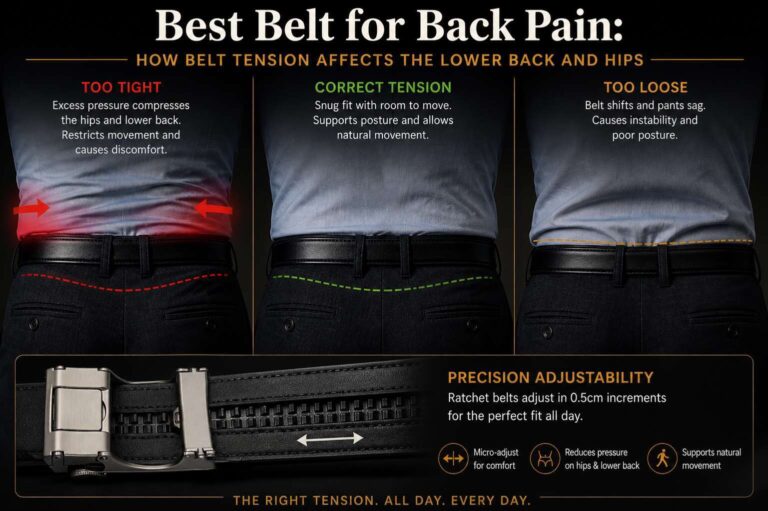
A ratchet mechanism distributes adjustment force across the track rather than concentrating it at a hole edge. Hole deformation is not a failure mode on a ratchet belt — the strap lasts as long as the leather, not as long as the weakest hole edge.
The buckle frame, prong, and any mechanism components fail on a different timeline from the leather. For most belts, hardware failure — specifically plating failure on electroplated zinc alloy — occurs before leather failure.
Electroplated zinc alloy: 6–18 months of daily professional wear before visible finish failure at friction points. The base metal exposed after plating failure is zinc alloy, which corrodes under sweat exposure.
PVD-coated zinc alloy: 5–10 years of daily wear before coating shows meaningful degradation at friction points. The PVD layer is chemically bonded to the base metal rather than mechanically deposited.
Solid brass: indefinite lifespan under normal daily wear. No coating to fail — the surface develops patina rather than degrading. A solid brass buckle worn daily for 20 years looks aged rather than failed.
Leather oils — the natural lipids in the fibre matrix — are depleted by sweat, heat, and mechanical cycling over time. Depleted leather becomes stiffer and more brittle, which accelerates fold cracking at the buckle and at any point where the belt is repeatedly bent.
Conditioning every 3–6 months replenishes these oils and maintains fibre flexibility. The effect on belt lifespan is not marginal — an unconditioned full-grain belt at 4mm will develop fold cracking years before an equivalent belt that has been conditioned regularly.
| Specification | Expected daily wear lifespan |
|---|---|
| Full-grain 4mm, solid brass, conditioned | 8–12 years |
| Full-grain 4mm, PVD zinc alloy, conditioned | 6–10 years |
| Full-grain 4mm, electroplated zinc, conditioned | 3–6 years (hardware fails first) |
| Top-grain 3.5mm, electroplated zinc | 2–4 years |
| Bonded leather any thickness | 6–18 months |
| Split leather, fashion buckle | 1–3 years |
These ranges assume 5 days per week of wear. Less frequent wear extends service life proportionally — a belt worn twice a week accumulates half the flex cycles of one worn daily.

Buckle fold cracking: Cracks at the tightest bend point of the strap. Surface cracking that doesn’t penetrate through the leather can be slowed with conditioning. Deep cracking through the leather thickness indicates the fold is structurally compromised — the leather will fail at this point under continued use.
Hole deformation on pin-buckle designs: The hole used most often is significantly oval. The belt no longer holds position correctly at that hole. Adjacent holes may still be usable, but the structural integrity of the leather in the hole zone is reduced.
Strap softening and profile loss: The strap no longer holds a flat profile. It curls at the front buckle area or along the strap length. On full-grain leather this takes many years — if it appears within 2–3 years, the leather was lower grade than specified.
Delamination: Visible separation at the strap edge where layers are peeling apart. Not repairable — the adhesive bond has failed.
Surface peeling: On coated or bonded leather only. The topcoat lifts from the base material. Not repairable — the coating and base material are incompatible under sustained flex.
Condition every 3–6 months. Apply a small amount of leather conditioner to a soft cloth and work it into the strap. Let it absorb for 20 minutes, buff the excess. This single habit has the largest effect on preventing fold cracking.
Hang vertically when not in use. Coiling or folding a belt under storage tension creates permanent stress lines in the leather. Hanging by the buckle allows gravity to keep the strap straight.
Rotate if you own multiple belts. Daily wear accumulates flex cycles faster than occasional wear. A belt worn every other day lasts roughly twice as long as one worn every day.
Avoid heat drying. If the belt gets wet, air dry at room temperature. Heat drying — radiator, hair dryer, direct sunlight — extracts the natural oils from the leather rapidly, producing brittleness that accelerates fold cracking.
Trim to fit on ratchet belts. A correctly trimmed ratchet belt wears at the middle of the adjustment range. A belt worn consistently at the end of the track produces uneven stress on the track mechanism. Trim if necessary.
For the full conditioning process and product recommendations, see our [leather belt care guide →]
The service life difference between a correctly specified belt and an underspecified one is most visible when expressed as cost per year of wear.
A $120 full-grain belt at 4mm with solid brass hardware lasting 10 years costs $12 per year of daily wear.
A $25 bonded leather belt lasting 18 months costs $16.67 per year — and requires replacement at least six times over the same 10-year period.
The cheaper belt costs more per year and requires six times the purchasing effort. This arithmetic is consistent across the market regardless of brand — the construction specification determines the service life, and the service life determines the real cost.
A full-grain leather belt at 4mm with solid or PVD-coated hardware, worn daily and conditioned every 3–6 months, should last 8–12 years. Most belts fail well before this because they use lower leather grades, insufficient thickness, or electroplated hardware that fails within 12–18 months.
The buckle fold is the tightest bend point on the belt — the leather is under the most repeated flex stress at this location. Thin or unconditioned leather becomes brittle and cracks at this point faster than adequately thick, regularly conditioned leather. Full-grain at 4mm with conditioning applied every 3–6 months resists fold cracking significantly longer than lower-grade or thinner leather.
Bonded leather belts typically last 6–18 months of daily wear before visible failure — surface peeling, structural softening, or buckle finish failure. Split leather belts last 1–3 years. These timelines are consistent regardless of brand or price within the budget segment because the failure is driven by construction, not brand quality.
The most common causes in order: bonded or split leather that lacks structural integrity under sustained flex, insufficient thickness (under 3.5mm), electroplated zinc alloy buckle with plating that fails at friction points, or layered construction that delaminate at the buckle fold. Any one of these produces a belt that fails within 1–3 years regardless of initial appearance.
Yes, significantly. Conditioning replenishes the natural oils in the leather fibre matrix that are depleted by sweat and mechanical cycling. The effect is most visible at the buckle fold — the highest-flex point — where unconditioned leather cracks years before conditioned leather. The recommended frequency is every 3–6 months for a belt worn daily.
By material specification: full-grain single-layer leather at 4–4.5mm thickness with solid brass hardware and no adhesive bond in the construction. This combination has no coating to fail, no bond to delaminate, and the structural properties to resist the sustained flex cycling of daily wear for a decade or more.
HoldForm belts are specified with leather grade and strap thickness listed on every product page.
[Leather belt care guide: conditioning, storage, and maintenance →] [How thick should a leather belt be: specs by use case →] [Why leather belts crack near holes: failure modes explained →] [Full-grain vs top-grain vs genuine leather: what the grades mean →]

Practical belt guides, sizing tips, and exclusive offers — straight to your inbox.

Leave a comment