The correct leather belt thickness is 3.5–4mm for everyday professional and dress wear, 4–4.5mm for daily casual wear and jeans, and 4.5–5mm for workwear, carry use, and belts under sustained heavy load. Below 3.5mm, most belts roll and deform under daily wear within months. Above 5mm adds weight and stiffness without meaningful structural benefit for most contexts.
The right thickness depends on what the belt is doing — not on a single universal standard.
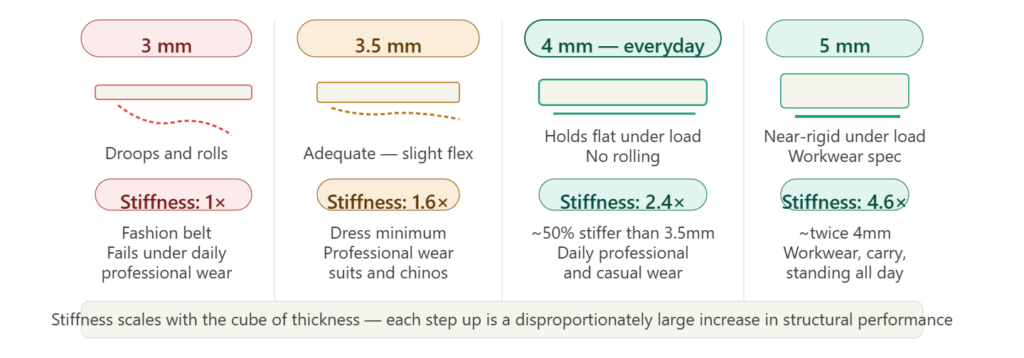
Belt thickness is the single specification with the most direct impact on how a belt performs under load. The relationship is not linear — bending stiffness in a flat beam scales with the cube of thickness.
This means a 4mm belt is not 14% stiffer than a 3.5mm belt. It is approximately 50% stiffer. A 5mm belt is not 25% stiffer than a 4mm belt — it is nearly twice as stiff. Each millimetre of additional thickness produces a disproportionately large increase in structural performance.
The practical consequence: the difference between a 3mm fashion belt and a 4mm structured belt feels categorical rather than incremental. The 3mm belt bends freely and loses its flat profile within weeks of daily wear. The 4mm belt holds its profile under the same conditions. This isn’t because one has better leather — it’s because of the cube relationship.
Rolling — the most common belt failure visible to the wearer — is caused by insufficient bending stiffness relative to the lateral tension the belt is under. When the leather can’t resist this tension, the strap bends forward at the buckle area and the belt curls away from the body. At 3mm, this is certain under normal daily wear. At 4mm full-grain, it doesn’t happen.
Hole enlargement on pin-buckle belts accelerates on thin leather because the leather at the hole edge has less material to absorb the repeated stress of the prong. Thicker leather distributes this stress across more fibre mass, slowing the enlargement that eventually makes fixed-hole belts unwearable at the correct position.
Buckle fold stress — the tight bend where the leather attaches to or enters the buckle frame — is the highest-stress point on any belt. Under daily flexing cycles, thin leather cracks at this point faster than thick leather. At 4mm full-grain, the fold radius keeps the fibre stress below the cracking threshold under normal use. At 2.5–3mm, it often doesn’t.
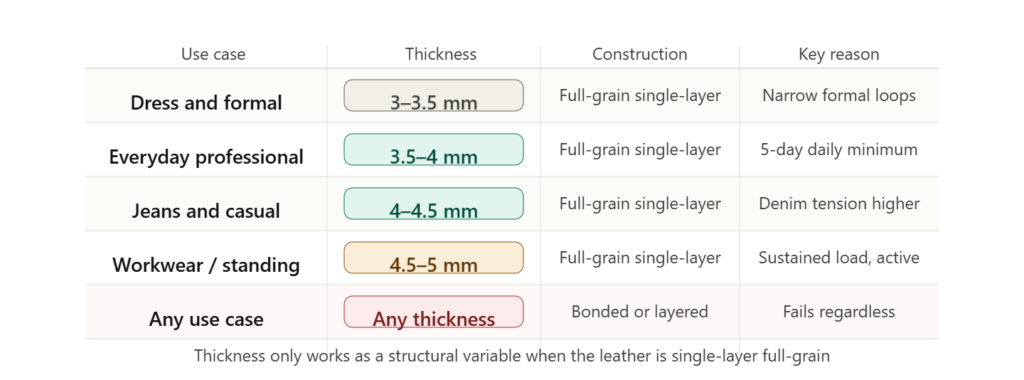
Formal suit trousers are cut with narrow, tight belt loops — typically 33–36mm wide. A very thick, stiff belt can be difficult to thread through these loops without stressing the waistband seam. The 3–3.5mm range provides enough stiffness to hold a flat profile on a dress belt at 30–35mm width while remaining flexible enough for tight formal loops.
For dress belts worn occasionally — weddings, formal events, a few times per week — the load is low enough that 3–3.5mm is adequate. The leather doesn’t accumulate the sustained daily stress that accelerates failure at thinner gauges.
For dress belts worn five days a week with suits, 3.5mm is the minimum. Below 3mm, even light daily professional wear produces visible profile deformation within 6–12 months.
This is the most common daily wear context and the range where getting thickness right matters most. A belt worn Monday to Friday for 8–10 hours accumulates significant load over a year. The difference between a 3.5mm and a 4mm belt in this context is measurable in years of service life.
At 3.5mm full-grain, the belt holds its profile under standard professional wear — suits, chinos, business casual trousers. It resists rolling, maintains flat contact with the waistband, and handles the sit-stand cycles of a desk-based workday without the lateral flex that produces migration and buckle pivot.
At 4mm full-grain, the stiffness increase (~50% versus 3.5mm) extends this to more demanding professional wear — longer days, more movement, heavier trouser fabrics. 4mm is the standard recommended across HoldForm’s belt range for everyday professional use.
For a full breakdown of how thickness affects seated daily wear specifically, see our [how tight should a belt be guide →]
Denim is heavier than dress trouser fabric and exerts more lateral tension on the belt. Standard jeans loops run 38–42mm, wider than formal trouser loops, and are built for belts with more physical presence. A dress belt at 3.5mm in a wide denim loop has insufficient stiffness for the load denim creates — rolling and profile deformation appear faster than in professional contexts.
At 4mm, a belt handles everyday casual denim wear adequately. At 4–4.5mm, it handles both heavy denim and mixed-use wardrobes — the same belt on jeans Monday and dress trousers Tuesday without compromising in either context.
The 4.5mm range is particularly appropriate for selvedge raw denim and workwear denim, where the fabric weight is higher and the traditional belt specification calls for heavier leather.
For the full width and spec guide for denim belts, see our [best belt for jeans guide →]
When a belt is worn for sustained physical activity, carries weight in addition to trouser tension, or is worn for 8–10 hours of standing and movement, the load is substantially higher than desk-based professional wear. This is the use case that makes 5mm the correct specification.
At 5mm single-layer full-grain leather, the belt has enough stiffness to resist the sustained lateral tension of active physical work, the rotational stress of bending and reaching, and the additional load of belt-mounted tools or equipment. A 4mm belt under these conditions will show visible profile deformation faster than a 4.5–5mm belt under the same conditions.
The stiffness of a 5mm belt does mean a longer break-in period compared to thinner leather — the fibre structure needs time to align to the wearer’s body. This is not a failure mode. It is the same process that makes thick full-grain leather produce a stable, body-fitted profile over months of wear rather than immediate compliance followed by deformation.
For the full construction spec guide for standing and workwear belts, see our [best belt for standing all day guide →]
When a belt carries holsters, knife sheaths, multitools, or other equipment, the load path runs from the carried item through the sheath attachment, through the belt strap, to the body. Every component in that path either transfers load cleanly or introduces movement.
At under 4mm, belt leather sags and twists under the sustained downward and rotational load of EDC equipment. The sheath moves, the draw angle changes, and the carry system fails to hold position. At 4.5–5mm full-grain, the belt has the stiffness to resist this load without deforming.
For a detailed breakdown of how belt thickness affects carry system performance, see our [guide to why belts fail with knife carry →]
Thickness is necessary but not sufficient. A 5mm belt built from bonded leather — the compressed fibre composite used in fashion belts — does not perform like a 5mm belt built from single-layer full-grain leather.
Bonded leather at any thickness lacks continuous fibre network. The structural integrity that gives full-grain its load resistance comes from the continuous collagen fibre structure of the hide. Bonded leather is a composite — ground leather fibre mixed with polyurethane binder. It measures 5mm on a calliper but has none of the tensile or bending properties of a genuine 5mm hide.
Layered construction delaminate under sustained stress. A belt built from two 2.5mm layers bonded together measures 5mm total but fails at the bond line under daily flexing. The bond between layers — typically contact adhesive — is under peel stress at the buckle fold every time the buckle is fastened. This stress accumulates over months of daily use and produces visible layer separation at the fold.
Single-layer full-grain is the correct specification for any belt where thickness is being used as a structural variable. The number on the calliper only means what it claims to mean when the leather is one uninterrupted piece of hide.
For a full breakdown of leather grades and how to identify them, see our [full-grain vs top-grain vs genuine leather guide →]
Most belt listings don’t state thickness, which is itself a useful signal — a brand that knows its product states its specifications. When thickness is listed, verify it refers to the finished strap thickness, not the hide thickness before processing (which is always thicker than the finished product).
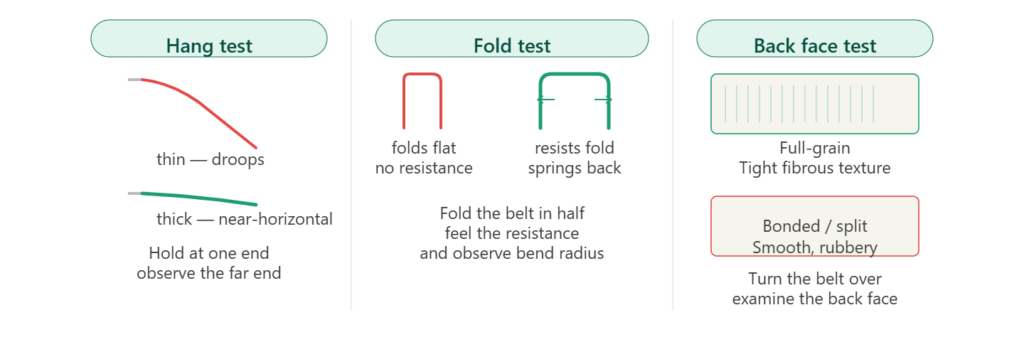
The physical test: Hold the belt horizontally at one end and let the far end hang. A 3mm belt droops visibly. A 4mm belt holds a near-horizontal line with only a slight downward curve over 80–90cm. A 5mm belt is close to rigid horizontally at the same length. This test takes three seconds and reveals the structural category of any belt before purchase.
The fold test: Fold the belt in half and observe the minimum bend radius. Thin, soft leather folds flat without resistance. Thick full-grain resists the fold and springs back to flat when released. A belt that folds flat easily is under 3.5mm, or is bonded leather at any thickness. A belt with noticeable resistance to folding is at 4mm or above.
The back face test: Turn the belt over and look at the back face. Single-layer full-grain has a tight, smooth fibrous texture — the compressed grain layer. Layered construction has a visible seam at the strap edge where the layers meet. Bonded leather has a very smooth, slightly rubbery back face with no visible fibre structure.
| Use case | Correct thickness | Construction |
|---|---|---|
| Formal and dress wear | 3–3.5mm | Full-grain single-layer |
| Everyday professional | 3.5–4mm | Full-grain single-layer |
| Everyday casual and jeans | 4–4.5mm | Full-grain single-layer |
| Workwear and standing | 4.5–5mm | Full-grain single-layer |
| EDC and carry | 4.5–5mm | Full-grain single-layer |
| Avoid at any thickness | — | Bonded or layered leather |
3.5–4mm full-grain single-layer leather for everyday professional and business casual wear. 4–4.5mm for everyday casual including jeans. Below 3.5mm, most belts show rolling and profile deformation within months of daily wear. The correct thickness depends on the specific wear context — formal dress, casual, and workwear each have different load requirements.
Most mid-range consumer belts run 3–3.5mm. Most fashion belts are 2.5–3mm. Quality everyday belts are 3.5–4mm. Workwear and structural belts are 4.5–5mm. The average across the market skews thin because fashion and budget belts make up the majority of volume — the average is not the correct specification for daily professional or casual wear.
For formal dress wear, yes — 5mm is stiffer than necessary and can be difficult to thread through narrow formal trouser loops. For everyday jeans, workwear, standing professions, and EDC carry, 5mm is the appropriate specification. It is not overkill for the use cases it’s designed for.
Yes, if the leather grade is equivalent. Thickness extends belt life by reducing the rate of hole enlargement on pin-buckle designs, slowing rolling and profile deformation, and distributing buckle fold stress across more material. A 4mm full-grain belt lasts significantly longer under daily wear than a 3mm belt of the same leather grade. Thickness advantage disappears with lower leather grades — a 5mm bonded belt fails faster than a 3.5mm full-grain belt.
Rolling is caused by insufficient bending stiffness — the leather can’t resist the lateral tension created by the trouser waistband, and bends forward. Cracking at the buckle fold is caused by accumulated stress at the highest-flex point exceeding the leather’s elastic limit — thin leather has less material to absorb each flex cycle. Both failure modes are directly related to thickness, which is why the bending stiffness relationship (scaling with the cube of thickness) determines practical belt performance more than any other single variable.
The fold test and hang test described above are reliable pre-purchase indicators without measuring equipment. If you have a calliper: measure at three points across the strap — the reading should be consistent if it’s single-layer full-grain, and may vary if it’s layered or bonded construction. A belt that measures 5mm at the centre and 3.5mm at the edges is layered or poorly finished.
HoldForm belts list leather grade and strap thickness in millimetres on every product page.
[View full-grain leather belt range →] [4mm vs 5mm belt thickness: structural comparison →] [Full-grain vs top-grain vs genuine leather: what the grades mean →] [Best belt for jeans: width, thickness and buckle →]

Practical belt guides, sizing tips, and exclusive offers — straight to your inbox.

Leave a comment