Most belt listings say “alloy buckle” or “solid brass” without explaining what that means for how the buckle performs over time. The material determines finish longevity, mechanism precision, corrosion resistance, and how the buckle feels in hand. These are not equivalent options — each material has specific advantages and specific failure modes, and the right choice depends on what the buckle is being used for.
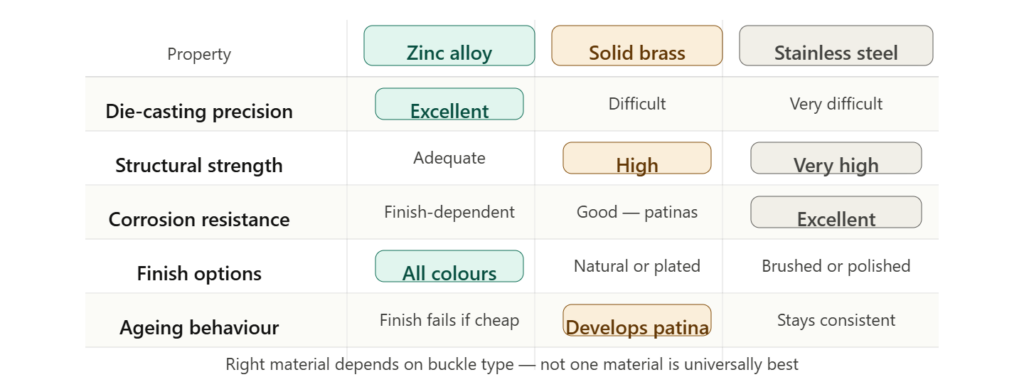
Zinc alloy — sometimes listed as “zamak” or “die-cast alloy” — is the most common buckle material in contemporary belt manufacturing. It is an alloy of zinc with small percentages of aluminium, magnesium, and copper, produced by die-casting: molten metal injected under pressure into a precision mould.
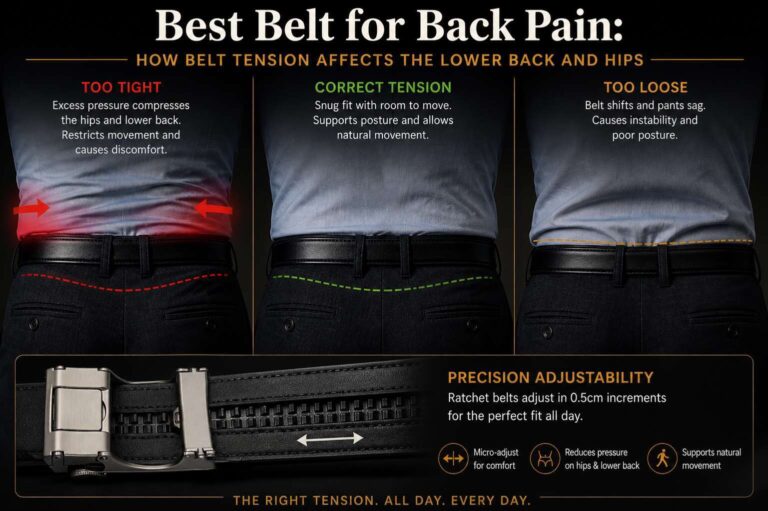
Why it’s used for ratchet mechanisms: The die-casting process allows zinc alloy to be formed into complex shapes with very tight tolerances — the internal teeth, springs, and release levers of a ratchet mechanism require precise geometry that’s difficult to achieve economically with harder metals. Zinc alloy’s lower melting point (around 380°C versus 900°C for brass) means the casting process is faster and less expensive, and the resulting components hold their dimensional accuracy well.
What it does well: Die-cast zinc alloy produces buckles with good weight and feel — denser than aluminium, lighter than solid brass. For contemporary ratchet designs with flat profiles and integrated mechanism housings, it is the practical engineering choice. It accepts surface finishes well and can be plated to any colour.
Where it fails: Zinc alloy is vulnerable to corrosion under sustained exposure to moisture and salt — the conditions of daily sweat contact. Unfinished or poorly finished zinc alloy develops zinc oxide on the surface, which appears as a white powdery deposit and then as surface pitting. The structural strength of zinc alloy is also lower than brass or steel — under sustained bending stress, zinc alloy deforms more than solid brass at equivalent cross-sections.
The finish dependency: Because zinc alloy corrodes under wear conditions, every zinc alloy buckle depends entirely on its surface finish for longevity. This is where the critical distinction between finish types matters more than the base material.
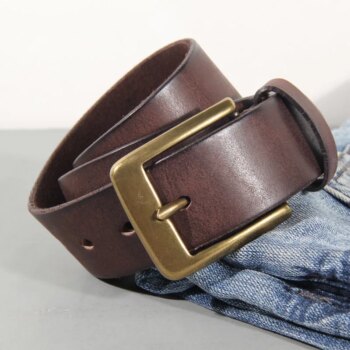
Brass is an alloy of copper and zinc — typically 60–70% copper, with the remainder zinc and trace elements. It is produced by casting or machining from solid stock rather than die-casting.
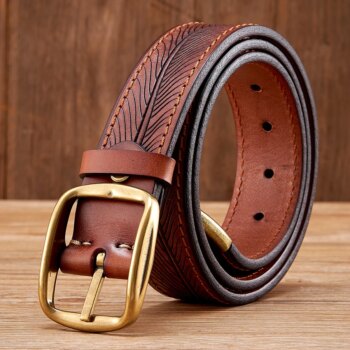
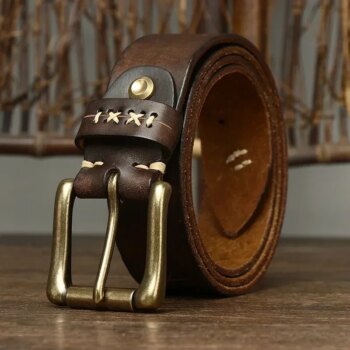
Why it’s used for heritage and pin-buckle designs: Brass has higher tensile strength than zinc alloy, resists deformation under sustained load, and develops a natural patina over time rather than corroding. The patina — a gradual darkening and surface oxidation — is a controlled ageing process that heritage leather goods buyers specifically seek. A solid brass buckle worn daily for ten years looks intentionally aged rather than degraded.
What it does well: Structural integrity under sustained load. A solid brass pin buckle on a daily-wear leather belt holds its geometry through years of use — the prong doesn’t wear through, the frame doesn’t flex, and the surface changes character rather than failing. Solid brass can also be finished without plating — the natural brass surface, lacquered or left bare, is the finish rather than a coating over a cheaper substrate.
Where it fails: Brass is heavier than zinc alloy at equivalent size, which matters for large decorative buckles but is negligible for standard dress and casual belt buckles. More practically, solid brass is difficult to die-cast into the complex internal geometries required for modern ratchet mechanisms — machining or simple casting doesn’t achieve the tolerances that die-casting does. This is why most ratchet buckles use zinc alloy housings rather than brass, even on high-quality belts.
The patina variable: Brass develops patina — this is a feature for buyers who want an ageing aesthetic and a problem for buyers who want consistent appearance. Lacquered brass slows patina significantly; unlacquered brass develops colour change within months of daily wear.
Stainless steel — specifically 304 or 316 grade for accessories — is an iron alloy with chromium content that creates a passive oxide layer preventing corrosion. It is harder than both brass and zinc alloy and is produced by casting, stamping, or machining.
Why it’s used for contemporary professional and EDC designs: Stainless steel does not tarnish, does not patina, and does not corrode under any normal daily wear conditions including sustained sweat exposure. It maintains a consistent appearance indefinitely. For belt buyers who want hardware that looks identical in year five as it did on day one, stainless steel is the only material that delivers this.
What it does well: Durability and corrosion resistance without any dependency on a surface finish. A stainless steel buckle frame is the material itself — there is no plating to chip, no base metal to expose, no patina to develop. The surface can be polished, brushed, or bead-blasted as a finishing treatment, but these are surface textures rather than protective coatings.
Where it fails: Stainless steel is the most difficult and expensive of the three to process into complex shapes. It cannot be die-cast at the tolerances zinc alloy achieves. For simple buckle frame geometries — a frame, a centre bar, a prong — stainless steel stampings and castings are practical. For complex ratchet mechanism internals, the machining cost is prohibitive at consumer price points. Most stainless belt hardware is therefore used for frame buckles rather than mechanisms.
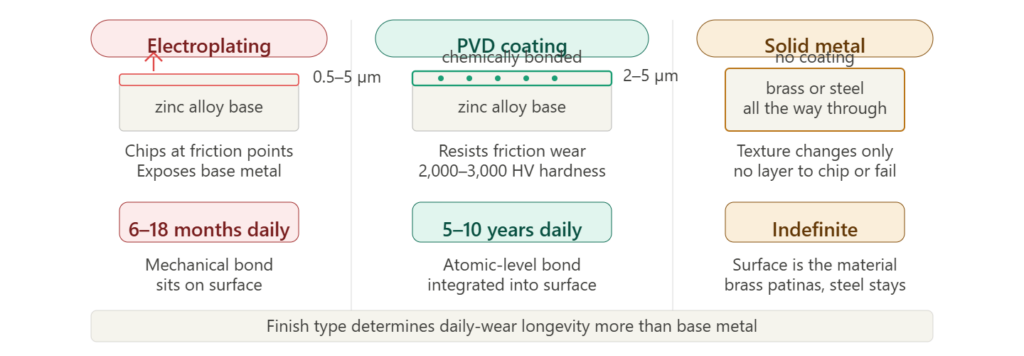
The base metal determines structural performance. The surface finish determines whether you can see it failing.
Electroplating applies a thin metallic layer to the base metal through electrolytic deposition. The layer is measured in microns — typically 0.5–5 microns for standard belt hardware. This layer is mechanically bonded to the surface rather than chemically integrated. At friction points — the prong tip, the frame bar contact area, the buckle edges — electroplating wears through with daily use. On zinc alloy, worn plating exposes the base metal to the corrosion conditions that accelerate surface failure.
The timeline for electroplated zinc alloy failure under daily wear: 6–18 months depending on plating thickness, sweat exposure, and how often the buckle is handled. Electroplated finishes over brass last significantly longer because brass is more corrosion-resistant when exposed.
PVD coating (Physical Vapor Deposition) deposits a coating at the atomic level in a vacuum chamber. The coating is chemically bonded to the base metal rather than mechanically deposited. PVD coatings are typically 2–5 microns thick but are significantly harder than electroplated layers — Vickers hardness of 2,000–3,000 HV versus 150–200 HV for standard nickel electroplating. At friction points under daily use, PVD coating outlasts electroplating by a factor of 3–5 in controlled wear testing.
PVD over zinc alloy produces hardware that holds its finish through years of daily wear. PVD is more expensive than electroplating and has a more limited colour range — it is primarily used for black, gunmetal, and dark metallic finishes rather than bright silver or gold tones.
Solid metal finishes — brushed, polished, or lacquered brass, and brushed or polished stainless — have no coating to fail. The surface treatment is a texture applied to the base material. Scratches on solid brass change the texture locally rather than exposing a different underlying material. The appearance changes with wear but doesn’t fail.
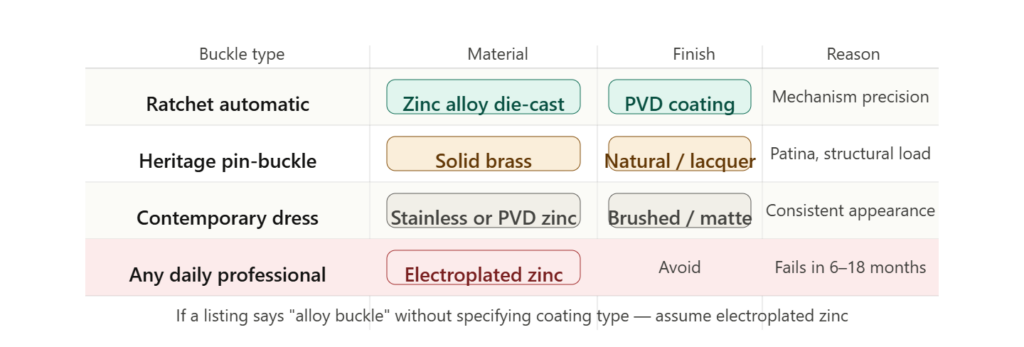
Ratchet belt buckles: Zinc alloy die-cast housing with PVD coating for black and gunmetal finishes, or electroplated with heavy plating for silver and gold tones. The die-casting precision requirement makes zinc alloy the correct material for mechanism components. PVD coating makes the finish durable enough for daily wear.
Heritage and classic pin-buckle belts: Solid brass. The structural integrity, patina development, and long-term appearance of solid brass suits the traditional pin-buckle construction and full-grain leather combination. Solid brass outlasts electroplated zinc alloy under sustained daily wear.
Contemporary professional and EDC belts: Stainless steel frames where mechanism complexity is low, or PVD-coated zinc alloy where mechanism precision is required. Stainless steel is appropriate where consistent appearance without any patina or finish maintenance is the priority.
What to avoid: Electroplated zinc alloy for any belt intended for daily professional wear. The finish failure timeline (6–18 months) is too short for a belt worn five days a week. The base metal exposure that follows is both visually poor and accelerates surface degradation.
Most belt listings describe material vaguely. These are the indicators that allow evaluation without a laboratory:
Weight: Solid brass is noticeably heavier than zinc alloy at the same size. Pick up a solid brass buckle and a zinc alloy buckle of similar dimensions — the difference is immediately apparent. Stainless steel is slightly heavier than brass.
Magnet test: Zinc alloy and brass are not magnetic. Stainless steel (particularly 304 grade) is very weakly magnetic or non-magnetic. Standard steel is strongly magnetic. If a buckle described as “stainless” attracts a magnet strongly, it is likely carbon steel — which will rust.
Edge examination: On a PVD-coated buckle, the edges are sharp and consistent — the coating covers the base metal completely. On an electroplated buckle, the edges may show thinner plating that appears slightly different in colour or texture from the face. On a solid brass buckle, the edges show the same material as the face.
Listings transparency: A brand that states the specific alloy, coating type, and coating process is more reliable than one that says “premium alloy” or “high-quality hardware.” Specificity indicates knowledge of the product and willingness to be held accountable to the specification.
For ratchet mechanism housings, yes — the die-casting precision that zinc alloy allows is the correct engineering choice for complex internal mechanisms. For the finish, quality depends entirely on the coating type: PVD-coated zinc alloy holds up well under daily wear, while electroplated zinc alloy typically shows finish failure within 12–18 months of daily professional use.
It depends on the buckle type. For ratchet automatic buckles, zinc alloy’s die-casting precision is a genuine advantage — brass cannot be die-cast to the same tolerances at comparable cost. For traditional pin-buckle designs, solid brass is more durable under sustained load and develops a controlled patina rather than degrading. The materials serve different design requirements rather than being directly comparable.
Zinc alloy does not rust in the iron oxide sense, but it does corrode. Unprotected zinc alloy develops zinc oxide — a white powdery deposit — under sustained moisture exposure. For a belt buckle worn daily, this means unfinished or poorly finished zinc alloy will show surface corrosion within months. A properly applied PVD coating prevents this by isolating the base metal from moisture contact.
Almost always zinc alloy (zamak). “Alloy” as a descriptor on budget-to-mid-range belt listings typically indicates zinc die-cast hardware with electroplated finish. The vagueness is intentional — “alloy” covers a wide range of quality levels without committing to specifics. When a listing specifies “solid brass” or “stainless steel,” the more specific claim is worth more because it can be verified.
Solid brass or stainless steel buckle frames, with no coating to fail: indefinitely under normal daily wear — the frame will outlast multiple leather straps. PVD-coated zinc alloy: 5–10 years of daily professional wear before the coating shows meaningful degradation at high-friction points. Electroplated zinc alloy: 1–3 years of daily professional wear before visible finish failure at friction points. The buckle doesn’t fail structurally — it fails visually, which for professional wear is functionally significant.
The majority of contemporary belt buckles in the mid-range market ($30–150 belts) use zinc alloy die-cast hardware with electroplated finishes. Higher-priced contemporary belts with ratchet mechanisms typically use zinc alloy with PVD coating. Heritage and traditional pin-buckle designs at quality price points use solid brass. Stainless steel is used in premium EDC and technical belt designs where corrosion resistance without patina is the priority.
HoldForm belt hardware specifications — base metal, coating type, and finish process — are listed on every product page.
[View ratchet belt range — zinc alloy with PVD hardware →] [View heritage belt range — solid brass pin-buckle hardware →] [Silver, gold and black buckle finishes: how to choose →] [Are designer belts worth it: what the price difference buys →]

Practical belt guides, sizing tips, and exclusive offers — straight to your inbox.

Leave a comment