Some designer belts are worth the price. Many aren’t. The difference is not the logo — it’s whether the construction specification justifies the cost. A $300 belt built to the same spec as a $100 belt is a branding premium, not a quality premium. A $300 belt with genuinely superior leather grade, hardware construction, and mechanism design has a legitimate case.
This guide covers the five construction variables that determine whether a belt is worth what it costs, what different price points typically deliver on each variable, and how to evaluate any belt — designer or otherwise — before buying.
The correct answer depends entirely on what the specific designer belt is made from, not which brand made it.
Luxury heritage brands — Hermès, Brunello Cucinelli, some Anderson’s pieces — genuinely use full-grain leather at adequate thickness with solid brass or sterling hardware and hand-finished edges. These belts justify premium pricing because the construction is premium. They will last a decade of daily wear, develop genuine patina, and can be re-strapped onto the original buckle when the leather eventually wears out.
Fashion and accessible luxury brands at the $200–400 price point vary enormously. Some use full-grain leather and solid hardware. Others use split leather with electroplated zinc hardware and spend the construction savings on the buckle logo. The label “genuine leather” appearing at $300 is not a quality guarantee — it is a legal minimum standard that permits split leather and bonded leather to be described as leather.
Mid-market quality belts in the $80–180 range from brands that prioritise construction over branding — building to declared specifications with full-grain leather and solid or PVD-coated hardware — regularly outperform fashion belts at twice the price on every durability measure that matters.
The five criteria below are the ones that determine where any belt actually sits on the quality spectrum, regardless of price.
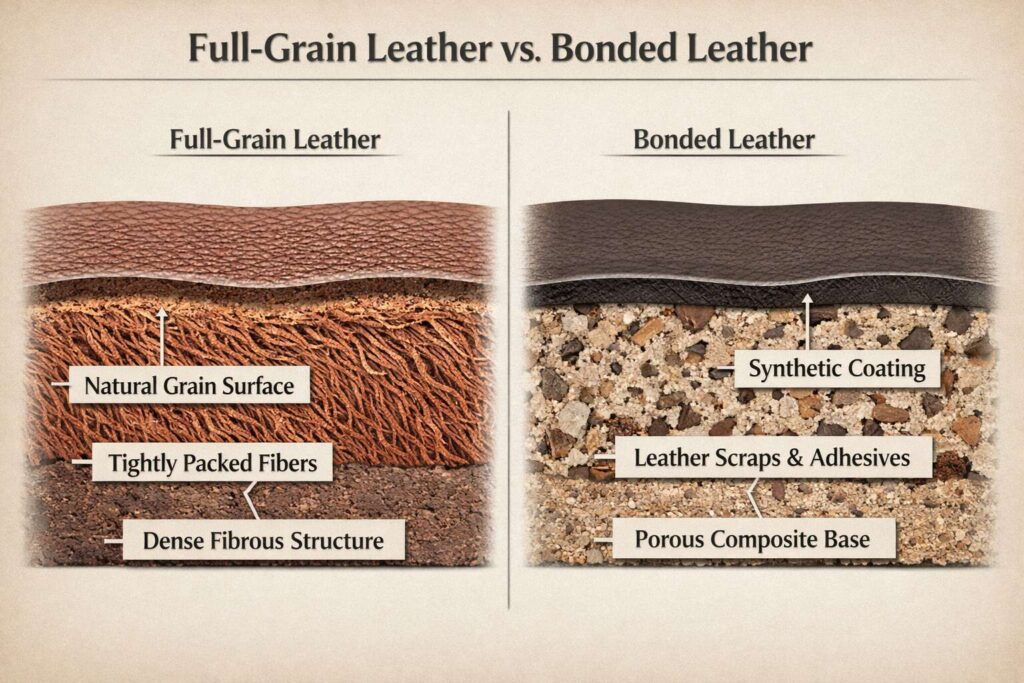
Leather is graded by which layer of the hide it comes from and how that layer is processed. The grade determines surface durability, bending behaviour under repeated use, and how the leather ages over years of wear.
Full-grain leather is the outermost layer of the hide, used with the natural grain surface preserved. The fibre density at this layer is the highest in the hide — it resists abrasion, holds its shape under tension, and develops patina rather than cracking. A full-grain belt at 4mm worn daily will typically last 8–12 years before the leather needs replacing. The surface develops character over time rather than deteriorating.
Top-grain leather has the outermost layer lightly sanded and coated with a correction layer to produce a uniform appearance. It’s more consistent-looking than full-grain but less durable — the correction layer wears through unevenly over time, and the sanded surface has less fibre density than unsanded full-grain. Adequate for daily wear, visible surface wear within 3–5 years of heavy use.
Split leather is the lower layer of the hide, separated from the top grain during processing. It has a looser, more parallel fibre structure with lower tensile strength than full-grain. Split leather belts are often sold as “genuine leather” — the label is legally accurate but describes a structurally inferior material. Under daily wear, split leather belts typically show significant wear within 18 months and crack at stress points within 2–3 years.
Bonded leather is not leather in any meaningful structural sense. It is a composite of shredded leather fibre, polyurethane binder, and a polyurethane surface coating. It looks like leather and is sold as leather. Under sustained stress, the layers separate — visible as surface peeling or flaking. No amount of conditioning prevents or reverses this failure.
What designer belts use: The most expensive brands use full-grain. Mid-range fashion brands often use top-grain or split with a corrected surface finish that looks identical to full-grain in photographs. Budget fashion belts at £30–80 are frequently bonded leather regardless of what the label says.
How to check: A full-grain belt has visible natural grain variation — no two sections look identical. Corrected grain is uniform and slightly plastic-looking in direct light. Split leather has a fibrous, suede-like back face. Bonded leather has a perfectly smooth, slightly rubbery back face. These are observable before purchase.
Thickness determines structural performance more directly than any other single specification. Bending stiffness scales with the cube of thickness — a 4mm belt is not 25% stiffer than a 3mm belt, it is roughly twice as stiff.
Dress and formal belts: 3.5–4mm at the narrow end (30–33mm) for suits and tailored trousers. This gives enough stiffness to hold a flat profile without the visual weight of a thicker strap.
Everyday and casual belts: 4–4.5mm for daily professional and casual wear. This is the specification that resists rolling under the lateral tension of daily wear and holds its profile through years of use.
Workwear and carry belts: 4.5–5mm for belts under sustained heavy load — tool belts, carry belts, belts worn with heavy denim or workwear. Above 5mm adds weight without proportional structural benefit for most daily wear contexts.
What designer belts use: The most expensive heritage belts are typically 3.5–4.5mm depending on the intended use. Many mid-range fashion belts are 2.5–3mm — thin enough to look flat in photographs but prone to rolling at the front of the waistband under daily wear. Thickness is rarely disclosed on fashion belt product pages, which is itself a useful signal.
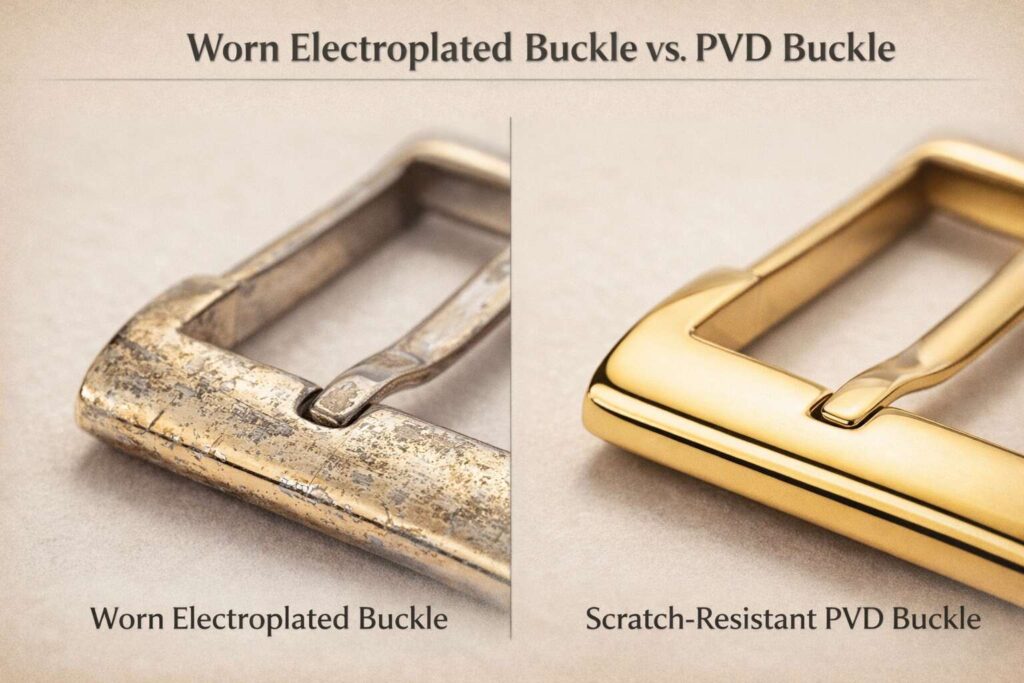
The buckle is the highest-wear component on the belt — it’s handled every day, removed at airports, contacted by clothing, and under sustained load during wear. Buckle quality determines both durability and whether the belt looks acceptable after three years of daily use.
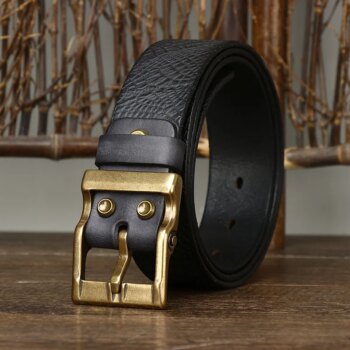
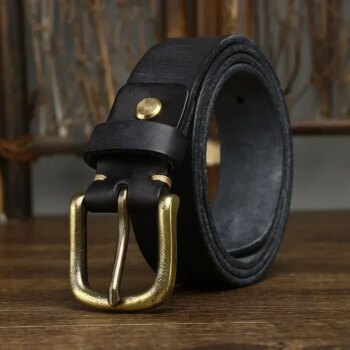
Solid brass: The best material for daily-use buckles. Brass has high density, develops a natural warm patina, and doesn’t chip or flake because there’s no coating to fail. Solid brass is heavy relative to zinc alloy — a meaningful quality indicator you can feel. Heritage brands use solid brass as standard.
Stainless steel: Equally durable to solid brass, with a cooler, more contemporary finish. Harder surface than brass, slower to develop patina. Correct for contemporary professional and casual wear.
PVD-coated alloy: Physical Vapor Deposition bonds colour at a molecular level rather than as a surface coating. PVD-coated zinc alloy hardware is significantly more durable than electroplated equivalents — the finish resists chipping under the friction and impact of daily use. The correct choice for contemporary finishes (matte black, gunmetal) where solid brass isn’t available.
Electroplated zinc alloy: The standard buckle material for mid-range and budget belts. Electroplating applies a thin metallic coating — effectively paint — over a zinc alloy base. The plating wears through at friction points (edges, centre bar, prong tip) within 12–18 months of daily use on most electroplated buckles. Under fluorescent office lighting, chipped plating is immediately visible.
What designer belts use: The most expensive brands use solid brass or gold-plated solid brass (which holds better than zinc plating because the base metal is more compatible with the finish). Mid-range fashion brands at £150–300 typically use electroplated zinc alloy with a heavier plating thickness than budget belts — they last longer before showing wear but still fail eventually. Budget fashion belts use the thinnest electroplating available, which fails within months.
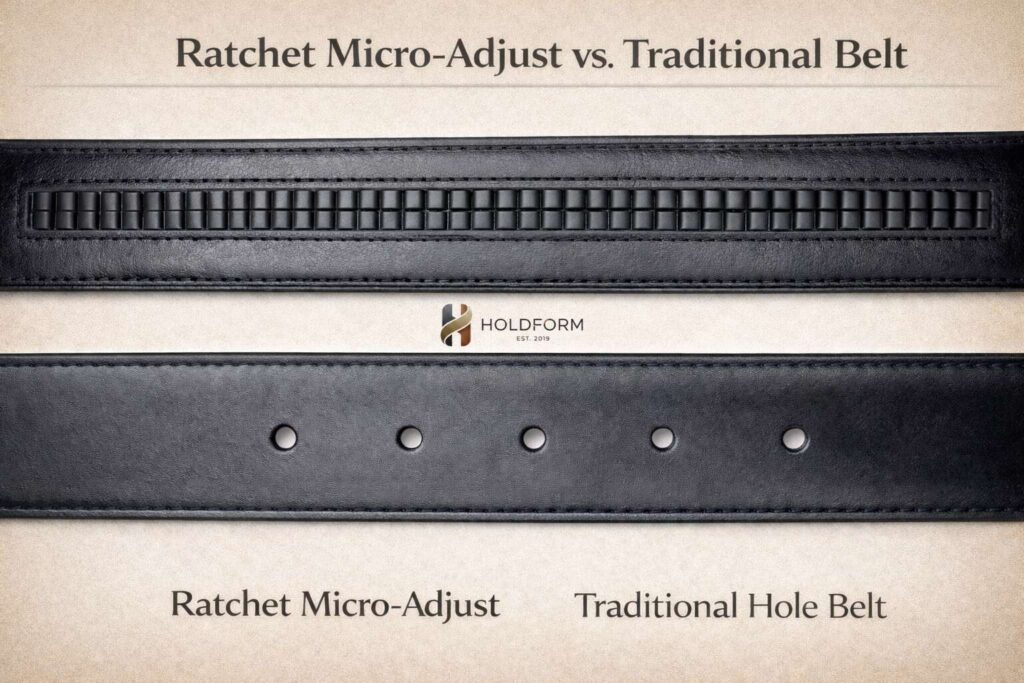
The adjustment mechanism determines fit precision and how that precision changes over time.
Fixed-hole pin buckle: One adjustment point per hole, with 25mm between holes. The correct tension falls between two holes for many people in many contexts. Repeated daily use concentrates stress at the same two or three holes, which gradually enlarge. On a well-made full-grain belt, hole enlargement is slow — measurable over years rather than months. On a thinner or lower-grade leather belt, hole enlargement can become functionally significant within a year of daily use.
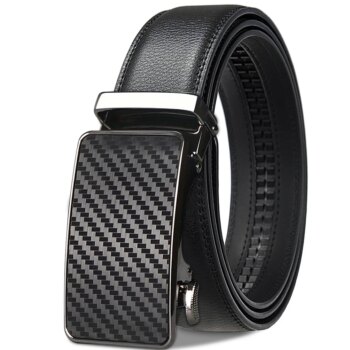
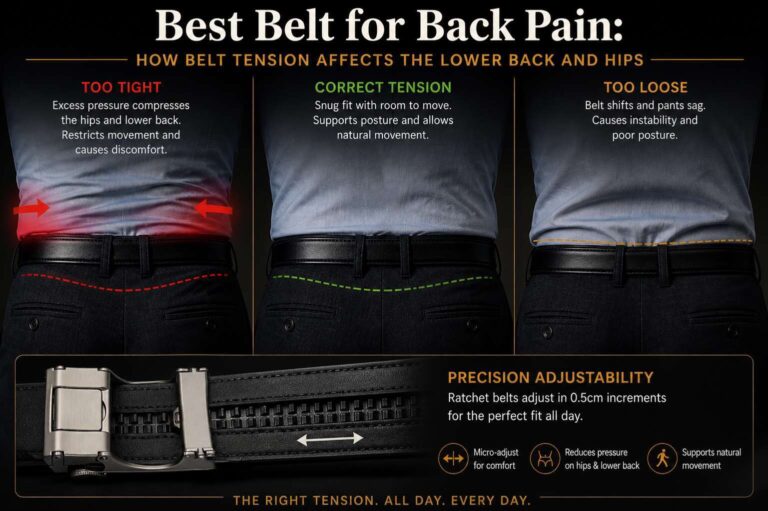
Ratchet mechanism: 0.5cm adjustment increments over a track length of 15–20cm. No single stress point — the mechanism distributes tension across the track rather than concentrating it at a hole edge. The precision advantage is real: for anyone whose waist varies by 1–3cm through a typical day (meals, sitting, physical activity), ratchet adjustment allows the correct tension to be set precisely rather than accepted as a fixed-hole compromise.
Friction-lock mechanism: Infinite adjustment within the strap range, holding via clamping pressure across the strap width. Provides the most precise adjustment of the three types. No holes in the leather at all. The limiting factor is mechanism quality — a well-made friction-lock holds consistently; a poorly made one loosens under sustained load.
What designer belts use: Heritage and luxury brands almost universally use fixed-hole pin buckles — the traditional construction that suits the patina and character aesthetic of full-grain leather. Mid-range fashion brands use pin buckles almost exclusively. Ratchet and friction-lock mechanisms are predominantly found in modern belt brands that prioritise functional engineering over traditional aesthetics.
How the belt is assembled determines longevity at the stress points where belts fail.
Single-piece full-grain strap: One continuous piece of leather from buckle end to tip, with no lamination or filling. This is the construction method used in traditional saddlery and heritage leatherwork — the leather distributes load along its full fibre length, ages uniformly, and can be resoled (re-strapped onto an existing buckle) when worn out.
Layered construction: Two or more layers of leather bonded together, sometimes with a filler material between layers to achieve apparent thickness. The adhesive bond between layers is the weak point — it fails under sustained bending stress, particularly at the buckle fold where the leather flexes most frequently. Layered construction can be identified by examining the strap edge: a single-piece strap has a continuous cross-section; a layered strap has a visible seam between layers at the edge.
Stitching quality: Saddle stitch — two threads per hole from opposite sides — holds even if one thread breaks. Machine lock stitch uses a single interlocked thread that unravels completely from a single break point. For daily-wear belts under sustained stress, saddle stitch at the buckle attachment and strap edge is significantly more durable than machine stitch.
| Price range | Leather grade | Thickness | Buckle | Construction |
|---|---|---|---|---|
| Under £50 | Bonded or split | 2–3mm | Electroplated zinc | Layered, machine stitch |
| £50–120 | Split or top-grain | 3–3.5mm | Electroplated zinc (heavier) | Single or layered, machine stitch |
| £120–200 | Top-grain or full-grain | 3.5–4mm | PVD or solid metal | Single piece, machine or saddle stitch |
| £200–350 | Full-grain | 3.5–4.5mm | Solid brass or PVD | Single piece, saddle or machine stitch |
| £350+ | Full-grain, often hand-finished | 4–5mm | Solid brass or gold-plated | Single piece, hand saddle stitch |
Note: these are typical ranges. Individual products vary significantly within each tier, and brands that prioritise construction over branding regularly outperform the tier above on specific criteria. The table describes what you typically find, not what you always find.
A $350 Gucci belt costs $350 not because the leather and hardware cost $350 to source and produce. The material and manufacturing cost of most luxury belts — including heritage brands — is a fraction of the retail price. The remainder is:
Brand allocation: The cost of the brand itself — its history, marketing, retail infrastructure, and the social signal the logo provides. This is not fraud. It is a genuine product attribute that buyers pay for consciously. The question is whether you are also getting construction quality to match, or only the brand signal.
Retail margin: Designer belts sold through boutiques carry 2–3x wholesale margin. A belt that costs $100 to produce and wholesale at $150 retails at $300–350. This is standard retail economics, not specific to belts.
Craft allocation: For the genuine heritage brands — Hermès, some Anderson’s products, a small number of Italian makers — a meaningful portion of the price reflects hand finishing, hand saddle stitching, and the time of skilled craftspeople. This is real value that produces a genuinely different product. It is also the minority of designer belt purchases.
The practical implication: at the $200–350 price range from fashion-focused brands, you are primarily buying brand signal with construction quality that is typically equivalent to a well-specified $120–180 belt from a brand that invests in materials rather than marketing. At the $350+ range from genuine heritage makers, you are often buying a belt that is constructively superior to anything available at lower prices — but the price gap still includes a significant brand premium.
Check the leather grade: Ask the seller directly — “Is this full-grain leather?” Not “genuine leather,” not “real leather,” not “premium leather.” Full-grain, specifically. If the answer is evasive or generic, assume it’s not full-grain.
Check the thickness: A quality belt should disclose thickness in millimetres. If it doesn’t, that’s a signal. For daily wear, 4mm minimum. For dress wear, 3.5mm minimum.
Examine the buckle: Hold it and feel the weight. Solid brass is noticeably heavy. Zinc alloy is lighter and has a slightly hollow sound when tapped. Look at the edges of the buckle — electroplated zinc shows wear at edges fastest; look for existing chips on display models.
Look at the strap edge: Single-piece leather has a continuous cross-section with no visible layer seam. Layered construction has a visible horizontal line at the edge. Burnished and sealed edges indicate quality finishing. Raw, fraying edges indicate rushed production.
Ask about the construction method: Single-piece strap or layered? Saddle stitch or machine stitch at the buckle attachment? A brand that can answer these questions is a brand that knows what it makes.
Consider total cost of ownership: A $150 belt that lasts 8 years costs $19 per year. A $60 belt that lasts 18 months and needs replacing twice costs $80 for the same period. Designer brand premium aside, construction quality is the primary determinant of which category a belt falls into.
Some are. The decision depends on the specific belt’s construction, not the brand. Designer belts from genuine heritage makers with disclosed full-grain leather, solid brass hardware, and saddle stitch construction are worth premium pricing. Designer belts from fashion brands where the construction is equivalent to a mid-market belt but the price reflects brand allocation are worth buying if you want the social signal — not if you’re optimising for durability.
Full-grain leather has visible natural grain variation — no two sections are identical, and the pattern is organic rather than stamped or uniform. The back face has a tight, smooth fibrous texture. When bent, it flexes without cracking and returns to its original shape. Corrected grain leather looks more uniform and slightly plastic in direct light. Split leather has a rougher, more open back face. Bonded leather has a very smooth, slightly rubbery back face.
Fixed holes concentrate bending and tensile stress at a single point every time the belt is worn. The leather at the hole edge undergoes more flex cycles than any other point on the strap. On full-grain leather at adequate thickness, this degradation is slow — years rather than months. On split or thin leather, hole enlargement and cracking are significantly faster.
For fit precision and leather longevity, yes. Ratchet adjustment distributes tension across the track rather than concentrating it at a hole, which extends strap life. The 0.5cm increments provide more precise fit than 25mm hole spacing. For traditional aesthetics and patina development, a classic pin buckle on full-grain leather has a genuine appeal that ratchet designs don’t replicate.
Full-grain or quality top-grain leather at 3.5–4mm thickness, a solid metal or PVD-coated buckle, and single-piece construction. These specifications are achievable at $100–150 from brands that prioritise materials over marketing. A belt meeting these criteria at $150 will outperform most fashion belts at $250–350 on every durability measure.
HoldForm belts list leather grade, strap thickness, buckle material, and construction method on every product page — because construction transparency is how you justify a price rather than a brand.
[View full-grain leather belt range →] [Full-grain vs top-grain vs genuine leather: the complete grade guide →] [How belt thickness determines structural performance →] [Silver, gold and black buckle: how finish and material affect longevity →]

Practical belt guides, sizing tips, and exclusive offers — straight to your inbox.

Leave a comment