Answers to the most common questions about HoldForm belt sizing, customization, materials, and care.
Order two sizes larger than your trouser size. A size 34 trouser takes a size 36 belt. This places the buckle at the centre hole, which is where the belt is designed to perform — leather stress is distributed evenly and you have adjustment range in both directions.
If you are between sizes, order the larger. A belt that is slightly long can be worn at a lower hole or trimmed. A belt that is too short cannot be extended.
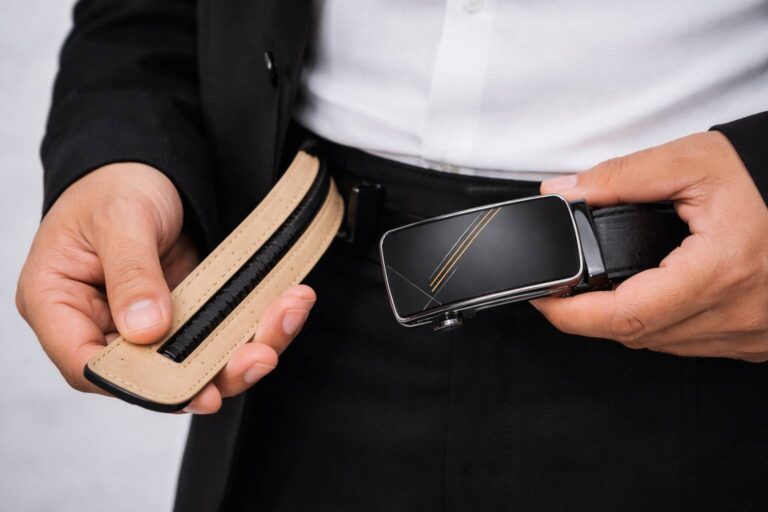
For ratchet belts: order at least one size above your trouser size and trim the strap to your exact waist length at home. The ratchet mechanism then handles fine adjustment in 0.5cm increments above and below your trim point. See our [how to trim a ratchet belt guide →] for the full process.
Lay the belt flat. Measure from the inner edge of the buckle — the point where the leather folds around the buckle frame — to the hole you use most. That measurement is your belt size. If it lands on a fraction or odd number, round up to the next even size.
Do not measure from the tip of the strap to the buckle — that includes the tail length, which varies by design and has no relationship to how the belt fits.
HoldForm belts are available in two primary widths:
35mm (3.5cm): For dress trousers, formal suits, and business chinos. Fits the narrower belt loops of tailored and formal trouser construction.
38mm (3.8cm): For everyday casual wear, jeans, and workwear. Fills standard denim and workwear loops correctly with 1–2mm clearance.
If you are unsure which width matches your trousers, measure the width of your belt loop at its narrowest point before ordering.
Yes — detachable buckle systems are available across the HoldForm range. The attachment method varies by belt type:
Pin-buckle belts: Chicago screw attachment. Remove with a flathead screwdriver.
Ratchet belts: Internal tension clamp. Press the release, slide the strap out, insert the replacement.
Most 38mm straps are compatible with standard interchangeable buckles of the same width.
Yes. Ratchet belts are designed for home trimming — the strap is supplied longer than needed specifically so you can trim to your exact waist length.
The process: detach the buckle, measure your correct strap length, cut from the buckle end (never the tip end), reattach the buckle. Cut less than you think you need on the first pass — you can always remove more, you cannot add length back.
See our [how to trim a ratchet belt guide →] for the full step-by-step process with the specific measurements.
The female side of the screw is spinning with the male side rather than holding still. Hold the female side in place while you turn the male side with the screwdriver.
Practical method: press your fingertip firmly against the female side on the back of the strap to create friction, then drive the screwdriver. If fingertip pressure isn’t enough, place a piece of rubber or a small square of grip tape on the female side to increase friction before driving.
Full-grain leather uses the outermost layer of the hide — the zone with the highest collagen fibre density. It resists sustained load, develops patina over time, and lasts significantly longer under daily wear than lower grades. It is the correct specification for a belt worn five days a week.
Split leather is taken from the lower layers of the hide where fibre density is lower. It is weaker under sustained tension, fails faster at stress points, and does not develop patina — it degrades. Split leather is common in budget and fashion belts where initial appearance matters more than longevity.
For a full explanation of how the grades differ mechanically, see our [full-grain vs top-grain vs genuine leather guide →]
Solid brass buckles: naturally nickel-free. Brass is an alloy of copper and zinc — it does not require nickel for strength or colour.
Zinc alloy buckles with PVD coating: nickel-free in the coating. PVD (Physical Vapor Deposition) is a coating process that produces a chemically bonded surface without nickel plating.
Zinc alloy buckles with standard electroplating: may contain nickel in the plating layer. If you have a nickel sensitivity, specify solid brass or titanium hardware when ordering.
For a full guide to buckle materials and which are safe for sensitive skin, see our [nickel-free belt buckle guide →]
HoldForm everyday belts use 4mm single-layer full-grain cowhide — the minimum thickness for daily professional and casual wear that resists rolling, hole deformation, and fold cracking under sustained use.
Workwear and carry-rated belts are specified at 4.5–5mm for the higher load of active physical work and belt-mounted equipment.
For a full explanation of why thickness matters mechanically, see our [how thick should a leather belt be guide →]
Yes. Squeaking on a new belt is caused by tight leather fibres at contact points — typically at the buckle fold or at the belt loop. It indicates dense, high-quality leather rather than a defect.
Apply a small amount of leather conditioner to the squeak point and work it in gently. The sound reduces as the leather fibre structure softens slightly at the contact points with wear. Most belts stop squeaking within 1–2 weeks of regular wear without any intervention.
Pat off surface water with a dry cloth. Hang the belt at room temperature in open air and allow it to dry naturally. Do not use a hair dryer, radiator, or direct sunlight — rapid heat extracts the natural oils from the leather fibre matrix and causes permanent brittleness and cracking.
Once dry, apply a small amount of leather conditioner to restore flexibility to any area that feels stiff after drying.
Apply a small amount of leather conditioner — not mink oil, not shoe polish — to a soft cloth and work it into the strap in long strokes along the grain direction. Let it absorb for 15–20 minutes and buff any excess with a clean cloth.
Frequency: every 3–6 months for a belt worn daily. The buckle fold — the tightest bend point — is the most important area to condition, as this is where leather becomes brittle and eventually cracks if moisture levels are not maintained.
For a full conditioning guide with product recommendations, see our [leather belt care guide →]
On standard full-grain cowhide in natural, dark brown, or black: no. The dye is penetration-dyed through the hide rather than surface-applied.
On some washed or antiqued leather finishes: possible if the belt gets wet. These finishes use surface-applied dye treatments that can transfer when wet. If transfer occurs, it typically washes out of clothing. Keep washed-finish belts dry and apply leather conditioner regularly to stabilise the surface dye.
Hang vertically by the buckle in a climate-controlled living space. Hanging by the buckle allows the strap to hang straight under its own weight, preventing the permanent stress lines that develop when a belt is coiled or folded under pressure.
Avoid: attics (heat causes drying and cracking), basements (moisture causes mould and fibre damage), sealed drawers without air circulation, leaving belts looped inside trouser waistbands.
Yes. Full-grain leather belts are covered against manufacturing defects under normal daily use. If a belt fails due to a construction or material defect — not normal wear — contact support at support@holdform.com with your order details and a description of the failure.
Normal wear — hole enlargement over years of daily use on a pin-buckle belt, gradual patina development, conditioning wear at the buckle fold — is not covered under warranty as these are expected outcomes of use.
No. HoldForm is a direct-to-consumer brand that sells exclusively online. This keeps quality control within one manufacturing specification and allows direct pricing without retail margin.
One-off custom manufacturing is not available. For non-standard setups, you can combine components independently — strap only, buckle only — to create a configuration that suits your requirements.
Email: support@holdform.com Hours: Monday–Friday, 09:00–18:00 GMT+2
Response time is typically within one business day. For sizing questions, include your trouser size, the type of belt you are ordering (pin-buckle or ratchet), and the trouser type you will primarily wear it with.

Practical belt guides, sizing tips, and exclusive offers — straight to your inbox.


Leave a comment