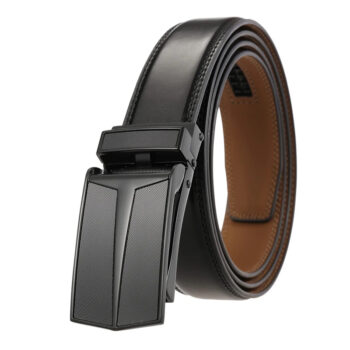
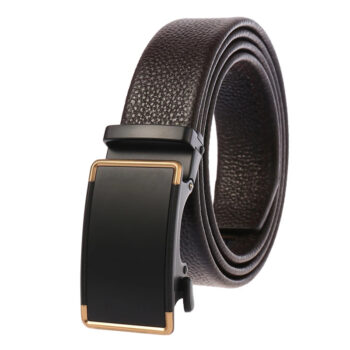
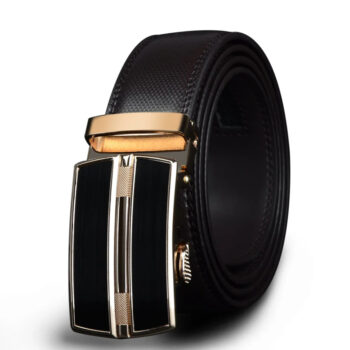
A ratchet belt arrives longer than needed so you can trim it to your exact waist size at home. The process takes under 60 seconds, requires only a pair of sharp scissors, and cannot damage the belt as long as you cut from the correct end. Once trimmed, the ratchet mechanism handles fine adjustment in 0.5cm increments — the belt fits precisely at your current waist measurement and adjusts within a range above and below that point.
This guide covers the full trim process, how to measure correctly before cutting, and the common mistakes that produce a belt that’s too short to fix.
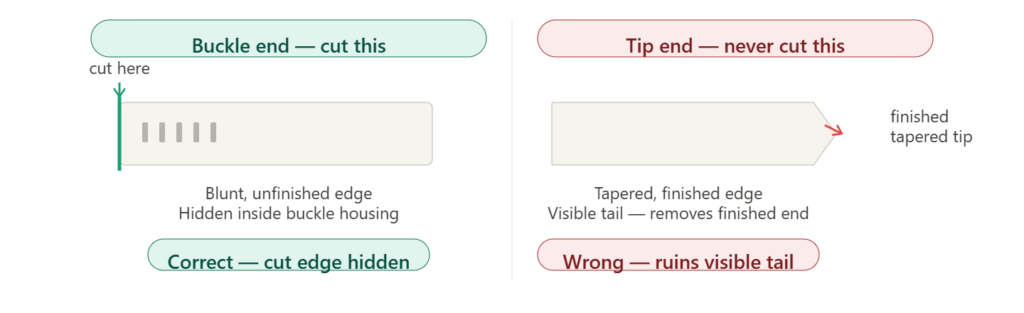
Always cut from the buckle end — never the tip end.
The tip end of a ratchet belt strap is the finished, tapered end with edge finishing. This end is the visual tail of the belt when worn. Cutting from the tip end removes the finished edge and shortens the visible portion of the belt — the wrong end.
The buckle end is the blunt, unfinished end that feeds into the buckle housing. This is the end you cut. When the trimmed end re-enters the buckle housing, the cut is hidden inside the mechanism. The visual appearance of the belt is unchanged.
Every men’s ratchet belt in our range is designed to be trimmed to your exact length at home in under two minutes.
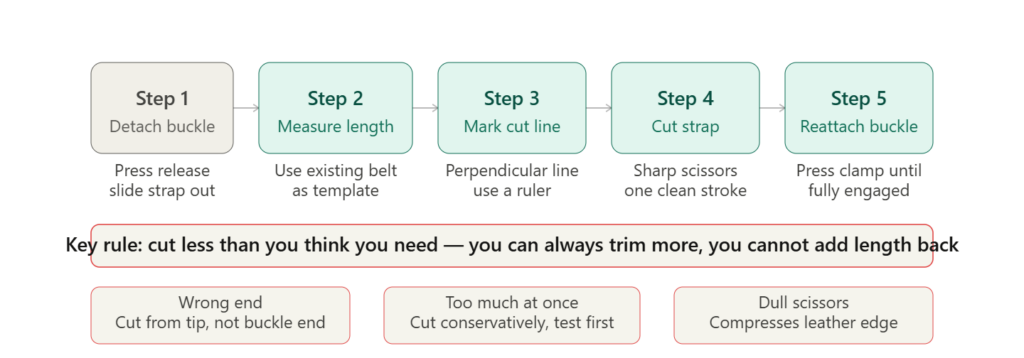
Lay the belt flat with the leather face down. On the back of the buckle, locate the clamp mechanism — a small lever, clip, or pressure release depending on the buckle design. Press or lift the release to separate the strap from the buckle. The strap should slide out cleanly.
If the clamp is stiff, press the release and apply light forward pressure on the strap simultaneously. Do not force it — the mechanism releases with minimal pressure when correctly engaged.
Set the buckle aside. You are now working with the strap only.
There are two measurement methods. Method A is more accurate; use it if you own an existing belt that fits correctly.
Method A — Use an existing belt as a template:
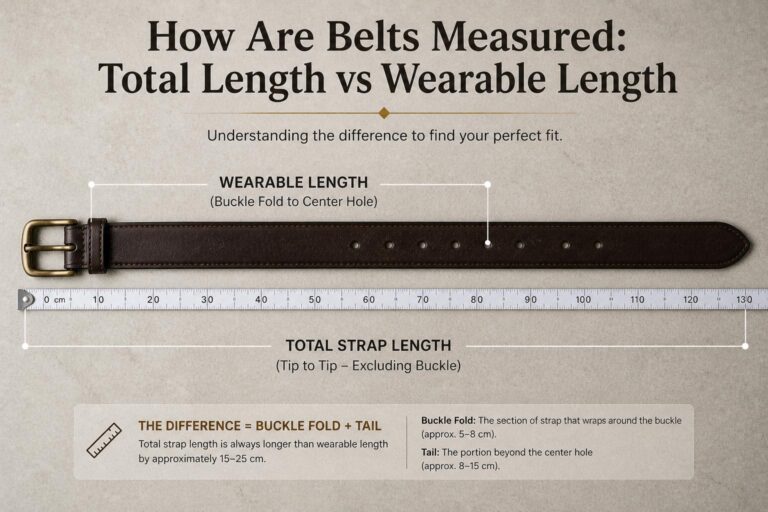
Take a belt that fits correctly and lay it flat. Measure from the fold point — where the leather wraps around or enters the buckle — to the hole you use most often. This distance is your target length.
On the ratchet strap, measure the same distance from the buckle end (the end you will cut) and mark the cut point with a pencil or masking tape on the back face of the leather.
Method B — Measure directly on your body:
Thread the strap through your trouser loops without the buckle attached. Bring the buckle end to where the buckle would normally sit. Add 6–8cm beyond that point to allow for the buckle attachment depth. Mark this point on the back face of the leather.
The most important instruction in this guide: Cut less than you think you need. You can always remove more leather. You cannot add it back. Make your first cut conservatively — attach the buckle, test the fit, and trim further if needed.
On the back face of the strap, draw a straight line perpendicular to the strap edges at your measured cut point. Use a ruler or the straight edge of the buckle frame as a guide. The cut needs to be square — an angled cut produces a strap end that doesn’t seat evenly in the buckle housing.
Use sharp scissors or a sharp craft knife with a steel ruler. Dull scissors compress the leather rather than cutting it cleanly, which produces a rough edge that may affect how the strap seats in the buckle.
Cut in a single clean stroke rather than multiple partial cuts. Full-grain leather at 4mm cuts cleanly in one motion with adequate scissors. If your scissors are struggling, they are not sharp enough — use a craft knife instead.
The cut edge does not need finishing. It will be hidden inside the buckle housing after reattachment and is not subject to the edge wear that affects the visible portions of the strap.
Insert the freshly cut end of the strap into the buckle housing. Push the strap in until it is fully seated — the strap end should be flush with or slightly inside the back of the buckle. Press the clamp mechanism closed firmly until it engages.
Test the attachment by pulling the strap forward with moderate force. The buckle should hold without the strap sliding. If the strap pulls loose, the clamp is not fully engaged — re-seat the strap and press the clamp more firmly.
Put the belt on and fasten at what feels like the correct tension. Check:
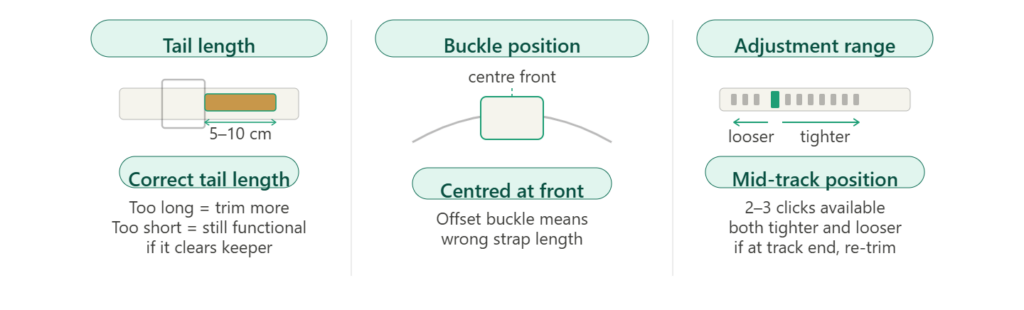
Buckle position: The buckle should sit at the centre front of the waistband, not offset to one side.
Tail length: The strap should pass through the first keeper loop after the buckle with approximately 5–10cm of tail visible beyond the keeper. Too much tail means you cut too little — the belt still fits, but the tail is long. Too little tail means you cut correctly or slightly short — still functional if the strap passes through the keeper.
Adjustment range: Fasten at your normal tension. You should be able to loosen by 2–3 clicks without running out of track, and tighten by 2–3 clicks without the strap running out on the other end. If you’re at the end of the track in either direction, the trim point needs adjustment.
If the tail is significantly too long, release the buckle, trim a further 1–2cm, and retest. Repeat until the fit and tail length are correct.
Cutting from the tip end. The most consequential mistake — removes the finished edge and shortens the visual tail rather than the hidden buckle-end excess. Check which end is which before cutting.
Cutting too much at once. Cut conservatively on the first pass. A strap cut 3cm too short has no fix. A strap with 3cm too much tail can be trimmed in a second pass.
Using dull scissors. Dull scissors compress the leather edge rather than cutting it, which can affect how the strap seats in the buckle housing. Use sharp scissors or a craft knife.
Cutting at an angle. A non-perpendicular cut means the strap doesn’t seat evenly in the buckle. Use a ruler as a cutting guide.
Not testing before final trim. Always attach the buckle and test the fit after the first cut before deciding whether to trim further.
Once trimmed, the ratchet belt adjusts in 0.5cm increments along the track. To adjust:
To tighten: Pull the strap forward through the buckle until it clicks into the correct position. Each click is one 0.5cm increment.
To loosen: Press the release lever or button on the buckle to disengage the pawl, then allow the strap to move to the looser position. Release the lever — the pawl re-engages the nearest tooth.
To remove the belt: Press the release and pull the strap back through the buckle, or use the full-release position if the buckle design has one.
The adjustment range of a correctly trimmed ratchet belt covers approximately 16cm above and below the trim point — enough to accommodate normal daily waist variation, seasonal changes, and different trouser waistband thicknesses.
A correctly trimmed ratchet belt should not need re-trimming under normal wear. If your waist size changes significantly — more than the adjustment range covers — the belt can be re-trimmed. Remove the buckle, measure the new target length, trim from the buckle end, and reattach. The strap can be trimmed multiple times as long as sufficient length remains.
Detach the buckle by pressing the release mechanism, measure your target strap length from the buckle end, mark a straight perpendicular line at the cut point, cut with sharp scissors, and reattach the buckle. Always cut from the buckle end — the blunt, unfinished end — not the finished tip end.
Pull the strap forward through the buckle to tighten — each click is a 0.5cm increment. To loosen, press the release lever on the buckle to disengage the locking pawl, move the strap to the looser position, and release the lever. The belt can be adjusted while being worn without removing it.
Release the buckle clamp, measure the excess length from the buckle end, cut with sharp scissors at the marked point, and reattach the buckle. Cut conservatively — you can always remove more, you cannot add length back.
Yes. Ratchet belts are designed to be trimmed from the buckle end. The cut is hidden inside the buckle housing. Cutting does not affect the track, the mechanism, or the structural integrity of the strap.
A strap cut too short cannot be lengthened. If the strap is too short to feed through the buckle mechanism correctly, the belt cannot be worn. This is why the guide recommends cutting conservatively on the first pass and testing fit before trimming further.
Cut the excess beyond your target fit length. Using an existing belt as a template is the most accurate method — measure from fold point to your most-used hole, use that as the target length on the ratchet strap, and add 2–3cm of margin before cutting. Test and trim further if needed.
No. A pair of sharp scissors is sufficient. A craft knife with a steel ruler produces a cleaner cut on thick leather (4mm+) and is worth using if your scissors struggle with the leather thickness.
HoldForm ratchet belts are trim-to-fit — all straps arrive in extended lengths ready for home resizing.
[View ratchet belt range →] [How ratchet belt mechanisms work: full technical guide →] [How to measure belt size correctly before ordering →] [Ratchet belt vs traditional belt: mechanism comparison →]


[…] → How to Resize a Ratchet Belt at Home […]
Practical belt guides, sizing tips, and exclusive offers — straight to your inbox.