Belt size and pant size are not the same measurement. They use different reference points, different measurement conventions, and often produce different numbers even on the same body. Using your trouser size to order a belt is the most common reason belts don’t fit correctly on arrival.
This explains why the two measurements differ, when the standard conversion rule works and when it doesn’t, and how to find your correct belt size directly rather than estimating from a trouser tag.
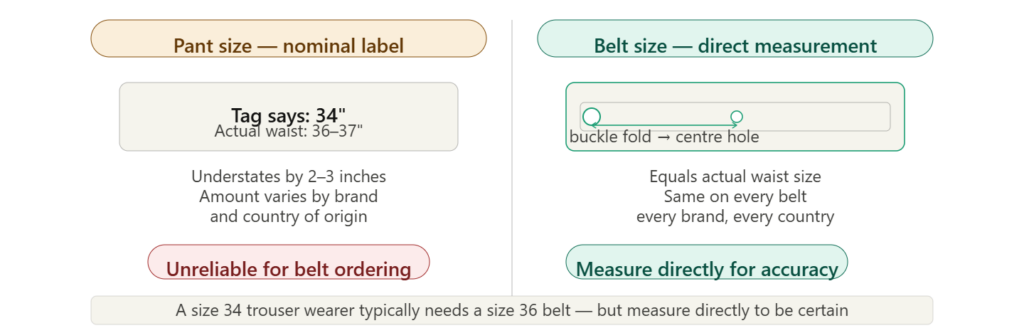
Trouser size — the number on the label — is a nominal size, not a direct body measurement. It is a manufacturer’s designation that approximates the waist measurement of the intended wearer, but it does not represent the actual waist circumference of the person wearing those trousers.
Most trouser manufacturers use vanity sizing — where the labelled size runs smaller than the actual garment measurement to make buyers feel comfortable with the number. A size 34 trouser typically has an actual waist measurement of 36–37 inches when laid flat. A size 32 often measures 34–35 inches.
This means two things: first, the trouser tag understates the actual waist measurement by 2–3 inches. Second, the amount of understatement varies by brand, country, and trouser style — a size 34 from one brand may measure differently from a size 34 from another.
The practical result: trouser size is an unreliable starting point for finding belt size.
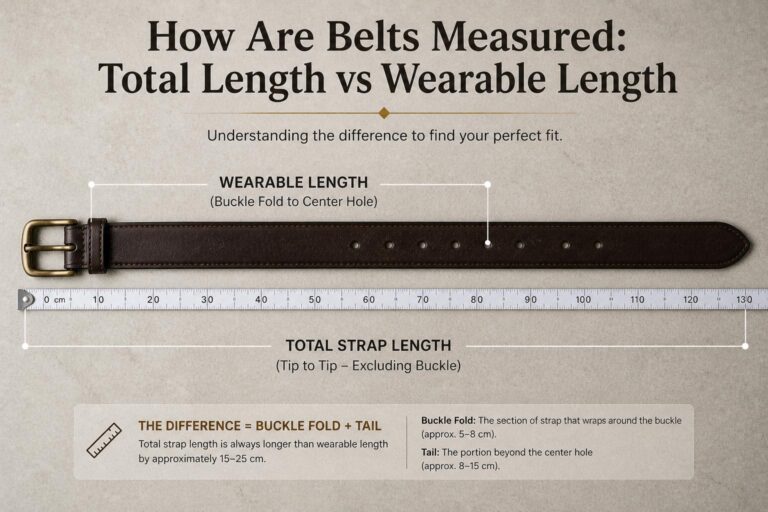
Belt size is a direct physical measurement. It is the distance from the buckle fold — the point where the leather wraps around the buckle frame — to the centre hole of the belt.
This is the measurement that determines where the belt fastens on the body. It represents the actual waist circumference at the position where the belt is worn, not a nominal size.
A belt listed as size 36 should measure 36 inches from the buckle fold to the centre hole. This is the hole where the belt is designed to fasten — with adjustment holes on either side providing a range of approximately 2 inches above and below.
Belt size is therefore a measurement of the wearer’s actual waist, not a nominal label. A buyer whose waist measures 36 inches at the belt loop position needs a size 36 belt — not a size 34 belt because their trouser tag says 34.
The common advice — “add two inches to your pant size to get your belt size” — is an attempt to correct for vanity sizing. If most size 34 trousers have an actual waist of 36 inches, then a person wearing size 34 trousers likely needs a size 36 belt.
This conversion works as an estimate when:
It breaks down when:
The two-inch rule is a reasonable estimate for a buyer who has no measuring tape and needs a quick approximation. It is not a reliable method for anyone who wants a belt that fits correctly from the first wear.
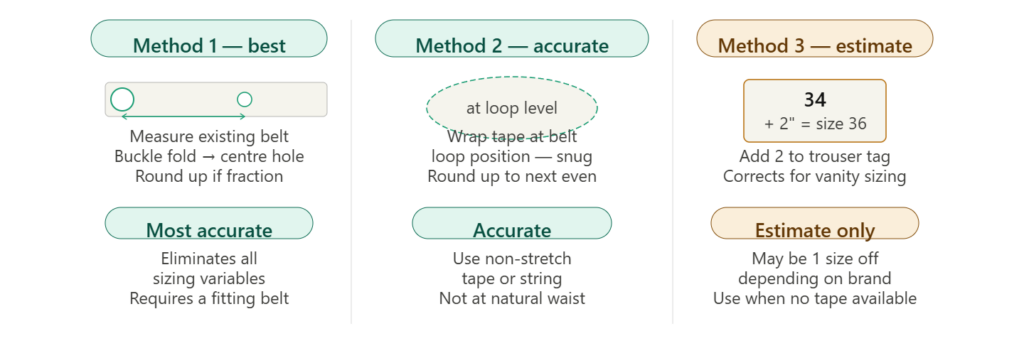
If you own a belt that fits correctly:
Lay the belt flat. Measure from the buckle fold — the inner crease where the strap wraps around the buckle frame — to the hole you use most. Do not measure from the strap tip. Do not include the buckle itself. The buckle fold to the centre hole is the measurement.
That number is your belt size. If it lands on a fraction, round up to the nearest whole inch or even centimetre.
This method eliminates all variables — trouser sizing, body position, tape measure placement. If the reference belt fits, the measurement is accurate.
If you don’t own a belt that fits, or your current belt fits poorly:
Use a non-stretch tape measure or a length of non-elastic string. Wrap it around your body at the position where you wear your belt — at the trouser waistband, threading through where your belt loops sit. This is typically 1–3 inches below the natural waist.
Keep the tape snug but not compressed — the tension of a correctly worn belt, not tight enough to indent the skin.
Note the measurement. That number is your waist measurement at belt position. Your belt size is this number rounded up to the nearest even inch — a 35.5 inch waist becomes a size 36 belt.
Add two inches to your trouser label size. A size 34 trouser suggests a size 36 belt.
Use this only when the other two methods are unavailable. Accept that the result may be one size off in either direction depending on how your trouser brand handles sizing.
Standard belt sizing — waist measurement to belt size — applies to pin-buckle belts where the belt fastens at a specific hole. For ratchet belts, the sizing logic is different.
A ratchet belt is trim-to-fit. The strap is supplied longer than needed and trimmed to your exact waist length before first wear. The ratchet mechanism then handles fine adjustment in 0.5cm increments above and below your trim point.
For a ratchet belt, you order by total strap length rather than waist size. The correct strap length is your waist measurement plus 15–20cm — enough to account for the buckle attachment depth, the belt loop span, and the tail that passes through the first keeper loop.
Ratchet belt sizing rule: Measure waist at belt loop position → add 15–20cm → order this strap length or the next size up.
A buyer with a 90cm waist needs a strap of approximately 105–110cm. A buyer with a 100cm waist needs approximately 115–120cm.
When in doubt with a ratchet belt, order longer. The strap can be trimmed at home; it cannot be extended.
For the full trim process, see our [how to trim a ratchet belt guide →]
Belt sizing is stated in both inches and centimetres depending on the market. The conversion is direct: 1 inch = 2.54cm.
A size 36 belt = 91cm. A size 38 = 97cm. A size 34 = 86cm.
When ordering from a brand that uses centimetre sizing, measure your waist in centimetres rather than converting from an inch trouser size — the direct measurement eliminates the conversion error.
Most international belt sizing uses centimetres. Most US trouser sizing uses inches. If you are ordering a European or Asian belt using a US trouser size as a starting point, measure directly rather than using the trouser tag conversion.
Belt too short: Can only fasten at the last hole, or cannot fasten at all. Maximum stress on the leather at the final hole accelerates hole deformation. The belt fails faster than a correctly sized one.
Belt too long: Fastens at the first hole, leaving excessive tail. Aesthetically poor and can interfere with clothing when the tail is too long to route through the keeper loop.
Pin-buckle belt at wrong size: No adjustment possible beyond the fixed holes. A belt one size too small cannot be extended. A belt one size too large may have no hole close enough to the correct tension.
Ratchet belt ordered too short: The track range does not cover the correct tension point. The belt either cannot fasten or cannot loosen to a comfortable position. Ratchet belts cannot be extended after trimming — ordering longer is always the correct approach when uncertain.
| Situation | Method | Rule |
|---|---|---|
| Own a belt that fits | Measure buckle fold to centre hole | That number = your belt size |
| No reference belt | Measure waist at loop position | Round up to next even number |
| Only have trouser tag | Add 2 inches | Estimate only — may be 1 size off |
| Ordering a ratchet belt | Measure waist at loop position | Add 15–20cm for strap length |
| International sizing (cm) | Measure in cm directly | Don’t convert from inch trouser size |
No. Pant size is a nominal label that understates actual waist measurement by 2–3 inches due to vanity sizing. Belt size is a direct physical measurement — the distance from the buckle fold to the centre hole — that corresponds to actual waist circumference. A person wearing size 34 trousers typically needs a size 36 belt.
Trouser sizes use vanity sizing — brands deliberately label trousers smaller than their actual measurements. Belt sizes use direct measurement. The gap between the two is typically 1–2 inches but varies by brand, country, and trouser style. Measuring directly is more reliable than using the trouser tag as a reference.
Wrap a non-stretch tape measure around your body at the position where you wear your belt — through the trouser belt loops, not at the natural waist. Keep it snug. Read the measurement and round up to the nearest even inch or centimetre. That is your belt size.
Typically size 36, because most size 34 trousers have an actual waist measurement of 36–37 inches. However this depends on the brand. For a precise fit, measure an existing belt from buckle fold to centre hole, or measure your waist directly at belt loop position.
Always order the larger size. A belt one size larger fastens at a slightly lower hole than centre — still functional and comfortable. A belt one size smaller either won’t fasten or fastens only at the last hole, placing maximum stress on the leather at that point. For ratchet belts, order larger and trim to your exact length.
Women’s belt sizing follows the same principle — belt size corresponds to waist measurement — but women’s trouser sizing conventions vary more than men’s and are even less reliable as a belt size reference. Measure directly rather than using the trouser tag.
Belt size in centimetres is a direct waist measurement, the same as inches but in metric units. Measure your waist at belt loop position in centimetres and order that size. Don’t convert from an inch trouser size — measure directly in the unit the belt is sized in.
HoldForm belts are available in standard sizes (pin-buckle) and trim-to-fit lengths (ratchet). Measure before ordering — the sizing guide covers both systems.
[How to measure belt size correctly — the three methods →] [How to trim a ratchet belt to your exact size →] [Big and tall belt guide: sizing for larger waist sizes →] [What is a ratchet belt — how it works and who it suits →]


Practical belt guides, sizing tips, and exclusive offers — straight to your inbox.


Leave a comment