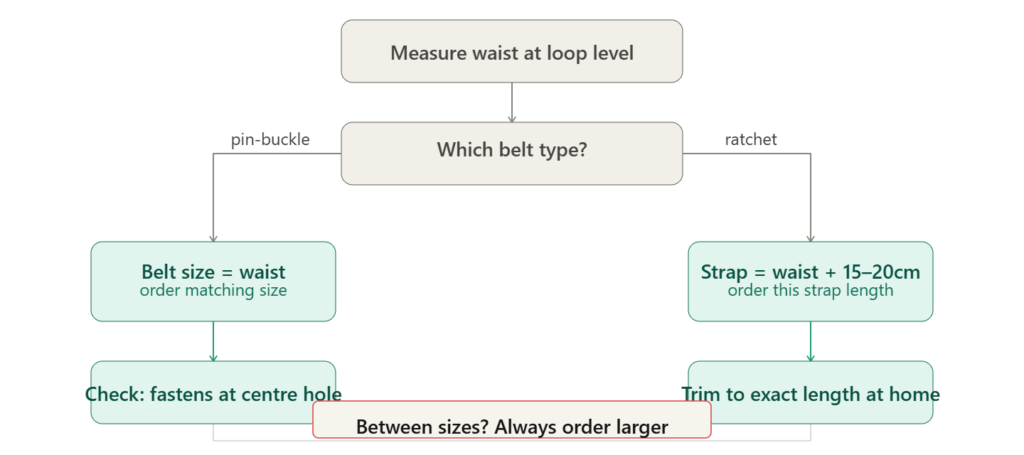
Choosing the correct belt size is a two-step process: measure your waist at the position where the belt will be worn, then match that measurement to the correct belt size or strap length depending on whether you are buying a pin-buckle or ratchet belt. The two systems use different sizing logic and require different approaches.
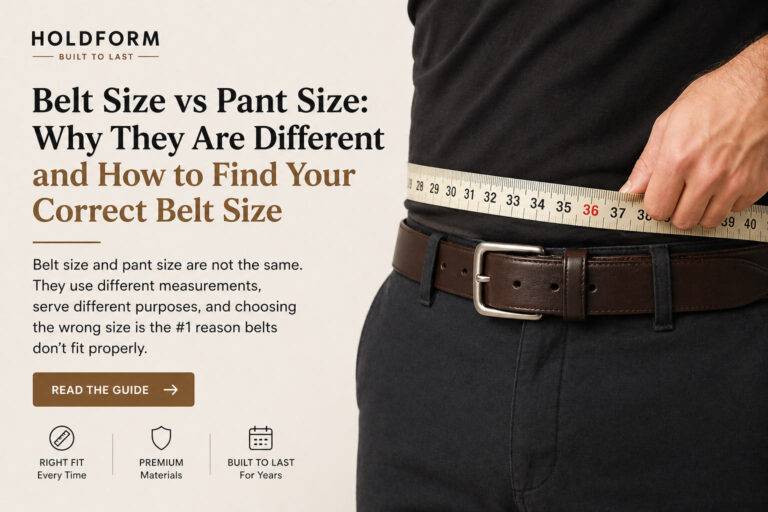
The waist measurement that determines belt size is not the same as the measurement used for trouser sizing. Trouser size uses vanity sizing — the label understates actual waist circumference by 2–3 inches. Belt size is a direct physical measurement.
Measure at the position where you wear your belt — at the trouser waistband level, threading through where the belt loops sit. This is typically 1–3 inches below the natural waist. Use a non-stretch tape measure or a length of non-elastic string.
Wrap the tape snugly around your body at this position — the tension of a correctly worn belt, not pulled tight enough to compress the skin. Note the measurement in centimetres or inches.
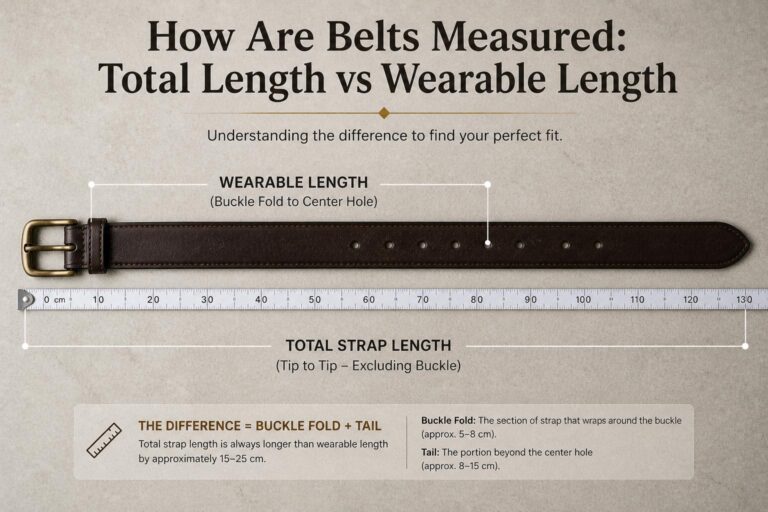
If you own a belt that fits correctly, you can skip the tape measure entirely. Lay it flat and measure from the buckle fold — the point where the leather wraps around the buckle frame — to the hole you use most. That measurement is your belt size.
Pin-buckle belts are sold in fixed sizes. The size corresponds to the distance from the buckle fold to the centre hole — the middle of the five or seven holes the belt comes with.
Your belt size should equal your measured waist size. A buyer whose waist measures 36 inches needs a size 36 belt. The centre hole will land at the correct tension, with adjustment holes on either side providing approximately 2 inches of range above and below.
If using your trouser tag as a starting point: Add 2 inches. A size 34 trouser suggests a size 36 belt. This corrects for vanity sizing but is less accurate than measuring directly.
If between sizes: Always order the larger size. A belt one size larger fastens at a lower hole than centre — still functional and comfortable. A belt one size smaller may not reach the correct tension, or fastens only at the last hole, placing maximum stress on the leather at that point.
Ratchet belts are sized by total strap length, not waist size. The strap is supplied longer than needed and trimmed at home to the buyer’s exact waist length. The ratchet mechanism then handles fine adjustment in 0.5cm increments above and below the trim point.
The calculation: Measured waist + 15–20cm = required strap length. A buyer with a 90cm waist needs a strap of 105–110cm. A buyer with a 100cm waist needs 115–120cm.
The 15–20cm addition accounts for the buckle attachment depth, the span of belt loops around the waistline, and the tail that passes through the first keeper loop after the buckle. At larger waist sizes, use the full 20cm addition — the loops are spaced further apart and require more tail length.
If between strap lengths: Always order longer. The strap is trimmed at home and cannot be extended. Ordering a strap that is 5–10cm longer than calculated is correct — the excess is removed at the trim point.
For the full trim process, see our [how to trim a ratchet belt guide →]
After length, width is the second variable to check. Most buyers focus on length and assume width is standard — it isn’t, and a belt that doesn’t fit your trouser loops creates problems regardless of whether the length is correct.
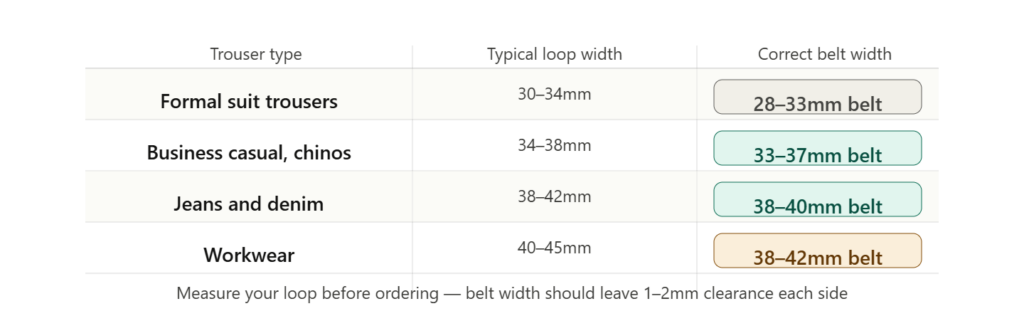
Measure your trouser belt loop at its narrowest point before ordering. The belt should fit through with 1–2mm clearance on each side.
Common widths by trouser type:
| Trouser type | Loop width | Correct belt width |
|---|---|---|
| Formal suit trousers | 30–34mm | 28–33mm |
| Business casual and chinos | 34–38mm | 33–37mm |
| Jeans and denim | 38–42mm | 38–40mm |
| Workwear | 40–45mm | 38–42mm |
A belt significantly narrower than the loop width has lateral play — it migrates during movement and the buckle shifts off-centre throughout the day. A belt wider than the loop cannot be worn at all, or forces the loop outward, creating visible tension at the waistband attachment points.
For buyers who have never owned a ratchet belt, the choice between ordering a fixed size (pin-buckle) and ordering a strap to trim (ratchet) introduces a question: which system is easier to size correctly?
Fixed size is simpler in the ordering process. You measure, you order the corresponding size, it arrives ready to wear. The limitation is that you are constrained to the five holes the belt comes with — if your correct tension falls between holes, there is no adjustment available.
Trim-to-fit requires one additional step — trimming the strap before first wear — but the result is a belt that fits exactly at your measured length rather than approximately at the nearest hole. Once trimmed, the ratchet mechanism handles all subsequent adjustment. The process takes under two minutes.
For buyers who have previously found that belt holes never land quite right, or whose waist varies enough through the day that fixed holes don’t adequately accommodate the variation, the trim-to-fit approach resolves both problems permanently.
Using the trouser tag directly. A size 34 trouser does not take a size 34 belt. Trouser size understates actual waist measurement by 2–3 inches due to vanity sizing. The correct conversion is trouser size plus 2 inches, or measure directly.
Measuring at the natural waist instead of the belt position. The natural waist — the narrowest point of the torso — is typically 1–3 inches above where belts are worn. Measuring at the natural waist produces a smaller number than the actual belt position measurement and results in a belt that is too small.
Ordering the strap length equal to waist measurement for a ratchet belt. A ratchet strap ordered at waist measurement will be too short — there is insufficient length for the buckle attachment and tail. Add 15–20cm.
Ordering a short strap to save trimming. For ratchet belts, always order longer than needed. The strap cannot be extended after trimming. A strap with excess length trims to perfect fit; a strap that is too short is unusable.
Not measuring the loop width. Belt width is often overlooked because most buyers assume “standard” width fits standard loops. It doesn’t — formal trousers and jeans have different loop widths, and the wrong width belt visibly misfits both.
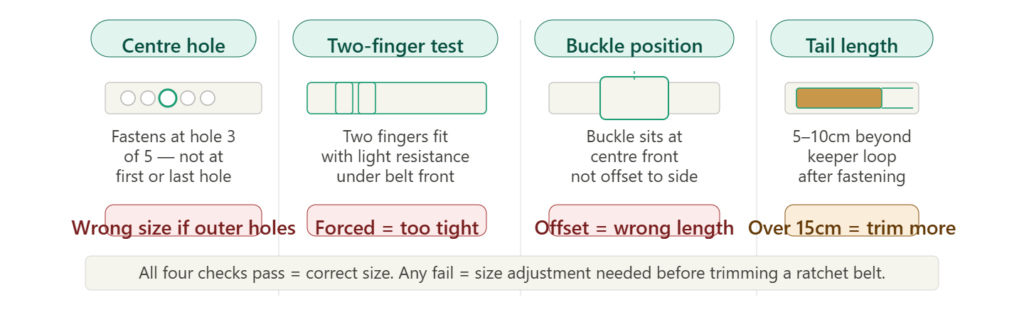
Once the belt arrives, verify the fit before committing to a trim (for ratchet belts) or before discarding the packaging (for pin-buckle belts).
Pin-buckle belt: The belt should fasten at the middle hole — the third hole on a five-hole belt, the fourth on a seven-hole belt. If it fastens at the outermost hole in either direction, the belt is the wrong size.
Two-finger test: With the belt fastened at the correct position, slide two fingers horizontally under the belt front. They should fit with light resistance — not forced, not loose. If two fingers cannot fit, the belt is too tight. If four fingers fit easily, it is too loose.
Buckle position: The buckle should sit at the centre front of the waistband, not offset to either side. An off-centre buckle indicates the belt is slightly the wrong length for the waist or was trimmed from the wrong end.
Tail length: After the belt is fastened and the tail passes through the first keeper loop, approximately 5–10cm of tail should extend beyond the keeper. More than 15cm indicates the belt is too long. Less than 3cm functional tail indicates it is slightly short.
For ratchet belts: Fasten at your normal tension and check that 2–3 clicks of adjustment are available in both directions — tighter and looser. If you are at the end of the track in either direction, the trim point needs adjustment.
Larger waist sizes (above 100cm): Standard sizing logic applies but the strap length addition increases. Add 20cm rather than 15cm to the waist measurement when ordering a ratchet belt. For pin-buckle belts, verify the brand offers adequate size range — many stop at 110–120cm. For a full sizing guide covering larger waist measurements, see our [big and tall belt guide →]
Athletic builds with significant waist-to-hip difference: For buyers whose waist is significantly narrower than their hips, the belt position measurement (at loop level, over the hips) may be larger than expected relative to the natural waist. Always measure at the actual belt position rather than estimating from the trouser tag.
Post-weight-change sizing: If your weight has changed recently, measure directly rather than ordering from memory of your previous size. For ratchet belts, the 0.5cm increment adjustment provides more tolerance for gradual size change than fixed-hole belts — but a significant size change (more than 5–7cm) may require re-trimming the strap.
| Situation | Method | Rule |
|---|---|---|
| Pin-buckle belt | Measure waist at loops | Order belt size = waist measurement |
| Pin-buckle, using trouser tag | Tag + 2 inches | Estimate only |
| Ratchet belt | Measure waist at loops | Waist measurement + 15–20cm = strap length |
| Between sizes — any belt | Order larger | A long belt trims; short cannot extend |
| Not sure of loop width | Measure loop before ordering | Belt width = loop width minus 1–2mm |
| Existing belt fits correctly | Measure buckle fold to centre hole | That = your belt size |
Measure your waist at belt loop level with a non-stretch tape measure. For a pin-buckle belt, order the belt size that matches your measurement. For a ratchet belt, add 15–20cm to your measurement and order that strap length. If between sizes, always order the larger option.
No. Trouser size understates actual waist measurement by 2–3 inches due to vanity sizing. A size 34 trouser typically has an actual waist of 36–37 inches. A person wearing size 34 trousers usually needs a size 36 belt. Measure directly for accuracy rather than relying on the trouser tag.
Order the larger size. A belt one size larger than your measurement fastens at a slightly lower hole than centre — still fully functional. A belt one size smaller may not fasten at the correct tension, or fastens at the last hole, which places maximum stress on the leather at that point. For ratchet belts, order larger and trim to your exact length.
Measure your waist at belt loop level. Add 15–20cm to that measurement. Order the ratchet strap length that matches or exceeds this figure. After receiving, detach the buckle, trim the strap from the buckle end to your measured waist length, and reattach. The ratchet mechanism handles all adjustment from that point in 0.5cm increments.
A 34-inch waist (measured directly at belt loop level) takes a size 34 belt. If your trouser tag says 34 but you haven’t measured, your actual waist is likely 36–37 inches — order a size 36 or 38 belt. When in doubt, measure directly.
Width is a separate variable from length but equally important for fit. Measure your trouser loop width before ordering. The belt should fit through the loop with 1–2mm clearance. Formal suit trousers take 28–33mm belts; jeans take 38–40mm. The wrong width belt either can’t be worn (too wide) or migrates during movement (too narrow).
HoldForm belts list strap width and available lengths on every product page. Ratchet belts are supplied as trim-to-fit with instructions included.
[How to measure belt size: the three methods →] [Belt size vs pant size: why they differ →] [How to trim a ratchet belt to your exact size →] [Big and tall belt guide: sizing for larger waist sizes →]

Practical belt guides, sizing tips, and exclusive offers — straight to your inbox.


Leave a comment