The choice between a ratchet belt and a traditional pin buckle belt gets framed as a preference question. It isn’t — or at least, preference isn’t where the decision should start.
Both systems are mechanisms. They hold a belt closed through different approaches, distribute load differently, fail at different points, and suit different use cases for structural reasons. Once you understand how each works, the choice for your situation usually becomes obvious.
This covers both systems mechanically: how each works, where each performs well, where each fails, and what that means in practice.
For the no-hole option, see our ratchet belt range.
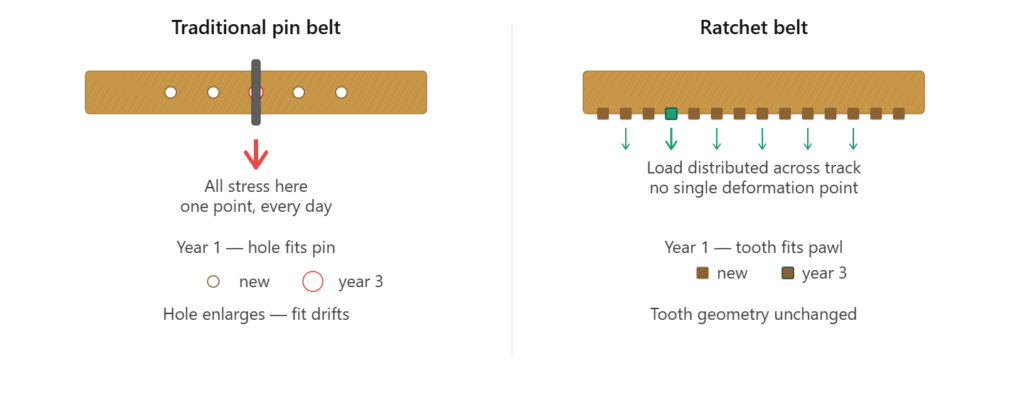
A traditional belt has three functional components: the frame, the bar the leather loops around, and the pin that passes through a hole in the leather and seats against the frame to hold it closed.
The leather strap has a series of holes punched at 2.5cm intervals. When you fasten the belt, you choose the hole that corresponds to your waist size, insert the pin, and the belt is held at that fixed position.
Where the load goes: All tension is concentrated at the hole in use. The leather fibres around that hole bear the compressive load of the pin against them, and the strap bears the full tension of whatever the belt is holding. Every time the pin seats, it compresses the leather fibres slightly at that hole. Over months of daily wear, those fibres spread outward — the hole enlarges gradually and the pin no longer holds the belt at the same position it did when the belt was new.
Adjustment range: Fixed. You can move one hole tighter or looser, which changes fit by 2.5cm in either direction. If your correct size falls between two holes, you wear the belt either slightly too tight or slightly too loose. There is no middle option.
The mechanism’s advantage: Almost no moving parts. A well-made pin buckle in solid brass or steel is essentially indestructible at the mechanism level. There is no spring to fatigue, no track to delaminate, no pawl to misalign. The leather fails before the buckle does in most cases.
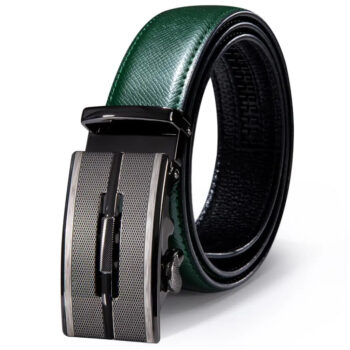
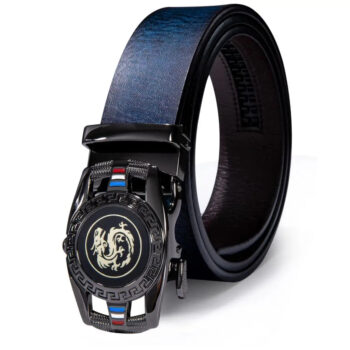
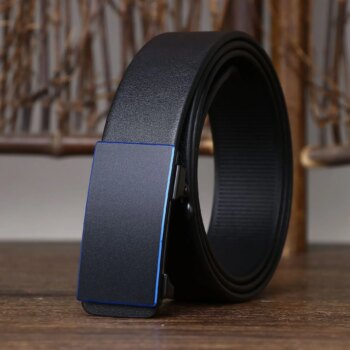
A ratchet belt replaces the hole-and-pin system with a track-and-pawl mechanism. The leather strap has a series of teeth cut into its inner face, typically at 0.5cm intervals. Inside the buckle housing, a spring-loaded pawl engages the teeth — camming forward over each tooth as the belt tightens, and locking against the vertical tooth face when under backward tension.
To release, a lever on the buckle face lifts the pawl clear of the track, allowing the strap to slide freely.
Where the load goes: Instead of concentrating stress at one hole, the ratchet mechanism distributes engagement load across the tooth the pawl is seated in. More importantly, the leather around the tooth doesn’t deform to accommodate the mechanism — the tooth geometry is fixed, and the leather maintains its structure at the adjustment point. The failure mode that causes hole stretch on traditional belts doesn’t exist on a ratchet belt.
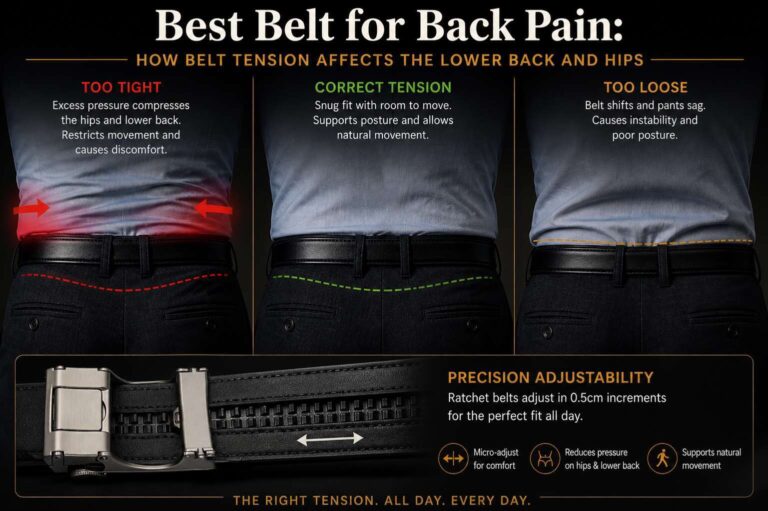
Adjustment range: Continuous within the track length, in 0.5cm increments. The correct fit is always achievable because there’s no gap between fixed positions. A ratchet belt can also be loosened or tightened slightly during the day — discreetly, with one hand — without removing the belt.
The mechanism’s limitation: More components means more failure points. The spring can fatigue, the track can delaminate if it’s a bonded insert rather than integrated leather, and the buckle housing can flex under load if it’s thin-gauge zinc alloy — causing the pawl to misalign with the track. These failures are quality-dependent. A well-made ratchet mechanism outlasts the leather strap. A poorly made one fails within a year.
For a full breakdown of ratchet mechanism failure modes and what to look for in construction quality, see our [guide to how ratchet belt mechanisms work →]
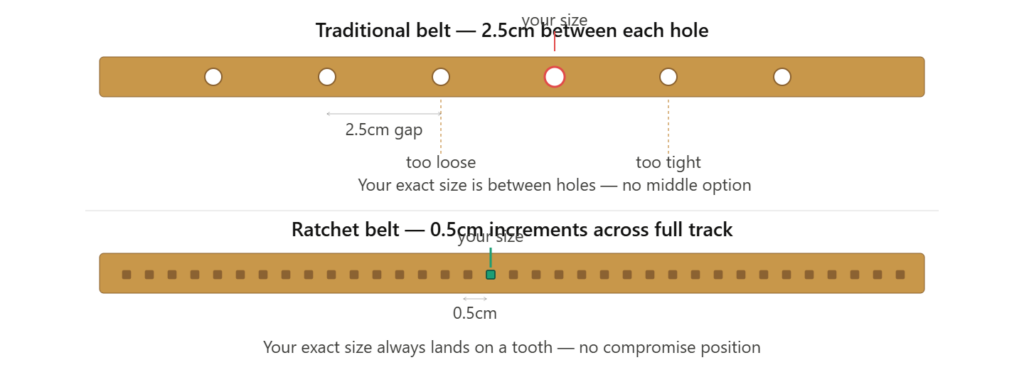
Traditional: 2.5cm increments between holes. If your correct waist size falls at 91cm and the nearest holes are at 89.5cm and 92cm, you wear it too tight or too loose.
Ratchet: 0.5cm increments across the full track. You can land at exactly 91cm. During a long day — after a large meal, with a heavy carry load, sitting for extended periods — you can adjust by a single increment without unfastening the belt.
For most casual and dress use, 2.5cm precision is adequate. For carry use where consistent belt tension affects holster position, 0.5cm precision is a functional advantage, not a cosmetic one.
Traditional: The wear hole develops permanent deformation. On quality full-grain leather at 4mm or above, this takes 2–4 years of daily use before it becomes a functional problem. On thinner or lower-grade leather, 6–12 months. The hole you use most will eventually be the hole that fails.
Ratchet: No single stress point on the leather. The track teeth are a fixed geometry — they don’t deform under normal use. Belt wear on a ratchet strap comes from flexing at the buckle fold and from overall leather aging, not from mechanism stress at a fixed point.
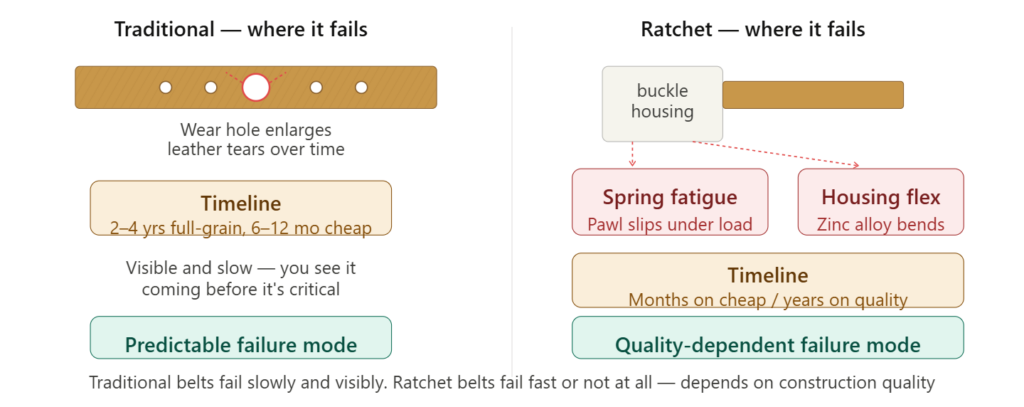
Traditional pin buckle in solid brass or steel: Extremely high. The mechanism has one moving part — the pin hinge. There is almost nothing to fail at the buckle level.
Ratchet mechanism: High when well-made, variable when not. Spring fatigue, track delamination, and housing flex are all real failure modes that separate quality ratchet belts from cheap ones. The mechanism specification matters more for ratchet belts than for pin buckle belts.
Traditional: Fit drifts as the wear hole enlarges. The belt that fits perfectly in year one fits slightly differently in year three at the same hole.
Ratchet: Fit doesn’t drift at the mechanism level. You trim the strap once to your correct length, and the mechanism handles fine adjustment from that baseline indefinitely — until the mechanism itself fails or the leather wears.
Both systems hold a belt adequately under normal dress and casual use. Under sustained carry load — a holster with a firearm, heavy EDC tools, sustained lateral pull — the differences become structural.
A traditional belt under sustained load concentrates stress at the pin hole. The hole enlarges faster under carry load than under dress use. A ratchet belt under the same load distributes engagement across the tooth face, which holds the position more consistently.
For carry use specifically, leather thickness and belt construction matter more than mechanism type — but when both are equal, the ratchet mechanism maintains consistent tension better under sustained dynamic load.
For a full technical breakdown of how load affects belt performance by thickness, see our [4mm vs 5mm belt thickness guide →]
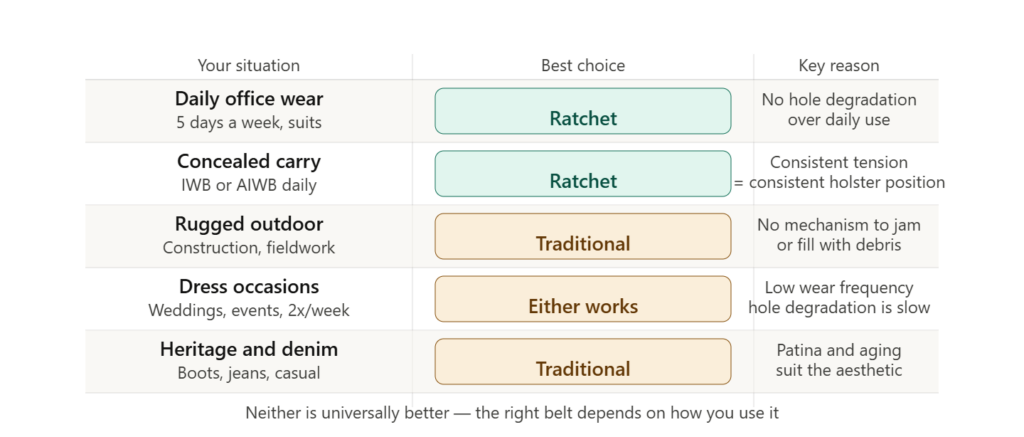
Intermittent wear: A belt worn 2–3 times per week for dress occasions doesn’t accumulate enough daily stress for the hole stretch problem to matter meaningfully. A quality pin buckle belt on full-grain leather at that frequency will last years without the wear hole becoming a functional issue.
Rugged and outdoor use: In environments where the belt takes physical abuse — construction, fieldwork, heavy outdoor use — the simplicity of a pin buckle is a genuine advantage. No spring to fatigue, no track to fill with debris, no mechanism to jam. A solid leather strap with a brass pin buckle is the most damage-resistant configuration for hard use.
Heritage and casual aesthetic: A pin buckle on full-grain leather develops patina differently from a ratchet belt. The visible holes, the aged pin, the worn keeper loop — these are authentic wear characteristics that improve the appearance of a well-made traditional belt over time. For heritage, denim, boot, or workwear styling, a pin buckle belt is the contextually appropriate choice.
Mechanism simplicity preference: If you prefer equipment with no mechanisms to fail, the traditional belt is the honest choice. Its limitations are real and predictable. Its failure mode — hole stretch — is slow and visible before it becomes critical.
Daily office and business wear: For a belt worn five days a week under dress and business casual use, the ratchet mechanism’s load distribution advantage compounds over time. The belt maintains its fit for longer because no single point on the leather is degrading from repeated pin stress.
Concealed carry and EDC: Consistent belt tension affects holster position and draw consistency. A ratchet mechanism holds the belt at the same tension point every day without the creeping inconsistency of an enlarging wear hole. For serious carry use, this matters.
Waist fluctuation: If your waist size changes across the day — after meals, after sitting for long periods, during fitness cycles — ratchet adjustment handles this without requiring a different hole. The 0.5cm increment means you can adjust to the right tension for any situation without committing to a position 2.5cm away from where you need to be.
Trim-to-fit precision: A ratchet belt cut to your exact waist length fastens at exactly the right position every time. A traditional belt fastens at whichever hole is closest to your size. For buyers who want precise fit rather than approximate fit, ratchet is structurally the more capable system.
Leather thickness: 4mm minimum for daily wear. Below 4mm the wear hole degrades faster under daily pin stress. Full-grain construction gives you the tightest fibre density at the hole edges.
Pin material: Solid brass or steel. Zinc alloy pins bend under sustained load, particularly on wider belts carrying weight.
Frame gauge: The bar the leather loops around should be heavy gauge. On thin-gauge frames, the bar bends under belt tension over time, creating uneven load distribution across the leather fold.
Track construction: Integrated into the leather is better than a bonded insert. Integrated tracks don’t delaminate. Bonded inserts eventually do.
Leather thickness: 4mm minimum for adequate tooth depth. At less than 4mm, the teeth are too shallow to resist stripping under sustained load.
Housing material: Brass or steel. Zinc alloy housings flex under belt tension, misaligning the pawl with the track and causing the mechanism to slip over time.
Spring specification: Rarely listed, but quality is detectable by feel. A well-made ratchet mechanism clicks with even, crisp resistance across every tooth. Variable resistance or a soft, vague click indicates a weak spring or inconsistent tooth geometry.
For a full construction evaluation guide for both types, see our [belt construction overview →]
For daily wear involving long periods of sitting, yes — the ability to adjust by 0.5cm increments means you can release tension after a meal or tighten slightly for a meeting without the commitment of moving a full hole. Whether that matters depends on how much your comfort is affected by fixed 2.5cm increments. For most dress and casual wear, traditional belts are adequately comfortable.
Not inherently. A slim ratchet belt with a low-profile brass buckle at 32–34mm width is appropriate for business and formal wear. The mechanism is hidden — the visible profile is the buckle face and the strap, which are indistinguishable from a traditional belt at a glance. The hidden-tail design on quality ratchet belts eliminates the tail entirely, producing a cleaner silhouette than a traditional belt with a keeper loop.
For dress, business, and carry use — yes. For heritage, denim, and hard-use outdoor contexts — a traditional belt is a better fit for the application. Many buyers own both: a ratchet belt for office and carry use, a traditional full-grain belt for casual and outdoor contexts.
At equivalent construction quality, a well-made ratchet mechanism outlasts the leather strap it’s mounted on. The limiting factor is the leather, not the mechanism. A poorly made ratchet mechanism — weak spring, bonded track insert, zinc alloy housing — can fail within a year of daily use. The quality range in ratchet belts is wider than in traditional belts, which means construction specification matters more when buying a ratchet belt.
Order at least one size larger than your measured waist size — ideally two. The strap is trimmed from the buckle end to your exact length before first wear. For a full sizing and trimming guide, see our [belt sizing guide →]
No. Feed the strap through the buckle until it clicks to the right tension. Press the release lever to loosen or remove. The mechanism is simpler to operate than a pin buckle for most people after the first use — one-handed release is faster than threading a pin through a hole.
HoldForm manufactures both ratchet and pin buckle belts to declared construction specifications. Leather grade, thickness, track construction, and housing material are listed on every product page.
[View ratchet belt range →] [View classic leather belt range →] [How ratchet belt mechanisms work — full technical guide →] [Belt sizing guide →]

[…] → Ratchet Belt vs Traditional Belt Guide […]
Practical belt guides, sizing tips, and exclusive offers — straight to your inbox.