Travel places a specific set of stresses on a belt that daily wear at home doesn’t. The fit problem is different — waist circumference changes more over a travel day than over a desk-based workday, and the consequences of a badly fitting belt at hour six of a long-haul flight are worse. The construction demands are different — packing and unpacking, temperature changes between climates, and the wear pattern of moving through multiple outfit contexts in a single trip accelerate the failure modes that ordinary daily wear produces slowly. And the versatility requirement is different — at home you can grab a different belt. On a trip with limited luggage, you can’t.
Understanding what travel specifically demands makes the choice straightforward.
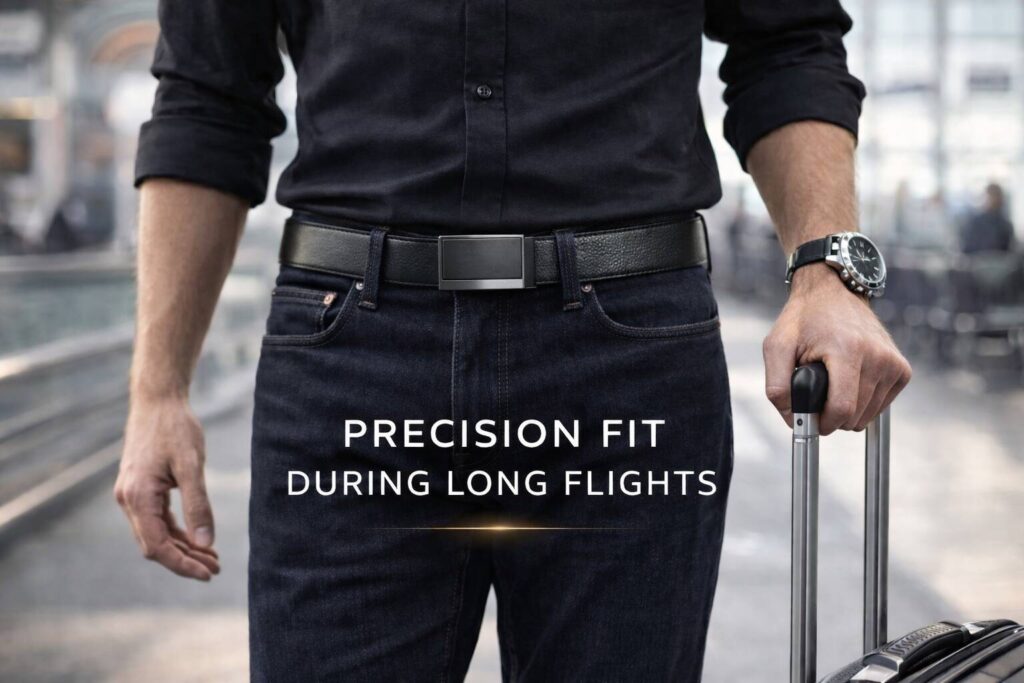
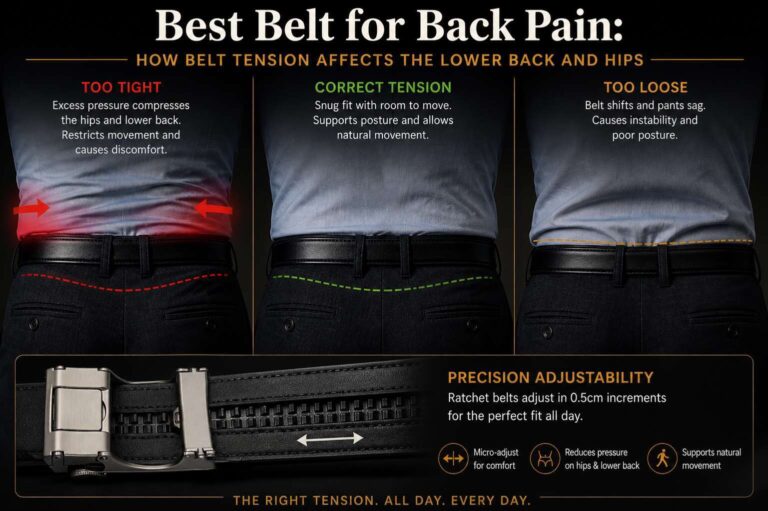
Fit changes through the day. A long-haul flight involves hours of sustained seated wear, meals, and the mild bloating that pressurised cabin air produces in most people. The waist measurement difference between early morning departure and late evening arrival can be 2–4cm. A belt set at the correct fixed hole at the start of the day is either uncomfortably tight or noticeably loose by the end. On a standard pin-buckle belt with holes every 25mm, there is no in-between.
Packing stress. A belt folded or coiled in luggage is under sustained compression and bending stress that it doesn’t experience hanging on a hook at home. Bonded leather — the compressed fibre composite used in many fashion belts — delaminates under this compression over time. The layers separate at the buckle fold first, which is both the tightest flex point and the point under most stress during buckle removal at security. Full-grain leather at adequate thickness compresses and rebounds without permanent deformation.
Temperature and humidity variation. Moving between air-conditioned environments, outdoor heat, and different climates within a single trip cycles leather through conditions that promote surface cracking if the leather is dry or surface marking if it’s wet. Well-conditioned full-grain leather handles this. Corrected-grain and bonded leather doesn’t.
Mechanism wear from repeated removal. Airport security requires belt removal multiple times on a typical business trip. A pin buckle removed and replaced repeatedly produces wear at the prong tip and at the hole edges. Over enough cycles, the wear hole enlarges and the fit drifts. A ratchet or friction-lock mechanism removed and replaced doesn’t have a single stress point — each removal and replacement distributes the same mechanical action across the full mechanism rather than concentrating it.
The fit system is the most important variable for travel, specifically because of the waist variation problem.
A ratchet belt with 0.5cm adjustment increments allows you to set belt tension at the correct point for your current state — seated on a long flight, standing at the hotel, dressed for a meeting. You are not choosing between the nearest hole that’s too tight and the nearest hole that’s too loose. You are setting the correct tension for the moment, in increments precise enough that the difference between one setting and the next is barely perceptible.
This matters most on the longest days. A 14-hour flight followed by a client dinner followed by a morning meeting the next day covers enough physiological variation that a fixed-hole belt is genuinely inadequate for all of it. A ratchet belt is set correctly for each context in under five seconds.
The ratchet mechanism also has a practical advantage at airport security. The mechanism releases with a single press or slide — faster than threading a prong out of a hole, and without the fumbling that happens when a tight pin buckle is removed in a hurry at a security tray. For frequent travellers who remove and replace their belt multiple times per week, this accumulates into a meaningful time and frustration saving.
What about hidden-tail belts for travel?
Hidden-tail construction is the right choice for travel if the primary context is business and formal — suits, tucked shirts, smart casual. The mechanism provides a wider adjustment range than fixed holes and produces a cleaner front silhouette under a blazer. For trips that are predominantly casual or involve significant outfit variation including denim, the ratchet mechanism handles the range better. For trips that are predominantly business formal, hidden-tail is the superior choice.
Classic pin-buckle for travel:
A well-made full-grain pin-buckle belt is adequate for travel if the trip is short, the outfit context is consistent, and the wearer knows their fixed hole fits correctly for travel conditions. The limitation is the fit precision problem — if long flights are involved, or if the trip spans both formal and casual outfits requiring different belt tensions, the fixed hole is a constraint. For rugged travel where simplicity and mechanical reliability under harsh conditions matters more than fit precision, a classic pin buckle has a strong case.

“Airport friendly belt” is a real consideration but most belt content doesn’t explain the specific variables. Here’s what actually determines how a belt performs at airport security.
Metal content and detector sensitivity. Modern airport metal detectors are calibrated to detect ferrous and non-ferrous metals above a threshold. A solid brass buckle will trigger most detectors at standard sensitivity. A steel buckle will trigger them. An aluminium or titanium buckle may or may not depending on size and detector sensitivity. The practical answer for frequent travellers is that any substantial metal buckle will require belt removal at a standard security checkpoint — the question is how easy and fast that removal is, not whether it happens.
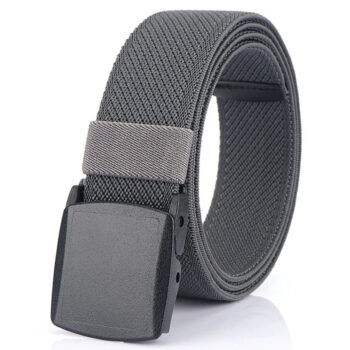
If belt removal at security is the priority — for buyers who pass through checkpoints multiple times per week, or those with metal sensitivity — the Travel-Lite belt uses an engineering plastic buckle with zero metal content. It does not trigger standard airport metal detectors. It passes through security without removal.
Mechanism release speed. A ratchet mechanism with a single-press release is faster to remove than a pin buckle that requires threading the prong out of a tight hole. At a busy checkpoint where you’re removing a laptop, shoes, and a jacket simultaneously, the speed difference between a one-press release and a wrestled pin buckle is real. A friction-lock mechanism (as used in the G-Buckle design) releases with a single lever press — similarly fast.
The belt’s ability to go back on cleanly. After security, you’re putting your belt on in a corridor while collecting your bags, usually in a hurry. A ratchet belt goes back on by threading through loops and pressing the buckle closed — no alignment of prong with hole required. It’s faster and produces a correctly tensioned fit without adjustment. A pin buckle requires finding the right hole under pressure, which most people get wrong once per security pass and have to adjust after.
Pre-check and trusted traveller programmes. TSA Pre-check, Global Entry, and equivalent programmes in other countries allow belts to stay on in most cases. For frequent international travellers, the calculus changes — mechanism removal speed matters less if you rarely remove the belt. In this case, any well-made belt with a correct specification is adequate.
The construction requirements for a travel belt follow from the stresses outlined above.
Leather grade: Full-grain at 4–4.5mm. Full-grain resists the delamination that packing compression causes in bonded leather. At 4mm minimum, the strap has enough stiffness to hold its flat profile after being coiled in luggage — thinner leather takes a set and holds a curl that takes hours to relax. At 4.5mm you get carry-adequate stiffness without the weight of a 5mm carry belt, which is heavier than most travel contexts require.
Buckle construction: Solid brass, stainless steel, or PVD-coated alloy. Electroplated zinc buckles chip under the mechanical stress of repeated packing — the plating cracks at flex points and peels at pressure points. The distinction between a buckle that looks good after three years of travel and one that looks worn after six months is almost entirely about base metal and coating method.
Strap width at the buckle fold: The fold where the strap wraps around or enters the buckle frame is the highest-stress flex point on the belt. Reinforced stitching at this point — rather than adhesive alone — prevents the fold from delaminating under repeated packing cycles. Check that the strap-to-buckle attachment is stitched through, not just bonded.
Trim-to-fit sizing: A belt trimmed to the correct length before a trip removes the visual bulk of excess tail and the practical annoyance of a long strap end that requires routing through a keeper twice. Trim from the buckle end for friction-lock designs, or from the tail end for ratchet designs that have pre-set tail length — check the specific product’s trimming guidance before cutting.
The most common travel belt question is how to cover multiple outfit contexts — suits for client meetings, chinos and a dress shirt for casual business days, and jeans for evenings or weekend days — with one belt.
The answer is specific. A dark brown leather belt at 35mm with a brushed silver or matte buckle is the single most versatile travel belt specification available. Here is why each element matters:
Dark brown leather over black: Black leather matches only black shoes. Dark brown matches both dark brown shoes and, with less precision but adequately, black shoes in casual contexts. For travel where you’re carrying one pair of dress shoes and one casual pair, dark brown gives more outfit coverage than black. For trips where you know you’re wearing only black shoes throughout, black is the cleaner choice.
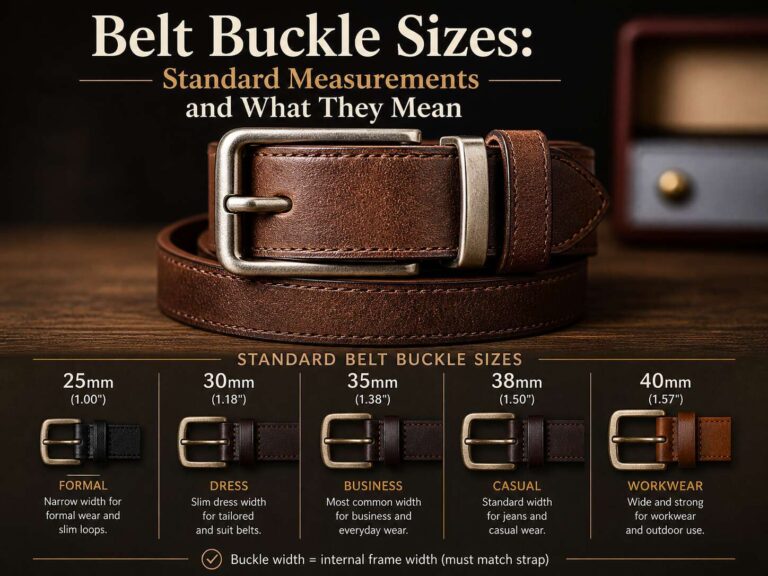
35mm width: At 35mm, the belt fits correctly in formal trouser loops (typically 33–38mm), sits well in chino loops, and works adequately in denim loops (typically 38–40mm, where 35mm has minor play but functions). It is the only single width that covers all three trouser types without looking significantly narrow in casual contexts or forcing its way through formal ones.
Brushed silver buckle: A brushed finish reflects less light than polished, which means it reads as appropriate in both formal and casual contexts. A polished silver buckle can look overdressed with jeans. A brushed or matte buckle doesn’t carry the same formality signal. Silver matches both cool-metal watches (most common) and reads neutrally with warm-metal accessories — more versatile than gold for outfit mixing.
Specific outfit combinations this specification handles:
A dark charcoal suit with black Oxford shoes: dark brown belt works here because the dark brown and black are close enough in tone that the mismatch is minor in low light. For the most formal business context, carry a black belt instead if suits are the majority of the trip.
Navy suit with tan Derby shoes: dark brown belt matches the shoes correctly. This is one of the cleanest business travel combinations — navy, tan, dark brown form a coherent warm-cool palette.
Chinos in stone or olive with loafers: dark brown belt is the natural pairing. The 35mm width sits correctly in chino loops without the oversized look of a 40mm casual belt.
Dark denim with a white dress shirt and white sneakers: dark brown belt works here as a transitional piece — dressier than a casual belt, but not so formal that it conflicts with the denim register.
| Outfit context | Correct width | Notes |
|---|---|---|
| Formal suits | 30–33mm | Narrow enough for tailored loops |
| Business casual trousers | 33–38mm | 35mm is the centre of this range |
| Chinos | 35–38mm | 35mm works well |
| Smart denim | 38–40mm | 35mm works adequately |
| Casual denim | 40mm | Slightly undersized at 35mm |
The practical conclusion: if the trip involves suits and smart casual but not heavily casual denim, 35mm covers everything. If the trip includes rugged casual wear, carry a second belt at 40mm or accept that 35mm will have minor play in denim loops.
| Trip type | Best fit system | Leather spec | Width |
|---|---|---|---|
| Business travel, suits primary | Hidden-tail or ratchet | 4mm full-grain | 33–35mm |
| Mixed business and casual | Ratchet | 4–4.5mm full-grain | 35mm |
| Casual travel, varied outfits | Ratchet | 4mm full-grain | 35–38mm |
| Rugged or outdoor travel | Classic pin-buckle | 4.5mm full-grain | 38mm |
| One belt, maximum versatility | Ratchet, dark brown | 4mm full-grain | 35mm |
| Frequent airport security / metal allergy | Metal-free plastic buckle | Polyester elastic | 38mm |
A 35mm ratchet belt in dark brown full-grain leather at 4–4.5mm with a brushed silver buckle. This specification handles the fit variation of long-haul travel, covers the widest range of outfit contexts with one belt, and holds up to packing stress without the delamination that affects fashion belts. If the trip is predominantly business formal, a hidden-tail belt at 33mm is the cleaner choice.
Any standard metal buckle — ratchet, pin, or friction-lock — triggers most airport metal detectors at standard sensitivity. The relevant variable is not the mechanism type but the buckle’s metal content. The advantage of a ratchet belt at security is removal and replacement speed, not metal content.
For buyers who need to pass through security without any belt removal at all, the Travel-Lite metal-free belt uses an engineering plastic buckle that does not activate metal detectors. View Travel-Lite →
Dark brown leather matches brown shoes directly and works adequately with black shoes in business casual and casual contexts. For the most formal business context — black-tie events, very formal meetings — a black belt is technically correct with black shoes. For mixed travel with both shoe colours, dark brown is the practical compromise.
Full-grain at 4–4.5mm. Full-grain resists the delamination and surface cracking that packing stress and climate variation cause in lower-grade leather. At 4mm minimum, the strap holds its flat profile after being coiled in luggage. Bonded leather and split leather fail under travel conditions faster than under ordinary daily wear.
Yes, if the belt is a trim-to-fit design. A correctly trimmed belt removes excess tail bulk and prevents the loose end from requiring double-routing through a keeper. Trim before departure rather than at the destination — trim from the correct end for your specific belt design and verify the trimming guidance before cutting.
A full-grain leather belt at adequate specification worn on 20–30 trips per year should last 5–8 years before the leather shows significant wear. The mechanism typically outlasts the strap. Buckle finish on solid brass or PVD-coated hardware lasts as long as the leather. Electroplated finishes on zinc alloy buckles show wear within 1–2 years of frequent travel use.
HoldForm travel belts are specified with leather grade, strap thickness, mechanism type, and buckle finish listed on every product page.

Practical belt guides, sizing tips, and exclusive offers — straight to your inbox.

Leave a comment