An office belt fails in three specific ways. It rolls at the front, breaking the clean horizontal line that holds a suit or trouser silhouette together. It fits between sizes — too tight on one hole, too loose on the next — and the resulting waistband tension either restricts movement or lets the trousers slip. Or the buckle finish chips and oxidises within a year, leaving hardware that looks cheap against a tailored jacket.
None of these failures are about style. They’re about construction. Choosing the right office belt means understanding which specifications prevent each failure — and then matching those specifications to how you actually dress.
For a boardroom-clean look, the hidden-tail business belt keeps the strap tucked away completely.
A belt worn with jeans on the weekend takes roughly 6–8 hours of casual wear. An office belt worn with trousers and a tucked shirt takes the same 8 hours, plus commuting, plus sitting at a desk for 5–6 hours of that time, plus meetings where it’s visible at close range to people whose job involves paying attention to presentation.
The demands are different in two ways. First, seated wear creates sustained lateral pressure on the belt at the buckle and keeper — the belt is compressed differently than when standing, and a belt that fits well standing can feel tight or uncomfortable after two hours at a desk. Second, professional contexts require the belt to look intentional rather than functional. A slight roll in the strap, a buckle that sits off-centre, or a keeper that has migrated along the strap — these are visible in ways they wouldn’t be in casual contexts.
Both problems have mechanical solutions. The fit problem is solved by the fit system. The structural problem is solved by leather grade and thickness.
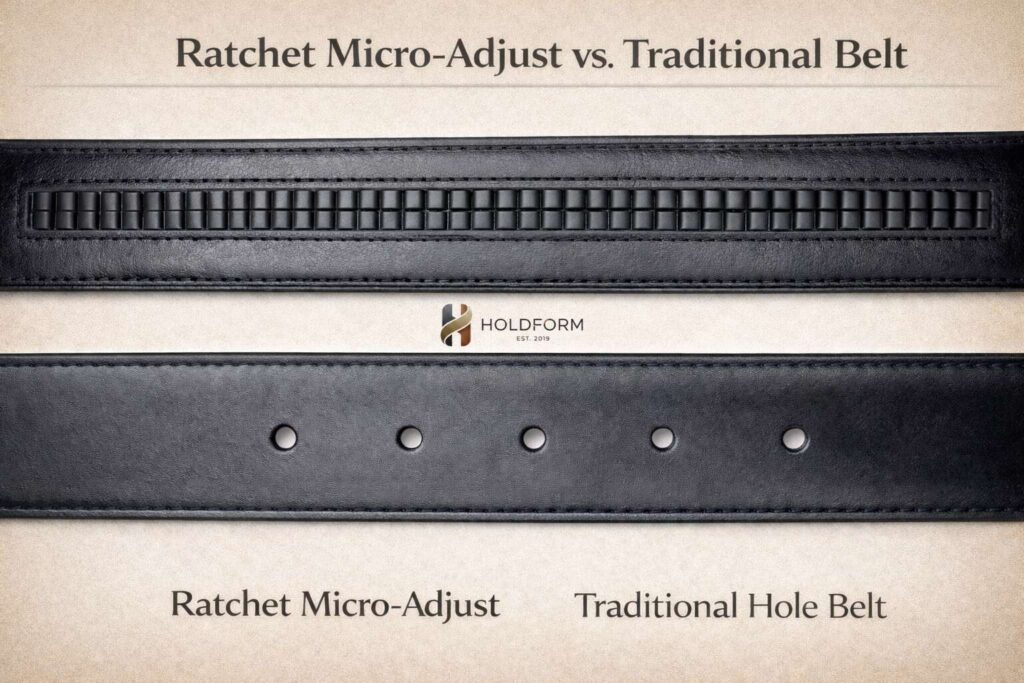
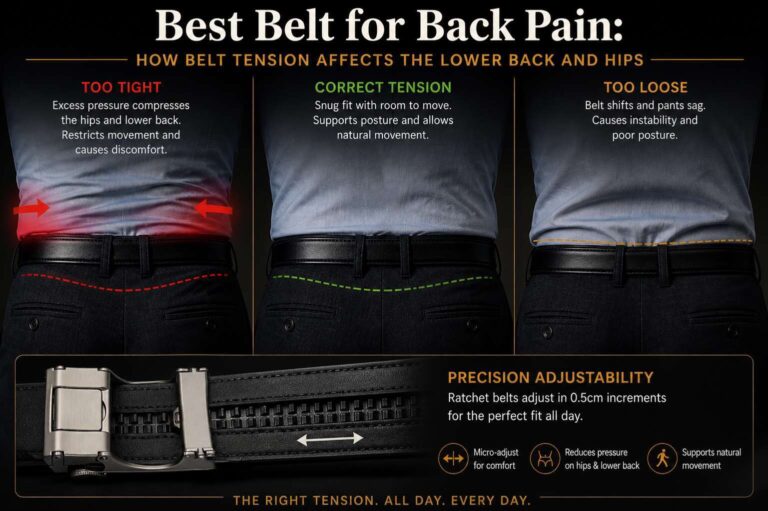
A ratchet mechanism with 0.5cm adjustment increments solves the office belt’s primary comfort problem: the fixed-hole spacing of a classic belt means your waist either sits between sizes or you accept the tension of the nearest hole.
For desk-based daily wear, this matters more than it does in casual contexts. A belt set to the correct ratchet position in the morning holds that tension consistently through a day of sitting, standing, commuting, and eating — the ratchet mechanism doesn’t drift the way a classic pin buckle can on a worn hole. The buckle releases cleanly when you want to adjust and re-engages positively when you set it.
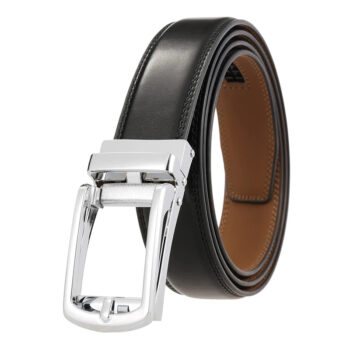
The aesthetic question most people have about ratchet belts in professional settings: does the mechanism look office-appropriate? The answer is yes, with two conditions. The buckle frame should be low-profile — a slim rectangular or square buckle in a restrained finish reads as professional. An oversized or decorative buckle in a ratchet design reads as casual. Second, the belt tail should have a clean finish — the trim-to-fit tail end of a ratchet belt is more controlled than the visible flap of a classic belt with multiple unused holes.
Best for: Daily suit and trouser wear, anyone who sits for most of the working day, and anyone whose waist varies through the day due to commuting and meals.
A well-made classic belt in full-grain leather at 4mm+ thickness is entirely appropriate for professional wear. The advantage over a ratchet design is patina — full-grain leather develops surface character over years of daily wear, and the classic belt construction allows this to happen uniformly. For anyone who values the long-term aesthetic of aged leather, a classic belt is the better investment.
The limitation is the fixed-hole problem. A classic belt at the correct hole has a specific tension that doesn’t adapt through the day. For desk-based work, this can translate to either a slightly loose setup (acceptable) or a slightly tight one (uncomfortable over a full workday). The practical solution is choosing the looser of two holes and accepting a marginally relaxed tension, rather than choosing the tighter hole and dealing with restricted comfort over an eight-hour day.
The other limitation is strap quality dependency. A classic belt at 3mm or under rolls under the tension of a tucked shirt and trousers — the strap bends forward at the front of the waistband, breaking the clean horizontal line that makes a belt look intentional. At 4mm single-layer full-grain, this doesn’t happen. Below that threshold, the silhouette suffers.
Best for: Formal office environments, anyone who prioritises patina and traditional construction, and wearers who don’t have the between-sizes fit problem that ratchet mechanisms solve.
A hidden-tail belt secures the strap end against the inner face of the belt rather than leaving a visible flap at the front. With a tucked shirt and a close-fitting trouser, this eliminates the small protrusion that a classic belt tip creates at the front of the waistband — a detail that’s invisible in casual contexts but visible in professional ones, particularly under a blazer that gaps slightly when seated.
Hidden-tail construction also removes the keeper management problem. Classic belts require a keeper to hold the strap tip against the belt body — a keeper that migrates is a minor but persistent annoyance in professional settings. Hidden-tail designs have no visible keeper because the tail is contained by the mechanism rather than held externally.
The trade-off is adjustability. Hidden-tail belts adjust within a range set by the strap length — typically a wider adjustment range than classic holes but less precise than a ratchet mechanism. For most wearers, this range is sufficient. For anyone with significant waist variation through the day, the ratchet mechanism is still the more practical choice.
Best for: Suits and formal trousers, minimalist wardrobes, and anyone who wears tucked shirts daily and wants the cleanest possible front silhouette.

The question “what makes a belt comfortable for all-day wear at work” has a specific mechanical answer that most belt content doesn’t give.
Comfort over a full desk-based workday depends on three things:
Consistent tension through movement. When you sit, your waist circumference changes — typically 1–3cm depending on build and clothing. A belt set at a fixed hole either under-tenses when seated (waistband loosens, trousers drop slightly) or over-tenses when seated (restricted through the working day). A ratchet mechanism with 0.5cm increments allows you to set the tension that works for your standing fit and, on days when it matters, adjust by one increment after sitting down.
No pressure point at the buckle. A buckle frame that sits flat against the waistband distributes pressure evenly. A buckle with protruding hardware or a thick frame that stands away from the body creates a localised pressure point when seated for extended periods. Low-profile buckles — flat frames, recessed hardware, no raised centre bar — are more comfortable for desk wear than buckles with significant physical depth.
Leather stiffness sufficient to resist lateral flex. When seated, the belt at the sides of the waist bends laterally as the hip moves. A belt under 3.5mm bends freely at this point — the strap flexes and the keeper migrates. At 4mm+ full-grain, the leather has enough stiffness to resist this flex and hold position. This is the single most overlooked specification for office belt comfort: thickness is not just an aesthetic or durability variable, it’s a comfort variable for all-day seated wear.
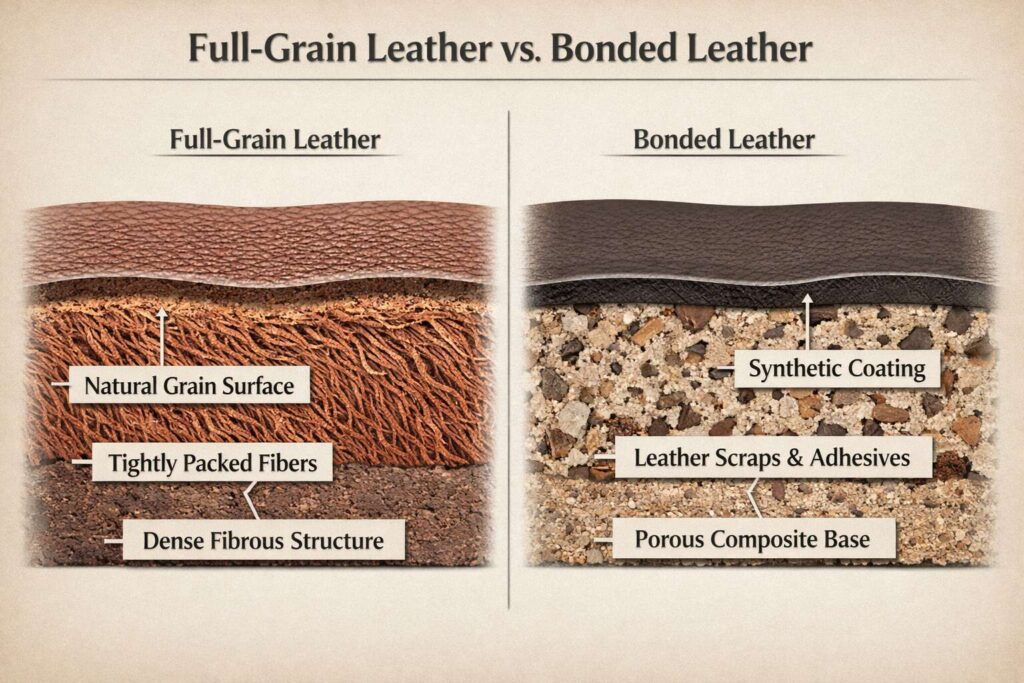
In professional contexts, the belt is under closer and more consistent visual scrutiny than in casual ones. Surface quality shows at close range. Structural quality shows over months.
Full-grain leather at 4–4.5mm is the correct specification for a daily office belt. Full-grain means the outermost layer of the hide is preserved — the tight, dense fibre structure of this layer is what gives the leather resistance to surface abrasion, moisture, and permanent deformation. The strap holds a flat profile because the leather has the structural integrity to resist the lateral and compressive forces of daily wear.
Top-grain leather at adequate thickness is acceptable but will show surface wear faster. The correction layer applied during top-grain processing gives the leather a uniform appearance that looks good when new but wears through unevenly over time. For a belt worn five days a week, this difference is visible within 18 months.
Bonded or genuine leather composites are inadequate for daily office wear. The compressed fibre structure deforms under sustained load. A bonded leather belt that looks acceptable in the shop has typically begun rolling and deforming at the buckle fold within three months of daily use. In a professional context where the belt is visible at close range, this is not an acceptable failure timeline.
For a full technical breakdown of leather grades and what each means structurally, see our [full-grain vs top-grain vs genuine leather guide →]
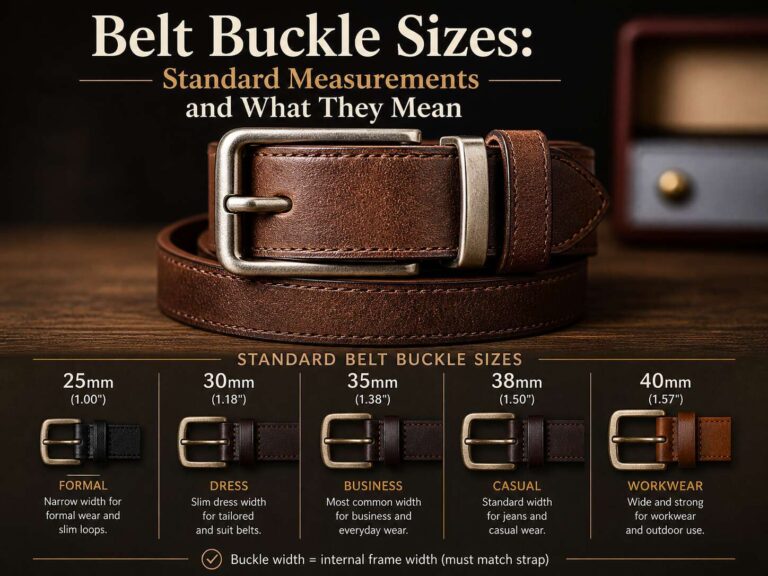
Width is a proportion problem with a specific logic. Trouser construction becomes more formal as cut becomes more tailored. More tailored trousers have narrower waistbands and smaller belt loops. A wide belt through a narrow loop distorts the trouser waistband and creates bunching — the opposite of the clean silhouette the trouser was cut to produce.
Formal suits and tailored trousers: 28–32mm. The narrowest belt loops on a well-cut suit trouser are typically 32–35mm wide — a 30mm belt sits cleanly with room for the loop to lie flat. A 38mm belt through a 34mm loop will stress the waistband seam over time and creates visible pulling at the loop attachment points.
Business casual trousers and chinos: 32–38mm. Less tailored cut means wider loops. A 35mm belt is the most versatile width for business casual — works with most trouser constructions without looking either too delicate or too heavy.
Smart jeans in business casual contexts: 38–40mm. Denim is constructed with wider loops designed for thicker belts. A 30mm belt through a 40mm denim loop sits loosely and shifts position. At 38mm, the belt fills the loop correctly and holds position.
The practical rule: match the belt width to the loop width of the specific trouser you’re wearing it with. When in doubt, go narrower rather than wider — a slightly narrow belt in a loop reads as intentional; a belt forcing its way through a tight loop reads as an error.
The buckle is the most visible hardware element on the belt and the most common point of visible failure. Plated finishes — thin electroplated chrome or gold over zinc alloy — chip and oxidise. Under fluorescent office lighting, chipped buckle plating is immediately visible.
Brushed silver (stainless or solid brass with rhodium finish): The safest office choice. Low reflectivity means it doesn’t catch light dramatically, which suits formal and business casual contexts. Brushed surface finish conceals minor wear better than polished. Matches silver watch cases, platinum rings, and white gold without coordination effort.
Polished silver: Appropriate for formal contexts but shows wear faster than brushed. The high-reflectivity surface makes small scratches visible. Correct match for formal dress watches with polished cases.
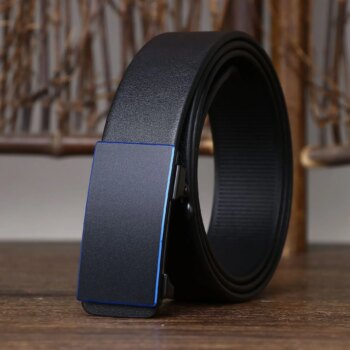
Matte black (PVD-coated): Works in contemporary professional environments and business casual contexts. PVD coating is significantly more durable than electroplated finishes — the coating is deposited at molecular thickness and bonds chemically rather than mechanically. Matches black shoe hardware and contemporary suit accessories.
Brass and gold-tone: Correct when worn consistently with warm-metal accessories — gold watch, brass cufflinks, tan shoes with gold hardware. Incorrect when mixed with silver watch cases or platinum hardware. The consistency of the metal family across all visible accessories is what makes it look intentional rather than mismatched.
What to avoid: Bright chrome plating over zinc alloy, gold electroplating, and any finish described as “gold-tone” without further specification. These are the finishes that chip under daily handling within 12 months.
For a full guide to matching buckle hardware across accessories, see our [silver vs gold vs black buckle guide →]
| Your office context | Best fit system | Key reason |
|---|---|---|
| Suits daily, desk work | Ratchet | Precise fit + seated comfort |
| Suits daily, on your feet | Hidden-tail or classic | Clean silhouette + traditional construction |
| Business casual, mixed sitting | Ratchet or hidden-tail | Comfort + versatility |
| Business casual, heritage aesthetic | Classic full-grain | Patina + traditional feel |
| Smart casual, longer days | Ratchet | All-day tension consistency |
Yes. The determining factor is buckle design, not mechanism. A ratchet belt with a low-profile, restrained buckle in a quality finish is indistinguishable from a classic belt when worn — the mechanism is hidden inside the buckle housing. The adjustment precision is a functional advantage in professional contexts where fit precision matters.
28–32mm for most suit constructions. Check the loop width on your specific suit trousers — the belt should sit in the loop with a small amount of clearance rather than forcing the loop to stretch. Most ready-to-wear suit trousers accommodate up to 35mm; bespoke and more tailored constructions often run narrower.
A full-grain leather belt at 4mm+ with a solid brass or steel buckle worn five days a week should last 5–10 years before the leather reaches end of life. The buckle should outlast multiple straps. Budget and mid-range belts with bonded leather and plated hardware typically show failure — rolling leather, chipping buckle — within 12–24 months of daily wear.
Black with black shoes, dark navy, and charcoal grey. Brown — in medium to dark shades — works with tan, brown, and navy outfits in business casual and less formal office contexts. Tan or light brown is business casual only. The rule is simpler than most style guides make it: match the belt leather tone to the shoe leather tone and you won’t go wrong.
With the right specification, yes. A 32mm hidden-tail or ratchet belt in black full-grain leather with a brushed silver buckle transitions between suits and business casual without looking out of place in either context. The width keeps it appropriate for tailored trousers, and the restrained hardware doesn’t read as too casual for formal wear.
Set at the tension that holds the trouser waistband flat without creating visible compression at the waist. If you can see the belt pulling the trouser fabric outward at the buckle, it’s too tight. If the waistband moves when you walk, it’s too loose. With a ratchet mechanism, you can set this precisely — you’re not limited to the tension of the nearest fixed hole.
HoldForm office belts are specified by fit system, leather grade, strap thickness, and buckle finish — all listed on every product page.
[View ratchet belts →] [View hidden-tail belts →] [View classic full-grain belts →] [Full-grain vs top-grain vs genuine leather: what the grades mean →] [Silver, gold or black buckle: how to choose →]

Practical belt guides, sizing tips, and exclusive offers — straight to your inbox.

Leave a comment