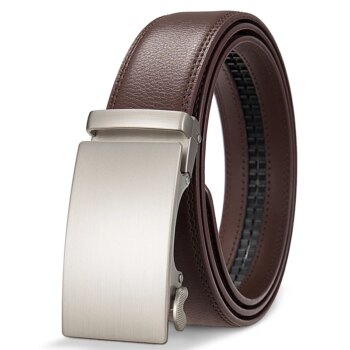
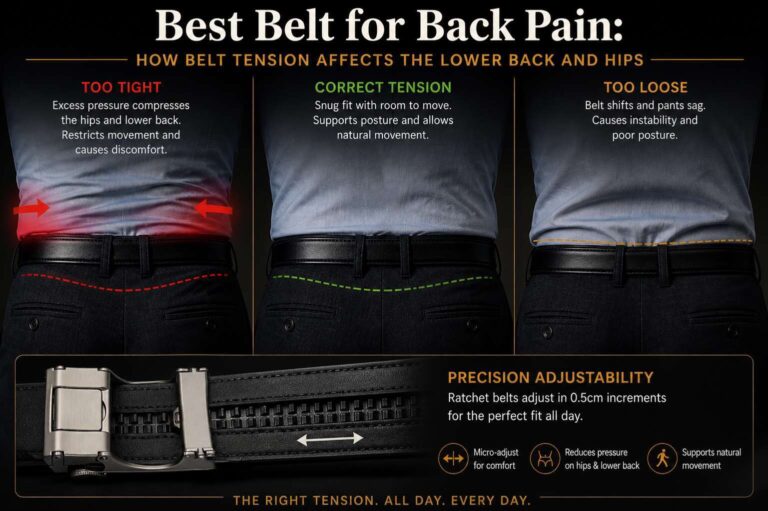
A ratchet belt is a leather belt that adjusts using a toothed track rather than punched holes. Instead of a pin passing through a fixed hole, a spring-loaded mechanism inside the buckle locks onto the track at any position along its length. The result is a belt that can be set to any tension in small increments — typically 0.5cm steps — rather than being limited to five preset positions spaced 25mm apart.
The mechanism is hidden inside the buckle housing. From the front, a ratchet belt looks identical to any other leather belt. The difference is entirely in how it fastens and adjusts.
The strap of a ratchet belt has a series of small teeth along its back face. These teeth are either part of a separate hardware track attached to the strap, or integrated into the strap itself depending on the design.
The buckle contains a spring-loaded pawl — a small pivoting tooth — that engages the strap teeth when the belt is fastened. When you pull the strap through the buckle, the pawl clicks over each tooth and locks at the nearest position. To release, a lever or button on the buckle disengages the pawl, allowing the strap to slide freely.
The adjustment is continuous along the track rather than fixed at preset holes. You can set the belt tighter or looser by a single tooth increment — 0.5cm — without moving to a completely different position the way a pin-buckle belt requires.
To remove the belt, press the release and pull the strap backward through the buckle, or use the full-release function if the buckle has one.
Once you understand the mechanism, the next step is choosing one — start with our selection of leather ratchet belts.
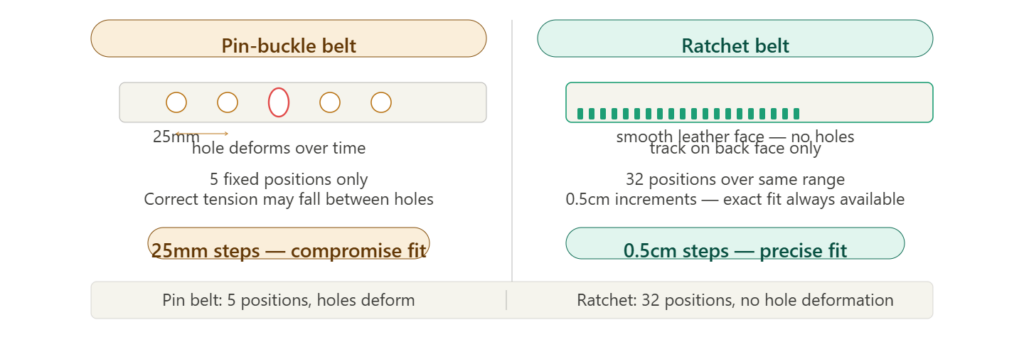
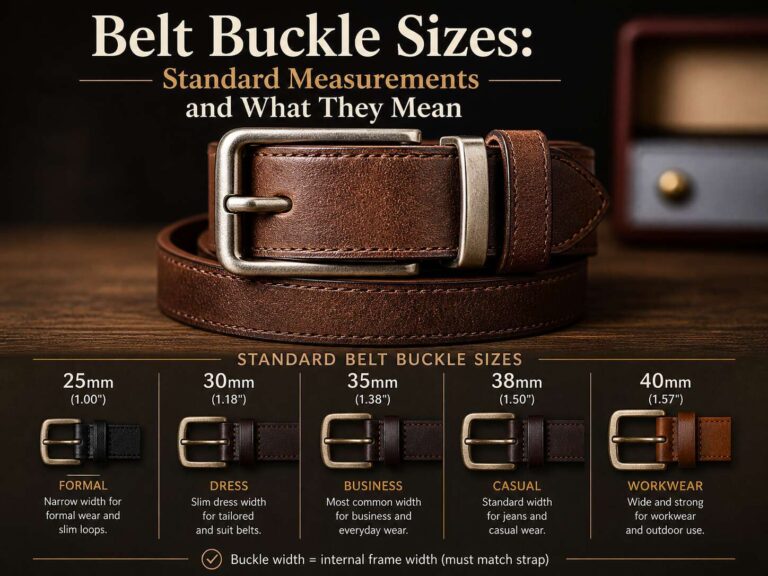
A traditional belt has five to seven holes punched at 25mm intervals. The buckle prong passes through one hole. The belt fastens at that hole and nowhere else — if the correct tension falls between two holes, the choice is slightly too tight or slightly too loose.
The differences in daily use:
Adjustment precision: A pin-buckle belt offers five positions over its adjustment range. A ratchet belt with 0.5cm increments offers approximately 32 positions over the same range. For a buyer whose correct tension varies through the day — before and after meals, seated versus standing, different trouser waistbands — this precision is practically useful.
Leather wear: A pin-buckle belt concentrates stress at the hole used most often. The leather fibres at the hole edge deform over time — the hole enlarges from round to oval and the belt eventually stops holding position correctly. A ratchet belt has no holes in the leather face. The strap surface remains unperforated and the stress is distributed across the track rather than concentrated at a single point.
Visual appearance: The leather face of a ratchet belt has no visible hole pattern. Under a tucked shirt or suit jacket, the belt presents a clean, uninterrupted surface. This is the construction choice behind hidden-tail and clean-face belt designs for professional wear.
Sizing: A ratchet belt is typically supplied longer than needed and trimmed to the buyer’s exact waist length before first wear. The mechanism then handles fine adjustment above and below that trim point. A pin-buckle belt is ordered in a fixed size and worn at a specific hole.
For a detailed mechanism comparison, see our [ratchet belt vs traditional belt guide →]
Most ratchet belts are supplied as trim-to-fit — the strap is longer than any buyer needs, and the buyer trims it to their exact waist length at home before wearing.
The process: detach the buckle, cut the excess from the buckle end of the strap, reattach the buckle. The cut is hidden inside the buckle housing. The process takes under two minutes and requires only scissors.
After trimming, the ratchet mechanism provides adjustment in 0.5cm increments above and below the trim point — typically a range of 8–10cm on each side. This covers normal daily waist variation, different trouser waistbands, and seasonal changes without ever needing to re-trim.
The trim-to-fit approach means a ratchet belt fits exactly at the trim point rather than approximately at the nearest hole. For buyers who have previously found that belt holes never quite land in the right place, this eliminates that problem permanently.
For the full trim process, see our [how to trim a ratchet belt guide →]
Daily professional wear: For someone who wears a belt five days a week through desk work, meetings, and commutes, the adjustment precision of a ratchet belt handles the waist variation of a normal workday without compromise. Waist circumference typically varies 1–3cm through the day due to meals, posture changes, and hydration. On a pin-buckle belt, this variation often means the belt is at the wrong hole for part of the day. On a ratchet belt, a single click corrects it.
Anyone whose tension varies through the day: The most common trigger for switching from pin-buckle to ratchet is the consistent experience of the belt feeling tight after lunch or loose in the afternoon. This is not a sizing problem — it is the fixed-hole spacing being too coarse for normal physiological variation. Ratchet adjustment solves it.
Buyers who want precise fit: For a buyer who has measured carefully and wants the belt to fasten exactly at their correct size rather than approximately at the nearest hole, ratchet mechanics deliver what pin-buckle cannot.
Travel: Adjustment during long seated periods — flights, trains, car journeys — is easier on a ratchet belt. A single click loosens the belt while seated; a single click retightens it when standing. No unbuckling, no hole change, no visible adjustment.
Post-surgery and medical recovery: For anyone whose waist changes significantly over a recovery period, ratchet adjustment tracks the change without requiring a new belt or a new hole.
Heavy workwear and dirty environments: Ratchet mechanisms can accumulate debris — soil, metal particles, construction dust — in the track over sustained exposure in outdoor or industrial environments. For sustained outdoor physical work, a classic pin-buckle belt with solid brass hardware is more robust.
Heritage and traditional aesthetics: The ratchet mechanism has no visible prong, no holes, and no traditional buckle appearance. For buyers who specifically want the classic pin-buckle look as part of their aesthetic — with leather-craft boots, heritage denim, Western-style clothing — a ratchet belt may not fit the visual intent regardless of its functional advantages.
Very formal or custom tailoring: Bespoke and made-to-measure suits are occasionally cut with very narrow, tight belt loops (under 32mm) where the ratchet buckle housing may be slightly deep. Most quality ratchet belts have low-profile buckles that work in these contexts, but worth checking the buckle depth against the loop clearance on bespoke pieces.
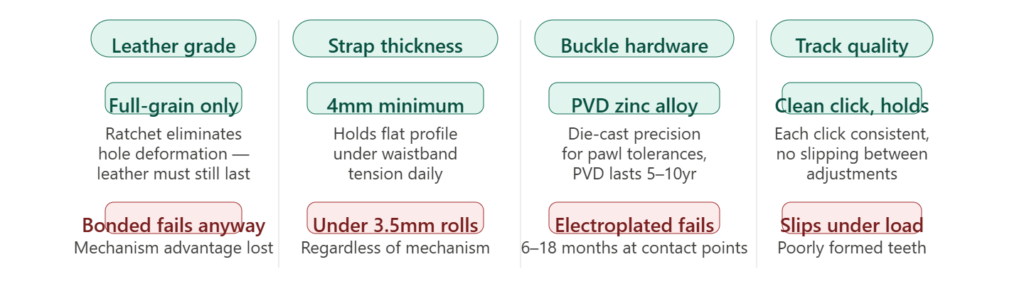
Not all ratchet belts are the same. The mechanism is the defining feature, but the strap construction determines how long the belt lasts and how it performs under daily wear.
Leather grade: Full-grain single-layer leather at 4mm is the correct specification for a ratchet belt intended for daily professional or casual wear. The ratchet mechanism eliminates hole deformation, but the leather still needs adequate thickness to hold a flat profile and resist rolling under the lateral tension of daily waistband wear. Bonded or split leather with a ratchet mechanism still fails — the mechanism advantage disappears if the strap fails first.
Strap thickness: 4mm for everyday professional and casual wear. 4.5mm for heavier casual, denim, and workwear. Thinner than 3.5mm and the belt will roll at the front regardless of the mechanism.
Buckle material: PVD-coated zinc alloy is the correct specification for ratchet buckle housings. The die-casting precision zinc alloy allows is necessary for the tight tolerances of the pawl-and-tooth mechanism. PVD coating outlasts electroplating by a factor of 3–5 at friction points. A ratchet belt with electroplated zinc hardware will show finish failure at the mechanism contact points within 12–18 months of daily wear.
Track quality: The teeth on the strap or track need to be consistently spaced and cleanly formed. Poorly formed teeth produce inconsistent clicks, partial engagement, and eventually a mechanism that slips under load. A quality ratchet mechanism clicks cleanly and holds without creep between adjustments.
For daily wear where tension varies through the day: yes, practically. The ability to set exact tension for any activity — standing, sitting, after eating — without being constrained to preset hole positions means the belt can always be at the correct tension rather than a compromise. Whether this feels more comfortable depends on how much the buyer’s waist varies and how much the hole spacing on a traditional belt forces a compromise.
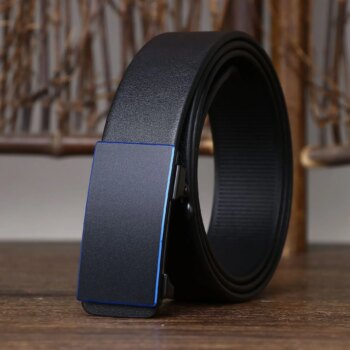
From the front, no. The leather face is smooth and unperforated — often cleaner in appearance than a pin-buckle belt because there is no visible hole pattern. The buckle design varies by brand. Some ratchet buckles are visually identical to classic frame buckles; others are more contemporary in profile. The mechanism is not visible when the belt is worn.
Yes. The relevant variable is buckle design and profile, not mechanism. A ratchet belt with a flat, low-profile buckle in a restrained finish — brushed silver, matte black, or brass — is indistinguishable from a classic belt in professional contexts and appropriate for business formal wear. For the most formal contexts (black tie, bespoke suiting), a narrow, flat-face buckle at 30–33mm is the correct choice regardless of mechanism.
The strap lasts as long as the leather — 8–12 years for full-grain at 4mm with regular conditioning. The mechanism lifespan depends on build quality. A quality ratchet mechanism with PVD-coated hardware can outlast the strap. A cheap mechanism with electroplated finish typically shows wear within 12–18 months. The key advantage is that ratchet straps don’t develop the hole deformation that limits traditional belt lifespan — the strap ages uniformly rather than wearing out at the most-used hole.
Order by strap length rather than waist size. Measure your waist at belt loop level, add 15–20cm, and order the strap length that matches or exceeds this figure. If between sizes, order longer — the strap is trimmed at home and cannot be extended.
For the full sizing guide, see our [belt size vs pant size guide →]
HoldForm ratchet belts are specified with leather grade, strap thickness, and buckle coating listed on every product page. Trim-to-fit instructions are included with every ratchet belt.
[View ratchet belt range →] [How ratchet belt mechanisms work: full technical guide →] [How to trim a ratchet belt to your exact size →] [Ratchet belt vs traditional belt: full comparison →]

Practical belt guides, sizing tips, and exclusive offers — straight to your inbox.

Leave a comment