A belt holster solves a specific problem that pocket carry doesn’t: tools that are large, heavy, or used repeatedly throughout the day work better at a fixed, accessible position on the belt than loose in a pocket where they shift, stack against other items, and require hunting to retrieve.
The choice between holster types — and between a holster and a knife sheath — comes down to what you’re carrying, how often you access it, and how much the belt system needs to manage simultaneously. This guide covers the construction variables that determine holster performance, the main holster formats by use case, and what the belt needs to do to make any holster system work.
Both are belt-mounted leather carriers. The distinction matters for construction and sizing.
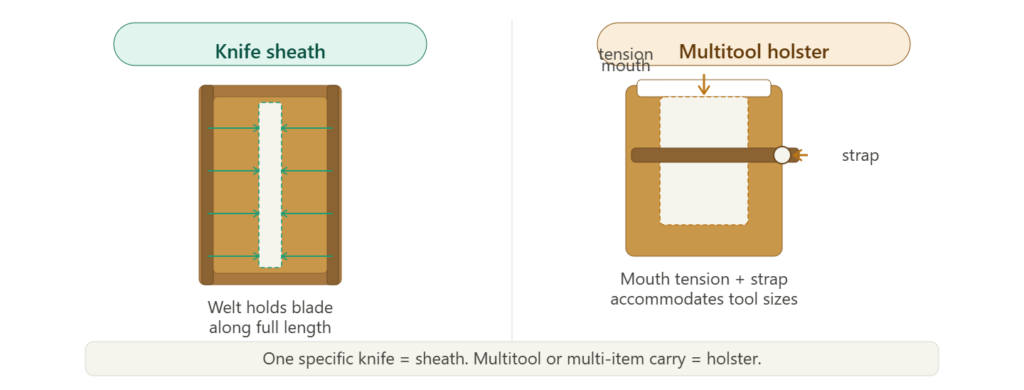
A knife sheath is built around one specific tool with a defined blade geometry. Retention depends on welt construction — the channel between the front and back panels that holds the blade along its length. The sheath is form-fitted to the knife.
A multitool holster is built around a category of tool rather than one specific item. It needs to accommodate different tool widths and heights while maintaining enough retention to prevent movement during carry. Retention in a multitool holster comes from mouth tension, strap-and-snap closures, or a combination of both — not from a welt channel that matches the tool geometry exactly.
This distinction affects the design choice: if you’re carrying one specific knife and nothing else, a dedicated knife sheath gives better retention and a lower profile. If you’re carrying a multitool, a flashlight, or multiple items that need to be accessed independently, a holster is the right category.
For a full breakdown of knife sheath construction and when a sheath is the better choice, see our [leather knife sheaths for belt carry guide →]
Before comparing formats, the four construction variables that determine whether a belt holster holds up under daily carry:
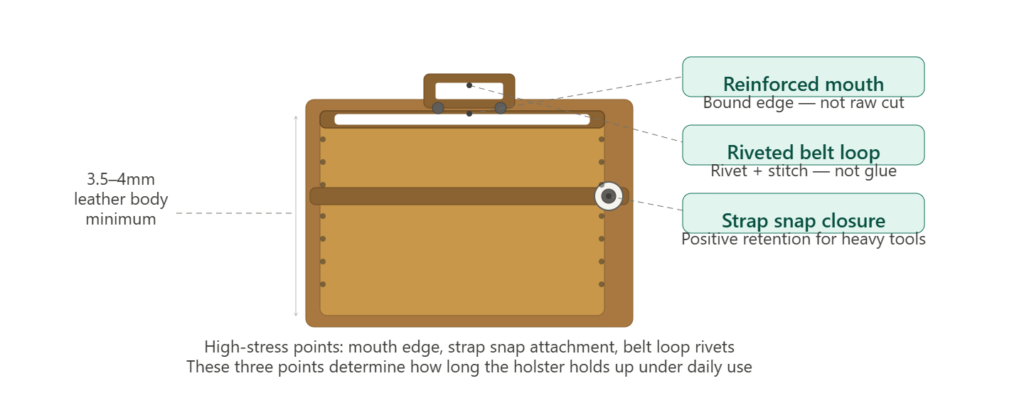
Leather thickness and rigidity: A holster holds its shape through the stiffness of its leather body. At under 3mm, holster leather compresses at the mouth over time — the opening widens, tools sit lower than intended, and retention decreases. At 3.5–4mm, the leather maintains its geometry through years of daily use. The same thickness logic that applies to knife sheaths and carry belts applies here.
Mouth construction: The mouth of the holster is the highest-stress point. Every insertion and draw cycle compresses and slightly widens the mouth opening. A reinforced mouth — stitched edge binding or a leather gusset at the mouth rim — distributes this stress across a wider footprint and slows the degradation of retention. An unreinforced raw-edge mouth concentrates stress at the cut edge and degrades faster.
Retention mechanism: Single-tool holsters typically rely on mouth tension alone — adequate for a snug-fitting tool. Multi-tool or heavier holsters often add a strap-and-snap closure across the tool body, which provides positive retention independent of mouth tension. The snap closure matters: a riveted snap holds under sustained load; a sewn-on snap attachment point pulls away from the leather under repeated opening cycles if the thread weight is inadequate.
Belt attachment construction: Same principles as knife sheaths. Single-loop attachment allows the holster to pivot forward and backward at the attachment point during movement. A wider single loop, double-loop attachment, or pancake-style back panel distributes the attachment load and prevents pivoting. For heavier multitools — particularly 200g+ full-size tools — single-loop attachment is marginal for active daily carry.
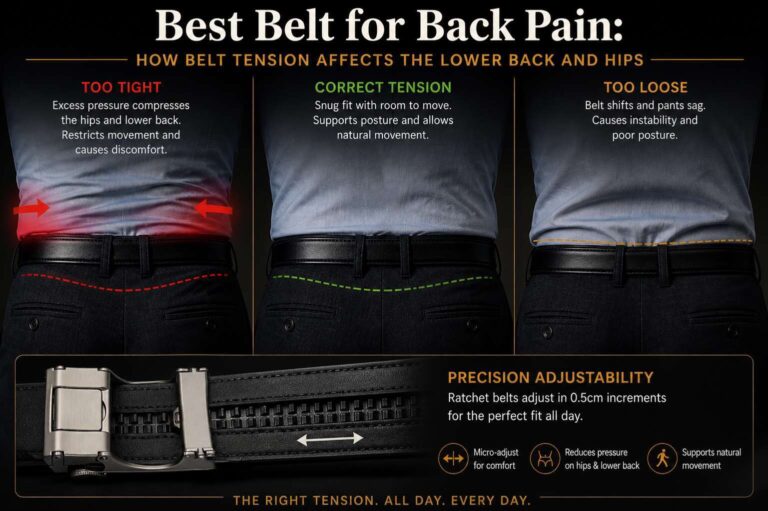
Every holster format in this guide performs better on a structurally adequate belt. The holster holds the tool. The belt holds the holster. When the belt sags, twists, or shifts, even a well-made holster fails to hold position.
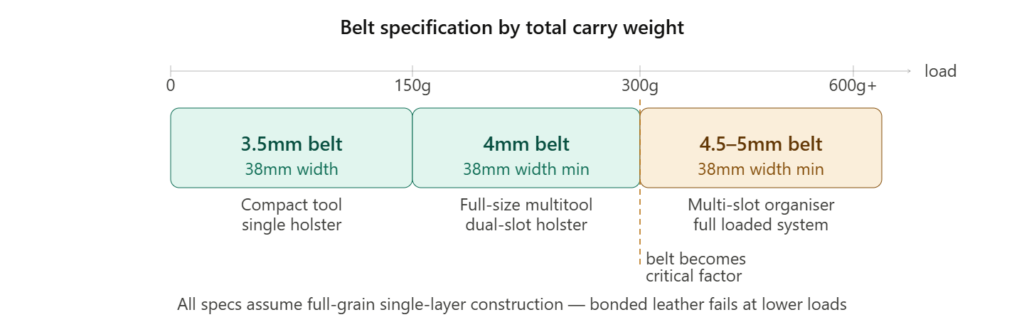
Minimum belt specifications for multitool carry:
For a full breakdown of how belt construction determines carry system performance, see our [guide to why belts fail with knife carry →] — the same load-bearing principles apply to holster carry.
The simplest format. One slot, built around a specific multitool width category. Low profile, minimal belt footprint, fast access.
The tradeoff is specificity: a single-tool holster built for a Leatherman Wave fits that tool well. Used with a narrower or wider tool, retention is either excessive (the tool is hard to draw) or inadequate (it moves in the holster). For users with one consistent multitool that they carry daily, this is the cleanest solution.
Construction points to verify: stated leather thickness (3.5mm minimum), mouth edge treatment (burnished or bound, not raw), and belt loop width matched to your belt. Single-tool holsters with stated construction specs are a better buy than those described only as “genuine leather” without further detail.
Best for: Consistent single-tool carry. Users who know which multitool they’re carrying and don’t change it.
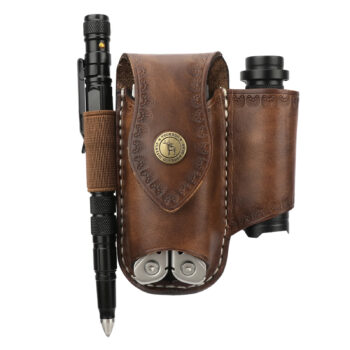
A purpose-built dual-carry design with separate slots for a multitool and a compact flashlight. The pairing is practical because both tools are commonly carried together and both benefit from fixed belt position over pocket carry.
The construction consideration here is slot spacing — the two slots need to be far enough apart that drawing one tool doesn’t disturb the other, but close enough that the holster footprint on the belt stays manageable. A dual holster where the slots are too close creates a situation where drawing the multitool requires two-handed stabilisation of the holster body.
Look for: individual slot retention for each tool rather than a shared open pocket, and a back panel wide enough to distribute the combined load of both tools across the belt attachment.
Best for: Utility and worksite carry where both tools are accessed regularly. Users who want each tool independently accessible without carrying two separate belt items.
Combines a knife slot and a multitool slot in one belt item. Functionally different from the flashlight pairing — a folding knife has different retention requirements than a flashlight because it’s sharper, often more valuable, and typically accessed with more deliberate intent.
The knife slot on a combined holster is rarely as secure as a dedicated knife sheath. It provides mouth-tension retention without the welt channel that gives a proper sheath its blade-length retention. For carry contexts where knife retention is a priority — active outdoor use, physical work — a dedicated sheath is more appropriate than a combined holster slot.
For daily carry where the knife is accessed occasionally and the multitool frequently, a combined holster is a practical compromise that keeps both tools in a single belt footprint.
Best for: Daily EDC where both tools are carried but the knife isn’t the primary tool. Users who want to simplify their belt carry to one item rather than two.
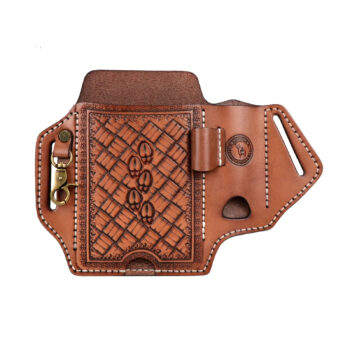
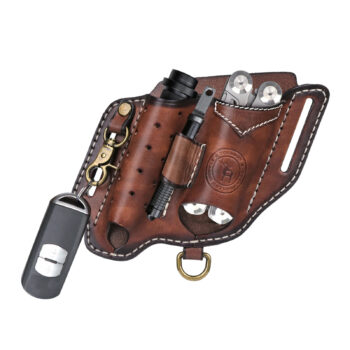
A full carry platform with multiple slots or compartments — typically accommodating a phone, multitool, knife, and sometimes additional small tools or keys. This is the maximum-capacity end of belt holster carry.
The practical consideration is weight. A multi-slot holster fully loaded — phone, multitool, knife — can reach 400–600g of combined tool weight. At that load, the belt requirements move to 4.5–5mm full-grain and 38mm minimum width. A 3.5mm belt under a fully loaded multi-slot holster will sag and shift within hours.
The other consideration is access speed. In a multi-slot holster, each item has a fixed position. Access is fast for the items you use most. But the holster works as a system — you need to commit to using it as intended rather than randomly inserting tools into whichever slot is convenient. A multi-slot holster where tools aren’t consistently returned to the same slots is slower to access than simple pocket carry.
Best for: Users who want to eliminate pocket carry almost entirely. Worksite carry where a defined set of tools is needed accessible throughout the day. Users willing to use the system consistently.
A smaller format built around compact or lightweight multitools — a Leatherman Squirt, a compact Swiss Army knife, a small folding tool rather than a full-size multitool. Lower profile and lighter than a standard multitool holster.
The sizing limitation is the same as the compact knife sheath: this format works well for the tools it’s sized for and poorly for tools that exceed its dimensions. Confirm your tool’s closed dimensions against the holster specifications before ordering.
Best for: Compact multitools. Light EDC setups where minimal belt footprint is a priority. Users who want belt carry without the bulk of a full-size holster.
A single slot with a clip attachment rather than a full belt loop — clips over the waistband or belt without threading the belt through a loop. The lowest-commitment format.
The stability limitation is significant: a clip-on attachment has one contact point and no through-the-belt anchor. Under the dynamic load of walking and repeated access, clip-on holsters migrate and tilt more than loop-attached designs. For light tools carried occasionally, this is adequate. For heavy tools or daily professional carry, the instability makes it a poor choice.
It has a legitimate use case as a transition format: users who are evaluating whether belt carry works for their routine before committing to a full loop-attached holster system.
Best for: Lightweight tools, occasional carry, users testing belt carry before committing to a full loop-attached system.
The question that comes up most often in EDC carry decisions is whether to carry a dedicated knife sheath and a separate multitool holster, or to use a combined holster that handles both.
The answer depends on two variables: how often each tool is accessed, and how important independent retention is for the knife.
Use a dedicated sheath and separate holster when:
Use a combined holster when:
The stability of any combined system — sheath plus holster, or combined holster — depends on the belt. Two items on a marginal belt creates compounding instability: both items shift, the combined load sags the belt further than either item would alone, and access to both tools becomes inconsistent.
| Your carry | Best format | Belt spec needed |
|---|---|---|
| Single multitool, light daily use | Single-tool holster | 3.5mm, 38mm width |
| Multitool + flashlight, utility work | Dual flashlight holster | 4mm, 38mm width |
| Folding knife + multitool, daily EDC | Combined knife/tool holster | 4mm, 38mm width |
| Multiple tools, full system | Multi-slot organiser | 4.5–5mm, 38mm minimum |
| Compact tool, minimal footprint | Compact holster | 3.5mm adequate |
| Evaluating belt carry | Clip-on format | Any belt |
Leather thickness: Stated in millimetres. 3.5mm minimum for any daily carry holster. If not listed, assume under 3mm.
Mouth construction: Look for mention of reinforced mouth, bound edge, or edge treatment. “Genuine leather” with no construction detail means raw-cut edges.
Retention mechanism: Is retention mouth-tension only, or is there a strap closure? For multitools over 200g, confirm whether mouth tension alone is sufficient or whether the design relies on a strap.
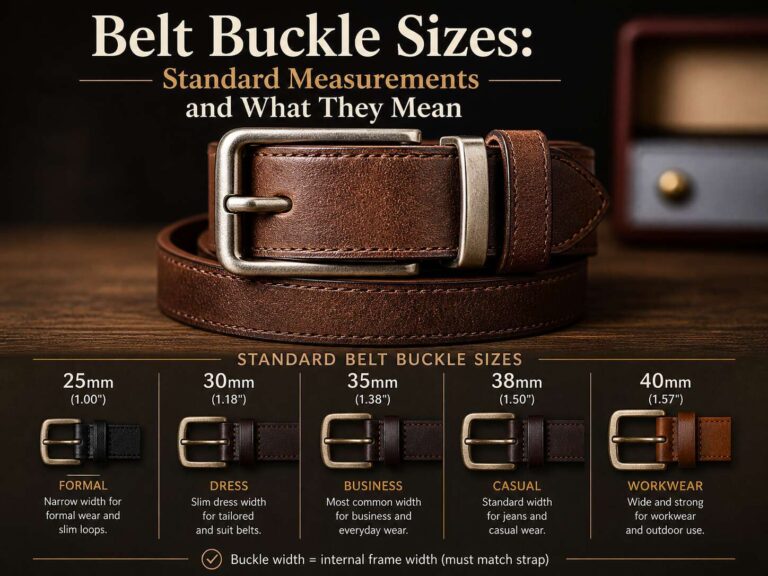
Belt loop width: Confirm against your belt width. Standard is 38mm (1.5 inch). A holster loop on a narrower belt introduces play that no construction quality compensates for.
Snap attachment quality: If the holster has a strap-and-snap closure, the snap should be riveted or through-bolted to the leather. A snap sewn through the leather surface with thread will eventually pull through under repeated use.
For a full picture of how holster selection fits into a structured carry system, see our [guide to building a structured EDC system →]
A knife sheath uses welt construction to hold a blade along its full length — it is purpose-built for one specific knife geometry. A multitool holster uses mouth tension and sometimes a strap closure to hold a category of tool — it accommodates different tool sizes with less form-specific retention. For dedicated knife carry, a sheath is more secure. For multitool carry or multi-item carry, a holster is the appropriate format.
As a rule of thumb: a single-tool holster with a multitool under 150g works adequately on a 3.5mm belt. A full-size multitool at 200–300g requires a 4mm belt minimum. A fully loaded multi-slot organiser at 400–600g requires 4.5–5mm and a 38mm minimum belt width. Beyond this, the belt sags and the holster shifts regardless of holster quality.
If the knife is accessed frequently and blade retention matters — outdoor use, physical work — use a dedicated sheath for the knife and a separate holster for the multitool. The dedicated sheath provides significantly better retention than a combined holster’s knife slot. If the knife is a folding blade carried for occasional use and the multitool is the primary tool, a combined holster simplifies the belt setup without meaningful compromise.
On quality full-grain leather at adequate thickness (3.5mm+), retention reduction over time is gradual and primarily affects the mouth opening. The mouth widens slightly over thousands of insertion cycles. On thinner or lower-grade leather, this process is faster and more pronounced. Conditioning the leather every 3–6 months slows the process by keeping the fibres supple rather than drying and compressing permanently.
Within a size range, yes. A holster built for full-size multitools will work for most tools in the 90–120mm closed length range with varying degrees of retention tightness. Outside that range — trying to use a compact holster with a full-size tool, or a full-size holster with a compact tool — retention will be either excessive or inadequate. Confirm your tool’s closed dimensions against the holster’s stated dimensions before purchasing.
HoldForm belt holsters are specified with leather thickness, construction method, and belt loop width on every product page.
[View leather belt holster range →] [Leather knife sheaths for belt carry →] [Why belt construction determines carry system performance →] [How to build a structured EDC system →]

Practical belt guides, sizing tips, and exclusive offers — straight to your inbox.

Leave a comment