Knife carry problems are almost never knife problems.
If your knife tilts outward during the day, drops lower than you positioned it, or creates pressure after an hour of wear — the sheath is rarely the cause. The sheath holds the knife. The belt holds the sheath. When the system fails, it fails at the foundation.
Most belts are not designed to carry load. They’re designed to hold trousers. Those are different mechanical requirements, and the construction that satisfies one often fails the other.
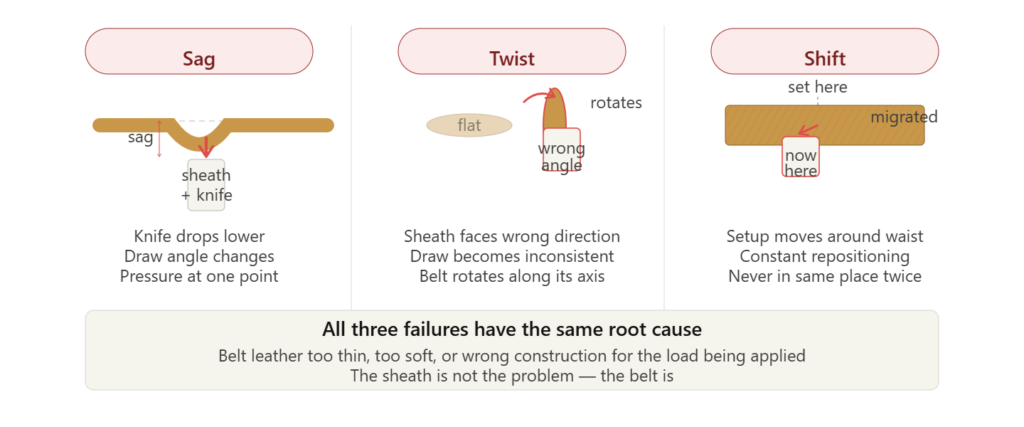
Belt failure under carry load takes three distinct forms, and each one produces a different carry problem.
Sag is the most common. The belt bends downward under the weight of the knife and sheath, pulling the sheath below its intended position. The draw angle changes, the knife sits lower than expected, and pressure builds at the attachment point. On thinner leather, sag is visible within the first hour of carry. On marginally better leather, it develops gradually over weeks of daily use and is often attributed to the sheath rather than the belt.
Twist happens when the belt rotates along its axis under load. A knife attached at the hip creates a moment arm — the weight of the sheath pulls the belt face outward at the attachment point. If the leather lacks the torsional stiffness to resist this, the belt rotates, changing the angle at which the sheath sits on the body. The result is a draw angle that feels wrong, a blade that points outward instead of downward, and inconsistent access because the sheath is never in exactly the same position twice.
Shift is lateral movement — the entire belt and sheath assembly migrates around the waist during movement. This is caused by a combination of insufficient belt thickness, a buckle that doesn’t hold position under dynamic load, and the absence of a structured keeper that prevents longitudinal belt movement. If you’re constantly repositioning your carry after walking, sitting, or changing posture, the belt is shifting.
All three failure modes feel like sheath problems. None of them are.
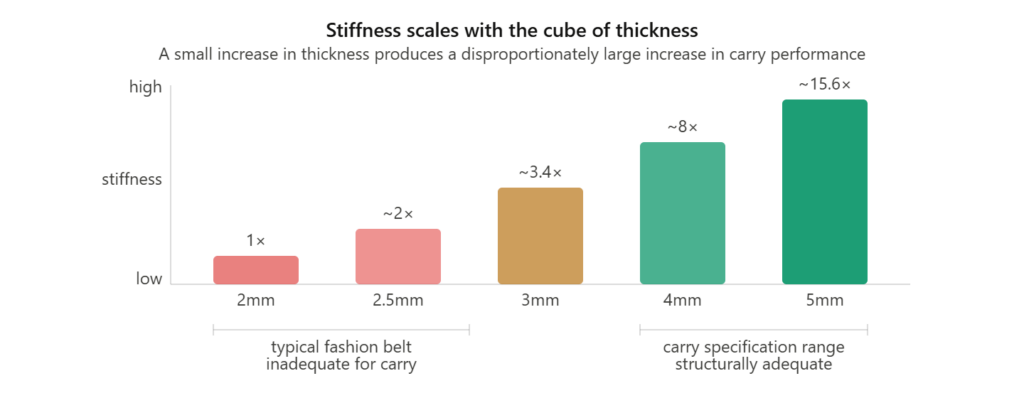
The most direct predictor of carry performance is leather thickness. Most fashion and dress belts run 2–3mm. At this thickness, the belt has enough stiffness to hold trousers in position under light load, but nowhere near enough to resist the bending moment created by a knife and sheath pulling outward at a fixed point.
The physics are straightforward: bending stiffness in a flat beam scales with the cube of thickness. A 3mm belt is not 25% less stiff than a 4mm belt — it is approximately half as stiff. A 2.5mm belt is less than a third as stiff as a 4mm belt. These are not marginal differences. They represent entirely different structural performance categories.
For knife carry under 1kg total load (knife plus sheath), 3.5mm is the minimum adequate thickness. For loads above 1kg, or for multi-tool setups where multiple items are attached to the belt simultaneously, 4–5mm single-layer full-grain leather is the appropriate specification. Below these thresholds, sag and twist are not occasional problems — they’re engineering certainties.
For a full breakdown of how leather thickness affects load performance, see our [guide to 4mm vs 5mm belt thickness →]
Thickness alone isn’t sufficient if the construction is wrong. A 4mm belt built from bonded leather — ground leather fibre mixed with polyurethane binder and pressed into a sheet — has very different mechanical properties from a 4mm single-layer full-grain belt, even though both measure 4mm on a calliper.
Bonded leather has no continuous fibre network. The material is a composite with low tensile strength in the horizontal direction — the direction that matters when the belt is under tension from a sheath pulling outward. Under sustained carry load, bonded leather compresses and deforms at the attachment point. The failure is often slow enough that it’s not immediately obvious, but after several months of daily carry the belt no longer holds the sheath in the position it was originally set.
Split leather — the lower hide layer, commonly used in “genuine leather” products — has a coarser, more parallel fibre structure than full-grain. It resists sag better than bonded leather but is significantly less stiff than full-grain at equivalent thickness. A split leather belt at 4mm will perform similarly to a full-grain belt at 3mm — which is to say, marginally adequate for light carry and inadequate for anything heavier.
For a full explanation of leather grades and what they mean structurally, see our [full-grain vs top-grain vs genuine leather guide →]
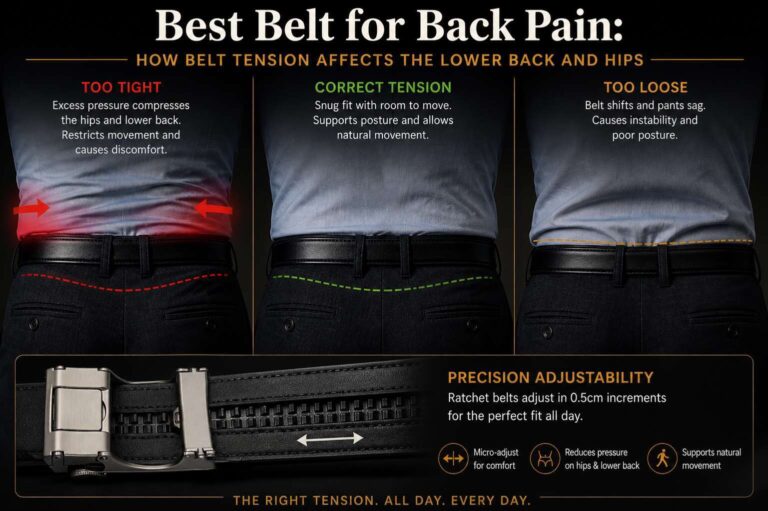
The buckle determines whether the belt holds its tension setting across a full day of movement. A pin buckle on a fixed hole holds at one point under one tension — and that tension changes as the wear hole enlarges over months of use. The belt that felt correctly tensioned in month one is slightly looser in month six, which means the entire carry system has slightly more movement.
A ratchet mechanism with 0.5cm adjustment increments allows you to set tension precisely and maintain that setting consistently. For carry use specifically, this matters because consistent belt tension is what keeps sheath position stable. A belt that loses 3–4mm of tension over a day of wear allows enough sheath movement to affect draw consistency.
For a technical comparison of how each mechanism distributes load differently, see our [ratchet belt vs traditional belt guide →]
Width affects how load is distributed across the trouser waistband and how well the belt resists lateral tilting at the sheath attachment point.
A 32mm dress belt with a knife sheath attached concentrates the attachment load over a small footprint. The belt edges at the attachment point bear disproportionate stress, and the narrow strap is more prone to lateral tilt than a wider one. A 38–40mm belt distributes the same load across a larger footprint, reducing stress per unit width and improving resistance to tilt.
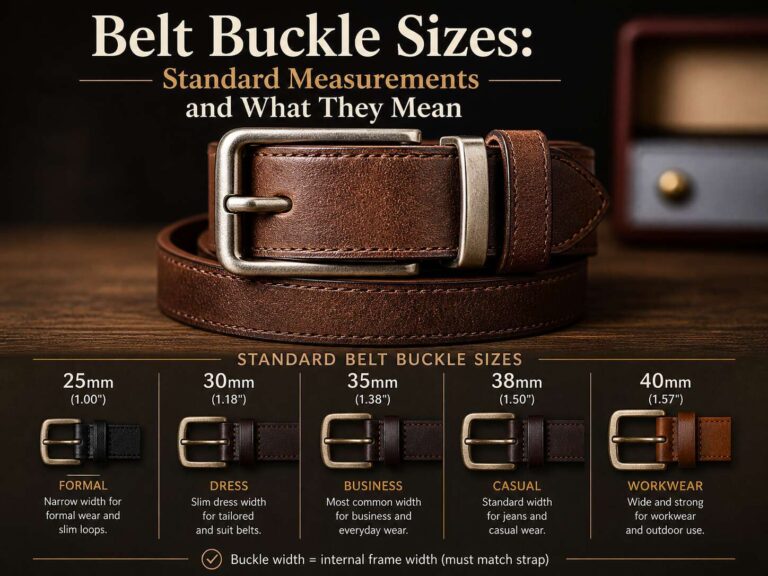
Most EDC knife sheaths are designed around a 38mm (1.5 inch) belt loop. Running a narrower belt through a sheath designed for 38mm creates additional play that compounds the movement problem.
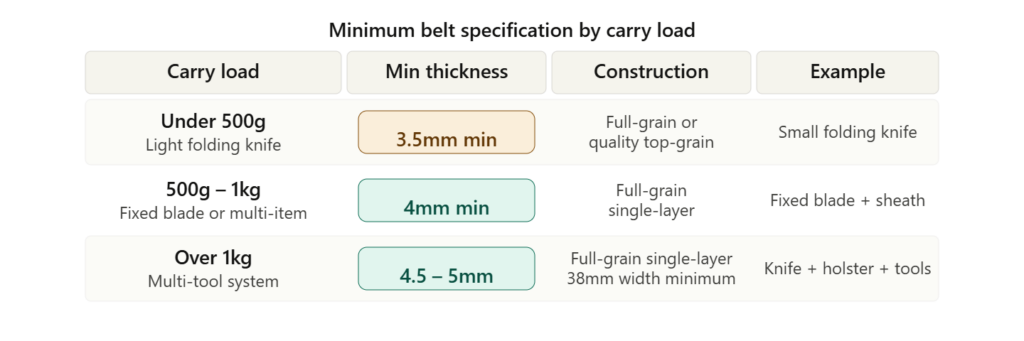
The structural requirements for a carry belt are specific and testable.
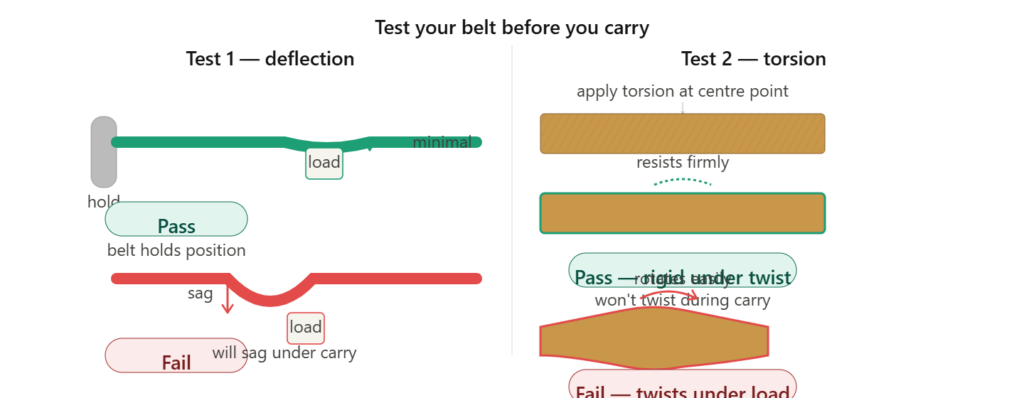
Resist bending under static load. Hold the belt horizontally at one end with a knife and sheath attached at the midpoint. A belt adequate for carry should show minimal deflection. If it bows noticeably under the weight of the sheath alone, it will perform worse under movement.
Resist torsion at the attachment point. Hold the belt flat and try to rotate it along its axis at the sheath attachment point. A structurally adequate belt should resist this with firm, even stiffness. If it rotates easily, it will twist during carry.
Maintain buckle tension across movement. A ratchet belt should hold its set tension through repeated sit-stand cycles. If you set the tension correctly seated and find it has shifted after walking for an hour, the buckle mechanism isn’t holding.
Meet the thickness and construction specification for your carry load:
| Carry load | Minimum thickness | Construction |
|---|---|---|
| Under 500g (folding knife, light sheath) | 3.5mm | Full-grain or quality top-grain |
| 500g–1kg (fixed blade, or multiple items) | 4mm | Full-grain single-layer |
| Over 1kg (multi-tool system, heavy fixed blade) | 4.5–5mm | Full-grain single-layer |
The failure pattern that most knife carry problems trace back to is treating the belt, sheath, and knife as three independent purchases rather than as a single system with a load path.
The load path runs from knife to sheath to belt to body. Every component in that path either transfers load cleanly or introduces movement. A high-quality sheath on a weak belt transfers load to a component that can’t handle it. The sheath holds the knife correctly. The belt fails to hold the sheath. The system fails.
Getting the belt right first — before evaluating sheaths or holsters — is the correct build order. The sheath selection matters, and carry orientation matters, but neither compensates for a belt that sags, twists, or shifts under the load you’re asking it to carry.
A belt that holds position makes every other component in the carry system perform better. A belt that fails makes every other component irrelevant.
When evaluating a belt for knife carry, these are the specifications that determine performance:
Leather grade and thickness: Full-grain at 4mm minimum for daily carry with a knife. Single-layer construction — not bonded, not layered. If the listing says “genuine leather” without specifying grade or thickness, assume it won’t hold under carry load.
Buckle mechanism: Ratchet with 0.5cm increments for carry use — consistent tension setting across the day. If using a pin buckle, full-grain at 4.5mm minimum to compensate for the tension inconsistency of fixed holes.
Width: 38mm (1.5 inch) minimum for knife carry. Matches standard sheath loop sizing and provides adequate footprint for load distribution.
Belt width at the sheath loop: Check that the sheath you’re pairing is designed for your belt width. Mismatched widths — a 38mm sheath on a 32mm belt — introduce play that no buckle adjustment can fix.
For a full breakdown of how to evaluate belt construction specs before purchase, see our [belt construction guide →]
For a very light folding knife worn occasionally, a quality 3.5mm fashion belt may be adequate. For daily carry of any fixed blade, or for daily carry of a folding knife and additional tools simultaneously, a fashion belt will produce sag, twist, or shift within weeks. The cumulative load of daily carry exceeds what most fashion belt constructions are specified for.
Outward tilt is belt twist. The sheath is doing its job — it’s holding the knife in the correct orientation relative to the sheath. The sheath is not doing its job of holding that orientation relative to your body because the belt is rotating at the attachment point. The fix is a stiffer belt, not a different sheath.
Up to a point. A 38–40mm belt distributes load better than a 32mm belt and resists lateral tilt more effectively. Beyond 40mm, the width advantage diminishes and the belt may not fit standard trouser loops without forcing. Match belt width to your trouser loop width and your sheath’s designed loop size.
The mechanism affects tension consistency more than structural stiffness. A ratchet belt at 4mm full-grain and a pin buckle belt at 4mm full-grain have similar structural stiffness — the ratchet belt holds tension more consistently across a full day of movement. For carry use where consistent sheath position matters, the ratchet mechanism’s 0.5cm adjustment precision is a functional advantage.
Remove the sheath and hold the belt horizontally with your hand at one end. Apply gentle downward pressure at the centre — about the weight of a folding knife and sheath. If the belt deflects noticeably, it will sag under carry load. Lay the belt flat on a table and try to rotate it along its axis at one point. If it rotates easily, it will twist during carry. These two tests identify the two most common belt failure modes before they cause problems.
HoldForm carry belts are specified for load — leather grade, strap thickness, and buckle mechanism listed on every product page. If you’re building a carry system and want to verify the belt spec before purchasing, contact support@holdform.com.
[View carry belt range →] [How ratchet belt mechanisms work — full technical guide →] [4mm vs 5mm belt thickness: structural comparison →] [Full belt construction guide →] [Horizontal vs vertical knife carry →] [Leather knife sheaths for belt carry →] [How to build a structured EDC system →] [Knife carry systems for belt EDC →]
For tactical and competition carry where a harder belt construction is required: IPSC Competition Belt Guide →

Practical belt guides, sizing tips, and exclusive offers — straight to your inbox.

Leave a comment