Most belt advice on this topic says “tight enough to hold your trousers but not so tight it’s uncomfortable.” That’s not an answer — it’s a restatement of the question. The correct belt tension has a specific mechanical definition, it changes between activities, and getting it wrong in either direction produces problems that most people attribute to the wrong cause.
A belt is correctly tensioned when it holds the trouser waistband in its designed position without compressing the trouser fabric at the belt loop attachment points.
The trouser waistband is constructed to sit at a specific position on the body — at the natural waist, at the hip, or somewhere between, depending on the trouser cut. The belt’s job is to maintain that position. The correct tension is the minimum tension that achieves this — the point where the waistband doesn’t drop or shift during movement, but the belt isn’t applying compressive force to the body beneath it.
Two specific failure modes indicate wrong tension:
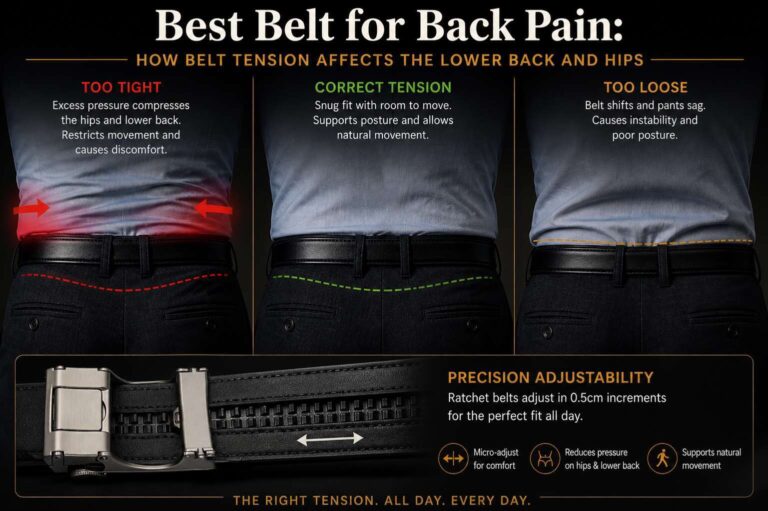
Too tight: The trouser fabric pulls inward at each belt loop, creating visible horizontal tension lines radiating from the loop attachment points. The waistband compresses the body rather than sitting against it. After two to three hours of desk work or sustained seated wear, this produces persistent discomfort at the hips and lower back — often attributed to the chair or posture rather than the belt.
Too loose: The waistband drops or shifts during movement. The belt migrates to a lower position than it was set. The trouser front loses its clean hang line. Less immediately uncomfortable than too tight, but produces the constant minor adjustment behaviour — pulling the trousers up, repositioning the belt — that signals the tension isn’t holding.

The waist circumference of most people changes by 1–4 cm over the course of a normal workday. The sources of this variation are physiological and predictable:
Meals: Eating produces transient abdominal expansion — typically 1–3 cm at the waistband level immediately after a meal, which reduces over 60–90 minutes as digestion progresses. A belt set at morning tension before breakfast is tighter after lunch. On a pin-buckle belt with holes spaced 25 mm apart, there is often no correct hole for the post-meal state — the choice is between a hole that was correct before eating (now too tight) and the next hole (too loose).
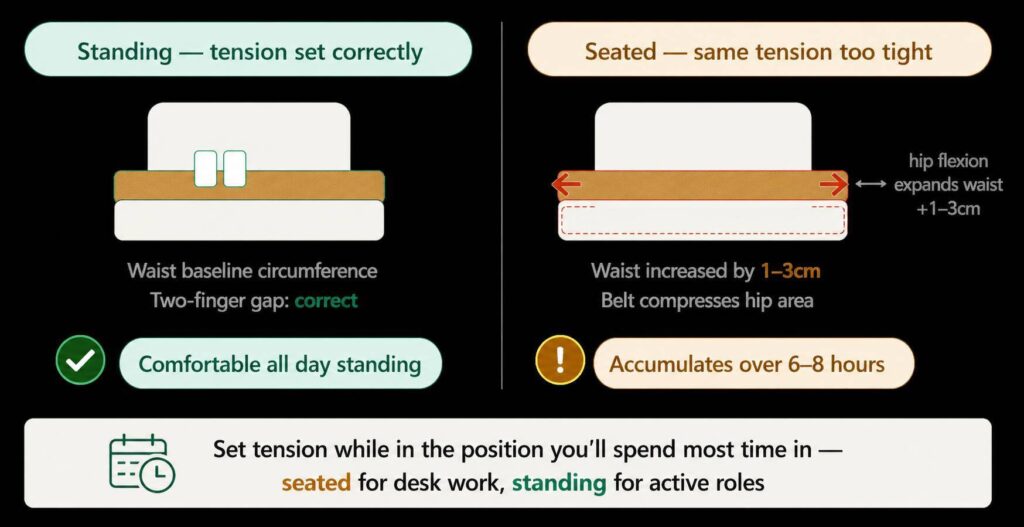
Sitting versus standing: The seated position changes the relationship between the trouser waistband and the body. When seated, the hips rotate and the anterior (front) hip area compresses. A belt set to the correct tension for standing creates compression across the hip flexors when seated. For someone spending 6–8 hours per day at a desk, this isn’t a minor annoyance — it’s sustained compression that accumulates into genuine discomfort by mid-afternoon.
Activity level: Physical movement — walking, exercise, physical work — requires slightly more waistband stability than sedentary activity. A belt that holds correctly during a desk day may feel slightly loose during sustained walking or physical activity, and vice versa.
The variation in correct tension through the day is the primary functional argument for micro-adjust mechanisms over fixed-hole pin buckles.
A fixed-hole pin buckle offers five positions spaced 25 mm apart. The correct tension at any given moment may fall between two of those positions. The wearer either accepts the compromise (most common) or adjusts to the nearest hole regardless of whether it’s actually correct (produces either the too-tight or too-loose failure mode).
A ratchet mechanism with 0.5 cm (5 mm) adjustment increments provides five positions within the same 25 mm span that a pin buckle covers with one. The correct tension can be set precisely and adjusted in seconds when conditions change — after a meal, transitioning from standing to desk work, or moving from a meeting to a commute.
For daily professional wear involving both desk work and meetings, or any context where tension varies meaningfully through the day, this precision is a functional advantage rather than a marketing claim.
For a full technical breakdown of how ratchet mechanisms work and how they compare to pin buckles, see our [ratchet belt vs traditional belt guide →]

The correct tension for a belt can be verified with a simple physical test that takes less than ten seconds:
Step 1: Fasten the belt at what feels like the correct tension standing up.
Step 2: Slide two fingers horizontally under the belt at the front, between the belt and the trouser waistband. With correct tension, two fingers should fit with light resistance — not loose, not requiring force.
Step 3: Sit down in a chair. If the two-finger gap disappears and the belt is pressing against your body when seated, the tension is too tight for seated wear. If the belt lifts away from the waistband when seated and you can fit four fingers, it’s too loose for standing stability.
Step 4: If you’re using a pin-buckle belt and neither hole passes both parts of the test, the holes are straddling your correct tension point. A ratchet or friction-lock belt at the correct position would resolve this.
Incorrect belt tension is an underrecognised contributor to lower back and hip discomfort during desk-based workdays. The mechanism is straightforward:
An overtight belt across the hip area compresses the external oblique muscles and the hip flexor muscle group. During prolonged sitting, these muscles are already in a shortened position. Adding compressive tension from an overtight belt increases the load on these already-compressed structures. Over 6–8 hours, the cumulative effect is muscular fatigue and tension that presents as general lower back or hip tightness.
The fix is not stretching or a different chair. It is resetting the belt to the correct tension for seated wear — which, on a fixed-hole pin buckle, may require moving to a looser hole than feels right standing up, and accepting that the belt will need resetting when you stand.
On a ratchet belt, the correct tension for seated and standing can be set independently within seconds. This is the practical reason why people who switch from fixed-hole to ratchet belts frequently describe improved comfort during long desk days — not because the ratchet mechanism is inherently more comfortable to wear, but because it allows precise tension setting for each activity state rather than requiring compromise.
Setting tension by feel while standing, then sitting for eight hours. Standing tension and seated tension are different. Set tension while in the position you’ll spend most time in — if that’s a desk, set it seated.
Over-tightening to compensate for a belt that migrates. A belt that migrates during wear is failing at the buckle mechanism or is the wrong width for the loop, not failing because it’s too loose. Adding tension doesn’t fix migration — it adds compression without solving the root problem.
Using the same hole every day out of habit. Waist circumference changes with diet, hydration, exercise, and season. The correct tension in winter under a heavier waistband layer is not the same as in summer. Check tension rather than defaulting to a familiar hole.
Ignoring visible tension indicators. Horizontal pull lines at belt loop attachment points are a reliable signal that the belt is too tight. They’re visible in photographs and in mirrors, but most people habituate to them and stop noticing. They indicate the waistband is under compressive load from the belt rather than just being held in position.
A belt is correctly tensioned when:
If these criteria cannot be met simultaneously with a pin-buckle belt, the correct tension falls between holes. A ratchet or friction-lock mechanism resolves this by providing the precision that fixed-hole spacing cannot.
For a suit, the belt should hold the trouser waistband position without compressing the fabric. The visual test: no horizontal pull lines at the belt loops when wearing the jacket open. For extended suit wear including meetings and desk time, set tension in the seated position — the standing tension can always be tightened slightly if needed, but the seated comfort is harder to recover once you’re uncomfortable.
No. A belt that requires effort to fasten is overtight. Correct tension should require light pressure to fasten, not force. A belt requiring significant effort creates compression throughout wear that accumulates into discomfort.
Wearing a correctly tensioned belt all day is not a problem. Wearing an overtight belt all day creates sustained compression at the hip and lower back that can produce muscular fatigue and tension. The issue is tension, not wearing duration.
Because it is tighter relative to your waist. Waist circumference typically increases 1–3 cm from morning to afternoon due to food, hydration, and postural changes. A belt correctly tensioned at 8am is likely overtight by 2pm. This is the most common experience that leads buyers from fixed-hole belts to ratchet mechanisms.
The waistband shifts during normal movement — dropping slightly when walking, requiring repositioning after sitting and standing. The belt buckle migrates off-centre through the day. These are signs of insufficient tension, not belt failure.
Yes. Consistent overtightening at the same fixed hole concentrates stress at that hole’s edges, accelerating hole enlargement and eventual leather cracking at the stress point. Correct tension at the right hole, or the distributed stress of a ratchet mechanism, significantly extends strap life.
HoldForm ratchet belts adjust in 0.5 cm increments — fine enough to set the correct tension for seated and standing wear without compromise.
[View ratchet belt range →] [How ratchet belt mechanisms work: full technical guide →] [Ratchet belt vs traditional belt: what actually differs →] [Best belt for office wear: fit system and leather grade →]

Practical belt guides, sizing tips, and exclusive offers — straight to your inbox.

Leave a comment