IPSC (International Practical Shooting Confederation) competition places a specific mechanical demand on a belt that standard belts — including most tactical belts — cannot meet: the belt must maintain absolute horizontal rigidity under the combined outward load of a holster, magazine pouches, and ancillary equipment attached to the outer face.
This is not a matter of belt quality in the general sense. A high-quality everyday leather belt or a standard nylon tactical belt will fail at this specific task regardless of construction quality, because neither is designed for the lateral load of a competition shooting rig. The solution is a hard belt — a specific belt category with a construction spec purpose-built for this use case.
This guide explains what makes a hard belt different, what the IPSC belt specification covers, and what to look for when choosing one.
In IPSC competition, a shooter draws a firearm from a holster attached to the outer belt, reloads from magazine pouches attached adjacent to the holster, and moves through a stage while maintaining both holster retention and magazine accessibility. The belt is the structural foundation for all of this.
Three mechanical demands are specific to this context:
Horizontal rigidity under outward load. A full IPSC rig — pistol holster, two or three magazine pouches, and sometimes a dump pouch — applies an outward moment force to the belt face. On a standard belt, this causes the belt to sag outward and the holster to tilt forward (cant). The draw angle changes, the holster retention loosens unpredictably, and magazine pouches shift position during movement. On a hard belt with sufficient stiffness, none of this happens — the belt maintains its flat profile under the full rig load.
Consistent draw angle. IPSC scores are partly determined by draw speed. A draw that produces an inconsistent angle — because the holster has shifted or tilted — introduces variation that slows the draw and affects grip. A correctly fitted hard belt holds the holster at a consistent position and angle across the duration of a stage.
Equipment stability during movement. IPSC stages involve running, crouching, and lateral movement. Equipment attached to a soft belt shifts position during these movements, which affects both draw access and overall stability. A rigid belt eliminates this movement.
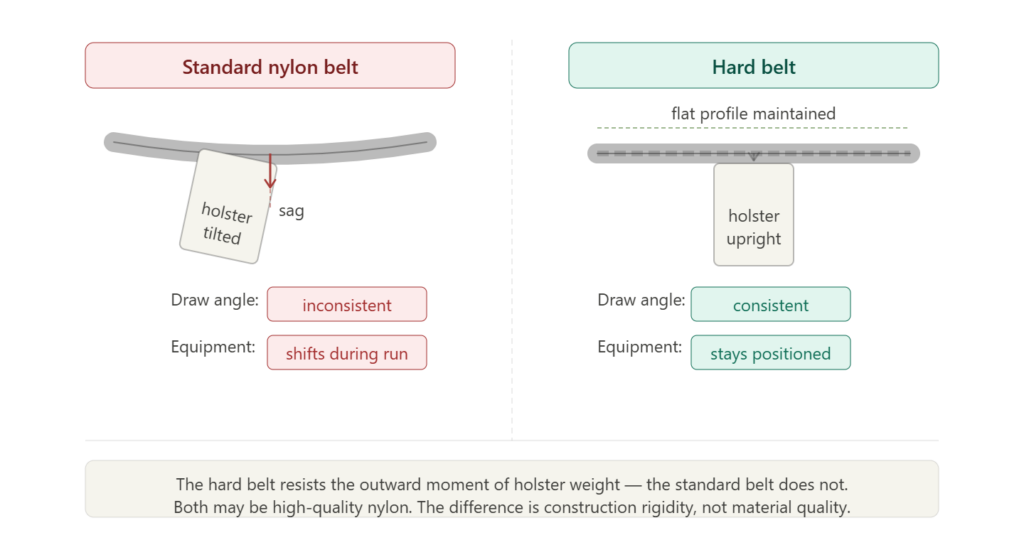
A hard belt uses a denser, stiffer nylon construction than standard tactical belts — typically 1000D or higher — combined with internal reinforcement to resist the outward flex moment that holster and pouch weight generates.
The critical distinction is structural rigidity, not just material strength. A strong standard nylon belt (1200D, well-constructed) still flexes under lateral load. A hard belt resists this flex. The construction method — weave density, internal reinforcement layer, edge treatment — is what produces rigidity rather than just tensile strength.
Hard belt vs standard nylon tactical belt:
| Property | Standard nylon tactical | Hard belt |
|---|---|---|
| Construction | Single-layer woven webbing | Double-thickened or reinforced internal core |
| Behaviour under holster load | Sags and rotates outward | Maintains flat horizontal profile |
| Draw angle consistency | Variable — holster tilts with belt | Consistent — holster stays at set position |
| Equipment movement during running | Present — gear shifts | Minimal — gear stays positioned |
| Daily comfort wear | Higher — more flex | Lower — stiffer feel initially |
| Correct for | General tactical, EDC, outdoor | IPSC, duty carry, holster rigs |
Buckle mechanism for IPSC: The buckle on a hard belt needs to stay locked under the sustained mechanical load of a full rig during active movement. A quick-release mechanism rated for this load is appropriate. An automatic slide-lock mechanism is the standard.
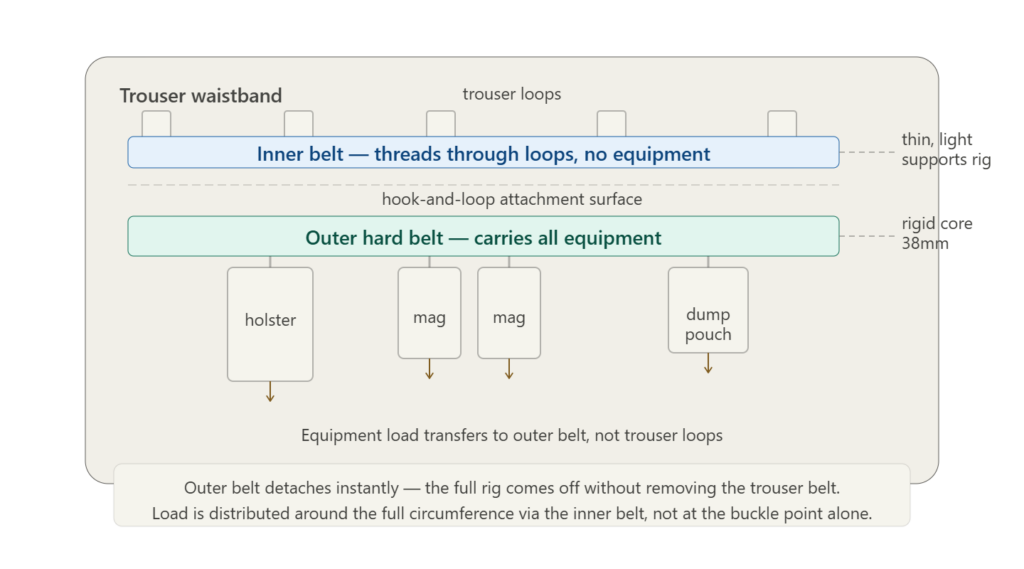
Most IPSC setups use a two-belt system: an inner belt and an outer belt.
Inner belt: A thin, stiff belt that threads through the trouser loops. It carries no equipment directly — its function is to provide the interface layer for the outer belt attachment system.
Outer belt (hard belt): The belt that carries the holster, magazine pouches, and other equipment. It attaches to the inner belt via hook-and-loop (Velcro) or a rigid clip system on the inner belt face. The outer belt does not thread through trouser loops — it sits over them.
The two-belt system has two functional advantages:
Load separation: The trouser loops carry only the weight of the inner belt — a thin, light strap. The outer belt and its full equipment load are supported by the inner belt attachment, distributing the rig weight around the full circumference rather than concentrating it at the buckle.
Quick removal: The outer belt detaches completely from the inner belt. At the end of a stage or when transitioning between contexts, the full rig can be removed in seconds without unbuckling the trouser belt. This is relevant for practical use at competitions where the rig is put on and taken off multiple times.
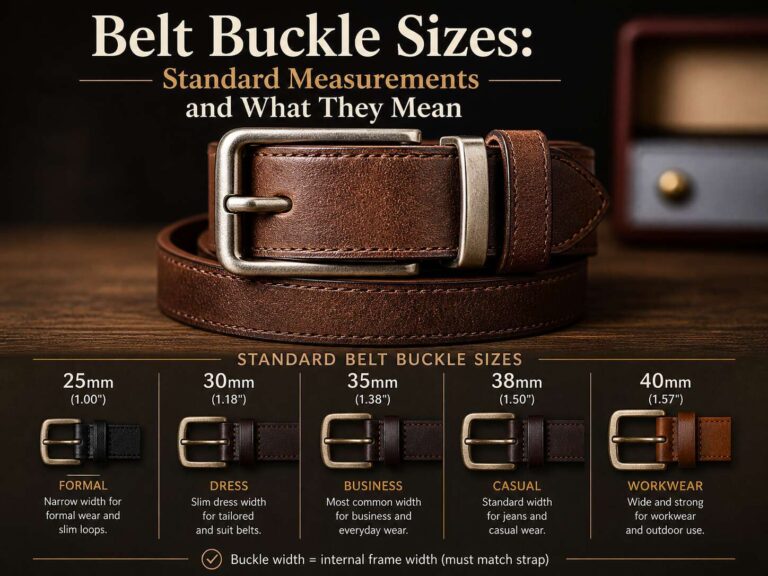
The industry standard for IPSC and competition holsters is 38mm (1.5 inches). This is the width that all major holster manufacturers — including most Kydex and injection-moulded OWB holster makers — design their mounting systems around.
Using a belt narrower than 38mm with a holster designed for 38mm produces lateral play between the holster mount and the belt. The holster shifts position during movement and the draw angle becomes inconsistent — exactly the problem a hard belt is intended to prevent.
Using a belt wider than 38mm (such as the 43mm VT44 in the HoldForm range) may not fit the holster mount. Confirm belt width against holster mount specification before ordering.
The Sentinel IPSC belt in the HoldForm range is 38mm — the correct width for standard IPSC holster and magazine pouch mounts.
The Sentinel IPSC Hard Tactical Belt → is the hard belt in the HoldForm tactical range. Key specifications:
| Feature | Specification |
|---|---|
| Construction | 1100D double-thickened nylon, reinforced internal core |
| Belt grade | Professional hard tactical / IPSC competition |
| Buckle | Zinc alloy automatic slide-lock, anti-oxidation |
| Edge treatment | Anti-curl, zero-roll construction |
| Width | 38mm — standard IPSC holster compatibility |
| Length | 120cm trim-to-fit |
| Weight | Approx. 240g |
| Colours | Black, Army Green, Wolf Brown, Dark Grey, Camouflage |
The internal support core is the construction detail that differentiates this from a standard nylon belt. The double-thickened 1100D weave resists the outward moment of holster load without the sagging or rotation that single-layer webbing produces.
Sizing for IPSC use: Measure your waist at the trouser loop level — not the natural waist. Add 15cm. Order the strap length that meets or exceeds this figure. For two-belt setups, the outer belt measurement should allow the buckle to sit at the correct position over the trouser belt buckle. Trim from the buckle end before first use.
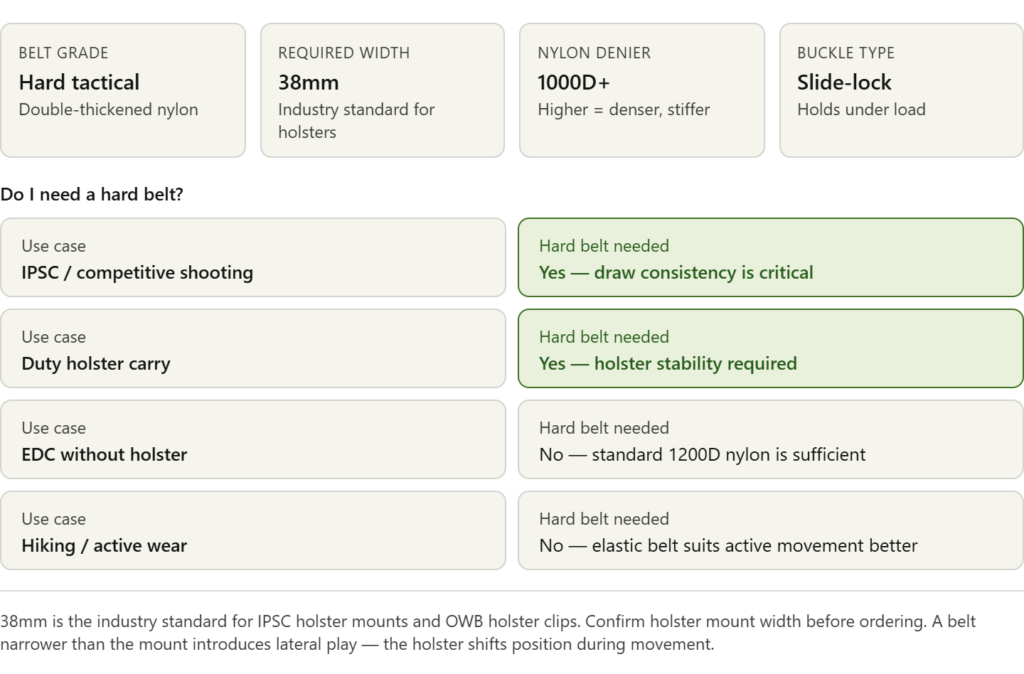
A hard belt is overkill for general daily use. The stiffer construction is less comfortable than a standard nylon belt for desk work, casual wear, or contexts without holster load. If the primary use is:
The hard belt specification is specifically correct for: IPSC and competitive shooting, duty holster carry, and contexts where equipment is attached to the belt and positional consistency of that equipment matters.
For everyday EDC knife and multitool carry without a firearm holster, the construction principles are the same but the belt specification is lighter. EDC Belt Carry Guide →
A hard belt is a tactical belt with a double-thickened or internally reinforced nylon construction designed to maintain horizontal rigidity under the outward moment load of a holster and magazine pouches. Standard nylon belts — even high-quality 1200D construction — flex under this load and the holster tilts. A hard belt does not. The term distinguishes this specific construction category from standard tactical webbing belts.
In construction, yes — the same rigidity requirement applies to police and security duty belts that carry a holster and equipment. IPSC belts are optimised for the additional requirement of quick draw consistency under competition conditions. Duty belts may also carry less gear in total and the design may differ slightly, but the hard belt construction principle is the same.
Not always — single hard belts worn through trouser loops are legal in IPSC Production and Standard divisions. The two-belt system is preferred in Open and Production Optics divisions where equipment load is higher and stage movement is more aggressive. For beginners, a single hard belt threaded through loops is the appropriate starting point.
Standard OWB (outside-the-waistband) Kydex and injection-moulded holsters with a 38mm belt loop or paddle mount are compatible. Confirm mount width against the 38mm belt spec before purchasing. Drop-offset mounts and thigh rig adapters use the same 38mm interface in most configurations.
Yes, but with the trade-off that it is stiffer than a standard nylon or leather belt. Some buyers find the additional lumbar support comfortable for long days on their feet. Others find the stiffness uncomfortable for extended desk work. The Enforcer or Apex-Flex are more appropriate for everyday non-holster use.
Remove the buckle by opening the rear lever. Cut the strap from the buckle end to your required length. Seal the cut edge with a lighter to prevent nylon fraying. Reattach the buckle. Full process: How to trim a tactical belt →

Practical belt guides, sizing tips, and exclusive offers — straight to your inbox.

Leave a comment