Zinc alloy and brass are the two most common belt buckle materials. They are not interchangeable — each suits a different belt type, a different aesthetic, and a different longevity profile. The right choice depends on which belt you are buying and what you expect from the hardware over years of daily use.
Solid brass is the correct material for pin-buckle heritage and casual belts. It has no coating to fail, no plating to peel, and ages through patina rather than degradation. Heavier and warmer in tone than zinc alloy.
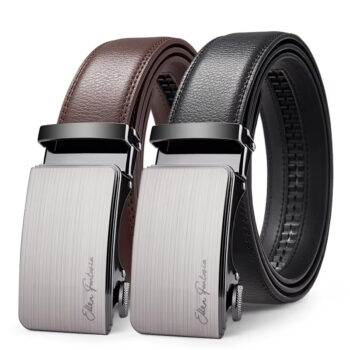
PVD-coated zinc alloy is the correct material for ratchet mechanism buckles. The die-casting precision zinc alloy allows is necessary for the tight tolerances of the pawl-and-tooth mechanism. With PVD coating, the finish lasts 5–10 years of daily professional wear.
Electroplated zinc alloy — the most common hardware on mid-range belts — is adequate for occasional wear and poor for daily professional wear. The plating fails at friction points within 6–18 months of daily use.
Zinc alloy (also called zamak or pot metal in lower grades) is a cast metal produced by combining zinc with small amounts of aluminium, copper, and magnesium. The primary advantage of zinc alloy is its die-casting precision — liquid zinc alloy can be injected into moulds under pressure and reproduce fine details and tight tolerances consistently. This makes it the dominant material for ratchet mechanism housings, where the pawl-and-track engagement requires precise geometry.
Zinc alloy on its own is grey, relatively soft, and corrodes under sustained sweat exposure. For this reason, zinc alloy buckles are always finished — either electroplated (nickel, chrome, brass-tone, or black) or PVD coated (titanium nitride, chromium nitride, or zirconium nitride).
Solid brass is an alloy of copper and zinc, typically 60–70% copper and 30–40% zinc. It is significantly denser and harder than zinc alloy, with a warm yellow tone that is inherent to the material rather than applied as a coating. Brass does not require a surface finish for appearance or corrosion resistance — the material itself is the surface. Over time, brass develops a patina: a darkening and slight surface change caused by oxidation that adds character rather than indicating failure.
Brass is produced through extrusion, forging, or lost-wax casting rather than die-casting, which makes it more expensive and less precise for complex geometries. For this reason, solid brass is practical for pin-buckle designs — frames, centre bars, and prongs — but not for the complex mechanism housings of ratchet buckles.
The comparison between zinc alloy and brass is also a comparison between coated and uncoated hardware.
Solid brass is uncoated. The surface is the material. Scratching a solid brass buckle reveals more brass. The finish cannot chip, peel, or flake because there is no separate finish layer — only the brass itself.
Zinc alloy is always coated. The coating type determines the longevity:
Electroplating deposits a thin layer (10–25 microns) of finishing metal — nickel, chrome, brass-tone, or black — onto the zinc alloy surface through an electrical current. The coating sits on top of the base metal, bonded mechanically rather than chemically. At friction points — the prong tip, the frame bar contact, the release mechanism — this coating abrades through daily use. On a daily-wear belt, electroplated zinc alloy typically shows visible finish failure at friction points within 6–18 months.
PVD (Physical Vapor Deposition) deposits a coating of 1–5 microns at the atomic level in a vacuum chamber. The coating bonds chemically with the zinc alloy surface rather than sitting mechanically on top of it. The result is a surface hardness of 2,000–3,000 Vickers versus 150–200 HV for electroplating — 10–15 times harder. PVD-coated zinc alloy buckles withstand daily friction at contact points for 5–10 years before showing comparable degradation to what electroplating shows in 12–18 months.
The choice between zinc alloy and brass is partly determined by the belt mechanism:
Pin-buckle belts: Both materials work. Solid brass is the traditional and preferred choice for heritage, classic, and casual pin-buckle designs. The material’s density gives a satisfying weight, the lack of coating means no plating failure, and the patina development is part of the expected ageing behaviour for classic leather goods.
Ratchet belt buckles: Zinc alloy is the practical requirement. The ratchet mechanism — spring-loaded pawl, precisely spaced track teeth, lever release — requires the die-casting precision that zinc alloy provides. Solid brass cannot be die-cast to the tolerances required for consistent pawl engagement. For ratchet belts, PVD-coated zinc alloy is the correct specification; electroplated zinc alloy is a compromise.
Solid brass is noticeably heavier than zinc alloy at the same buckle dimensions. A solid brass pin buckle at 35mm typically weighs 40–60g. An equivalent zinc alloy buckle weighs 20–35g.
For buyers who prefer heavier, more substantial-feeling hardware, solid brass delivers this inherently. For buyers who prefer lighter hardware — particularly relevant for travel and all-day professional wear — zinc alloy is the more comfortable choice.
Neither solid brass nor PVD-coated zinc alloy contains nickel. Solid brass is an alloy of copper and zinc — naturally nickel-free. PVD coatings (titanium nitride, chromium nitride, zirconium nitride) are nickel-free and chemically inert.
Electroplated zinc alloy finishes may contain nickel in the plating layer. Once the plating fails at friction points, the base metal and any residual plating is exposed to skin. For buyers with nickel sensitivity, solid brass or PVD-coated zinc alloy are both appropriate. Electroplated zinc alloy is not.
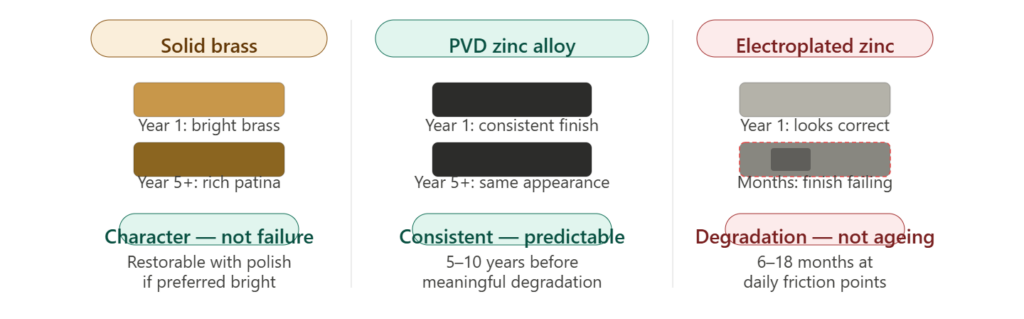
Solid brass develops patina over years of daily wear — the surface darkens gradually, particularly at contact points and edges, as the copper content oxidises. Patina is consistent with high-quality heritage leather goods and considered desirable by buyers who want hardware that ages rather than degrades. If you prefer the original bright brass appearance, a soft cloth or dedicated brass polish restores it in minutes.
PVD-coated zinc alloy maintains a consistent appearance over its service life. The finish does not patina or darken — it holds its colour. This is appropriate for buyers who want the hardware to look the same in year five as it did in year one. Degradation, when it eventually occurs, happens at friction points as the coating slowly wears through to the zinc base.
Electroplated zinc alloy degrades visibly and predictably. The finish dulls, then shows colour change at friction points as the base metal is exposed, then corrodes. This is not a considered ageing process — it is failure.
| Variable | Solid brass | PVD zinc alloy | Electroplated zinc |
|---|---|---|---|
| Coating | None — material is the surface | PVD — chemically bonded | Electroplated — mechanical bond |
| Surface hardness | 80–100 HV (brass) | 2,000–3,000 HV | 150–200 HV |
| Daily wear lifespan | Indefinite — patinas | 5–10 years | 6–18 months |
| Mechanism compatibility | Pin-buckle | Ratchet and pin | Any |
| Nickel-free | Yes — naturally | Yes — coating is inert | Depends on plating |
| Ageing behaviour | Patina — character | Consistent appearance | Degrades |
| Weight | Heavier | Lighter | Lighter |
| Best for | Heritage, casual, classic | Professional ratchet daily wear | Occasional wear only |
For pin-buckle heritage and casual belts: solid brass. No coating to fail, patinas naturally, indefinite service life. For ratchet belt mechanisms: PVD-coated zinc alloy. The die-casting precision zinc alloy allows is necessary for the mechanism tolerances, and PVD coating provides the finish durability the mechanism contact points require.
Depends on the finish. PVD-coated zinc alloy: 5–10 years of daily professional wear. Electroplated zinc alloy: 6–18 months before visible finish failure at friction points. The base material is the same — the coating is the variable that determines longevity.
Solid brass develops patina — a natural darkening caused by oxidation — over years of daily wear. This is different from tarnishing in the pejorative sense. Patina on brass is consistent with the expected ageing of quality leather goods. If you prefer the original bright appearance, it can be restored with a soft cloth or brass polish.
Zinc alloy itself does not contain nickel. However, electroplated zinc alloy finishes may contain nickel in the plating layer. Once the plating wears through at friction points, skin contact with the plating residue is possible. For nickel sensitivity: choose solid brass (naturally nickel-free) or PVD-coated zinc alloy (coating is nickel-free and inert). Avoid electroplated zinc alloy for daily wear if you have a nickel allergy.
On new hardware, both can look identical. On aged hardware, solid brass shows patina (darkening, particularly at edges and contact points) while zinc alloy shows plating failure (colour mismatch at worn spots, grey base metal visible). The weight test is useful: a solid brass buckle is noticeably heavier than an equivalent zinc alloy buckle at the same dimensions.
For the complete buckle materials guide covering brass, zinc alloy, stainless steel, titanium, and PVD coating in full detail, see our [belt buckle materials guide →]
[What is PVD coating on a belt buckle →] [Nickel-free belt buckles: why buckles cause skin rash →] [Types of belt buckles: ratchet, pin, roller and plate →]

Practical belt guides, sizing tips, and exclusive offers — straight to your inbox.

Leave a comment