Most leather product listings use grade terms as marketing signals — “full-grain” to suggest quality, “genuine leather” to suggest authenticity. Neither term is defined for the buyer, and the result is a market where a $25 belt and a $180 belt can both carry the same label without either being wrong.
This covers what the grades actually refer to structurally: which layer of the hide each one comes from, what processing changes about the material at each tier, and what that means for a belt that gets worn daily under load.
A cowhide is not a uniform material. It’s a layered structure with distinct mechanical properties at different depths — and those properties vary significantly from the outermost surface to the inner layers.
The outermost layer — the grain layer — has the tightest, most densely packed fiber network in the entire hide. This is not a coincidence of anatomy. The outer surface of an animal’s skin evolved over millions of years to resist exactly the stresses a belt encounters: abrasion, tension, moisture, repeated bending, and sustained load. The fiber bundles at the surface are interwoven at multiple angles, which gives them resistance to tearing in any direction.
As you move deeper into the hide, the fiber structure loosens. The fiber bundles become coarser, less interwoven, and more parallel in orientation. Parallel fibers resist load well in one direction but split readily when stressed laterally. This is why leather cut from deeper in the hide — even if it looks similar on the surface — performs differently under the mechanical stress of daily wear.
The leather grade system — full-grain, top-grain, genuine — maps directly onto this structural hierarchy. The grades tell you how much of the outer fiber layer was preserved, how much was removed, and what was done to replace what was taken away. Understanding that framework makes every leather spec sheet readable.
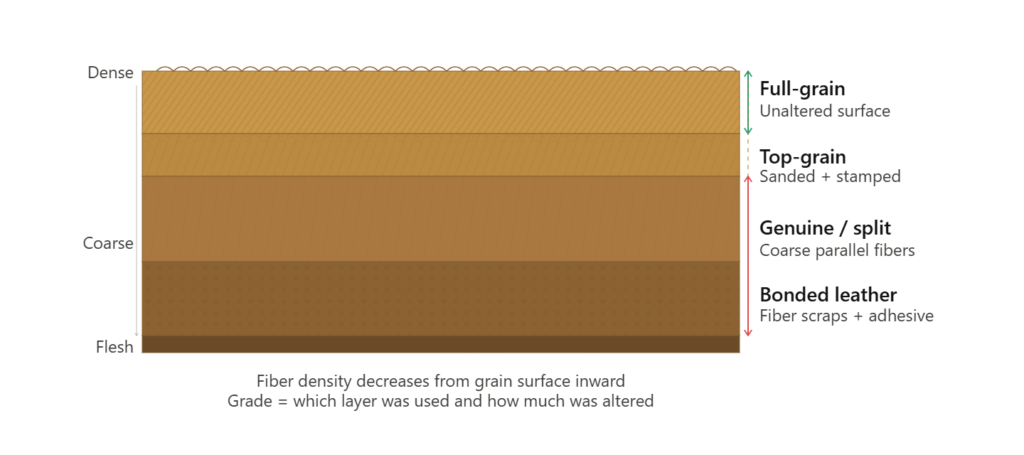
Full-grain leather uses the complete outer surface of the hide — the grain layer — with no sanding, buffing, or surface correction. The fiber structure from the outermost layer is intact. No material has been removed from the high-density zone.
This matters for two mechanical reasons.
Tensile strength: The interwoven fiber network at the grain surface resists tearing in multiple directions simultaneously. When a belt is under lateral load — a holster pulling outward, a buckle under tension — the fibers at the surface are the first line of resistance. Intact full-grain fiber structure resists that load without elongating significantly. Processed surfaces that have had the outer layer removed or disrupted don’t have the same multi-directional resistance.
Surface integrity under flex: A belt bends at the buckle fold and at the carry point hundreds of times a day. The grain surface on full-grain leather flexes without cracking because the fiber density at the surface is high enough to distribute stress across a large number of fibers simultaneously. When fewer fibers carry the same load — as in processed leather where the surface has been thinned — each fiber carries more stress per cycle, and cracking at flex points occurs sooner.
What natural markings mean: Full-grain leather retains the natural surface variation of the hide — subtle pore patterns, slight grain differences, and occasionally faint marks from the animal’s life. These are not defects. They’re evidence that the fiber surface hasn’t been altered. Perfect surface uniformity on leather is almost always a sign that the surface has been sanded and restamped — which is top-grain territory, not full-grain.
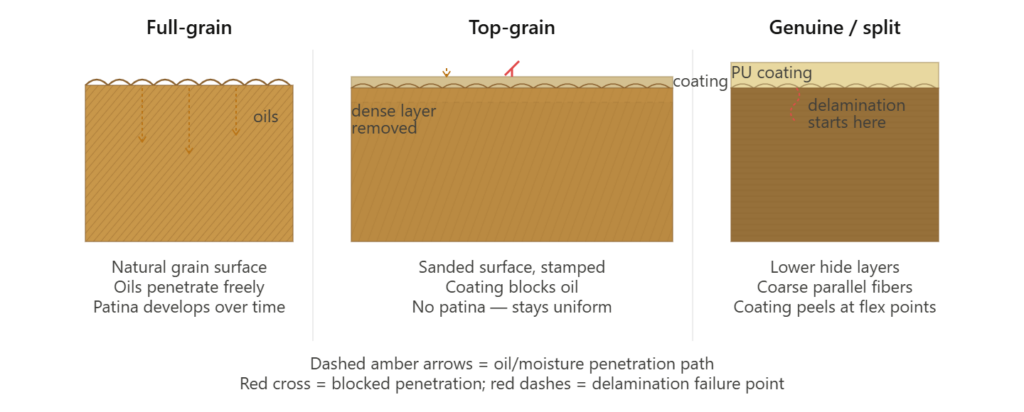
How full-grain ages: The patina that develops on full-grain leather is a structural process, not just aesthetic. As the leather is worn, natural oils from handling and body heat gradually penetrate the fiber network and increase the supple density of the surface. The leather doesn’t weaken over time — it becomes more consolidated. A well-maintained full-grain belt at five years is structurally denser and more flexible than it was new. Lower-grade leather doesn’t do this because the surface coating or processing prevents oil penetration.
Veg-tan vs chrome-tan full-grain: Full-grain refers to what layer was used, not how it was tanned. Full-grain leather can be vegetable-tanned (firm, develops pronounced patina, higher initial stiffness) or chrome-tanned (softer, more moisture-resistant, faster processing). For belt applications — especially carry use — veg-tan full-grain at 4–5mm is the most structurally capable combination. For dress belts where suppleness matters more than stiffness, chrome-tan full-grain is appropriate.
Top-grain leather starts with the same upper hide section as full-grain, but undergoes surface correction before finishing. The very surface of the grain layer is sanded or buffed to remove visible imperfections — scars, pore irregularities, natural marks. After sanding, a uniform grain pattern is stamped onto the surface, and a protective coating is applied.
The result looks cleaner and more consistent than full-grain. It also performs differently in specific and predictable ways.
What the sanding removes: The sanding process removes material from the outermost fiber layer — the highest-density zone. How much is removed varies by hide quality and manufacturer: a light correction removes only the surface irregularities while leaving most of the dense fiber network intact. A heavy correction — used on hides with significant surface damage — removes substantially more, cutting into the tight fiber zone and leaving a thinner high-density layer above the coarser mid-hide fibers.
This variance is why top-grain is a wide category. Well-corrected top-grain from a quality hide with minimal correction can perform comparably to full-grain in most non-carry applications. Heavily corrected top-grain from a lower-quality hide is closer to genuine leather in structural terms, even though both carry the same grade designation.
The stamped grain: After sanding, the surface has no natural texture — it’s smooth and undifferentiated. A grain pattern is embossed under heat and pressure to restore the appearance of natural leather. This stamped pattern is cosmetic. It provides no structural function and doesn’t affect the fiber network below. The surface coating that seals the stamped pattern adds abrasion resistance but also reduces breathability and prevents the oil penetration that produces patina.
How top-grain ages: Because the surface coating prevents oil penetration, top-grain leather doesn’t develop patina the way full-grain does. It stays visually consistent for longer — which some buyers prefer. When the surface coating eventually wears through at flex points, the underlying leather is exposed, and that exposure tends to show as wear rather than character because the fiber surface below the coating wasn’t conditioned throughout the belt’s life.
Where top-grain is appropriate: For dress belts worn intermittently — 2 to 3 times per week, no carry load, dress or business formal use — top-grain leather performs well and its visual consistency is a genuine advantage. The reduced patina development and uniform appearance suit formal contexts where you don’t want variation. For daily carry use with sustained load, full-grain at adequate thickness is structurally the better choice.
“Genuine leather” is a legally permitted label in most markets for any product that contains real leather. It’s not a grade in the same sense as full-grain or top-grain — it’s a minimum threshold. The label means the product is made from animal hide. It says nothing about which layer, what processing was applied, or how it was constructed.
In practice, products labeled “genuine leather” typically fall into two categories.
Split leather: When a hide is split to create a thinner sheet, the lower portion — below the grain layer — is called a split. Split leather has no grain surface. It’s entirely composed of the coarser, more parallel fiber structure of the mid-hide. To make it look like grain leather, a polyurethane coating is applied to the surface, sometimes with an embossed grain pattern. Split leather looks similar to top-grain in photos and on initial handling. Under sustained load, the parallel fiber structure stretches more readily, holes tear out faster, and flex point cracking occurs sooner.
Bonded leather: The lowest tier. Leftover leather fiber scraps and shavings are ground up, mixed with polyurethane binder, and pressed onto a backing material. The resulting sheet can be dyed and embossed to look like grain leather. It has no continuous fiber network — it’s a composite material. Bonded leather doesn’t stretch so much as it separates: the fiber matrix breaks down at stress points, and the material begins to delaminate and flake. In belts, this typically manifests as surface peeling at the buckle fold within 6 to 18 months of daily use.
Why the label persists: “Genuine leather” sounds like an assurance of quality. Legally, it’s just an assurance that animal hide is present somewhere in the product. The labeling convention creates genuine confusion — buyers assume it’s a positive designation, and manufacturers use it on products where specifying the actual grade would reveal lower material quality. A brand confident in its leather specifies the grade. “Genuine leather” is what appears when the grade isn’t worth specifying.
A belt is one of the most mechanically demanding applications for leather. It’s under tension for 8 to 12 hours a day, bends repeatedly at the buckle and carry point, bears lateral load from whatever is attached to it, and is adjusted hundreds of times over its life. The grade differences that are marginal in a wallet or a briefcase handle become significant in a daily-wear belt.
At the buckle hole: Pin buckle belts concentrate stress at a single hole in the leather. The fibers around that hole are compressed and spread with every insertion of the pin. Full-grain fiber density at the surface resists this compression and spreading better than lower grades — holes stay tighter for longer. In split or bonded leather, the weaker parallel fiber structure at the hole edge compresses permanently within months, and the hole enlarges to the point where the pin no longer holds the belt at the intended position.
At the flex point: The belt bends most sharply at the buckle fold and at the carry point. Each bend cycle stresses the surface fibers in compression and tension alternately. Full-grain leather distributes this stress across its dense, interwoven network. Top-grain leather, with its reduced surface density and coating, concentrates stress at the coating-to-fiber interface — which is why the coating cracks first at flex points on top-grain belts. Split leather, with no surface coating over coarse fibers, cracks directly through the fiber structure.
Under ratchet track load: A ratchet belt with an integrated track relies on the tooth geometry cut into the leather to hold under load. As covered in the ratchet mechanism guide, tooth depth requires sufficient leather thickness to provide adequate root margin. But leather grade affects this independently of thickness: full-grain fiber density at the tooth root means each tooth resists stripping under load because the fibers grip the pawl engagement across the full tooth face. Split or bonded leather at the same thickness provides the same tooth geometry but lower fiber resistance at the engagement surface — the tooth face compresses under repeated load faster than full-grain would.
For the internal linking: How leather grade interacts with belt thickness — specifically how the two specs compound at the ratchet track — is covered in the [4mm vs 5mm belt thickness guide →]. How the pawl engages the track and where failures begin is covered in the [ratchet belt mechanism guide →]. This article covers the material. Those cover the construction that depends on it.
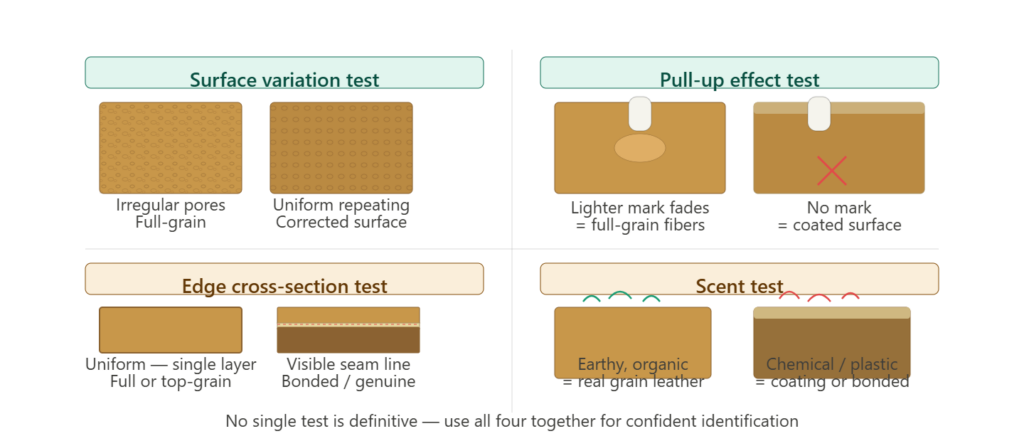
Most leather goods don’t come with a grade certificate. Here’s how to evaluate the material from what you can observe directly.
Surface variation: Natural full-grain leather has grain variation — pore patterns, subtle texture differences, and occasionally faint marks. These variations are irregular and non-repeating. Stamped or corrected leather has a uniform, repeating pattern. If you look at the surface under a raking light and see a pattern that tiles, the surface has been stamped. This doesn’t make it low quality — top-grain with light correction is a legitimate material — but it confirms the outer fiber layer has been altered.
The pull-up effect: On full-grain and high-quality top-grain leather, pressing a fingernail firmly into the surface and releasing it shows a temporary lighter mark that fades within a few seconds as the fibers redistribute. This is called pull-up. It indicates that the surface fibers are responsive to pressure — a sign of intact fiber density. Heavily coated or bonded leather doesn’t show pull-up because the coating prevents fiber movement from being visible at the surface.
Edge cross-section: Cut edge or visible belt end shows the construction in cross-section. Single-layer full-grain or top-grain leather shows a uniform cross-section — one continuous material from face to back. Bonded leather shows a visible layer structure: a thin face material, a clearly different backing material, often with a visible bonding layer between them. Split leather with a coating shows a thin coat layer over coarser underlying fiber that’s visually distinct from the face.
Surface smell: Real grain-layer leather — full-grain or lightly corrected top-grain — has a characteristic earthy, organic scent from the tannins and natural oils in the fiber. Heavily coated split leather or bonded leather smells predominantly of polyurethane — a plastic or chemical scent. This isn’t definitive, but it’s a reliable indicator when comparing unfamiliar materials.
Weight and stiffness per millimeter: At equivalent thickness, full-grain leather is denser and heavier than split or bonded leather because the fiber network is tighter. A genuine full-grain belt at 4mm will feel more substantial in hand than a split leather belt at the same stated thickness. If a belt feels light for its stated thickness, the material density is lower than expected.
The single most informative thing a leather product listing can do is specify the grade precisely and unambiguously. Not “genuine leather.” Not “high-quality leather.” The actual grade: full-grain, top-grain with degree of correction if known, or split leather with construction method.
Most listings don’t do this. The reasons are straightforward: precise specification creates accountability. A listing that says “4.5mm single-layer full-grain veg-tanned cowhide” can be tested against that claim. A listing that says “premium genuine leather” cannot.
When evaluating any leather belt — or any leather product built for daily load-bearing use — treat the absence of grade specification as information. It tells you the brand either doesn’t know what grade their material is, or knows and prefers not to say.
The table below summarizes the structural differences across grades for quick reference.
| Full-grain | Top-grain | Split / Genuine | |
|---|---|---|---|
| Hide layer | Outermost grain surface, unaltered | Upper hide, surface-corrected | Lower hide or fiber composite |
| Fiber density at surface | Maximum — tight, interwoven | Reduced by sanding | Low — coarse, parallel |
| Surface treatment | Natural or minimal finishing | Sanded, stamped, coated | Coated or bonded |
| Patina development | Yes — oil penetrates fiber | Limited — coating restricts penetration | No — coating or composite prevents it |
| Flex point performance | Distributes stress across fiber network | Cracks at coating-to-fiber interface | Cracks through coarse fiber structure |
| Hole stretch resistance | High | Moderate | Low |
| Expected lifespan (daily wear belt) | 7–15 years | 3–7 years | 6 months–2 years |
| Grade confirmation | Specify: “full-grain” | Specify: “top-grain” | Often labeled “genuine leather” |
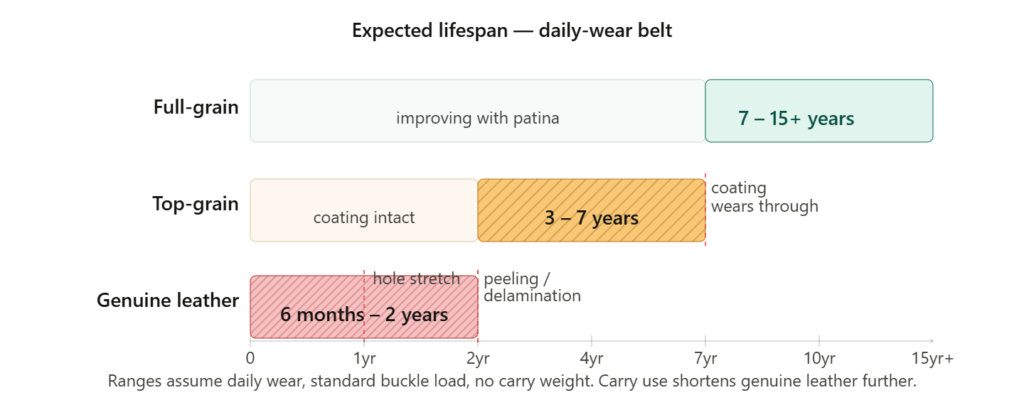
For daily wear belts under load — carry use, work use, frequent daily wear — full-grain with intact fiber surface is structurally superior. For dress belts worn 2 to 3 times per week with no carry load, lightly corrected top-grain from a quality hide performs adequately, and its visual consistency can be an advantage in formal contexts. The question isn’t which grade is universally better — it’s which grade is appropriate for the application and wear frequency.
Partially. Natural surface variation, irregular pore patterns, and the pull-up effect under fingernail pressure are indicators of intact grain surface. Perfect surface uniformity with a repeating grain pattern indicates correction. But a full confirmation requires knowing the processing history — a brand that specifies “full-grain” and stands behind that claim is more reliable than visual inspection alone, because high-quality top-grain with light correction can look similar to full-grain without close examination.
Because surface correction removes the natural variation and imperfections that characterize full-grain. The stamped, uniform surface reads as “clean” and “refined” against full-grain’s natural variation. This is a genuine trade-off, not a deception: top-grain’s uniform appearance is a real characteristic that suits certain applications. The trade-off is that the visual consistency comes at a structural cost at the surface fiber layer.
No — it means the belt contains real animal hide leather. What it doesn’t tell you is which layer, at what thickness, or how it was constructed. A product labeled “genuine leather” could be a split leather belt with a polyurethane coating, or it could be a lower-grade full-hide product that simply wasn’t labeled precisely. In both cases, “genuine leather” tells you almost nothing useful about how it will perform. Assume the worst unless additional specifications are provided.
They’re independent variables that compound. A 5mm split leather belt is thicker than a 3mm full-grain belt — but the split leather’s coarser fiber structure means it performs worse under sustained load despite the thickness advantage. For carry use specifically, both variables need to meet a minimum threshold: full-grain (or high-quality lightly corrected top-grain) at 4mm minimum is the combination that holds up under daily carry load. For a full breakdown of how thickness affects belt performance, see our [guide to 4mm vs 5mm belt thickness →]
Tanning method and leather grade are separate specifications — both matter. Full-grain leather can be vegetable-tanned or chrome-tanned. Veg-tan full-grain is firmer and develops more pronounced patina; chrome-tan full-grain is softer and more moisture-resistant. The grade tells you which layer was used; the tanning method tells you how that layer was processed. A belt specified as “full-grain chrome-tan” tells you both. A belt specified as only “full-grain” leaves one variable unknown.
HoldForm specifies leather grade, tanning method, and strap thickness on every product page. If those details aren’t listed on a belt you’re comparing, the omission is worth noting.
For a full overview of all leather grades including bonded leather and PU synthetic, see: Leather grades explained →
[View full construction specifications →] [How leather thickness affects belt performance under carry load →] [How ratchet track construction depends on leather grade and thickness →] [Full belt construction guide →]

Practical belt guides, sizing tips, and exclusive offers — straight to your inbox.

Leave a comment