Most leather products are labelled “genuine leather” — which sounds reassuring but describes the lowest quality grade that can legally call itself leather. Understanding what the label actually means, and what the alternatives are, takes about five minutes and changes how you evaluate any leather purchase.
There are four grades in common use. From highest to lowest quality:
Each is made from cowhide (or occasionally buffalo or other hides). The grade describes how much of the original hide structure is preserved and what processing has been applied to the surface.
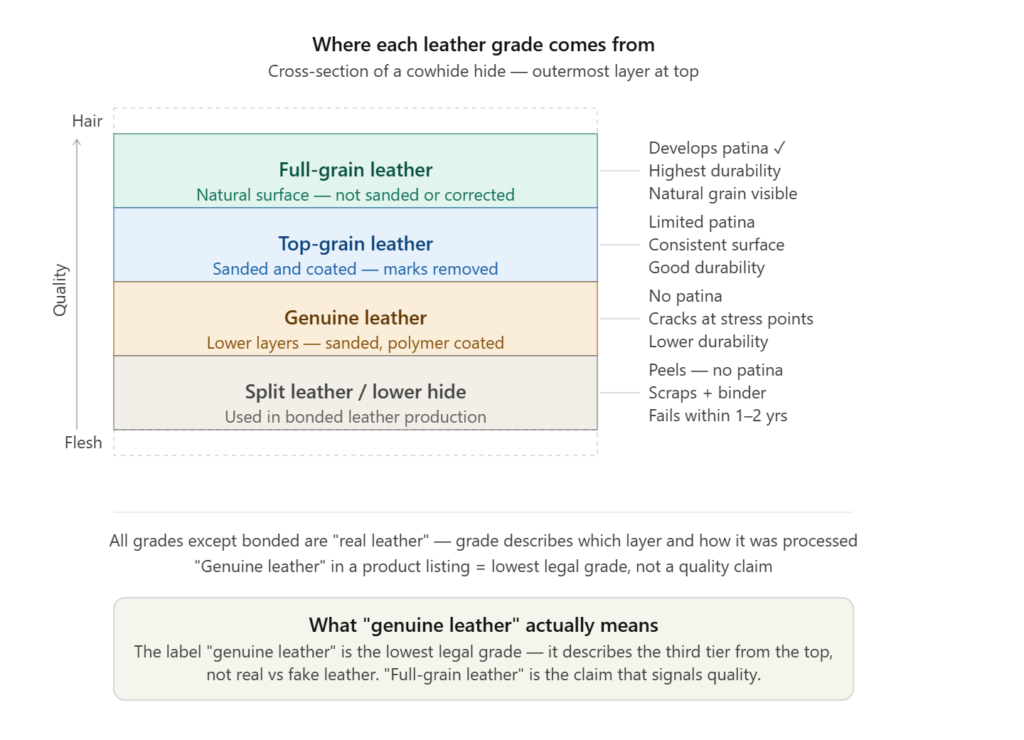
Full-grain leather uses the outermost layer of the hide — the surface that was directly beneath the animal’s hair. This layer has the highest fibre density and the most intact natural structure. It is not sanded, buffed, or corrected to remove surface marks.
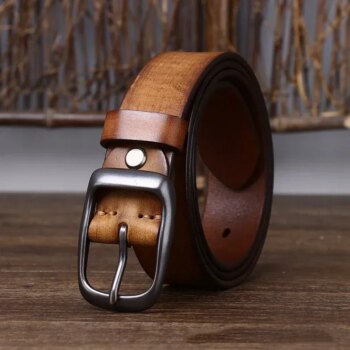
Full-grain cowhide belt range →
Because the natural grain is intact, full-grain leather:
The visible grain variation in full-grain leather — minor scars, insect bites, natural texture irregularity — is evidence of the grade, not a defect. Machine-consistent appearance is a characteristic of lower grades where the surface has been processed to remove variation.
Full-grain leather is the correct choice for products that will see sustained daily use and where you want the material to improve in character over years: belts, wallets, bags, boots.
Top-grain leather starts from the same outermost layer as full-grain but the surface is sanded and buffed to remove natural marks and irregularities. A polymer coating or corrected finish is then applied to create a consistent, uniform appearance.
Top-grain leather:
Top-grain leather is the standard for mid-range leather goods — belts, bags, and wallets at the middle of the market. It is a legitimate leather grade and a reasonable choice for buyers who prefer consistent appearance over natural character development.
“Genuine leather” is a specific grade — not a general term for real leather. It refers to leather made from the lower layers of the hide, below where the top-grain and full-grain layers have been cut away.
These lower layers have lower fibre density, less tensile strength, and a looser, more open grain structure. To make them usable as a visible surface, they are sanded smooth and a polymer coating is applied to the top.
Genuine leather:
In belts specifically, genuine leather at standard strap thickness (3–3.5mm) will compress at the buckle attachment point and flex creases over months of daily wear. Full-grain cowhide at the same thickness does not compress in the same way.
Bonded leather is not a leather grade in the same sense as the others — it is a manufactured material made from leather scraps and fibres mixed with polyurethane binder, coated with a surface layer that resembles leather.
Bonded leather:
Bonded leather should not be purchased for any product expected to last more than 12–18 months of daily use.
PU leather is entirely synthetic — it contains no leather. It is a polyurethane material that is manufactured to resemble leather in appearance and texture. It is not a leather grade and should not be labelled as leather, though it sometimes appears in product listings alongside leather grades.
PU leather is more flexible than genuine leather from first use and is lighter. It does not develop patina and has a different lifespan profile from leather under sustained daily wear. It is the correct material for buyers who want the aesthetic of leather at a lower price point and do not require the durability or ageing characteristics of genuine hide.
| Grade | Source layer | Surface processing | Patina development | Durability | Notes |
|---|---|---|---|---|---|
| Full-grain | Outermost — intact grain | None — natural surface | Yes — develops character over years | Highest | Natural variation is a quality indicator |
| Top-grain | Outermost — buffed | Sanded, corrected, coated | Limited — coating affects ageing | High | More consistent appearance than full-grain |
| Genuine leather | Lower layers | Sanded, polymer coated | No | Moderate | Legal minimum to use the term “leather” |
| Bonded leather | Scraps and fibres | Manufactured | No | Low | Peels — characteristic failure mode |
| PU / synthetic | No leather content | Manufactured | No | Variable | Not leather |
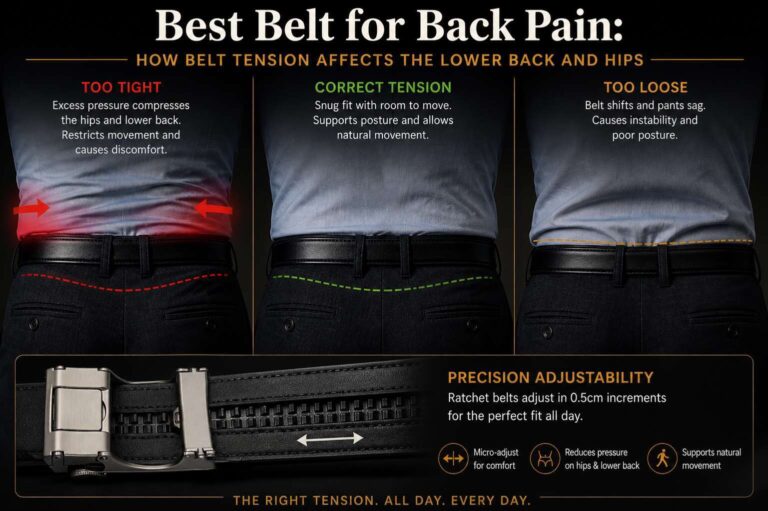
A belt is subject to sustained daily flex stress at the buckle fold, sustained tension through the strap length, and contact friction at the holes or ratchet track. These three stress points reveal the difference between leather grades over time.
Full-grain cowhide at 4–5mm thickness holds its flat profile under these stresses indefinitely. It does not crack at the hole edges (the fibre density is too high) and the buckle fold develops a flex memory rather than a permanent crease.
Top-grain cowhide at standard belt thickness performs well for several years of daily use before the edge stitching area and hole edges show stress — the buffed surface layer has slightly less resistance at these points than intact full-grain.
Genuine leather at belt thickness (typically 3–3.5mm to keep the product light enough for everyday carry) compresses and cracks at hole edges within 12–24 months of daily use. The lower fibre density means the punch holes elongate under sustained load.
Bonded leather belts typically fail within 12–18 months — the surface coating separates from the fibre core at flex points.
For a belt worn daily for multiple years, full-grain cowhide at 4mm minimum is the construction that delivers on the investment.
Most product listings do not state the leather grade clearly. Common obscuring practices:
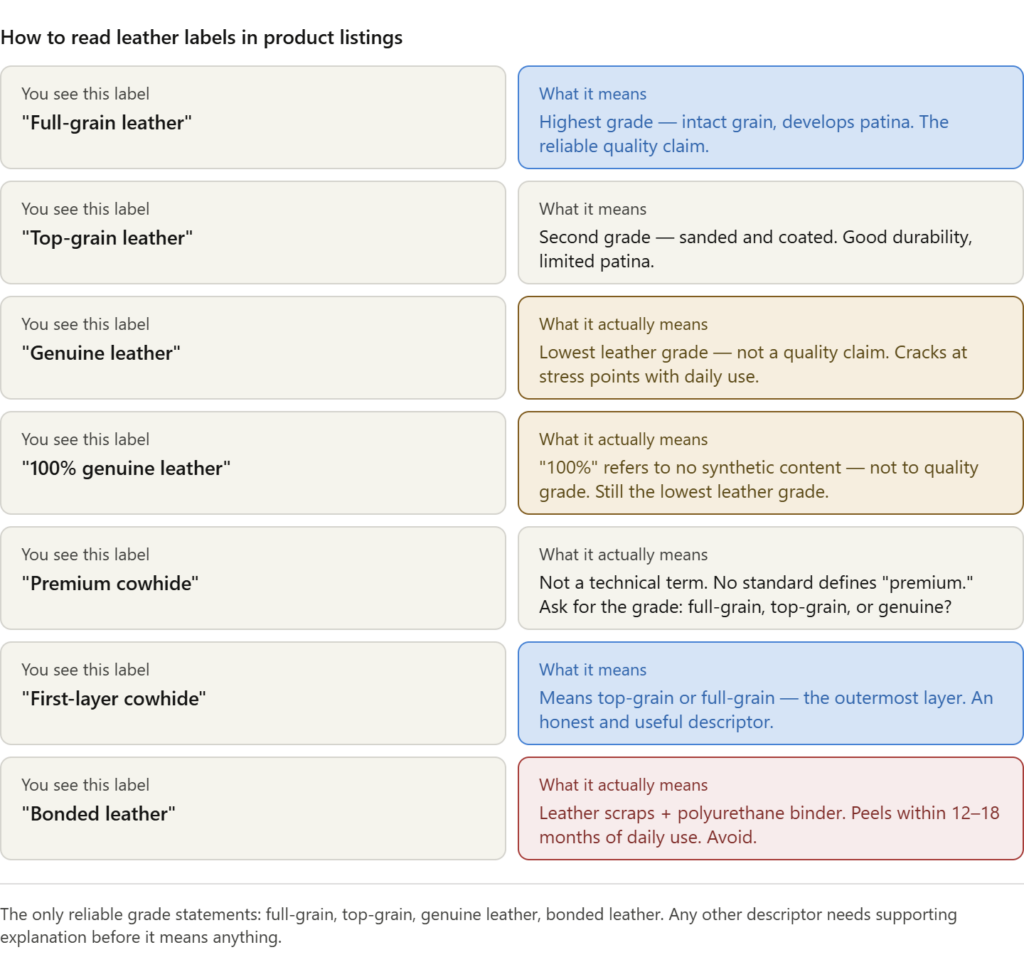
“Genuine leather” in marketing copy — sounds like a quality claim, is actually the lowest leather grade.
“Real leather” — means the product contains real leather content, which includes genuine leather and bonded leather. Not a grade statement.
“Premium cowhide” — not a technical term. No standards body defines “premium” in leather grading.
“First-layer cowhide” — means top-grain or full-grain. Honest and useful when stated.
“100% genuine leather” — 100% genuine leather is still the lowest grade. “100%” here means no synthetic content, not a quality grade.
The only reliable grade statements are: full-grain, top-grain, genuine leather, and bonded leather. Any other descriptor needs supporting explanation.

Practical belt guides, sizing tips, and exclusive offers — straight to your inbox.


Leave a comment