The buckle determines how a belt adjusts, how it ages, how it sits under clothing, and how the hardware reads in the context of an outfit. Two belts built from identical leather will perform and look completely differently depending on buckle type. Understanding the mechanical differences between closure types makes choosing the right belt straightforward rather than a matter of guesswork.
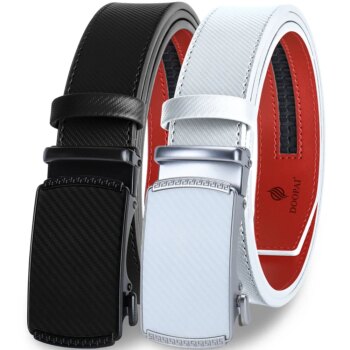
How it works mechanically: A ratchet buckle contains a spring-loaded pawl — a small pivoting tooth — inside the buckle housing. The strap has a series of teeth on its back face, either as a separate hardware track or integrated into the strap attachment. When the belt is fastened, the pawl engages the nearest tooth and locks the position. To release, a lever or button on the side or rear of the buckle disengages the pawl, allowing the strap to slide freely.
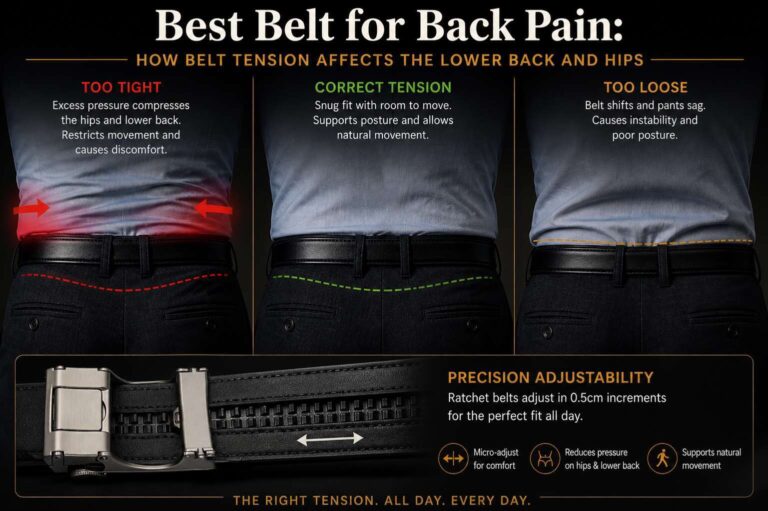
The adjustment is continuous — the strap can be positioned at any tooth along the track rather than at preset holes. The increment between teeth is typically 0.5cm, which provides five adjustment positions within the same 2.5cm span that a pin-buckle belt covers with one hole.
What this means in daily wear: Tension can be set precisely for different states — standing, seated desk work, travel, post-meal — without moving between preset holes. Because the leather face has no punched holes, there are no stress concentration points in the strap. Hole deformation — the progressive enlargement of a hole under daily pin-buckle use — is eliminated as a failure mode.
The finish dependency: Most ratchet buckle housings are zinc alloy die-cast — the die-casting process allows the tight tolerances required for the pawl-and-tooth engagement. The longevity of the finish depends entirely on coating type. PVD-coated zinc alloy holds its finish for 5–10 years of daily professional wear. Electroplated zinc alloy shows finish failure at friction points within 6–18 months. When evaluating a ratchet belt, the coating specification matters as much as the mechanism design.
Best contexts: Daily professional wear, business casual, office, travel. Any context where tension varies through the day and precise adjustment without hole-spacing compromise is valuable. The clean leather face (no visible hole pattern) suits tucked-shirt business contexts.
Less appropriate for: Heavy workwear and outdoor contexts with sustained dirt and debris exposure, where particles can work into the mechanism over time. Heritage and traditional aesthetic contexts where the classic pin-buckle is part of the visual intent.
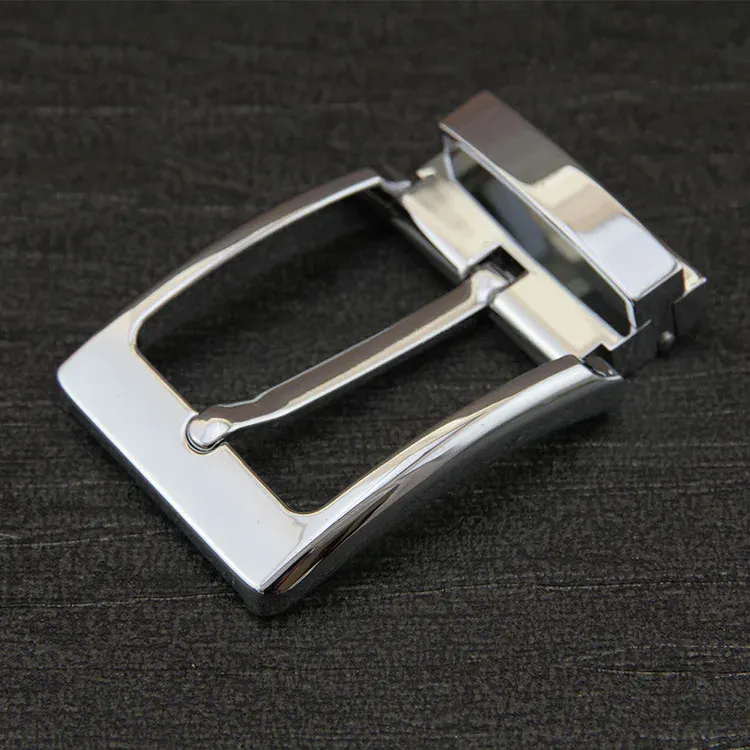
How it works mechanically: A rectangular or D-shaped metal frame has a fixed centre bar. A prong pivots from the centre bar. The leather strap has five to seven holes punched at 25mm intervals. The prong passes through one hole and sits against the leather face; the frame bar sits against the back face of the strap; the tail passes through the keeper loop.
Tension is set by hole selection — there are no intermediate positions. The belt is designed to be worn at the centre hole, with holes on either side providing a range of approximately 50mm above and below the designed fit position.
The mechanical trade-off: Every unit of belt tension is transferred from the buckle frame through the prong into the leather at the hole edge. This hole edge is under cyclical stress — the same point loaded in the same direction every time the belt is worn. Over time, the leather fibres at the hole edge separate and the hole elongates from round to oval. This is not a failure of the leather generally — it is localised fibre failure at a stress concentration point. The rate of deformation depends on leather grade and thickness: full-grain at 4mm resists deformation significantly better than thinner or lower-grade leather.
Roller buckles are a direct mechanical improvement to the pin buckle. A roller — a cylindrical bar that rotates freely — replaces the fixed centre bar where the leather contacts the buckle frame. As the strap tightens and the leather slides against the bar, the roller turns rather than creating sliding friction. This reduces the abrasion at the strap entry point, which is the second highest-stress location after the hole edge itself. Roller buckles extend leather life measurably under daily wear, particularly on heavier leather at 4.5–5mm where the contact force is higher.
Best contexts: Heritage, workwear, outdoor, casual denim — contexts where the classic mechanism aesthetic is part of the visual intent and where robustness under harsh conditions matters. Roller variant is specifically valuable for heavy leather and sustained physical work. Solid brass construction is appropriate for outdoor and workwear contexts where corrosion resistance without a plated finish is important.
Less appropriate for: Daily professional wear where tension variation requires more adjustment precision than fixed holes provide.
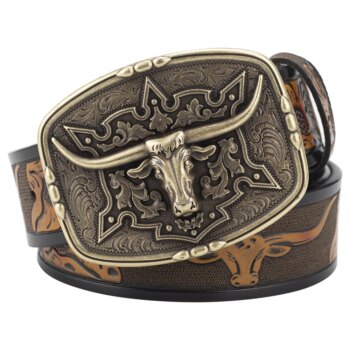
How it works mechanically: A plate buckle presents a solid decorative face that covers the closure area. The attachment to the strap varies by design — some use a hidden prong and hole system behind the decorative plate, others use a hook-and-bar system, others integrate a ratchet mechanism. The defining characteristic is the large flat or slightly curved face rather than an open frame.
The decorative face is the functional element from a styling perspective — it is the first thing visible at the front of the belt, often covering the entire width of the waistband with a designed surface.
What this means in wear: Plate buckles are hardware-dominant — they draw visual attention to the belt front rather than letting the belt disappear into the outfit. This is the opposite intent from dress belts and formal wear, where the goal is a clean, uninterrupted waistline. Plate buckles are appropriate in casual and fashion contexts where the belt hardware is a deliberate outfit element rather than a structural accessory.
The depth consideration: Plate buckles typically have more forward depth than frame buckles because the decorative plate sits on top of the closure mechanism. For anyone wearing a tucked shirt or a close-cut jacket, the plate profile creates a visible bump at the front waistline. This limits plate buckles to untucked-shirt and open-jacket contexts in most cases.
Best contexts: Casual outfits where the belt buckle is a deliberate statement element. Denim with an untucked shirt. Western and heritage-inspired styling where large buckle hardware is part of the tradition. Fashion-forward casual wear where the buckle is treated as jewellery.
Less appropriate for: Suits, formal wear, tucked-shirt professional contexts, or any context where belt hardware should be subtle.
The term “automatic buckle” is used inconsistently across belt listings — it describes both ratchet mechanisms (which are automatic in the sense of self-locking) and a specific lever-release variant worth distinguishing separately.
In the specific sense: an automatic buckle has a spring-loaded clamp that grips the strap continuously rather than locking at discrete teeth. A lever on the side releases the clamp, allowing the strap to slide to a new position. This provides infinite adjustment rather than the discrete increments of a toothed ratchet system.
In practice, most “automatic” belts sold today use a toothed ratchet mechanism with a lever release. The distinction is primarily in mechanism precision — discrete teeth provide consistent, repeatable positions that can be returned to exactly; continuous clamp systems provide infinite positions but can drift slightly under heavy load.
The buckle mechanism determines how it adjusts. The buckle material determines how long it looks correct.
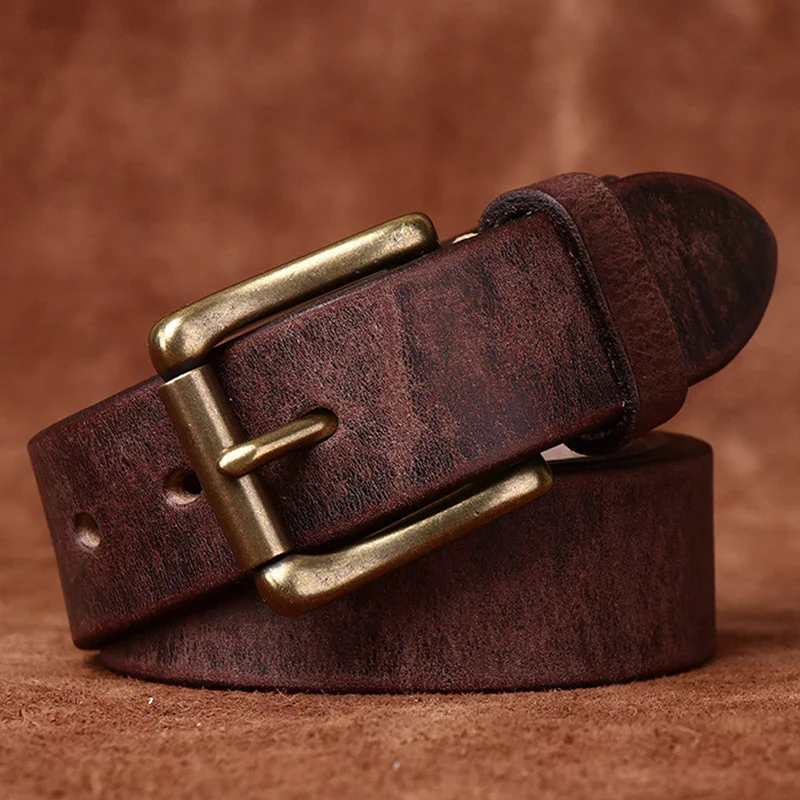
Solid brass is used for heritage and classic pin-buckle designs. It has no surface coating to fail — the brass surface develops patina over time rather than degrading. A solid brass buckle worn daily for ten years looks aged rather than failed. Not practical for ratchet mechanisms because solid brass cannot be die-cast to the tolerances required for pawl-and-tooth engagement.
PVD-coated zinc alloy is the correct specification for ratchet mechanism housings in contemporary professional belts. The die-casting precision zinc alloy allows is necessary for the mechanism tolerances. PVD coating — deposited at the atomic level in a vacuum chamber — bonds to the zinc alloy surface chemically rather than mechanically, producing a hardness of 2,000–3,000 Vickers versus 150–200 HV for standard electroplating. At daily-wear friction points, PVD outlasts electroplating by a factor of 3–5.
Electroplated zinc alloy — the most common material across mid-range and budget belts — has a finish lifespan of 6–18 months under daily professional wear before the plating shows visible failure at friction points. Adequate for occasional wear. Not adequate for a belt worn five days a week.
Stainless steel is used in buckle frames where mechanism complexity is low — simple frame buckles, centre bars, keepers. No coating to fail, no patina to develop. Consistent appearance indefinitely. The hardness of stainless steel makes it difficult to die-cast into complex ratchet mechanism geometries at consumer price points.
For a complete breakdown of buckle materials and finish types, see our [belt buckle materials guide →]
| Buckle type | Adjustment | Best for | Hardware spec |
|---|---|---|---|
| Ratchet | 0.5cm increments | Professional, office, travel | PVD zinc alloy |
| Pin — standard | Fixed holes, 25mm steps | Heritage, casual, workwear | Solid brass or stainless |
| Pin — roller | Fixed holes, reduced friction | Heavy leather, workwear | Solid brass |
| Plate / plaque | Varies by design | Fashion, casual statement | Mixed |
| Automatic clamp | Continuous | Dress, contemporary | PVD zinc alloy |
Business professional and office: Ratchet or automatic clamp mechanism with a flat, low-profile face. The precise adjustment handles the tension variation of a desk-based workday. The clean front face suits a tucked shirt or open jacket.
Business casual: Ratchet or pin-buckle depending on aesthetic preference. The hardware finish should match watch case metal — silver buckle with steel watch, brass or gold-tone buckle with gold watch.
Casual denim and weekend wear: Pin-buckle in solid brass or stainless. The classic mechanism suits the heritage character of denim and casual leather goods. Roller buckle if the leather is 4.5mm+ and longevity at the strap entry point matters.
Workwear and outdoor: Pin-buckle or roller buckle in solid brass or heavy-duty stainless. Simplicity and robustness under harsh conditions. Ratchet mechanisms are less suitable in heavily contaminated environments.
Formal suits: Ratchet or pin-buckle in a narrow, flat-profile frame. The buckle should be as unobtrusive as possible — low profile, no raised hardware, restrained finish. No plate buckles.
Statement casual: Plate buckle in any material. Untucked shirt, open jacket, or workwear denim. The buckle is the visual focus rather than something to minimise.
Ratchet mechanism: The strap feeds into the buckle rather than threading through a frame. There is typically a small lever or button visible on the side or back of the buckle. No holes in the leather face.
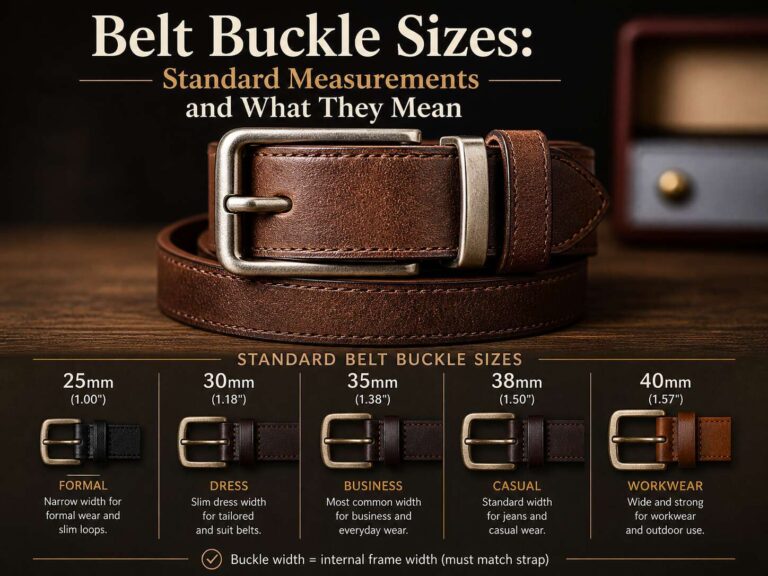
Pin buckle: Open rectangular frame with a visible centre bar and pivoting prong. The strap threads through the frame and has five to seven punched holes.
Roller buckle: Identical to pin buckle in appearance, but the centre bar is a cylinder that rotates when you press it with a fingertip. If the bar doesn’t rotate, it’s a fixed-bar pin buckle.
Plate buckle: The front of the buckle is a solid decorated face rather than an open frame. The closure mechanism is behind the plate.
Material identification: Solid brass is noticeably heavy and has a warm yellow tone at cut edges. PVD-coated zinc alloy has a consistent hard finish that resists scratching at surface level. Electroplated zinc alloy shows thinner coating at edges and corners — sometimes visible as a slightly different tone at the edge versus the face.
For longevity of appearance: solid brass pin-buckle or stainless steel frame — no coating to fail, no patina failure. For mechanism longevity under daily use: ratchet mechanism with PVD coating — the mechanism distributes stress across the track rather than concentrating it at a single hole edge, and PVD coating outlasts electroplating significantly at friction points.
For precision fit and longevity of the leather strap: yes — no holes means no hole deformation. For simplicity, robustness in harsh conditions, and heritage aesthetic: pin buckles are the more appropriate choice. They serve different contexts rather than one being universally better.
In most contemporary belt listings, “automatic” refers to a ratchet mechanism — the buckle locks automatically when the strap is inserted and releases with a lever. In some listings it refers to a continuous-clamp mechanism that provides infinite rather than incremental adjustment. Check whether the adjustment is in discrete clicks (toothed ratchet) or slides continuously (clamp mechanism).
A roller buckle has a rotating cylinder replacing the fixed centre bar where the leather strap contacts the buckle frame. As the strap tightens, the roller turns rather than creating sliding friction against the leather. This reduces abrasion at the strap entry point — the second highest-stress location on a belt after the hole edges — extending the leather’s lifespan at that point. Most valuable on heavy leather (4.5mm+) in workwear and daily casual contexts.
Ask for the coating specification. PVD coating over zinc alloy has a hardness of 2,000–3,000 HV and lasts 5–10 years of daily professional wear. Electroplating over zinc alloy has a hardness of 150–200 HV and shows visible failure at friction points within 6–18 months of daily wear. A listing that says “alloy buckle” or “premium alloy” without specifying the coating type is almost certainly electroplated zinc.
HoldForm belt hardware specifications — buckle type, base material, and coating process — are listed on every product page.
[View ratchet belt range →] [Belt buckle materials: zinc alloy, brass and steel compared →] [Silver, gold and black buckle finishes: how to choose →] [Ratchet vs traditional belt: full mechanism comparison →]

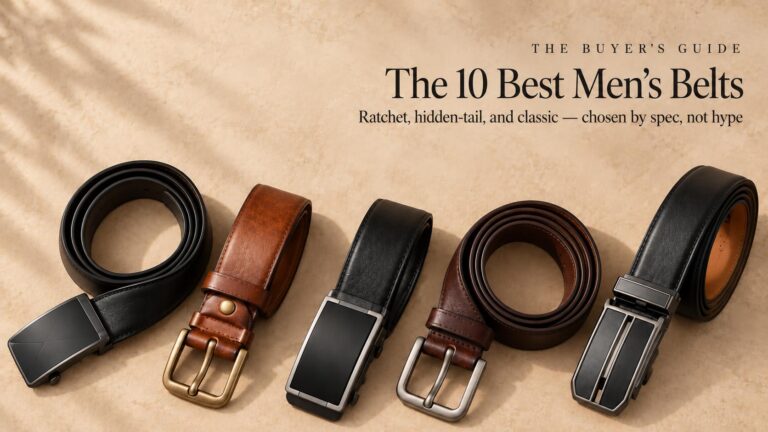
[…] Most “best belt” lists rank belts the writer never touched. This one is the ten we actually build and sell most — each with its declared spec so you compare on facts, not adjectives. Sorted by what each is best for. New to belt construction? Start with our guide to belt closure types. […]
Practical belt guides, sizing tips, and exclusive offers — straight to your inbox.