A reversible belt solves one specific problem: carrying two colour options in a single belt. For travel, minimalist wardrobes, or anyone who moves between black-shoe and brown-shoe outfits without wanting to manage two separate belts, it’s a genuinely practical design.
The mechanism that makes it work is simple — but the construction variables that determine whether it holds up are not obvious from most product listings. This covers how the rotating buckle system works, what fails on cheap implementations, and how to evaluate a reversible belt before buying.
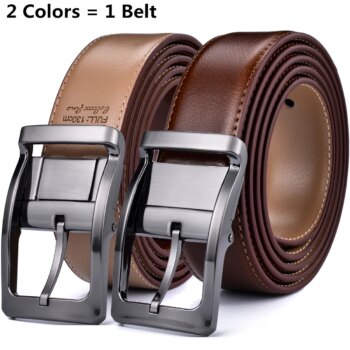
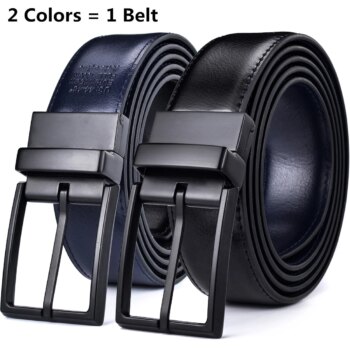
One belt covers both black and brown outfits — see the current reversible leather belts for men.
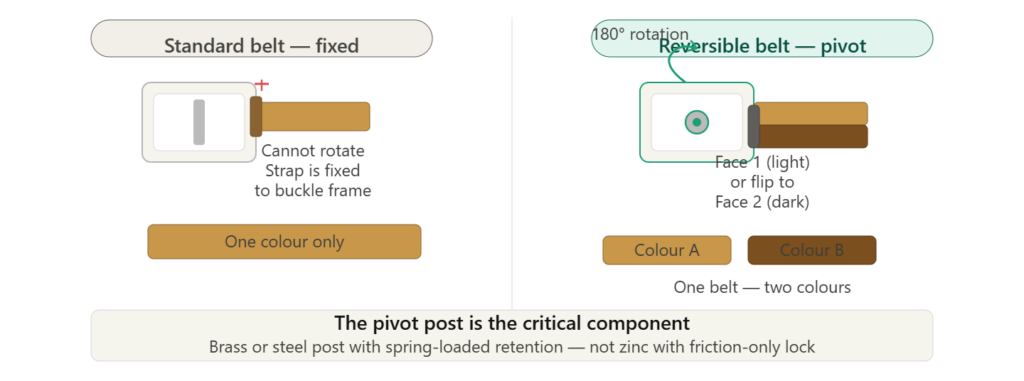
A standard belt has its strap attached to the buckle in one of two ways: stitched through a fixed loop on the buckle frame, or folded around the frame bar and secured with a rivet or screw. In both cases, the attachment is fixed — the strap can’t move relative to the buckle without disassembling it.
A reversible belt uses a different attachment: the strap connects to a central post or pivot point on the buckle that allows 180-degree rotation. When you want to switch colours, you lift or release a locking mechanism on the buckle, rotate the strap to expose the other face, and re-engage the lock. The buckle stays on the belt. Only the visible face of the strap changes.
The pivot point is the critical component. On well-made reversible belts, the pivot is a solid metal post with a friction or spring-loaded retention mechanism that holds the strap position once set. On cheap implementations, the pivot is a thin stamped ring with no retention mechanism — the strap flips when it should stay fixed, or won’t flip cleanly when you want it to.
The locking mechanism varies by design. Some buckles use a spring-loaded pin that seats into a notch on the pivot; others use a simple friction fit. The spring-loaded pin is more reliable because it holds the strap position positively — it doesn’t rely on leather tension or user grip to stay in place.
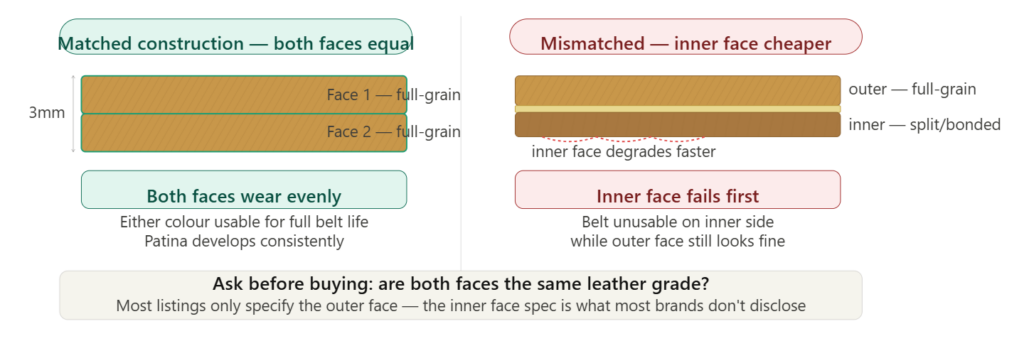
A reversible belt wears on both leather faces — this is an additional failure mode that single-sided belts don’t have.
On a standard belt, the inner face never sees UV exposure, handling friction, or visible wear. On a reversible belt, both faces are periodically the outer face, which means both faces accumulate surface wear. If the two leather faces are different grades — a full-grain outer face bonded to a lower-grade inner face — the inner face degrades faster, and the belt becomes unwearable on that side while the other face still looks acceptable.
A properly constructed reversible belt uses the same leather grade and thickness on both faces. This costs more to manufacture and is almost never specified in product listings, which is why it’s worth asking explicitly: are both leather faces the same material and grade?
The leather thickness also matters for reversible construction specifically. A reversible strap needs to be thin enough to flip cleanly through the buckle mechanism without excessive resistance, but thick enough to maintain structural integrity over years of daily wear. The practical range is 2.5–3.5mm per face — below 2.5mm the leather compresses at the buckle attachment point too quickly; above 3.5mm the strap becomes difficult to flip through the mechanism without stressing the pivot.
Pivot wear: The central pivot post bears rotational stress every time the belt is flipped. On zinc alloy posts with a thin chrome or nickel plating, this wear is visible within a year of regular use — the plating wears through at the rotation point, exposing the base metal. A brass or steel pivot post handles this rotation without surface degradation.
Leather delamination at the fold: Most reversible belts are constructed from two layers of leather bonded together through the strap length, with the two-tone colour visible at each face. The bond between the layers is under peel stress at the buckle fold — the tightest flex point on the belt. Adhesive-bonded construction without mechanical reinforcement at the fold eventually separates at this point. Look for stitching at the fold edges rather than adhesive alone.
Locking mechanism failure: Cheap reversible buckles lose their locking retention after a few hundred flips. The belt flips accidentally during wear — the strap rotates when it shouldn’t — which is both irritating and makes the mechanism functionally useless. Test this before purchasing: flip the mechanism several times and check whether the retention feels firm and consistent throughout, or whether it’s already loose in the shop.
Buckle post loosening: The central post that the strap wraps around can loosen from the buckle frame over time if it’s held by thread or adhesive rather than a mechanical fastener. A post that wobbles in the frame produces inconsistent strap alignment and eventually fails entirely. The post should be fixed to the frame with a mechanical screw or rivet — not press-fit or bonded.
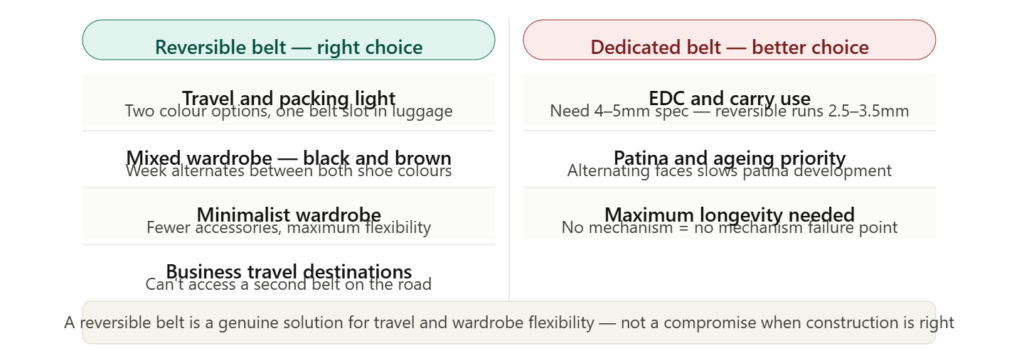
A reversible belt is the correct choice when:
You travel and pack light. One belt handling both black and brown leather outfits reduces luggage without any functional compromise. This is the strongest use case for reversible design.
Your wardrobe alternates between two colour palettes. If your typical week involves both black-shoe formal wear and brown-shoe casual wear, a reversible belt eliminates the decision of which belt to wear without requiring you to own two.
You carry one belt to a destination and need flexibility. Business travel to locations where you can’t easily access a second belt — the reversible design gives you the flexibility of two without the luggage space of two.
A reversible belt is not the right choice when:
You need a carry belt for EDC or holster use. Reversible belts run 2.5–3.5mm total thickness by design. This is adequate for everyday dress and casual wear but below the 4–5mm specification required for sustained carry load. If you need a belt that supports a holster, a knife sheath, or a multitool holster with daily load, a dedicated single-face carry belt at adequate thickness is the correct choice.
You want a belt that develops patina over time. Full-grain leather patina is a surface characteristic that develops from consistent UV exposure, handling, and body heat on the same face. A belt that alternates faces every few days doesn’t develop patina on either face at the same rate — the aesthetic payoff of full-grain leather aging is reduced.
Durability at the highest level is the priority. A dedicated belt built to a single specification — one leather grade, one construction method, no rotation mechanism — will outlast a reversible belt at equivalent price. The mechanism adds a failure point. For long-term daily wear with no interest in colour switching, a dedicated belt is the better investment.
Pivot post material: Brass or steel, not zinc alloy. Ask the seller or check the product spec sheet. If it says “alloy” without further specification, assume zinc.
Locking mechanism type: Spring-loaded pin retention is more reliable than friction-only. Test the flip action if you can — it should engage and release with consistent resistance rather than feeling loose.
Leather grade on both faces: Both faces should be the same leather grade. If the listing specifies “full-grain” only for the outer face, ask what the inner face is. Bonded or split leather on the inner face will degrade faster.
Fold edge construction: Look for stitching at the fold edges where the two leather layers meet. Adhesive-only construction is a delamination risk.
Stated leather thickness: 2.5–3.5mm per face for a reversible belt is the appropriate range. Below this range the leather compresses quickly at the buckle attachment; above it the mechanism becomes difficult to flip.
Locate the locking lever or button on the back of the buckle — on most designs this is a small tab or pin on the buckle frame. Press or lift it to release the pivot lock, rotate the strap 180 degrees so the other colour faces outward, then release the lock to re-engage it. The entire process takes under ten seconds once you’ve done it a few times.
Depends on the construction. A reversible belt where the strap is bonded through its full length and the buckle attaches via the rotating post can usually be trimmed from the tip end — the non-buckle end — without affecting the mechanism. Trimming from the buckle end risks disrupting the pivot attachment. Check the manufacturer’s trimming guidance before cutting.
Apply leather conditioner to both faces, not just the one you’re currently wearing. The inner face is still leather and dries out if untreated. Avoid conditioning the area immediately around the buckle pivot — oil or conditioner on the pivot mechanism can reduce the friction retention that holds the strap in position.
Yes, if the leather grade and buckle finish are appropriate. A full-grain reversible belt with a low-profile brushed buckle is appropriate for business and smart casual wear. The reversible mechanism is invisible when the belt is worn — nothing about the buckle reads as informal.
HoldForm reversible belts are constructed with matched leather grades on both faces and spring-loaded pivot retention. Full construction specifications — leather grade, pivot post material, locking mechanism type — are listed on every product page.
View the HoldForm reversible belt range →

Practical belt guides, sizing tips, and exclusive offers — straight to your inbox.

Leave a comment