A full-grain leather belt is under daily mechanical stress: buckle tension, repeated flexing at the fold, friction against belt loops, sweat and salt absorption, and compression during storage. None of these stresses are avoidable — they’re the conditions of daily use. What determines whether a belt lasts three years or fifteen is whether the leather retains the oils and suppleness it needs to flex under that stress without cracking.
This guide covers the specific steps for cleaning, conditioning, and storing a full-grain leather belt — including which products work, which damage leather, and what the early warning signs mean before failure becomes irreversible.
Leather is processed animal hide — predominantly collagen fibres bonded by natural oils and fats that give the material its flexibility and tensile strength. When those oils are depleted by sweat, heat, dry air, or chemical exposure, the collagen fibres become brittle. A belt that has lost its natural oils doesn’t feel significantly different until it cracks — at which point the fibre damage is structural and permanent.
Full-grain leather holds oils better than corrected or bonded leather because the outermost hide layer — the tightest, most densely structured part of the hide — is preserved. The surface acts as a partial barrier against moisture loss. But the barrier isn’t complete. In dry climates, with daily wear, or with sweat exposure, the oils deplete faster than the leather can compensate on its own.
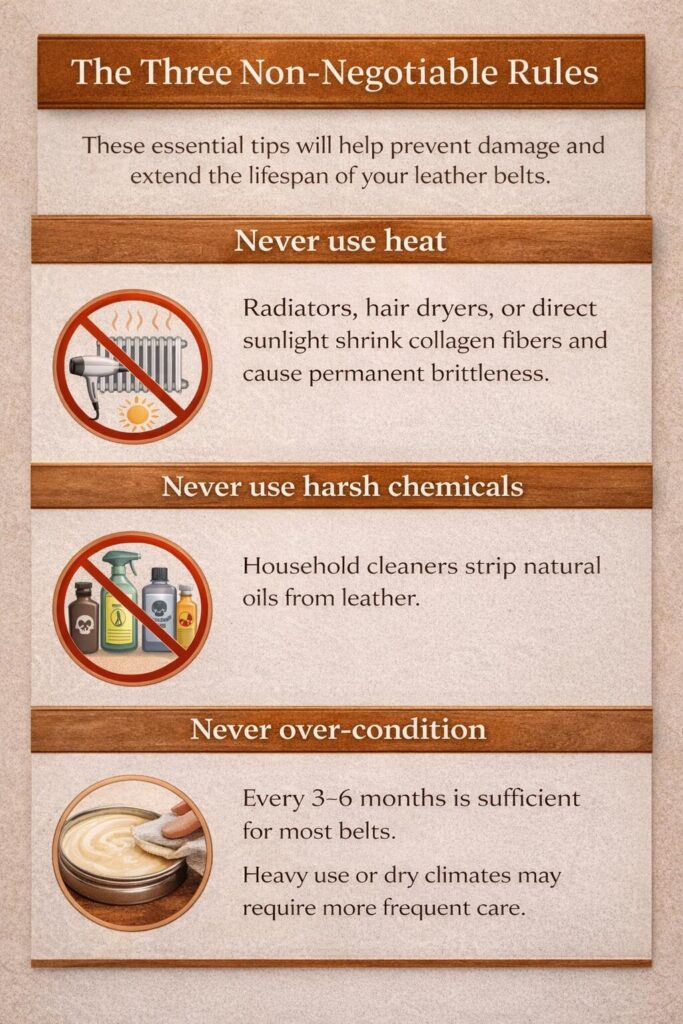
Conditioning replaces the depleted oils before the fibres become brittle. Done at the correct interval — every three to six months under normal conditions — it prevents cracking at the cost of thirty minutes twice a year.
What happens without care:
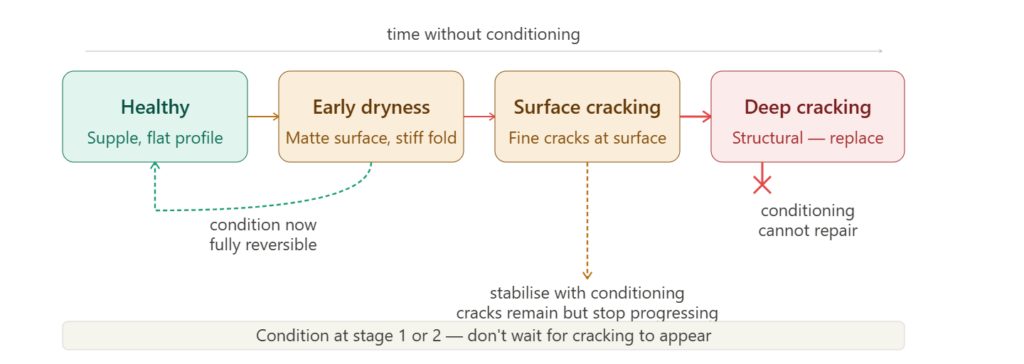
The belt develops surface dryness first — a slightly chalky or matte appearance that appears before any structural damage. Then stiffness develops near the buckle fold, where the leather flexes most frequently and loses oil fastest. Then surface cracking, initially fine and shallow. Then deep cracking at the fold, which is structural and irreversible. The entire sequence from healthy leather to irreparably cracked can take as little as 18 months under poor conditions — dry climate, daily sweat exposure, no conditioning.
Clean the belt before conditioning — conditioning over a dirty surface traps contaminants in the leather and produces uneven oil absorption.
What you need:
Step 1: Remove surface dust and loose dirt. Wipe the full length of the belt with a dry microfiber cloth, including the back face and the strap edges. Use light pressure — the goal is removing loose surface material, not scrubbing. Pay attention to the area around the buckle fold and the belt loop wear points, where dirt accumulates in the texture of the grain.
Step 2: Wipe down with a slightly damp cloth. Dampen a clean cloth with water — wrung out so the cloth is barely damp, not wet. Wipe the full length of the strap in long strokes with consistent pressure. The cloth should feel almost dry to the touch against the leather. This removes sweat residue, salt deposits, and the fine surface oils that have oxidised and become sticky. Sweat and salt are the primary contributors to leather drying — they draw moisture out of the hide as they evaporate, accelerating oil depletion.
Do not soak the leather. A wet belt takes too long to dry evenly, and uneven drying causes the leather to contract inconsistently, which can introduce warping at the thinner sections near the buckle.
Step 3: Use saddle soap for heavier soiling. If the belt has visible soiling — staining, embedded dirt in the grain, or a sticky surface from oxidised body oils — apply a small amount of saddle soap to a damp cloth and work it into the soiled area using small circular motions. Saddle soap is a mild surfactant specifically formulated for leather — it cleans without stripping the leather’s natural oils as aggressively as general-purpose cleaners.
Test on the back face of the belt first. Some saddle soaps slightly darken leather, particularly lighter browns. If the colour change is unacceptable, rinse the test area and use the damp-cloth method only.
Wipe off all saddle soap residue with a clean damp cloth before drying. Residue left on the surface can dry as a white film or harden in the grain texture.
Step 4: Air dry before conditioning. Hang the belt vertically at room temperature and allow it to dry completely before applying any conditioner. This typically takes 30–60 minutes depending on how damp the cleaning process made the surface.
Never use heat to speed drying. Radiators, hair dryers, and direct sunlight all cause the collagen fibres to contract rapidly and unevenly, which introduces brittleness and can cause cracking at the fold even on otherwise healthy leather. The heat that dries the surface in five minutes depletes the leather’s oils faster than a month of normal wear would.
Conditioning is the process of replacing the oils depleted from leather fibres through wear, sweat, and environmental drying. The goal is to restore suppleness and surface moisture barrier without over-saturating the leather.
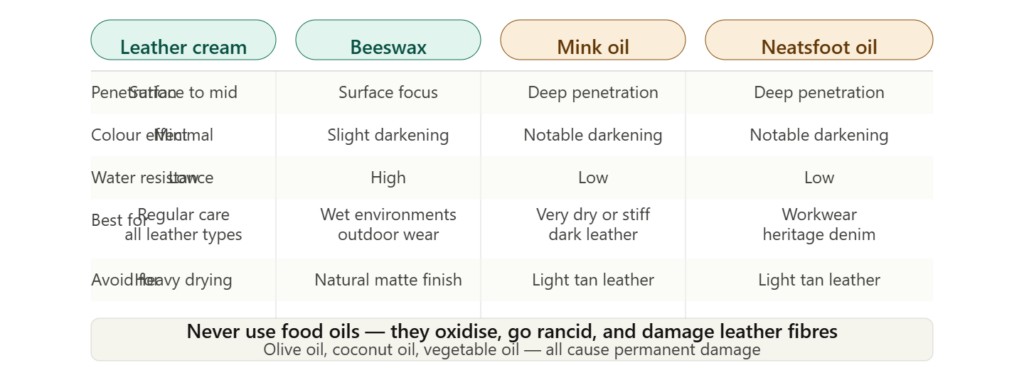
Leather conditioner or leather cream: The most broadly appropriate choice for daily-wear leather belts. A quality leather conditioner contains oils and waxes in a balanced formulation that absorbs evenly into full-grain leather without over-saturating it. Creams with a higher wax content provide some surface water resistance after application, which is useful for belts worn in wet or humid environments.
Beeswax conditioner: Higher wax content than standard conditioner, providing a stronger surface barrier after application. Better for belts exposed to moisture or worn outdoors. Slightly heavier application feel and can darken leather more than a pure conditioner. Apply more sparingly than liquid conditioner.
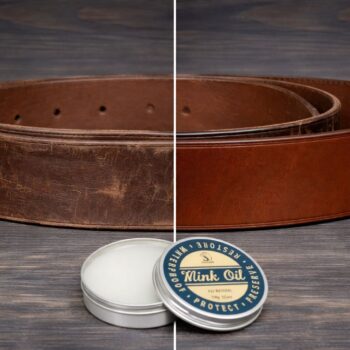
Mink oil: A traditional leather conditioner derived from the fat layer of mink pelts. Penetrates deeply into leather fibres and is particularly effective on very dry or stiff leather that has lost significant oil content. Darkens leather noticeably on application — the darkening reduces over days as the oil distributes. Not ideal for light tan or natural leather where colour preservation matters. Excellent for dark brown and black full-grain belts.
Neatsfoot oil: Similar in action to mink oil — deeply penetrating, effective on dry leather, darkens on application. Traditional choice for workwear and saddlery leather. Appropriate for belts in the same contexts: heavy denim, work boots, heritage and outdoor use. Can soften the leather enough to reduce structure in very high concentrations — apply sparingly on belts where stiffness is a structural requirement.
What not to use:
Food oils — olive oil, coconut oil, vegetable oil — are not appropriate for leather care. They oxidise on the leather surface, become rancid, and produce a persistent unpleasant odour that penetrates deeply into the hide. The oxidised fatty acids also damage the collagen fibre structure over time. This is not a marginal risk — food oils will ruin a leather belt.
Petroleum-based products including Vaseline and mineral oil are occasionally recommended in general leather care guides. They condition the surface temporarily but don’t penetrate the fibre structure effectively, and they can seal the leather surface against moisture exchange in a way that creates uneven drying over time.
Household cleaners, alcohol-based sprays, and anything not formulated specifically for leather strips the natural oils faster than it replaces them.
Apply a small amount of conditioner to a clean soft cloth — roughly a pea-sized amount for a full-length belt. Work it into the leather in long strokes along the grain direction, covering the full length of both faces. Use slightly more product at the buckle fold, where the leather flexes most frequently and oil depletion is fastest.
The leather will absorb the conditioner within minutes. After full absorption — typically 5–10 minutes — buff the surface lightly with a dry cloth to remove any excess that hasn’t absorbed and to bring up a slight surface sheen.
Expect mild darkening on application. This is normal and temporary on most conditioners — the colour returns to normal as the oil distributes evenly through the fibre structure over 24–48 hours. On mink oil and neatsfoot oil, some permanent darkening is expected and is part of the leather’s natural ageing process.
Every three to six months for a belt worn daily in normal temperate conditions. Increase to every two to three months if any of the following apply:
Condition when you notice early dryness — a slightly matte or chalky surface appearance, or initial stiffness near the buckle fold. Don’t wait for cracking.
The physics of leather storage are straightforward. Leather is a fibrous material that holds a shape under sustained load. A belt stored in a coiled or folded position for months holds that curvature — the fibres on the inside of the curve compress, those on the outside stretch, and the belt develops a permanent set that’s difficult to remove without remoistening and reshaping.
Vertical hanging under gravity keeps the fibres in their natural alignment — no sustained bending load, no compression on one side. The belt hangs straight and stays straight.
Best storage: Hang vertically on a belt hook or peg, buckle end up, full length hanging free. A dedicated belt rack is ideal. A single hook on the inside of a wardrobe door works equally well.
For travel storage: Roll loosely from the buckle end with the grain side outward. Rolling with grain outward puts the tighter, more structured grain layer on the outside of the curve rather than the inside — it compresses less under the same bend radius. Roll loosely enough that the coil diameter is at least 8–10cm. Secure with a soft tie rather than a rubber band, which can indent the surface.
Never fold a leather belt. Folding concentrates the full bending stress at a single point and creates a permanent crease. The collagen fibres at the fold are compressed beyond their elastic limit — the crease is structural damage.
The standard three-to-six-month conditioning interval applies to temperate conditions with normal indoor humidity. Climate significantly affects how quickly leather dries out.
Dry climates and heated interiors: Condition every two months. Low ambient humidity draws moisture from leather faster than the natural oil content can compensate. Belts hung in centrally heated rooms during winter are particularly vulnerable.
Hot climates with heavy sweat exposure: Wipe down after each wear with a barely-damp cloth to remove salt residue before it dries. Condition every two to three months. Sweat is acidic and the salt content directly depletes leather oils.
High-humidity environments: Less frequent conditioning required — once every four to six months is usually sufficient. The risk in high-humidity environments is surface mould on leather stored in low-ventilation conditions. Store in breathable cotton rather than plastic, and ensure storage areas have adequate air circulation.
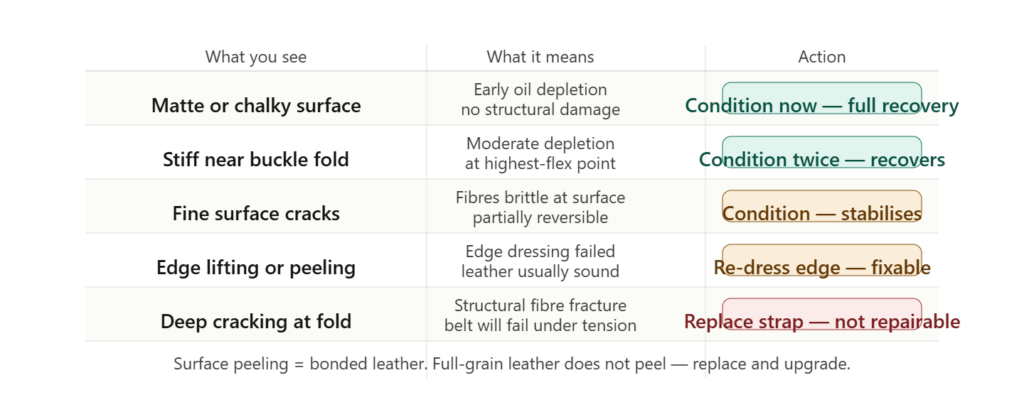
Slightly matte or chalky surface appearance: Early oil depletion. The leather is drying but not yet structurally damaged. Clean and condition immediately — the leather will recover fully.
Stiffness near the buckle fold: Moderate oil depletion, concentrated at the highest-flex area. Clean and condition, applying extra product at the fold. Recover with two conditioning treatments two weeks apart. The stiffness should reduce significantly after the first treatment.
Fine surface cracking: The leather surface has begun to crack — the collagen fibres at the surface are brittle and have started to fracture under flexing. This is partially reversible with aggressive conditioning — the cracks won’t disappear but the leather can be stabilised and made supple enough to prevent further cracking progression. This is the last point at which care can meaningfully extend the belt’s life.
Edge lifting or edge peeling: The strap edges are delaminating. On full-grain leather, this typically means the edge dressing or finishing has failed, not the leather itself. Edge dressing can be reapplied with a leather edge tool and appropriate edge finish product. The underlying leather is usually sound.
Deep cracking at the fold: The fibre structure at the buckle fold has fractured through the leather’s depth. This is structural damage and is not repairable. The belt will fail at this point under continued tension — replace the strap. The buckle, if solid brass or quality alloy, can be transferred to a new strap on some belt designs.
Surface peeling or flaking: Bonded leather delaminating. This is not a care failure — it is a construction failure. Full-grain leather does not peel. A belt that is peeling was never full-grain regardless of how it was labelled. Replace it.
Full-grain leather develops patina over years of wear — a gradual darkening, deepening of colour at wear points, and slight burnishing of the grain surface where it contacts hands and clothing. Patina is not damage. It is the natural consequence of the leather’s surface absorbing small amounts of body oil, ambient oils, and light polishing from contact.
A well-cared-for belt at ten years of wear looks different from the same belt at purchase — darker at the fold and wear areas, slightly polished at the grain surface, with colour variation that reflects its specific history of wear. This is the aesthetic that makes full-grain leather preferable to corrected or bonded alternatives: the surface records use rather than masking it.
The distinction between patina and damage is straightforward. Patina is a surface change that doesn’t affect structure — the leather is still supple, still strong, still flat in profile. Damage is a structural change: cracking, stiffness, peeling, or deformation that affects how the belt performs. Care prevents damage. It cannot prevent patina, and there is no reason to try.
Every three to six months for normal daily wear in temperate conditions. Increase to every two to three months for daily wear in dry climates, with heavy sweat exposure, or for outdoor and manual work use. Condition when you first notice a slightly matte or chalky surface — don’t wait for cracking.
No. Food oils oxidise on leather, become rancid, and damage the collagen fibre structure over time. The odour penetrates deeply and is very difficult to remove. Use only products formulated specifically for leather.
Fine surface cracking can be stabilised with aggressive conditioning — the cracks won’t disappear but further cracking progression can be prevented. Deep cracking through the leather’s thickness, particularly at the buckle fold, is structural damage that conditioning cannot repair. Replace the strap at this point.
Hang vertically on a belt hook or peg with the full length hanging free. Vertical hanging keeps the leather fibres in their natural alignment with no sustained bending load. For travel, roll loosely from the buckle end with the grain side outward and secure with a soft tie. Never fold a leather belt — folding creates a permanent crease at the fold point.
Peeling indicates bonded leather — the compressed fibre composite used in budget belts, which delaminates under daily wear stress. Full-grain leather does not peel. If your belt is peeling, it cannot be repaired with conditioning and should be replaced with a properly specified belt.
Mink oil or a quality leather conditioner are both appropriate for dark brown full-grain leather. Mink oil penetrates more deeply and is particularly effective if the leather has already become dry or stiff. Expect some temporary darkening on application that reduces over 24–48 hours. Avoid conditioners with heavy wax content if you want to maintain a natural matte finish — high-wax conditioners produce more surface sheen.
Water stains occur when leather dries unevenly after moisture exposure — the water carries oils to the edge of the wet area as it evaporates, leaving a ring. To remove them, dampen the entire belt face evenly with a slightly damp cloth, then allow it to dry evenly hanging vertically. This distributes the oils uniformly across the surface rather than concentrating them at the stain edge. Condition after drying.
HoldForm belts are cut from full-grain leather specified for daily wear. Belt thickness, leather grade, and hardware finish are listed on every product page.
[View full-grain leather belt range →] [Full-grain vs top-grain vs genuine leather: what the grades mean →] [How belt thickness affects structural performance →] [Why most leather belts fail — and what the construction difference is →]

Practical belt guides, sizing tips, and exclusive offers — straight to your inbox.


Leave a comment