A new full-grain leather belt is stiff. This is not a defect — it is the correct starting condition for quality leather. The dense collagen fibre structure of full-grain hide at 4mm has enough tensile strength and bending stiffness to hold a flat profile under daily waistband tension for years. That same density is what makes the belt feel rigid when new.
Softening happens through two mechanisms: wear and conditioning. Wear — daily movement, body heat, and the natural flex of walking and sitting — gradually aligns the leather fibres to the wearer’s movement patterns. Conditioning replenishes the oils in the fibre matrix that make the leather flexible rather than brittle. Both work. Conditioning accelerates what wear alone takes longer to achieve.
Full-grain leather is taken from the outermost layer of the hide — the zone with the highest collagen fibre density. These fibres are tightly packed and cross-linked, which is what gives full-grain its structural properties. When the leather is tanned and dried, the fibres hold their position in a dense, relatively rigid matrix.
This is different from lower-grade leathers that have been sanded, split, or processed in ways that reduce fibre density. Corrected-grain and split leather feel immediately soft because the processing has disrupted the fibre structure. They feel better in the shop and fail faster in use.
A stiff new full-grain belt is one that will hold its profile for years. A soft new belt is often one that will deform and lose structure within months.
The break-in period for a 4mm full-grain belt is typically 2–4 weeks of daily wear. By the end of this period the leather has softened at the buckle fold and conformed slightly to the wearer’s waist profile. The belt is noticeably more comfortable than when new while retaining its flat structural profile.
The most reliable way to soften a leather belt is daily wear. Body heat warms the leather fibres during wear, making them temporarily more pliable. Movement — walking, sitting, standing — works the fibres through their range of flex. Over days and weeks, the fibres align to the wearer’s movement patterns and the belt develops a slight curve that matches the waistline.
This process cannot be rushed without risk. The leather is softening in the directions it actually needs to flex rather than being bent arbitrarily, and at the temperature of normal body heat rather than an applied heat source.
For the first week of wear, the belt may feel uncomfortable at the buckle fold. This is the area of tightest bend and therefore the area that requires the most fibre movement to soften. By the end of the second week this discomfort typically resolves as the fold area becomes more flexible.
Applying leather conditioner before wearing the belt for the first time accelerates the break-in period by replenishing the fibre oils that make leather flexible.
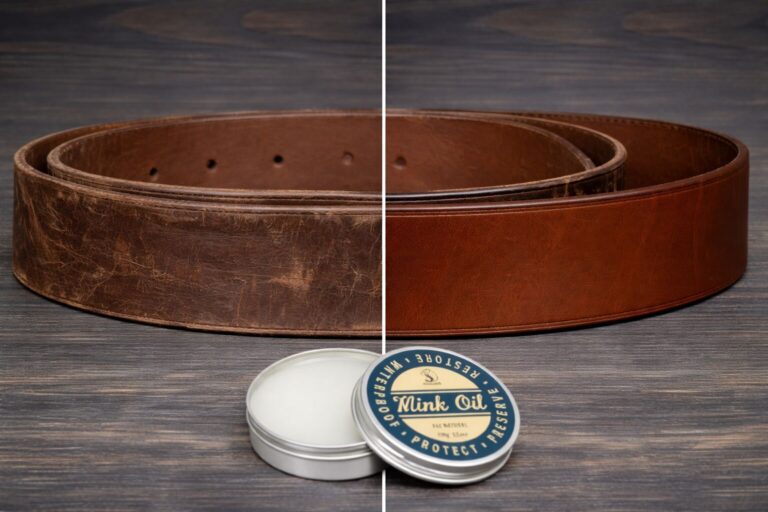
What to use: A leather conditioner formulated for natural leather — beeswax-based or lanolin-based conditioners are appropriate. Avoid petroleum-based products, which can darken leather unevenly and weaken the fibre matrix over time with repeated application. Mink oil is acceptable in small quantities but darkens leather more aggressively than most buyers expect on a first application.
How to apply:
After conditioning, the belt will feel noticeably more supple immediately. The full effect develops over the first few days of wear as the fibres begin to move with the conditioner present.
How often: For a new belt, one conditioning application before first wear is sufficient. Subsequent conditioning every 3–6 months maintains the fibre flexibility as the belt is used. Over-conditioning — applying conditioner more than every 2–3 months — can oversoften the fibre matrix and cause the belt to lose its flat structural profile prematurely.
Gentle manual flexing along the length of the strap accelerates the initial break-in period. This works the fibres through their range of movement before daily wear begins.
How to do this correctly: Hold the strap in both hands approximately 10cm apart. Apply gentle flex pressure — bend the strap slightly inward in the direction it will naturally flex when worn. Move your hands along the strap, working the full length. The bend should be gentle — approximately the same radius as the strap would take around a typical waistline.
What not to do: Do not fold the strap back on itself, crease it, or apply aggressive bending. Leather fibres that are compressed beyond their natural flex range can crack — particularly in the early stages of break-in before the fibres have begun to align and soften. The goal is to introduce gradual movement, not to force softening at a rate the leather cannot accommodate.
This method is useful as a single pre-wear preparation, not as a regular technique. Once the belt has had one week of daily wear, manual flexing is no longer necessary or beneficial.
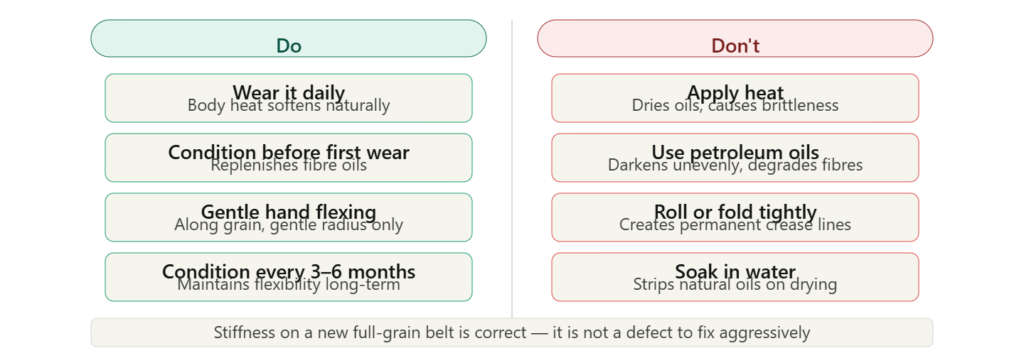
Heat application. Hair dryers, radiators, direct sunlight, or any accelerated heat source will dry the natural oils from the leather fibre matrix rapidly and aggressively. Heat softens leather temporarily — it becomes momentarily pliable under heat. But heat-softened leather is brittle leather. Once the heat source is removed and the leather cools, it is stiffer and more prone to cracking than before. Heat drying is the single most common cause of premature fold cracking on quality leather belts.
Petroleum-based oils and products. WD-40, petroleum jelly, and similar products applied to leather for softening purposes will darken the leather and can degrade the fibre matrix over time with repeated application. They may produce temporary softening but the long-term effect on leather quality is negative.
Aggressive folding or rolling. Rolling the belt tightly and leaving it in this position — or wrapping it tightly around an object — creates permanent crease lines in the leather. These crease lines are points of concentrated stress under daily flex cycling and will eventually crack. Store the belt hung or flat, never tightly rolled.
Soaking in water. Wet leather becomes temporarily pliable but loses its natural oils as it dries. Saturating leather with water and allowing it to dry produces a stiff, brittle result worse than the original. If you want to use moisture to encourage softening, a light application of conditioner provides the moisture in a controlled, oil-bearing form that benefits the leather rather than depleting it.
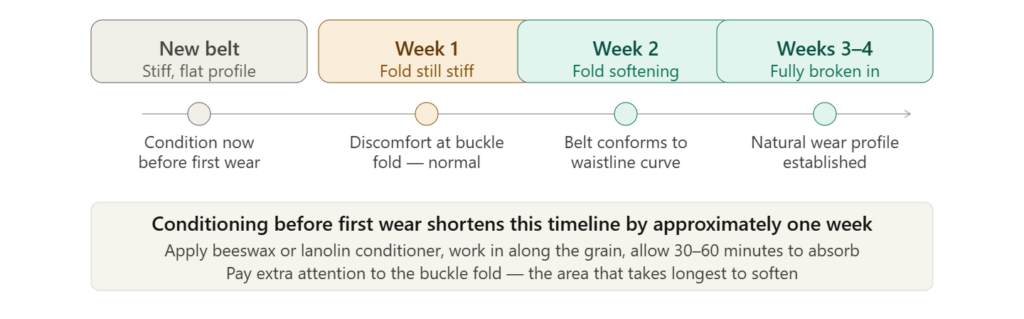
For a 4mm single-layer full-grain belt worn daily:
Week 1: Noticeable stiffness, particularly at the buckle fold. The belt holds a flat profile under tension. May feel slightly uncomfortable where it contacts the waistband.
Week 2: The buckle fold area begins to soften. The belt conforms slightly to the waistline curve. Daily wear comfort improves noticeably.
Weeks 3–4: The belt has found its natural wear profile. The buckle fold is comfortable under daily use. The strap has developed the slight waistline curve that marks a broken-in belt.
Month 2 onward: The leather continues to develop patina and character. Condition at 3–6 months. The belt is now in its long-term service profile.
Conditioning before first wear shortens this timeline by approximately one week by pre-softening the fibre matrix before the first flex cycles begin.
Full-grain leather at 4mm has a dense collagen fibre structure that makes it resistant to deformation. This density is what makes it last for years under daily wear. The stiffness resolves through 2–4 weeks of daily wear as the fibres align to the wearer’s movement patterns. Conditioning before first wear accelerates this.
Apply leather conditioner before the first wear to pre-soften the fibre matrix, then wear the belt daily. This is the fastest safe approach. Manual gentle flexing along the strap can supplement the first few days of break-in. Avoid heat — it produces temporary softening and long-term brittleness.
Natural food oils will darken leather significantly and can go rancid in the fibre matrix over time, producing an unpleasant smell. Use a product formulated for leather — beeswax or lanolin-based conditioners are the correct choice for softening and conditioning.
Yes, with regular conditioning. A broken-in full-grain belt that is conditioned every 3–6 months maintains its flexible, comfortable profile indefinitely. Without conditioning, the natural fibre oils are depleted by sweat and mechanical cycling over time, and the belt gradually becomes stiffer and more prone to fold cracking.
Yes — for quality full-grain leather, initial stiffness is the expected starting condition and indicates a dense, durable leather grade. A belt that is soft immediately from the shop is more likely to be a lower-grade leather that has been processed or coated to feel soft, which also means it will degrade faster.
HoldForm full-grain leather belts are specified at 4mm single-layer construction. Conditioning instructions and product recommendations are in our leather care guide.
[Leather belt care guide: conditioning, cleaning and storage →] [How thick should a leather belt be: why thickness affects break-in →] [Why leather belts crack and fail: what prevents fold cracking →] [Best everyday leather belt: what the spec means →]

Practical belt guides, sizing tips, and exclusive offers — straight to your inbox.


Leave a comment