A belt is a mechanical object. The type you choose determines how it adjusts, how it ages, how it looks under clothing, and how well it holds up under daily load. The differences between belt types are not primarily aesthetic — they are construction and mechanism differences that produce different performance outcomes.
This covers the main belt types, how each one works, and the specific contexts where each performs best.
Every belt is defined by two things: the adjustment mechanism (how tension is set and changed) and the strap construction (how the leather is built and how it ages). Understanding both tells you more about a belt than any style description.
Adjustment mechanisms: Pin-buckle (fixed holes), ratchet (continuous track), automatic (lever-release clamp), friction-lock (no holes, no track — pressure holds position). Each produces different fit precision, different daily usability, and different leather wear patterns over time.
Strap construction: Single-layer full-grain, layered construction, split leather, reversible two-face. Each has different thickness, stiffness, ageing behaviour, and failure modes.
The belt types below are defined by the combination of these two variables.
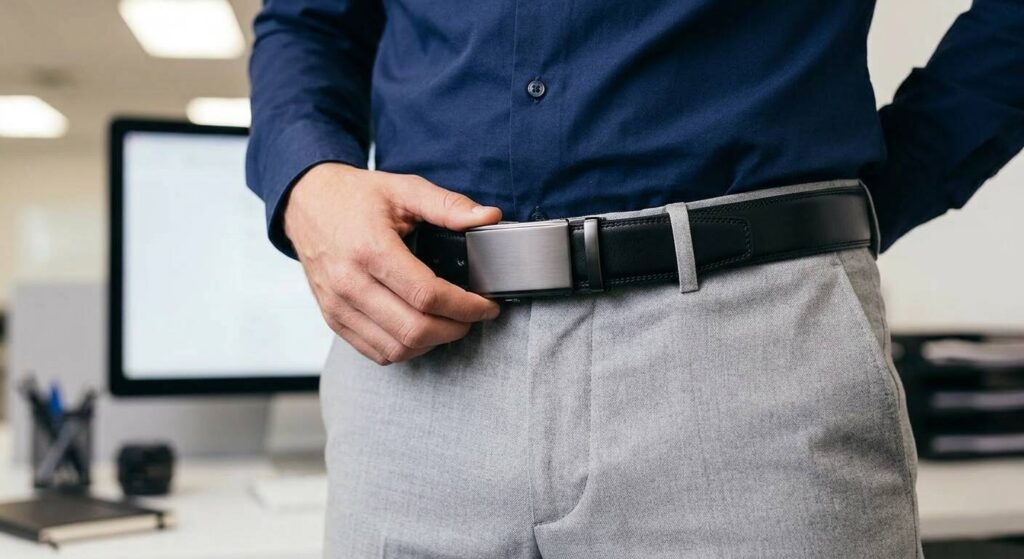
How the mechanism works: A ratchet belt replaces punched holes with a continuous track of teeth on the back face of the strap, hidden inside the buckle housing. The buckle contains a spring-loaded pawl — a locking tooth — that engages the track teeth when the belt is fastened. To adjust, you press the front of the buckle to disengage the pawl, move to the correct position, and release. The pawl re-engages the nearest tooth with an audible click.
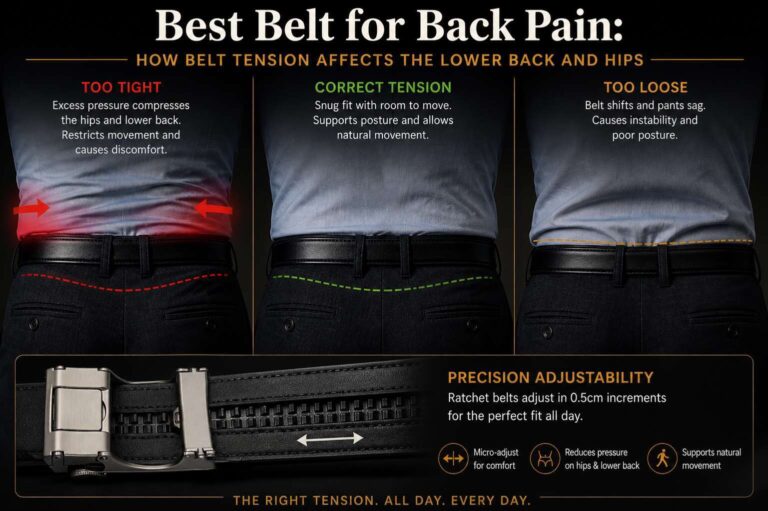
Adjustment is continuous rather than fixed — you set tension at any point along the track rather than choosing between preset holes. The typical increment between track teeth is 0.5cm, which provides five adjustment positions within the same 2.5cm span that a pin-buckle belt covers with one hole.
What this means in practice: The correct tension can be set precisely for different activities — standing, desk work, post-meal — without moving to a different hole. Because there are no holes punched in the leather face, the strap has no stress concentration points. The leather face remains smooth and unperforated.
Where it performs best: Daily professional wear where tension varies through the day. Business casual and office contexts where the clean leather face (no visible hole pattern) suits a tucked shirt. Travel, where tension adjustment between seated and standing is frequent.
Where it is less appropriate: Very heavy workwear or outdoor contexts with high dirt and debris exposure — track mechanisms can accumulate debris in demanding environments. Heritage and traditional aesthetic contexts where the classic pin-buckle design is part of the visual intent.
For a full technical comparison between ratchet and pin-buckle mechanisms, see our [ratchet vs traditional belt guide →]
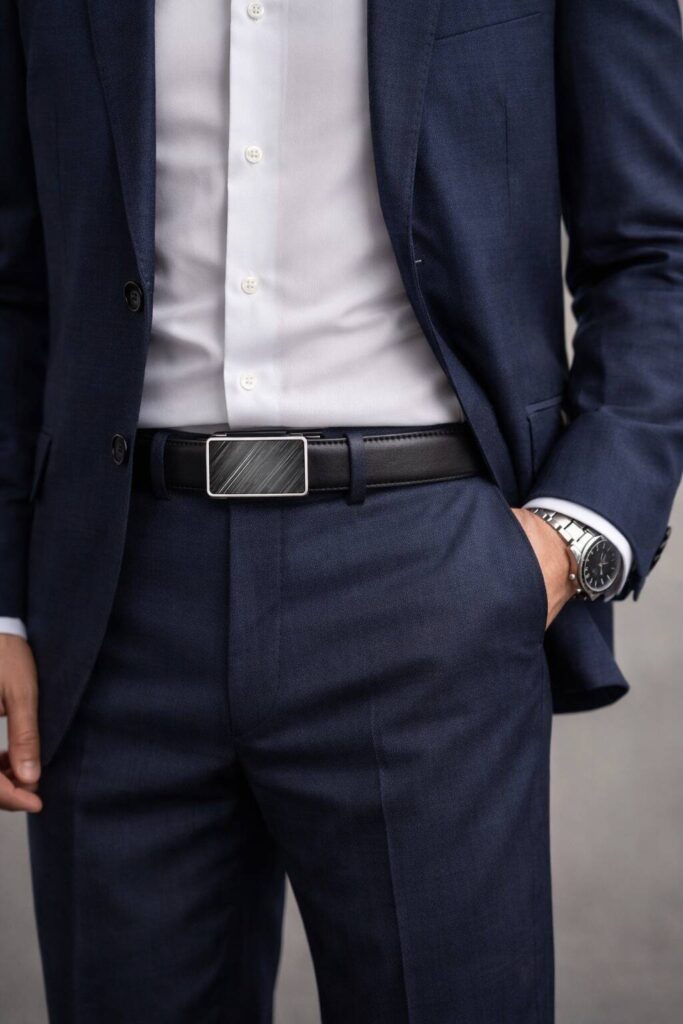
How the construction works: A standard belt has a visible tail — the strap end that exits the buckle and passes through the keeper loop. A hidden-tail belt routes this tail behind the buckle housing rather than forward. The strap end is concealed inside or behind the buckle, producing a clean waistline with no visible flap extending beyond the buckle face.
Most hidden-tail designs combine the concealment construction with a ratchet or automatic mechanism. This means the strap can be trimmed to exact waist length, eliminating the tail entirely — there is no excess strap to route because the strap ends precisely at the buckle after trimming.
What this means in practice: Under a tucked shirt or a suit jacket, the waistline is uninterrupted. No tail flap creates a bump or silhouette line under fabric. The front of the belt is flat from buckle to the left side — no visual break.
Where it performs best: Suit wear and tailored trouser outfits where a clean waistline is important. Tucked-shirt business professional contexts. Minimalist wardrobes where visual simplicity at the waistline is the priority.
Where it is less appropriate: Workwear and outdoor contexts where the concealment construction adds no practical value. Casual jeans wear where the visual detail of a belt tail is part of the outfit character.
For a detailed guide to hidden-tail construction, see our [hidden-tail belt guide →]
How the mechanism works: A metal prong pivots from the buckle frame’s centre bar. The strap has five to seven holes punched at 25mm intervals. The prong passes through one hole, the frame bar sits against the leather, and the tail passes through the keeper loop. Tension is set by which hole the prong is in — there are no intermediate positions.
The centre hole is the design position — the belt is built to perform correctly when worn at the middle hole, distributing strap length evenly on each side of the buckle. Using the outermost holes in either direction indicates a size mismatch.
The structural trade-off: The hole edge is the stress concentration point on a pin-buckle belt. Every time the belt is worn, the prong applies lateral force to the leather fibre at the hole edge. Over time, this fibre deforms — the round hole elongates into an oval, the belt loses its fit precision at that hole, and eventually the hole edge tears. Full-grain leather at 4mm resists this deformation significantly better than thinner or lower-grade leather, but hole deformation is an inherent property of the mechanism.
Where it performs best: Heritage and traditional aesthetic contexts — workwear, denim, outdoor — where the classic mechanism is part of the visual intent. Contexts where mechanism simplicity and robustness matter more than adjustment precision. Formal dress belts where a slim, flat frame buckle suits tailored suiting.
Where it is less appropriate: Daily professional wear where tension varies significantly through the day and the fixed-hole spacing can’t accommodate the variation precisely.

Dress belts are defined by their dimensions and surface rather than their mechanism — they can use either pin-buckle or ratchet mechanisms. The defining characteristics are narrowness, smooth leather surface, and restrained hardware.
Correct specifications for dress belts:
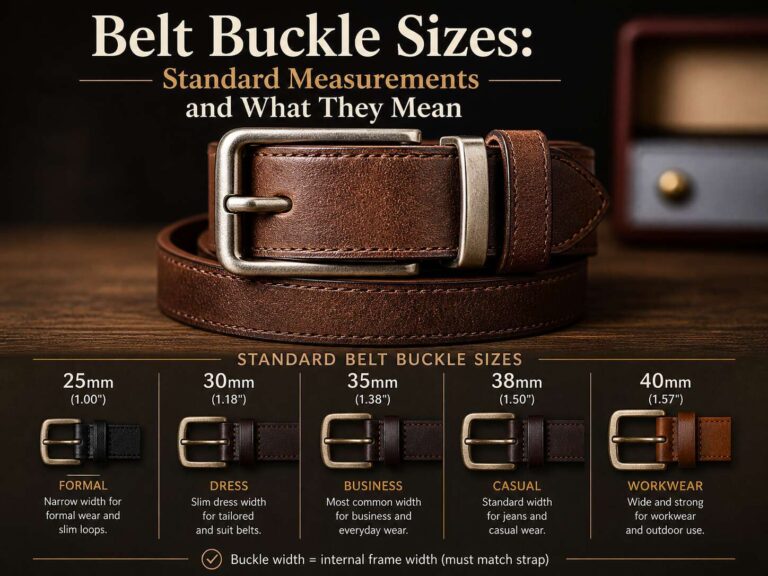
Width: 28–35mm. Tailored suit trousers have loops in the 30–35mm range. A belt wider than 35mm forces the loop and creates visible tension at the waistband attachment points.
Leather: Full-grain at 3–3.5mm. Thick enough to hold a flat profile under the light tension of suit wear, thin enough to thread correctly through formal loops.
Surface: Smooth grain or fine emboss. Heavily textured or distressed leather is inappropriate for formal contexts — the surface should be restrained and consistent.
Hardware: Low-profile, flat-face buckle. The buckle depth should be minimal — a suit jacket sits over the belt and a deep buckle creates a visible bump under the jacket front.
A dress belt should be invisible in the context of a formal outfit. The eye should move from the jacket to the trousers without registering the belt. If the belt is the most noticeable element at the waist, it is wrong for the context.
For suit-specific belt and colour guidance, see our [what belt to wear with a suit guide →]
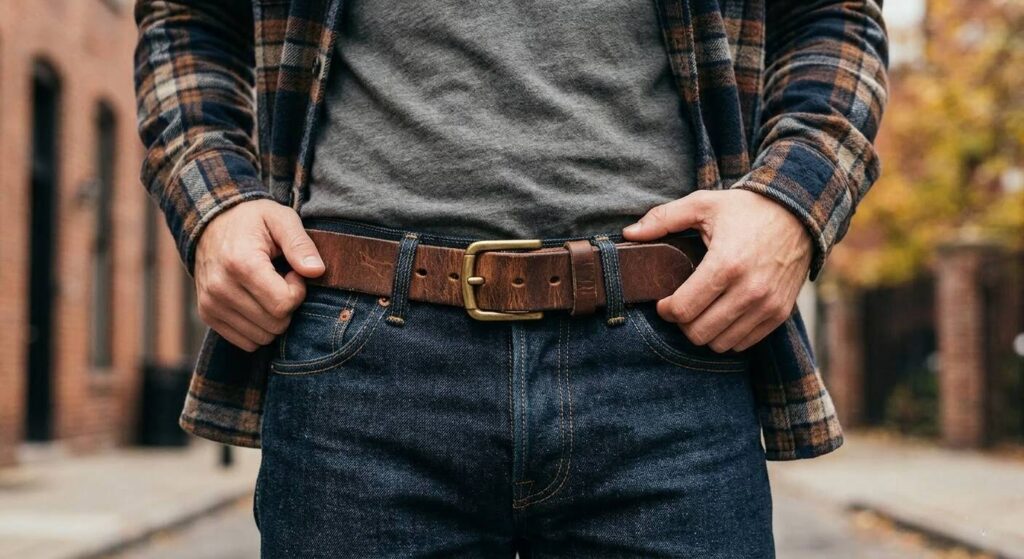
Casual belts are typically wider, thicker, and more visually prominent than dress belts. The construction prioritises load-bearing performance and longevity under daily active wear rather than formal restraint.
Correct specifications for casual belts:
Width: 35–42mm depending on trouser loop width. Jeans loops are typically 38–42mm — a belt at this width fills the loop correctly and distributes load across the waistband rather than concentrating it at a narrow contact point.
Leather: Full-grain at 4–4.5mm for everyday casual wear. The higher thickness handles the lateral tension of heavier denim and workwear trousers without rolling at the front.
Hardware: Pin-buckle or ratchet, depending on preference. Larger frame buckles are appropriate in casual contexts where the hardware is part of the outfit character rather than something to minimise.
How casual belts age: Full-grain leather at casual belt thickness develops visible character over years of use — a patina specific to the wearer’s habits and the environmental conditions of daily wear. This is the ageing process that makes quality casual belts improve with time rather than degrade.
For detailed guidance on casual belt specification for specific contexts, see our [best belt for jeans guide →]
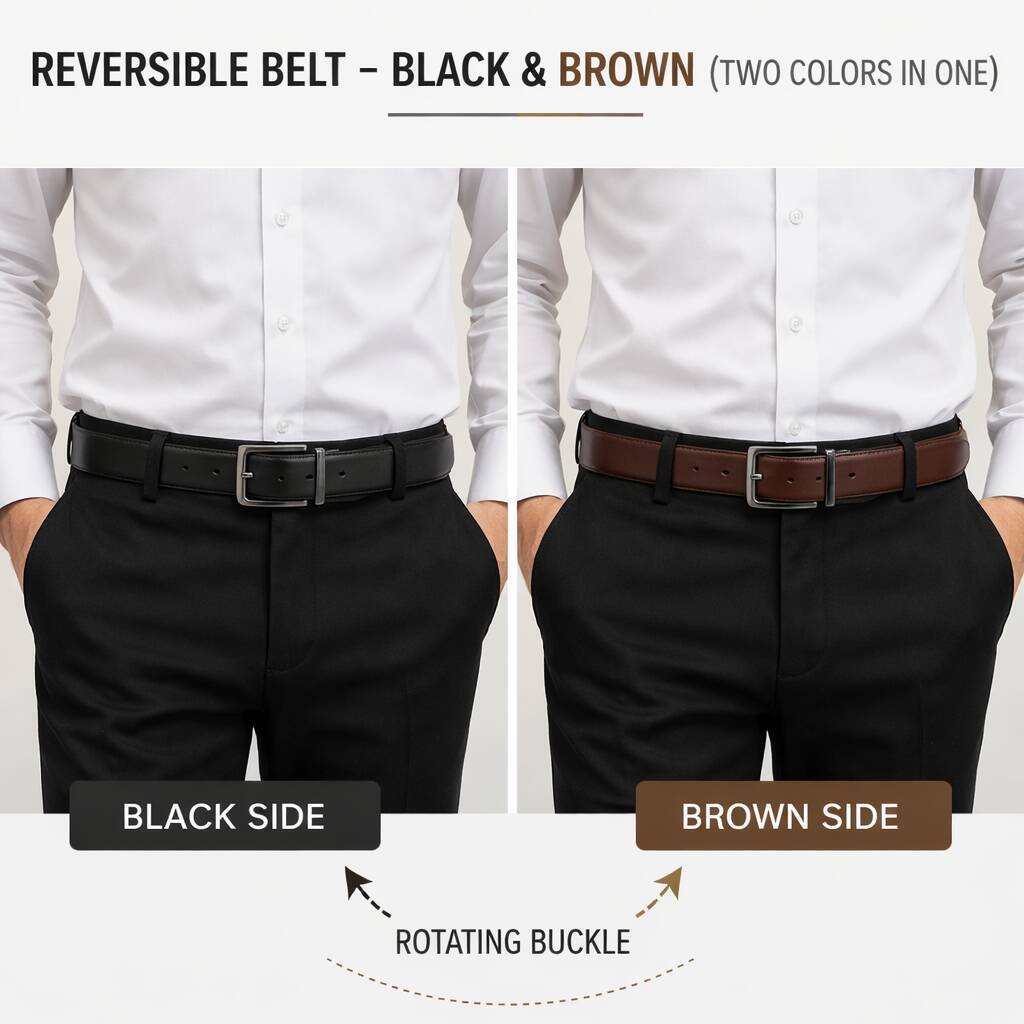
A reversible belt has two leather faces — typically black on one side and brown or tan on the other — with a rotating buckle mechanism that allows the wearer to flip the belt and present either colour.
How the mechanism works: The buckle attaches to the strap via a rotating connector rather than a fixed attachment. Pressing a release button allows the buckle to rotate 180 degrees, exposing the opposite face. The strap itself is thinner than a single-face belt because the two-face construction requires flexibility in both directions.
The construction trade-off: The reversible strap is thinner than a comparable single-face belt because it must flex cleanly in both directions for the flip mechanism to work. This reduces the structural stiffness compared to a single-layer full-grain belt at equivalent width. For occasional wear and travel contexts, this is acceptable. For heavy daily use, a single-face belt at full thickness is more durable.
Where it performs best: Travel and packing contexts where carrying two separate belts is impractical. Wardrobes where the two colour combinations cover the primary outfit requirements. Formal and business casual contexts where the strap thickness trade-off is acceptable.
For full guidance on reversible belt construction and travel use, see our [best belt for travel guide →]
Buckle type is independent from strap construction — the same strap design can accept different buckle types depending on the attachment system. The main buckle types:
Ratchet buckle: Contains the track engagement mechanism (spring-loaded pawl) in addition to the frame. The mechanism housing adds some depth to the buckle rear. The front face can be any profile — flat, angled, or shaped.
Automatic buckle: A lever or button on the side of the buckle releases the strap clamp, allowing position adjustment without disengaging the entire buckle. Used on some ratchet and friction-lock designs.
Plate buckle: A flat plate with no centre bar — the strap feeds through a slot and is held by the plate weight and friction. Common in fashion belts and military designs. No adjustment points — the strap position is fixed once threaded.
| Situation | Belt type | Mechanism | Width |
|---|---|---|---|
| Business suits, formal | Dress belt | Ratchet or pin | 28–35mm |
| Business casual, office | Ratchet or hidden-tail | Ratchet | 32–38mm |
| Everyday jeans, casual | Casual leather | Pin or ratchet | 38–40mm |
| Workwear, outdoor | Classic pin-buckle | Pin or roller | 38–42mm |
| Travel, packing light | Reversible | Ratchet | 35–38mm |
| Minimalist, suit | Hidden-tail | Ratchet | 28–34mm |
| Standing all day | Casual or ratchet | Ratchet preferred | 38–40mm |
| EDC and carry | Casual, full-grain | Pin or ratchet | 38–42mm |
Two belts cover the majority of contexts: one dress belt for formal and business wear, one casual belt for everyday and jeans wear. A third — a ratchet or hidden-tail belt for professional daily wear — is the addition that most improves daily comfort without wardrobe complexity.
The case for a ratchet belt as the primary everyday belt: it adjusts precisely for different activities, doesn’t develop hole deformation over time, and in a restrained finish and profile is indistinguishable from a classic belt in professional contexts.
A ratchet belt uses a continuous track instead of punched holes. Adjustment is made in small increments (typically 0.5cm) rather than fixed 25mm hole steps. The leather face has no holes — no stress concentration points, no hole deformation over time. A traditional pin-buckle belt uses fixed holes and a pivoting prong. Simpler mechanism, classic aesthetic, but limited adjustment precision and eventual hole deformation with daily wear.
A dress belt at 28–35mm width with a flat low-profile buckle. The narrow width fits formal trouser loops without forcing them. The flat buckle profile sits flush under a suit jacket without creating a visible bump. Colour matched to shoes — black belt with black shoes, dark brown or cognac with brown shoes.
A casual leather belt at 38–40mm in full-grain leather at 4–4.5mm thickness. The wider width fills denim belt loops correctly. The higher thickness handles the lateral tension of heavy denim without rolling. Pin-buckle or ratchet both work — pin-buckle for traditional workwear character, ratchet for adjustment precision.
Yes. The determining factor is buckle design and profile, not mechanism. A ratchet belt with a flat, low-profile buckle in a restrained finish — brushed silver, matte black, or brass — is appropriate for business professional and formal contexts. The mechanism is hidden inside the buckle housing and not visible when worn.
A belt where the strap end is routed behind the buckle housing rather than extending forward as a visible flap. The result is a clean waistline with no tail visible beyond the buckle face. Most hidden-tail belts use a ratchet mechanism and are trimmed to exact waist length, eliminating the tail entirely.
Measure your trouser belt loop at its narrowest point. Order a belt that is 1–2mm narrower than the loop — this allows the belt to slide through without forcing the loop, while keeping enough contact area to prevent lateral migration during movement. Dress trousers: 30–35mm. Business casual and chinos: 35–38mm. Jeans and workwear: 38–42mm.
HoldForm belts are available across all mechanism types — ratchet, hidden-tail, and classic pin-buckle — with leather grade, strap thickness, and buckle specification listed on every product page.
[View ratchet belt range →] [View hidden-tail belt range →] [Ratchet vs traditional belt: full mechanism comparison →] [How to measure belt size correctly →] [Best belt for jeans: width, thickness and buckle →] [What belt to wear with a suit →]

Practical belt guides, sizing tips, and exclusive offers — straight to your inbox.

Leave a comment