The belt choice for a suit comes down to three variables: leather colour matched to shoe colour, buckle finish matched to watch hardware, and width matched to the trouser loop construction. Get these three right and the belt disappears into the outfit — which is exactly what a suit belt should do.
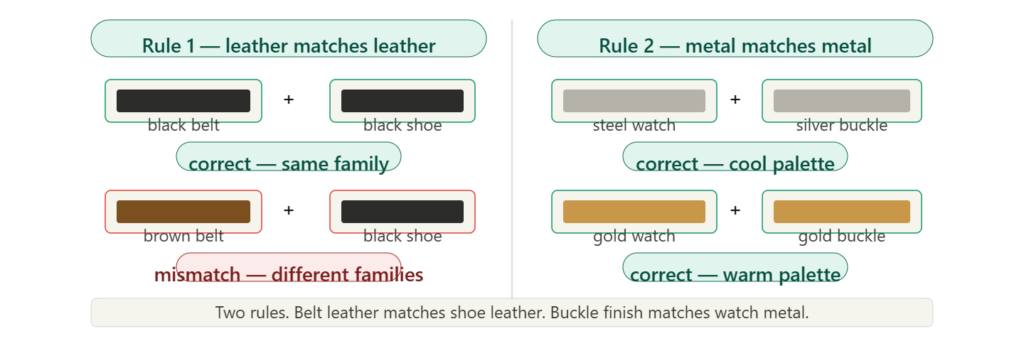
Rule 1: Match belt leather to shoe leather. The belt and shoes are the two leather accessories in a suit outfit. When their colours align, the eye reads the outfit as resolved. When they conflict, the eye registers the mismatch at the waist before noticing anything else.
The match doesn’t need to be identical — same colour family is sufficient. A dark mahogany belt with dark walnut shoes reads as coherent. The same belt with black Oxford shoes reads as a mismatch because the colour families are different.
Rule 2: Match buckle finish to dominant watch metal. Silver watch with silver buckle. Gold watch with gold buckle. The consistency of metal family across accessories creates the impression of intentional coordination rather than assembled coincidence. Mixed metal families — a steel watch with a gold buckle — read as unresolved.
Brushed finishes in both metals are the safer choice for professional wear. Polished finishes read as more formal but show wear faster and reflect more light, which can draw attention to the hardware in formal contexts where the goal is a clean, uninterrupted silhouette.
For formalwear specifically, our executive dress belts are cut slimmer and finished for a suit.
Belt colour: Black leather only.
A black suit is built around a monochromatic structure. The belt should complete this structure, not introduce a new colour variable at the waist. Brown leather — regardless of shade — creates a warm-cool contrast against a black suit that reads as unintentional rather than deliberate.
Shoe implication: Black suit almost always involves black shoes. The belt-shoe match is therefore automatic. If wearing dark brown shoes with a black suit as a deliberate warm-cool contrast, the belt follows the shoe — dark brown belt matching the dark brown shoe.
Buckle: Brushed silver or gunmetal. Silver completes the cool palette of a black suit. Gold can work if worn with warm-metal accessories throughout, but silver is the default correct choice.
Belt colour: Dark brown, cognac, or black — depending on shoes.
Navy is the most versatile suit colour for belt matching because it sits between warm and cool on the tonal spectrum. It accepts both warm leather tones (dark brown, cognac) and cool ones (black) without either reading as wrong.
Dark brown with navy is one of the most coherent combinations in professional dress. The warm-cool contrast is deliberate and widely recognised as intentional. Cognac with navy works in business casual and less formal contexts. Black with navy is correct when wearing black shoes — the shoe anchor rule takes priority.
Buckle: Silver with black leather, silver or gold with brown or cognac leather. Navy and silver is clean and contemporary. Navy with warm brown leather and a gold buckle is a coherent warm palette.
Belt colour: Black or oxblood with black shoes. Dark brown or oxblood with brown shoes.
Grey is tonally neutral — it accepts both warm and cool accessories without obvious conflict. This makes it the most accommodating suit colour for belt and shoe combinations. The shoe still anchors the belt colour choice, but grey provides more flexibility in the transition tones.
Oxblood — the dark burgundy-red leather — works particularly well with grey suits. It provides more visual interest than plain black while remaining formal enough for professional and even semi-formal contexts. With a grey suit, oxblood reads as a considered choice rather than a casual one.
Buckle: Silver with black or oxblood leather. The cool neutrality of grey suits most naturally with silver hardware.
Belt colour: Light brown, cognac, or camel — matching the warm neutral palette.
Tan and khaki suits are built around warm neutrals. A black belt creates a harsh contrast against the warm fabric that breaks the outfit’s tonal coherence. Light to medium brown leather in the same warm family — cognac, camel, tan — extends the palette naturally.
Buckle: Brass or gold tone. Warm suit, warm leather, warm hardware. The consistency of warm tones throughout the outfit produces a resolved, cohesive result.
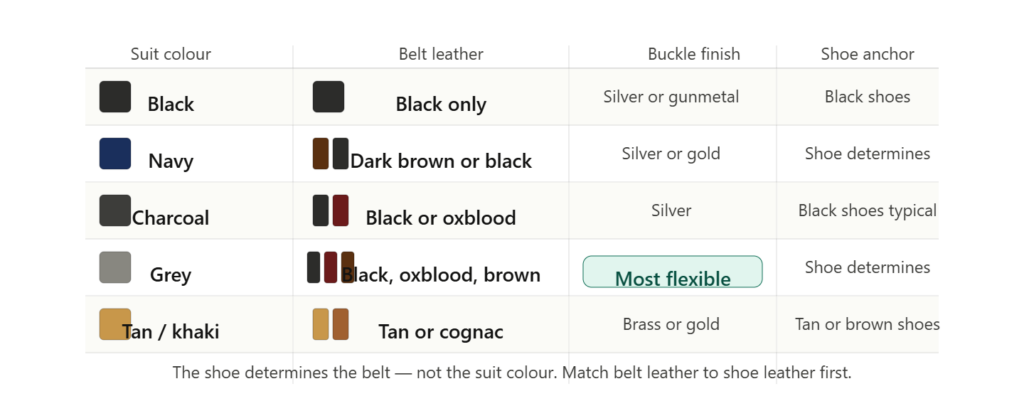
| Suit colour | Correct belt colour | Buckle finish |
|---|---|---|
| Black | Black | Silver or gunmetal |
| Navy | Dark brown, cognac, or black | Silver or gold |
| Charcoal | Black or oxblood | Silver |
| Grey | Black, oxblood, or dark brown | Silver |
| Tan / khaki | Light brown or cognac | Brass or gold |
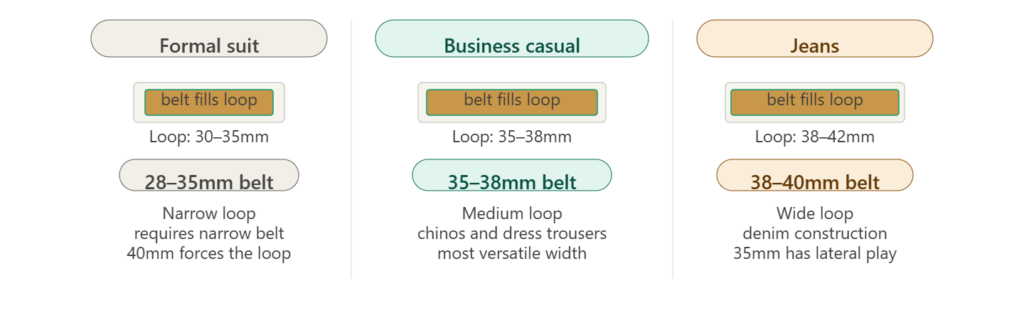
Suit trousers are cut with belt loops in the 30–35mm range. The waistband construction of a tailored trouser is designed for a narrow, flat belt — not the 38–40mm belt that suits denim.
Correct width for suits: 28–35mm. This range fits correctly in tailored trouser loops without forcing the loop outward or creating bunching at the loop attachment points. A wider belt on a suit trouser stresses the waistband seam and creates visible tension at each loop.
The visible consequence of wrong width: A 40mm belt in a 34mm suit trouser loop pulls the trouser fabric at the loop attachment points — visible as small horizontal tension lines when the jacket is open. This is a construction problem, not a style preference.
For business casual trousers with wider loops, 35–38mm is appropriate. For jeans worn in smart casual contexts, 38–40mm. The loop width determines the belt width — measure the loop before ordering if unsure.
A suit buckle needs to be flat-profile — the frame sits flush against the belt face with no raised hardware on the front and no mechanism housing that extends forward from the waistband.
The reason is physical: a suit jacket sits over the belt at the front. A buckle with significant depth pushes the jacket fabric outward, disrupting the clean front line the jacket was cut to produce. This is visible when the jacket is buttoned or held closed.
Ratchet mechanisms for suits: A ratchet belt with a flat, low-profile buckle is appropriate for suit wear. The mechanism housing sits on the back of the buckle rather than extending forward. The adjustment precision is a functional advantage for all-day professional wear — the correct tension can be set independently for standing and seated contexts.
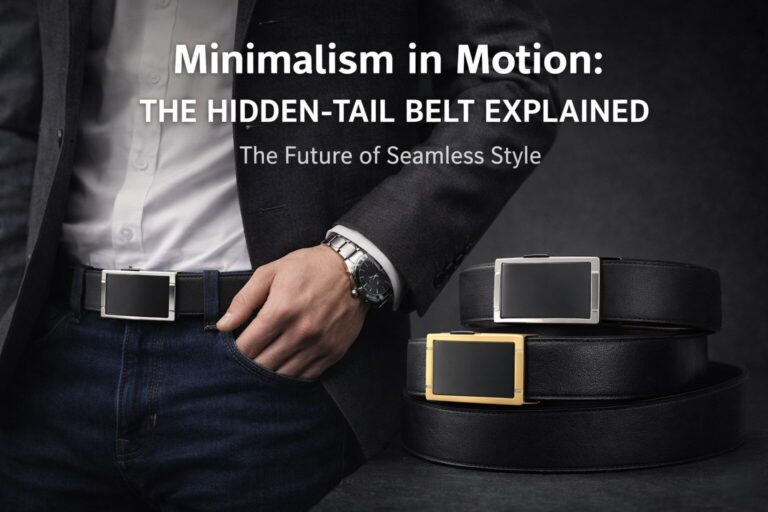
Hidden-tail for suits: Hidden-tail construction — where the strap end is concealed inside the buckle housing rather than exiting as a visible flap — produces the cleanest front silhouette for suit wear. No visible keeper, no strap tip protrusion, no belt tail requiring double-routing under a tucked shirt.
For the full guide to fit system choice for professional wear, see our [best belt for office wear guide →]
Once colour and width are correct, surface texture is the detail that moves a belt from adequate to considered.
Smooth grain leather is the default correct choice for formal suits. It reads as restrained and formal, consistent with the clean surfaces of tailored suiting.
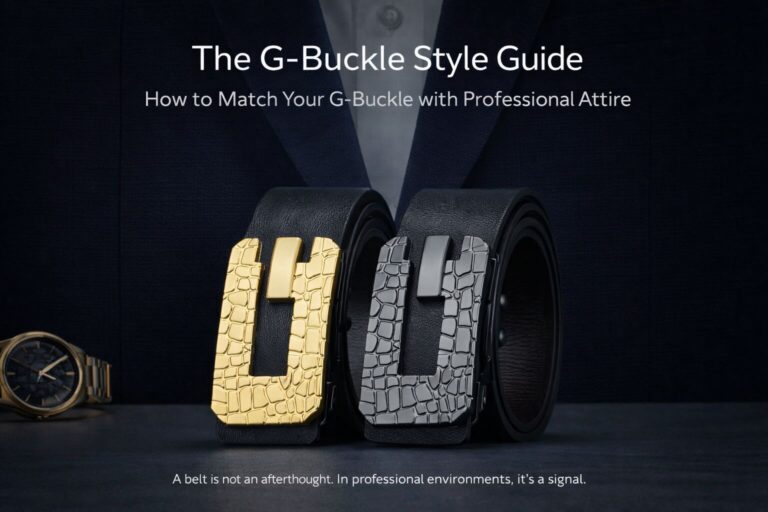
Embossed textures — crocodile, ostrich, saffiano — are appropriate for business formal and boardroom contexts when the finish is subtle. A fine emboss pattern at normal viewing distance reads as a textured matte finish rather than a decorative motif. At close range it reveals the detail. This is the right level of complexity for suit wear — understated at a glance, considered on closer inspection.
Matte versus polished leather surface: Polished leather reads as more formal but shows scuffs and wear more visibly. Matte leather reads as slightly less formal but holds its appearance under daily professional wear longer. For a belt worn five days a week with suits, matte full-grain is the more practical choice.
If you wear suits across black, navy, and grey, three belts cover every combination:
Belt 1: Black full-grain, 30–33mm, brushed silver buckle. Covers black suits, charcoal suits, grey suits with black shoes, and any formal context requiring a monochromatic structure.
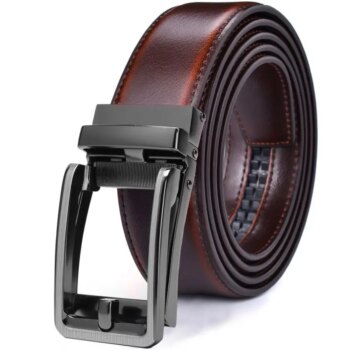
Belt 2: Dark brown full-grain, 32–35mm, brushed silver or gold buckle. Covers navy suits with brown shoes, grey suits with brown shoes, and business casual contexts. Dark brown is more versatile than any other brown shade — it works with the widest range of suit colours and shoe tones.
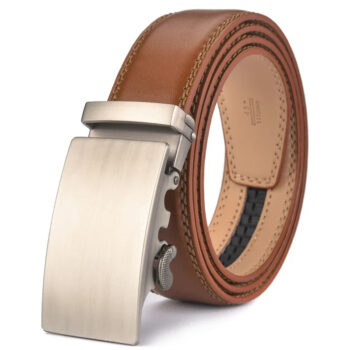
Belt 3: Cognac or tan, 32–35mm, brass buckle. Covers tan and khaki suits, lighter summer suiting, and smart casual contexts where a warmer, softer leather tone suits the outfit register.
These three cover the overwhelming majority of suit-wearing contexts without duplication or redundancy.
Dark brown is the most coherent choice for navy suits worn with brown shoes — the warm-cool contrast of navy and dark brown is a recognized combination in professional dress. Black is correct if wearing black shoes — the shoe colour anchors the belt choice. Cognac works in business casual and less formal contexts.
Generally no. A black suit is built around a monochromatic cool structure. Brown leather introduces a warm contrast at the waist that reads as unintentional rather than deliberate. The exception is a very dark brown worn with dark brown shoes as an explicit warm-cool contrast choice — in this case the shoe-belt match makes the combination coherent.
28–35mm. Tailored suit trousers have belt loops in the 30–35mm range. A belt wider than 35mm forces the loop and creates visible tension in the waistband fabric. A belt at 30–33mm sits correctly in the loop with 1–2mm clearance.
Shoes. The belt-shoe leather match is the primary rule in formal and professional dress. The tie relates to the shirt and jacket — it operates in a different colour register from the leather accessories. Coordinating tie and belt colour is not a recognized convention in men’s professional dress.
Yes. The determining factor is buckle design and profile, not mechanism. A ratchet belt with a flat, low-profile buckle in a restrained finish is indistinguishable from a classic belt when worn — the mechanism is hidden inside the buckle housing. The adjustment precision is a practical advantage for all-day suit wear.
Oxblood is a dark burgundy-red leather — darker than standard burgundy, warm but not bright. It works particularly well with grey suits, where both black and brown are technically correct but oxblood provides more visual interest without looking informal. It also works with navy suits in business casual contexts. Oxblood does not work with black suits — the warm-red undertone conflicts with the cool structure of a black suit.
HoldForm belts for suit wear are available in 30–35mm widths with flat-profile ratchet and hidden-tail mechanisms. Leather grade, strap thickness, and buckle specifications are listed on every product page.
[View belt range for suits and formal wear →] [Best belt for office wear: fit system, leather grade, and width →] [Black belt or brown belt: the full matching guide →] [Silver, gold and black buckle: how to choose →]

Practical belt guides, sizing tips, and exclusive offers — straight to your inbox.


Leave a comment