Jeans place different demands on a belt than dress trousers do. The loops are wider, the fabric is heavier, and the wear conditions are more varied — jeans go from casual daywear to long driving days to worksite use in ways that formal trousers don’t. A belt that works correctly on denim needs to be specified for those conditions, not selected from the dress belt range.
This covers the four variables that determine whether a belt works on jeans: width, leather thickness, buckle construction, and mechanism choice. Each one has a specific correct range for denim, and the reasoning for each range is mechanical rather than stylistic.
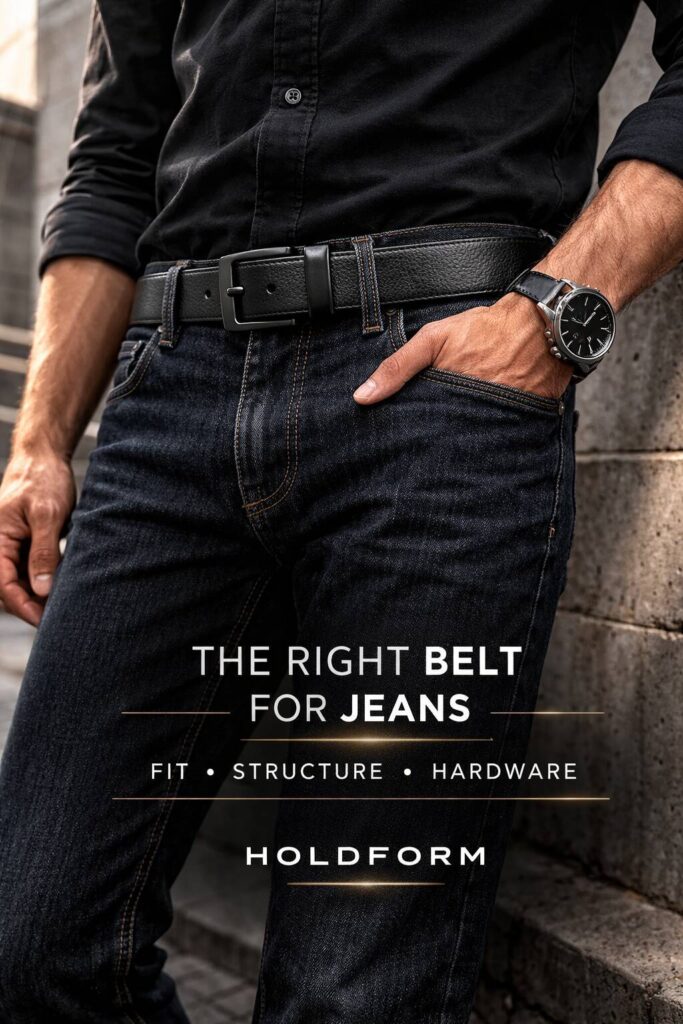
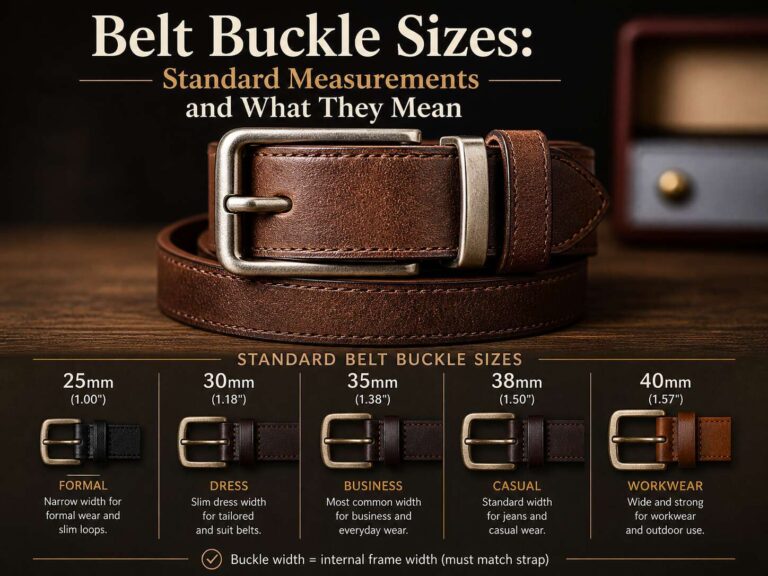
The difference starts with loop construction. Suit trousers are cut with belt loops in the 30–35mm range, sized for the narrow, flat belts that suit tailoring. Jeans are constructed with loops in the 38–42mm range — wider, deeper, and designed for thicker belts that can handle the mechanical demands of denim wear.
Denim is a workwear fabric. Standard mid-weight denim runs 11–14oz per square yard — substantially heavier than dress trouser fabrics. This weight means the waistband exerts more lateral force on the belt during movement. It also means the loop geometry is different: denim loops are wider and often have more vertical depth than dress loops, because the fabric construction requires room for a thicker belt strap.
The practical consequence: a 30mm dress belt in a 40mm denim loop has 10mm of lateral play. The belt shifts sideways in the loop during movement, the buckle migrates off-centre, and the overall silhouette looks loose and unconsidered. A 38–40mm belt in a 40mm loop has 0–2mm of play — the belt sits correctly, the buckle stays centred, and the waistline looks resolved.
This is not a style rule. It is a fit constraint set by the specific geometry of denim construction.
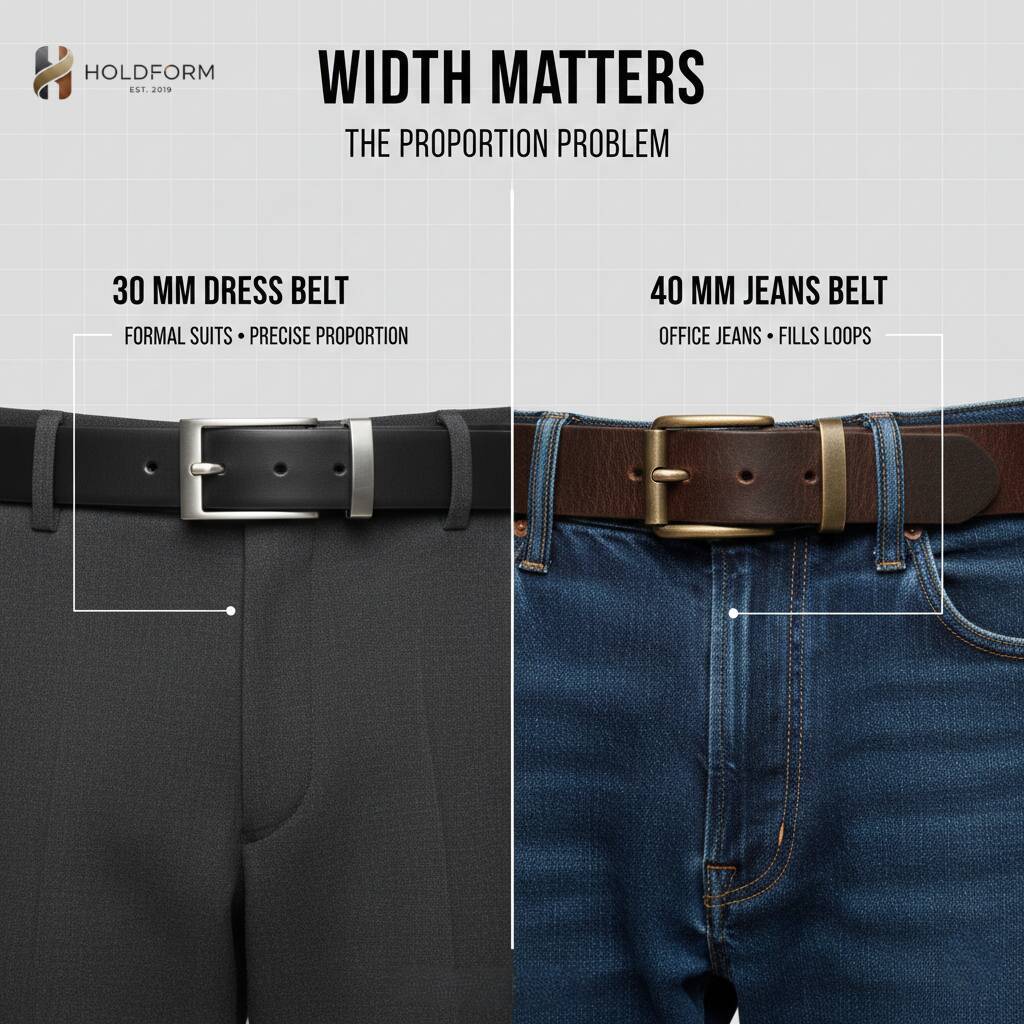
The standard correct width for most jeans is 38–40mm. This range fits correctly in the loop construction of most mid-rise and straight-cut denim without forcing the loops or floating loosely in them.
Within this range, the specific width depends on the jeans cut and the visual weight of the outfit:
Slim and tapered jeans: 35–38mm. Slim-cut denim has narrower loops than standard or relaxed cuts — the tapered construction uses a more refined silhouette that requires proportionally narrower hardware. A 40mm belt in a slim jean loop forces the loop open and creates visible stress on the waistband seam. At 35–38mm, the belt sits in the loop with correct clearance.
Standard straight and mid-rise jeans: 38–40mm. This is the most common jeans construction and the range where 38–40mm fits correctly. The loop is wide enough to accept 38–40mm without forcing, and the belt fills the loop properly without floating.
Relaxed, bootcut, and wide-leg denim: 40–45mm. Relaxed-cut denim has wider loops built for the proportionally heavier hardware that suits a wider-leg silhouette. A 38mm belt in a 44mm loop has 6mm of play — the belt shifts and the buckle migrates. At 40–42mm, the fit is correct.
Work denim and selvedge: 40–45mm. Raw selvedge denim and work denim are built to heritage belt specifications — wider loops designed for the thicker, heavier belts of workwear tradition. A narrow belt looks wrong both proportionally and historically in this context.
High-rise jeans have loop geometry that differs from mid-rise in two ways: the loops are positioned higher on the waist, and they are often slightly narrower and more tightly constructed than the loops on the same brand’s mid-rise equivalent.
The implication for belt selection: measure the loop width specifically on high-rise jeans before purchasing. A 40mm belt that fits correctly in mid-rise denim from the same brand may be tight in the high-rise equivalent. The safe specification for high-rise denim is 35–38mm — wide enough to look proportionally correct on the higher waist position, narrow enough to fit correctly in tighter loop construction.
The higher waist position also means the belt is more visible than it is on mid-rise jeans — there is more exposed waistband above the trouser top button. This makes buckle choice slightly more significant in high-rise contexts: a restrained, clean buckle at the correct width reads as intentional; oversized or decorative hardware looks disproportionate at the higher waist position.
| Jeans type | Typical loop width | Correct belt width |
|---|---|---|
| Slim / skinny | 35–38mm | 35–38mm |
| Mid-rise straight | 38–42mm | 38–40mm |
| High-rise | 35–40mm | 35–38mm |
| Relaxed / bootcut | 40–44mm | 40–42mm |
| Wide-leg | 42–46mm | 40–44mm |
| Raw selvedge / work denim | 40–44mm | 40–44mm |
The most common failure mode on jeans belts is rolling — the strap bends forward at the buckle area and the front of the belt curls away from the body. This creates a visible sag at the front of the waistband and makes the outfit look structurally collapsed.
Rolling is caused by insufficient leather thickness relative to the lateral tension the belt is under. Denim creates more lateral tension on the belt than dress trousers — the heavier fabric pulls more on the waistband, which transfers to the belt. If the leather lacks the bending stiffness to resist this tension, it bends forward instead of holding flat.
The bending stiffness of leather scales with the cube of thickness — a 4mm belt is not 25% stiffer than a 3mm belt, it is roughly twice as stiff. This is why the difference between a 3mm fashion belt and a 4mm structured belt feels categorical rather than incremental. Below 3.5mm, rolling on heavy denim is not a possibility — it is a certainty under daily wear within months.
Correct thickness for jeans: 4–4.5mm full-grain single-layer leather.
At 4mm, the leather has enough bending stiffness to resist the lateral tension of standard and mid-weight denim without rolling. At 4.5mm, the strap is adequate for heavy raw denim and work denim where the fabric tension is highest. Above 4.5mm, the belt is moving into carry-belt specification — correct for load-bearing use but stiffer than most casual jeans wear requires.
Leather grade matters as much as thickness. Full-grain leather has a continuous fibre network that gives it structural integrity throughout its thickness. Bonded leather — the compressed fibre composite used in fashion belts — lacks this continuous structure. A 4mm bonded belt has less bending stiffness than a 3.5mm full-grain belt, and it deforms under sustained load rather than rebounding. The deformation is permanent: a bonded belt that has begun rolling will not recover its flat profile.
Top-grain leather at 4mm is adequate for most casual denim wear — it resists rolling under normal conditions but will show surface wear faster than full-grain. For a belt worn with jeans five days a week, full-grain is the correct choice because the surface wear rate on top-grain leather is visible within 18 months of daily use.
Jeans exert more mechanical stress on buckle hardware than dress trousers — the heavier fabric transfers more force to the buckle through the strap, and the casual wear context means the belt is removed and replaced more frequently, often more roughly, than a dress belt.
Base metal: Solid brass or stainless steel for daily-use jeans belts. Brass is the traditional choice for heritage and Western denim wear — it develops a warm patina over years of use that suits the ageing aesthetic of raw denim. Stainless steel is appropriate for contemporary or casual denim contexts where a cleaner, more modern hardware appearance is preferred. Both materials handle the mechanical stress of daily jeans wear without deformation.
Cast zinc alloy with PVD coating is acceptable for everyday casual denim if the alloy density is adequate. PVD coating bonds at a molecular level and resists the scratching that denim’s selvedge edge produces against buckle hardware during daily wear. Electroplated zinc is not adequate for daily jeans wear — the plating chips at the hardware edges where denim friction is highest, exposing the base metal within months.
Buckle profile: Low to medium depth for most jeans wear. A flat-profile buckle sits against the denim waistband without creating a pressure point under jackets or when seated in vehicles. A deep-profile or statement buckle is appropriate for heritage and Western denim contexts where the buckle is an intentional visual element — but it requires a strap at 38–40mm minimum and full-grain leather at adequate thickness to support the hardware weight without the strap sagging.
For a full guide to buckle material and finish selection, see our [silver, gold and black buckle guide →]
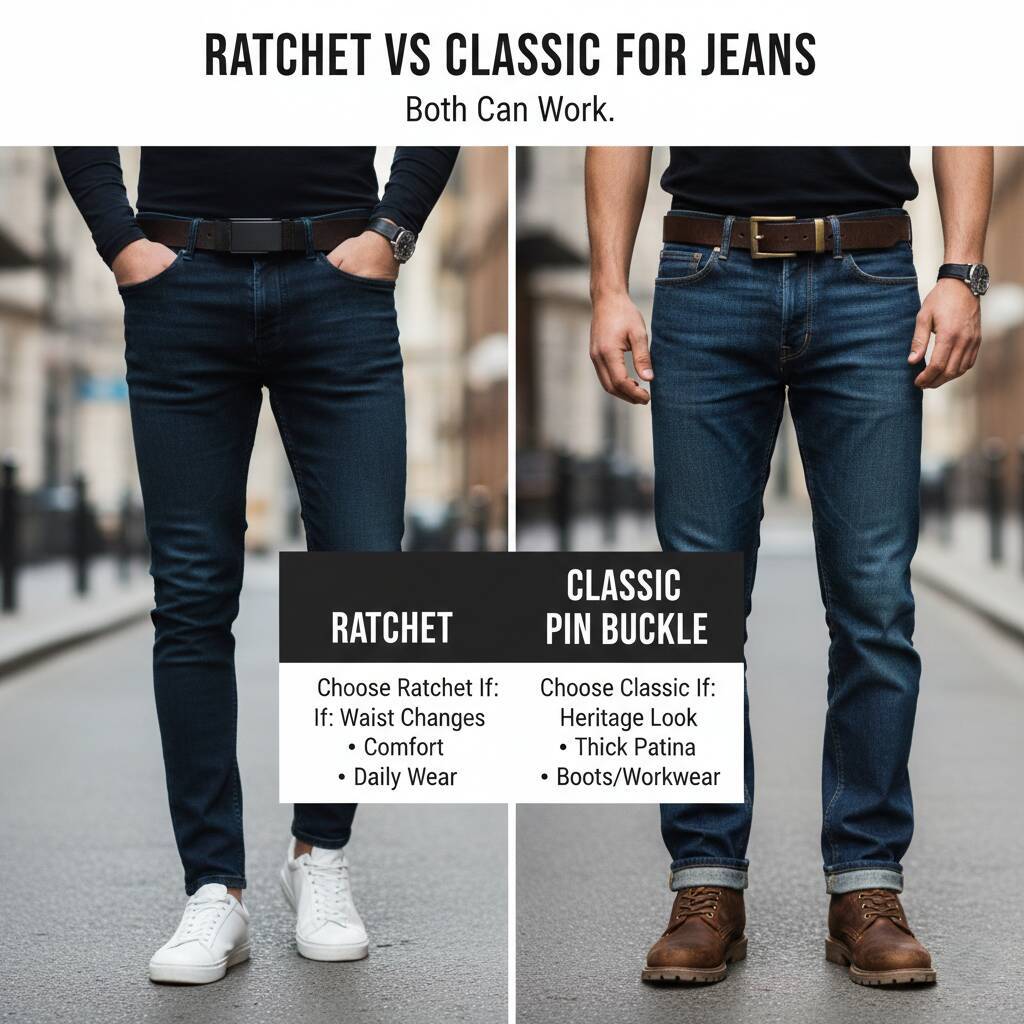
Both ratchet and classic pin-buckle mechanisms work correctly on jeans with the right strap specification. The choice depends on wear context and preference.
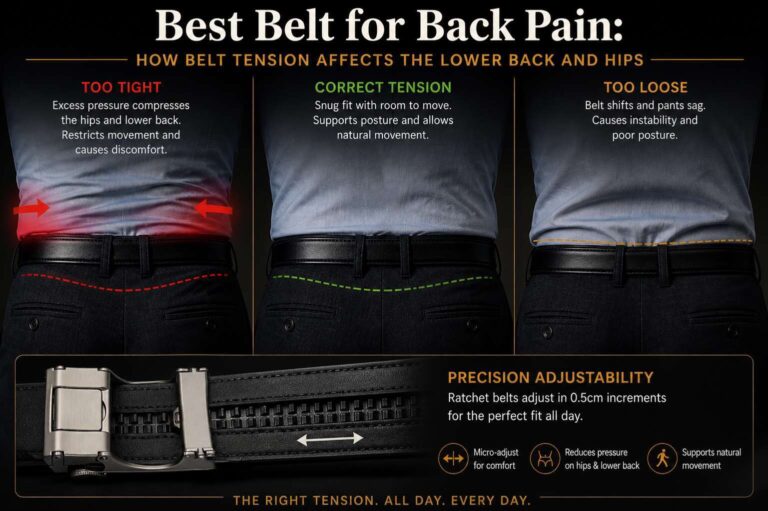
Ratchet for jeans: The 0.5cm adjustment increments are more relevant for denim than for dress wear — jeans are worn across a wider range of activities, from seated desk work to physical movement to long driving days, and waist size varies more across these contexts than it does in a stable office environment. A ratchet belt set to the correct tension for seated wear adjusts in seconds for standing or active wear. For anyone who wears jeans daily across varied activities, ratchet is the more practical mechanism.
The aesthetic question about ratchet belts on denim: the mechanism reads as contemporary and functional, which suits most modern denim contexts. For heritage raw denim and workwear contexts where traditional construction is part of the aesthetic, a classic pin buckle is more appropriate.
Classic pin-buckle for jeans: The correct choice for heritage denim, selvedge raw denim, workwear, and any context where the patina and character of traditional construction is part of the outfit’s identity. A heavy solid brass pin buckle on a 4.5mm full-grain leather strap ages alongside raw denim in a way that a ratchet mechanism doesn’t. For buyers building a heritage denim wardrobe, this combination — heavy strap, solid brass, classic pin — is the more authentic specification.
Roller buckles are a valid third option for jeans specifically. The roller reduces friction between the prong and the leather at the hole, which extends hole life on a pin-buckle belt worn daily. For workwear denim where the belt takes heavy daily use and hole longevity matters, a roller buckle is a practical upgrade over a standard frame buckle.
Denim is a casual fabric with a wide colour palette — blue, black, grey, and white denim all appear in everyday wear. This gives more flexibility in belt colour selection than formal wear allows.
Dark brown: The most versatile single belt colour for jeans. Dark brown works with blue denim (warm-cool contrast that reads as intentional), black denim (the tonal proximity is close enough in casual contexts), and grey denim. It matches brown and tan shoes directly and works adequately with white sneakers. If you own one belt for jeans, dark brown at 38–40mm covers the widest range of denim outfit combinations.
Black: The correct choice for black denim, dark outfits, and jeans worn with black shoes where a direct match is preferred. Slightly less versatile than dark brown across the full denim palette because it reads as cooler and more formal — it suits black and dark grey denim more naturally than blue denim.
Tan and medium brown: Work well with lighter denim, summer-weight cotton trousers, and casual outfits in warm neutral palettes. Less versatile than dark brown across the full denim range.
Buckle finish: Brushed or matte over polished or high-shine for casual denim contexts. A brushed silver buckle reads as casual-appropriate across most denim outfits. A high-polish mirror buckle reads as overdressed against the casual register of denim. Match buckle metal family to watch metal where possible — brushed silver watch with brushed silver buckle, brass watch with brass buckle.
For the full matching logic, see our [black belt or brown belt guide →]
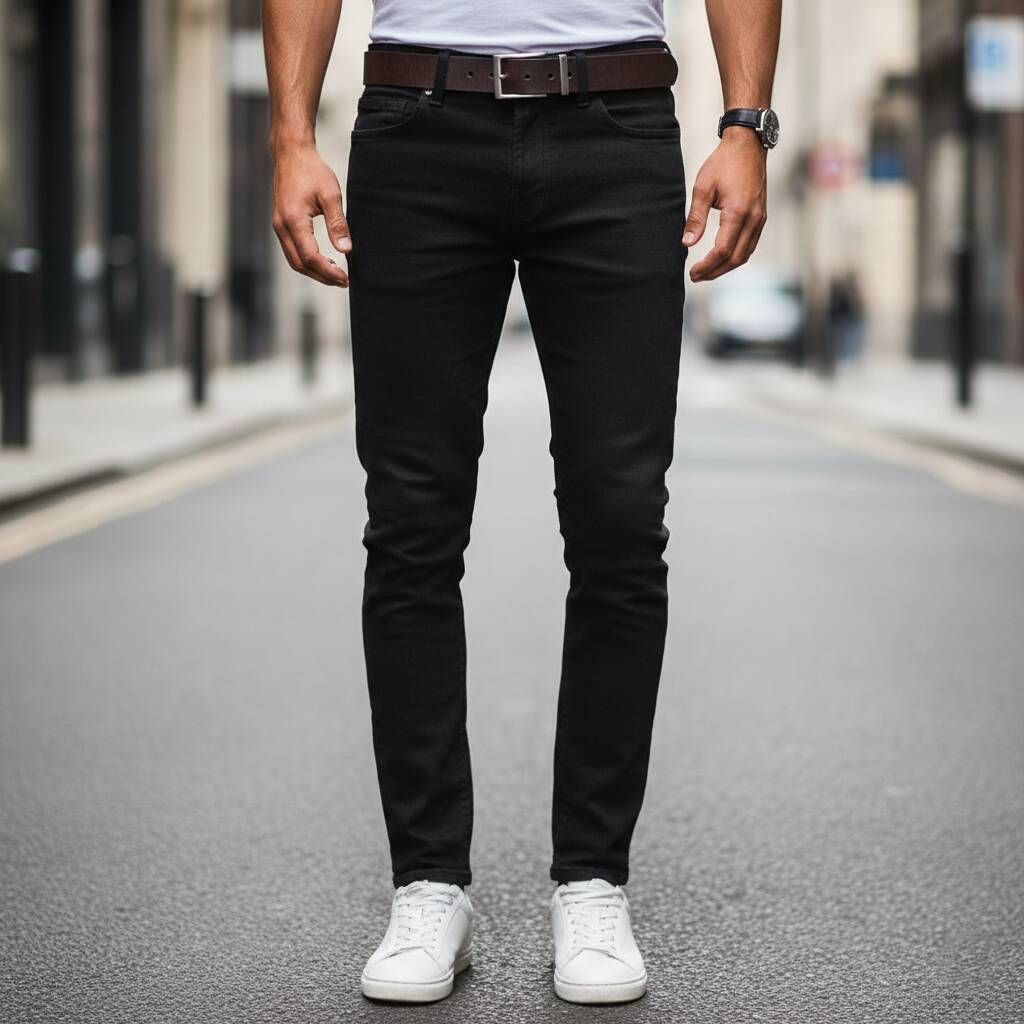
If you want one belt that covers the widest range of denim outfit combinations:
38mm, dark brown full-grain leather at 4–4.5mm, brushed silver or brass buckle.
This specification works with:
It does not work optimally with formal suits — for those contexts, a 32–35mm belt in the correct colour is the better choice. The one-belt-for-jeans specification is a dedicated denim belt, not a universal solution.
Using a dress belt on denim. A 30mm belt from the formal range floating in a 40mm denim loop looks immediately wrong to anyone paying attention. The lateral play makes the buckle migrate and the overall fit look careless. Width-matching belt to loop is the single most impactful correction most people can make.
Choosing bonded or split leather. Fashion belts in the 30–80 price range are almost universally bonded or split leather. They look correct at purchase and begin rolling and delaminating within three to six months of daily wear on denim. The visual degradation is faster on jeans than on dress trousers because the heavier fabric exerts more stress on the strap.
High-shine buckle on casual denim. A polished chrome or mirror-finish buckle creates a formality mismatch with denim’s casual register. The contrast reads as the outfit not knowing what it wants to be.
Ignoring high-rise loop width. High-rise jeans often have narrower loops than mid-rise equivalents from the same brand. A belt that fits a mid-rise pair of jeans from the same brand may be tight in the high-rise version. Measure the loop width specifically rather than assuming consistency across cuts.
38–40mm for standard mid-rise and straight-cut jeans. 35–38mm for slim and high-rise cuts where loops are narrower. 40–44mm for relaxed, wide-leg, and raw selvedge denim. The correct width is the one that fills the specific loop with 1–2mm of clearance — enough to thread the belt without forcing the loop, not so much that the belt has lateral play.
Most mid-rise straight and relaxed-cut jeans have loops in the 38–42mm range. Slim-cut and high-rise jeans typically run 35–38mm. Raw selvedge and workwear denim often runs 40–44mm. These are manufacturing norms — individual brands and cuts vary, so measuring the loop on a specific pair is more reliable than assuming.
4–4.5mm full-grain single-layer leather. Below 3.5mm, the leather lacks the bending stiffness to resist the lateral tension of heavy denim and rolling is likely within months of daily wear. At 4mm, the belt holds flat under normal denim wear conditions. At 4.5mm, it handles heavier raw denim and work denim without deformation.
Yes. The 0.5cm adjustment increments are practically useful for denim wear across varied daily activities. The mechanism reads as contemporary rather than heritage — for raw denim and workwear contexts where traditional construction is part of the aesthetic, a classic pin buckle is more appropriate. For everyday casual and smart casual denim, ratchet is the more practical choice.
35–38mm is the most common belt width across men’s dress and casual categories. For jeans specifically, 38–40mm is the correct standard — the most common general width is narrower than what denim construction requires.
35–38mm is the safest width for high-rise jeans, which typically have narrower and more tightly constructed loops than mid-rise equivalents. The higher waist position also makes the belt more visible, so a clean, restrained buckle reads better than statement hardware. Dark brown or black at 35–38mm with a brushed buckle is the correct specification for most high-rise denim.
Match belt leather to shoe leather as the primary rule — dark brown belt with brown shoes, black belt with black shoes. Jeans allow more flexibility than formal wear, so the match doesn’t need to be exact, but the broad colour family should align. Buckle metal should match dominant watch metal where possible.
HoldForm jeans belts are specified with leather grade, strap thickness, and loop-width compatibility listed on every product page.
[View 38–40mm ratchet belts for jeans →] [View classic heritage belts for denim →] [Black belt or brown belt: the full matching guide →] [How belt thickness affects structural performance →]

Practical belt guides, sizing tips, and exclusive offers — straight to your inbox.

Leave a comment