Belt width is not a style preference. It is a fit specification set by the loop width of the trousers you are wearing. When the belt is too wide, it stresses the loop. When it is too narrow, it moves inside the loop and pulls the buckle off-center.
The correct belt width is the one that fills the specific trouser loop with 1–2mm of clearance. This guide covers the standard widths, which trouser type each serves, how to measure your loops, and the single-number rule for buyers who want a fast answer.
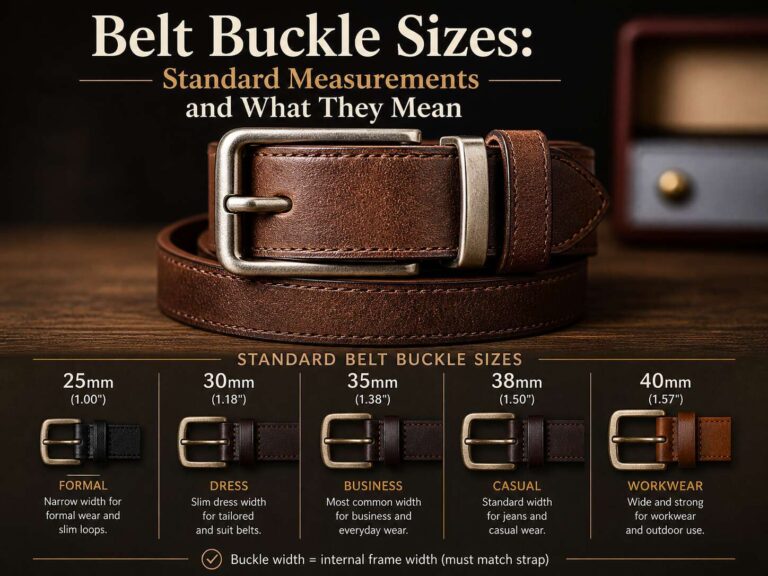
Fast answer: Choose 35mm for suits, dress trousers, chinos, and smart casual wear. Choose 38–40mm for jeans and casual trousers. Choose 30–33mm for narrow formal evening trousers with belt loops.
For most men, the decision is simple: 35mm for office trousers, 38–40mm for jeans.
Men’s belts are manufactured in four practical widths. Each width corresponds to the loop construction of a specific trouser category.
30–33mm — Formal evening and tailored suits
The narrowest practical belt width for men. Formal evening trousers with belt loops typically require 30–32mm — tighter, flatter, and more discreet than casual trouser construction. A 30–33mm belt in a 32mm loop sits correctly with 1–2mm of clearance. A 38mm belt in the same loop forces the fabric open and creates a visible ridge at the waistband.
This width is also the correct choice for slim-cut dress trousers where the loop construction is proportionally narrower than standard business trousers. If you own trousers where a standard 35mm belt feels slightly tight threading through the loops, the trouser was cut for a 30–33mm belt.
View 30–33mm slim formal belts →
35mm — Standard business, dress trousers, and smart casual
The most widely manufactured belt width and the correct specification for most business and professional wardrobes. Standard dress trousers, chinos, and smart casual trousers are built with loops in the 33–38mm range — wide enough for 35mm with correct clearance, narrow enough that 38–40mm starts to feel snug.
35mm is the safe default for any buyer who is uncertain. It works across business formal, business casual, smart casual, and most chino constructions without forcing or floating. If you own one dress belt, 35mm at the correct leather grade is the specification that covers the widest range of trouser contexts.
38–40mm — Jeans, chinos with wider loops, and casual trousers
The correct width for most denim construction. Jeans are built with loops in the 38–44mm range — wider, deeper, and designed for thicker belts that can handle the mechanical demands of heavier fabric. A 35mm dress belt in a 40mm denim loop has 5mm of lateral play; the buckle migrates off-center during movement and the waistline looks unconsidered.
38mm is also correct for casual chinos and relaxed-fit trousers where the loop construction runs wider than standard dress trouser spec.
40–45mm — Workwear, raw selvedge denim, and heavy-duty casual
The widest practical width for everyday wear. Raw selvedge denim and workwear trousers are built to heritage belt specifications — wider loops designed for the thicker, heavier belts of traditional workwear. A 38mm belt in a 44mm loop has 6mm of play. At 40–42mm, the fit is correct and the belt reads as proportionally appropriate for the heavier fabric weight.
Shop heritage and workwear belts →
| Trouser type | Typical loop width | Correct belt width |
|---|---|---|
| Formal evening (with belt loops) | 28–32mm | 30–32mm |
| Tailored suits | 30–35mm | 30–35mm |
| Standard dress trousers | 33–38mm | 35mm |
| Chinos (slim/standard) | 33–38mm | 35mm |
| Chinos (relaxed) | 38–42mm | 38–40mm |
| Slim-cut jeans | 35–38mm | 35–38mm |
| Mid-rise straight jeans | 38–42mm | 38–40mm |
| Relaxed / wide-leg jeans | 40–44mm | 40–42mm |
| Raw selvedge / workwear | 40–44mm | 40–44mm |
The most reliable method is direct measurement with a ruler or tape measure. Remove the belt from the trouser and measure the internal width of the loop at its widest point — the measurement across the inside of the loop from one seam edge to the other.
The correct belt width is this measurement minus 1–2mm. A 40mm loop takes a 38–39mm belt. A 36mm loop takes a 34–35mm belt.
If you cannot measure directly: thread a strip of paper through the loop and mark where it meets each edge. Measure the marked length. This gives the internal loop width accurately enough to select the correct belt width.
Why manufacturers are inconsistent: loop width varies between brands, between cuts within the same brand, and sometimes between different colorways of the same trouser. A 34″ slim-cut chino from one brand may have 35mm loops; the same size from a different brand may have 38mm loops. The loop measurement is more reliable than the trouser cut label.
If you want a single belt width that covers the most common wardrobe combinations without measuring individual loops:
35mm for a professional and smart casual wardrobe. 38mm for a casual and denim wardrobe.
If you dress primarily in suits and business formal: 35mm. If you dress primarily in jeans and casual trousers: 38mm. If you dress across both contexts regularly: own one of each.
A 35mm belt in a 40mm jeans loop is a common mistake — it looks slightly wrong to anyone who knows what they are looking at, and slightly uncomfortable to the person wearing it. The 38mm jeans belt worn in a 34mm dress trouser loop is the same problem in reverse. Matching belt width to loop width is the single most impactful correction most men can make to how their outfits look at the waistline.
Belt width and leather thickness work together. A narrow belt at inadequate thickness rolls forward under tension — the strap bends away from the body at the buckle area and the front of the waistband sags. A wide belt at adequate thickness holds flat.
The correct thickness by width:
For a full explanation of how leather thickness affects belt performance, see our belt thickness guide →
Buckle size should be proportional to belt width. A large statement buckle on a narrow dress belt looks architecturally wrong — the hardware dominates the strap rather than completing it. A narrow flat buckle on a wide jeans belt reads as undersized.
The practical rule: buckle face width should be within 5–8mm of belt width. A 35mm belt reads correctly with a 38–43mm buckle face. A 40mm belt reads correctly with a 42–48mm buckle face.
Statement hardware — oversized animal motifs, large letter-initial designs, 3D sculptural buckles — requires a minimum 38mm belt to support the visual weight of the hardware. For formal and business contexts, the buckle face should be restrained — flat rectangular or oval, matching the width of the strap without significant overhang.
Wearing a 30–33mm dress belt with jeans. The belt floats in the wider denim loop, the buckle migrates, and the outfit reads as a dress belt worn by accident with casual clothes.
Assuming all trousers take the same width. Slim-cut dress trousers from tailoring brands often have 30–33mm loops. Relaxed casual trousers from workwear brands often have 40–42mm loops. The loop varies more than most buyers expect across trouser categories.
Choosing width for aesthetic reasons rather than loop fit. A wider belt does not automatically look more substantial or higher quality. A 40mm belt in a 35mm dress trouser loop looks like a mistake. Correct fit reads as more considered than any specific width choice.
Ignoring high-rise loop construction. High-rise trousers — both jeans and dress cuts — often have narrower loops than their mid-rise equivalents from the same brand. Measure the high-rise loop specifically rather than assuming consistency across cuts.
35mm is the most common manufacturing standard for men’s dress and business casual belts. For jeans, 38–40mm is the correct standard. The correct width for any trouser is the one that fills the specific loop with 1–2mm of clearance.
30–35mm for most suit trousers. Formal evening trousers with belt loops: 30–32mm. Standard business suits: 33–35mm. Measure the suit trouser loop width and subtract 1–2mm for the correct belt width.
35mm for slim and standard-cut chinos, which typically have loops in the 33–38mm range. 38mm for relaxed-cut chinos with wider loop construction. Measure the loop if uncertain — chino loop width varies significantly between brands and cuts.
35mm covers most dress trouser constructions. Formal evening trousers with belt loops take 30–33mm. Standard business dress trousers take 35mm. If the 35mm belt feels snug threading through the loops, the trouser was cut for a narrower belt.
Most mid-rise straight and relaxed-cut jeans have loops in the 38–42mm range. Slim-cut jeans typically run 35–38mm. Raw selvedge and workwear denim often runs 40–44mm. Measuring the loop is more reliable than assuming.
The belt should be 1–2mm narrower than the loop — enough clearance to thread without forcing the loop open, not so much that the belt has lateral play.
35–38mm. High-rise jeans typically have narrower and more tightly constructed loops than mid-rise equivalents. The higher waist position also makes the belt more visible — a clean, restrained buckle at the correct width reads as intentional.
Choose the belt by the trousers it will be worn with. Width first, leather second, buckle third. When the belt fills the loop correctly, the whole waistline looks cleaner.
HoldForm belts are available across four widths — 30mm, 33mm, 35mm, and 38–40mm — with loop-width compatibility listed on every product page.
View 35mm belts for suits and business wear →

Practical belt guides, sizing tips, and exclusive offers — straight to your inbox.


Leave a comment