Yes — if your belt uses a removable attachment system. No — if the buckle is stitched, woven, or riveted to the strap. The distinction is visible in under 10 seconds and determines whether your belt is repairable or disposable.
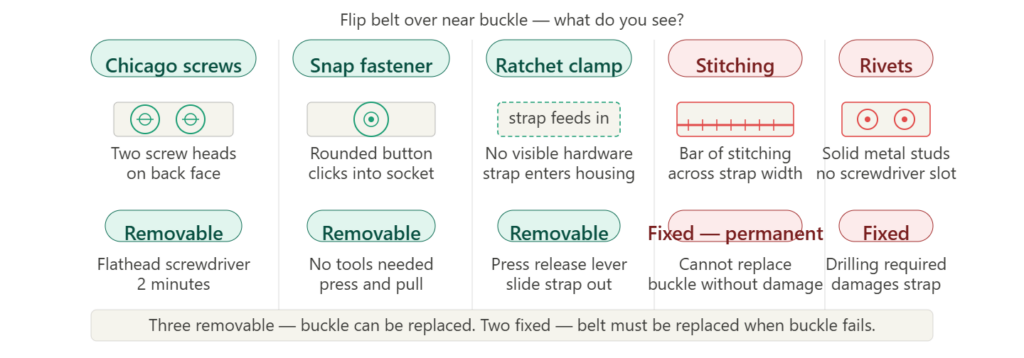
Turn the belt over near the buckle. Look at the back of the strap where it meets the buckle frame.
You can replace the buckle if you see:
Two screw heads — a round post on the back face and a matching socket on the front with a screwdriver slot. These are Chicago screws — the most common removable attachment on quality leather belts. One screwdriver, two minutes, buckle replaced.
A rounded snap button — a button on the strap back that presses into a socket. Common on Western-style belts. Press and pull to release, no tools needed.
No visible hardware, strap feeds into buckle — the strap slides into the back of the buckle housing and is held by an internal clamp. This is a ratchet clamp system. Press the release lever, pull the strap out.
You cannot replace the buckle if you see:
A bar of stitching across the strap width — the strap is folded around the buckle frame and stitched flat. Removing the buckle means cutting the stitching at the highest-stress point on the belt. Not a practical repair.
No visible attachment hardware at all, woven or braided construction — the buckle is structurally integrated into the strap construction. Removing it compromises the strap.
Solid metal studs or rivets — unlike screws, rivets cannot be removed without drilling through them, which damages the strap hole permanently.
The question “can I replace the buckle” is usually asked in one of two situations:
The buckle has failed — the finish has chipped, the prong has bent, or the mechanism has broken — but the leather strap is still in good condition. If the attachment is removable, you replace the buckle and keep using the strap. If it isn’t, the belt goes with the buckle.
You want to change the finish — switching from silver to brass, or from a standard frame to a different design, without buying a new belt. This only works if the strap uses a detachable buckle system.
A belt with a serviceable attachment system effectively separates the lifespan of the leather from the lifespan of the hardware. The strap can outlast multiple buckles. A belt with a permanent attachment has a single lifespan determined by whichever component fails first — and buckle finish failure typically comes well before leather failure on quality full-grain straps.
Electroplated finish failure. The most frequent reason buyers ask this question. An electroplated zinc alloy buckle — standard hardware on most mid-range belts — typically shows finish failure at friction points within 12–18 months of daily professional wear. The silver or black finish chips at the prong tip, the frame contact points, or the release mechanism, exposing the grey zinc base metal beneath. If the strap is still good, replacing the buckle with PVD-coated hardware extends the belt’s useful life by years.
Buckle mechanism failure. On ratchet belts, the spring-loaded pawl can weaken over years of daily use. The mechanism clicks but no longer holds position under load. If the strap is serviceable, a new buckle housing with an intact mechanism restores the belt to full function.
Finish upgrade. A buyer who purchased a silver buckle and now predominantly wears gold-watch outfits. If the strap uses a detachable system, the buckle swap takes two minutes.
Size correction. A buyer who trimmed a ratchet strap and then lost weight — the strap is now too long even at the shortest track position. A buckle swap isn’t the fix here; re-trimming the strap is. But the buckle still needs to come off as part of that process.
If your belt has a removable attachment, verify these before ordering:
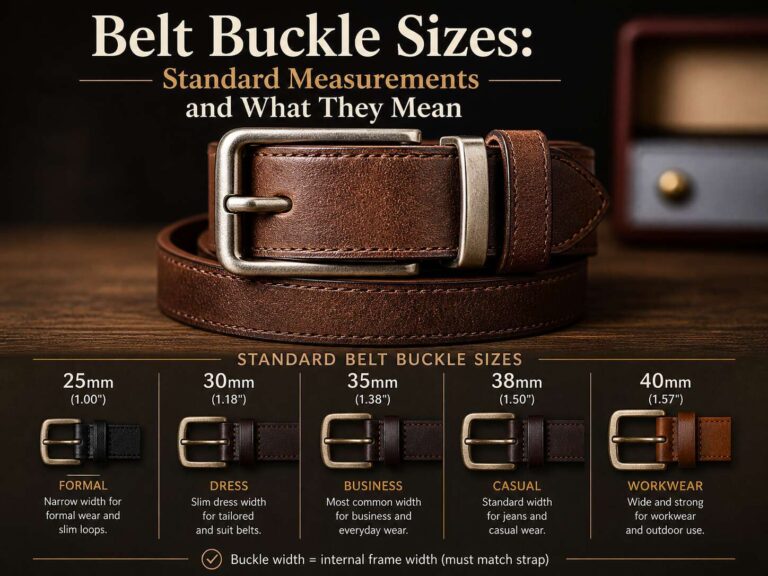
Strap width. The most common mistake. Replacement buckles are width-specific — a 35mm buckle will not correctly accept a 38mm strap. Measure the strap width at the buckle end before ordering.
Attachment type. Chicago screw buckles need a strap with Chicago screw holes. Ratchet clamp buckles need a strap with a ratchet track. The systems are not interchangeable without modifying the strap.
Buckle frame bar width. On pin-buckle designs, the strap wraps around the frame bar. The bar must be narrower than the strap — a bar equal to or wider than the strap won’t fold cleanly.
Once you’ve confirmed your belt has a removable attachment and your replacement buckle is compatible, the step-by-step process for each system type is in our [how to change a belt buckle guide →]
That guide covers Chicago screw removal including the spinning-screw fix, snap fastener replacement, ratchet clamp removal and reinstallation, and the nail polish thread-locker trick for preventing Chicago screws from loosening over time.
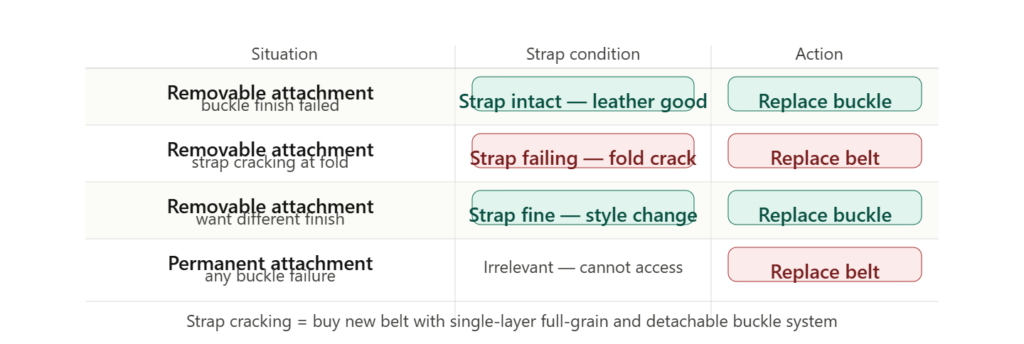
If the strap itself is failing — fold cracking at the buckle, delaminating layers, oval holes that won’t hold position — replacing the buckle doesn’t fix the underlying problem. Cracking at the fold is leather fibre fatigue; a new buckle on the same strap still fails at the same point. Delamination is adhesive bond failure in layered construction; the strap structure is compromised regardless of the buckle.
In these cases the belt needs replacement, not repair. The question is then what construction to choose for the replacement — and the answer is single-layer full-grain leather at 4mm with a detachable buckle system, so the same situation doesn’t arise again.
For a full breakdown of why leather belts fail and what the construction differences mean, see our [why leather belts crack and how to prevent it guide →]
No. Only belts with removable attachment hardware — Chicago screws, snap fasteners, or ratchet clamp systems — allow buckle replacement. Stitched, woven, and riveted attachments are permanent. Flip the belt over near the buckle to identify which system yours uses.
If the strap is in good condition and the attachment is removable, replacing the buckle is worth it — especially if you’re upgrading from electroplated zinc to PVD-coated hardware, which will hold its finish significantly longer. If the strap itself is cracking, delaminating, or has severely deformed holes, replace the belt.
Turn the belt over near the buckle. Chicago screws appear as two circular metal posts — one on the back face with a slotted or smooth head, one on the front with a screwdriver slot. They typically sit 1–2cm from the strap end inside the buckle fold.
Yes. Most ratchet belts use an internal clamp mechanism — press the release lever, slide the strap out, insert the strap into the new buckle housing, release the clamp. Width compatibility is the main variable to check: the new buckle housing must match the strap width exactly.
Finish failure on electroplated zinc alloy hardware — the plating chips or peels at friction points (prong tip, frame bar contact, release mechanism) after sustained daily wear. PVD-coated replacement hardware lasts significantly longer under the same conditions.
HoldForm belt straps and buckles are available separately, allowing buckle replacement and upgrades without replacing the strap.
[How to change a belt buckle: step-by-step for each attachment type →] [Belt buckle materials: zinc alloy, brass and steel compared →] [Types of belt buckles: ratchet, pin, roller and plate →] [Why leather belts crack and how to prevent it →]

Practical belt guides, sizing tips, and exclusive offers — straight to your inbox.

Leave a comment