PVD coating — Physical Vapor Deposition — is a surface finishing process that bonds a hard, thin layer of material onto a metal substrate at the atomic level. On belt buckles, it is used to apply a durable, consistent finish to zinc alloy hardware that holds its appearance under sustained daily wear significantly longer than standard electroplating.
When a belt listing says “PVD coated,” it means the buckle finish was applied through this vacuum-deposition process rather than through conventional electroplating. The practical difference is in how long the finish lasts at friction points under daily use.
In a PVD process, the buckle is placed in a vacuum chamber. The coating material — typically titanium nitride, chromium nitride, or zirconium nitride depending on the target finish colour — is vaporised using heat or plasma. The vaporised atoms travel across the vacuum and deposit onto the buckle surface one atomic layer at a time.
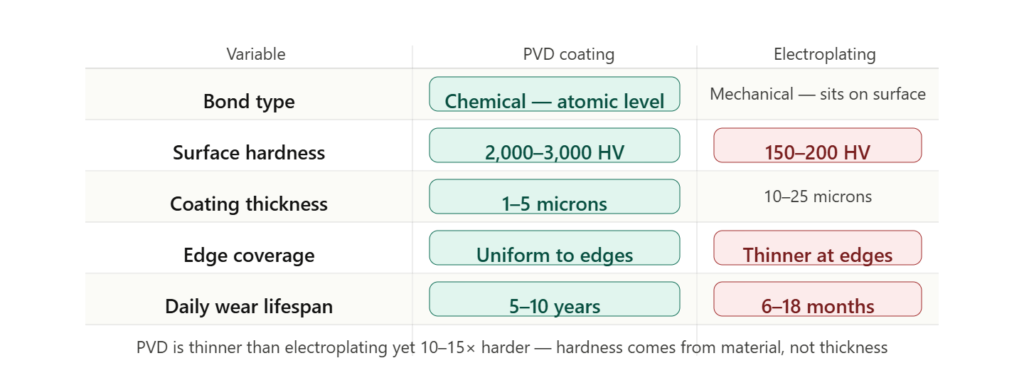
Because the deposition happens at the atomic level, the coating bonds chemically with the metal surface rather than sitting mechanically on top of it. The result is a coating that is integrated into the surface rather than layered over it — the boundary between the coating and the base metal is a chemical bond rather than a mechanical adhesion.
The coating thickness produced by PVD is typically 1–5 microns (0.001–0.005mm). This is thin enough to preserve the original surface geometry of the buckle while providing a hardness and wear resistance that standard electroplating cannot match.
Electroplating — the finishing method used on most mid-range and budget belt buckles — works through a completely different mechanism. The buckle is submerged in a solution containing dissolved metal ions. An electrical current causes the metal ions to deposit onto the buckle surface. The deposited layer sits on top of the base metal, bonded through molecular attraction rather than chemical integration.
The practical differences between the two processes:
Hardness: Electroplated finishes on zinc alloy buckles typically achieve 150–200 Vickers hardness (HV). PVD coatings achieve 2,000–3,000 HV depending on the coating material. This is a hardness difference of 10–15 times. Vickers hardness measures resistance to surface deformation under load — higher numbers mean the surface resists scratching and abrasion more effectively.
Bond type: Electroplating produces a mechanical bond. PVD produces a chemical bond integrated into the surface. Mechanical bonds fail progressively — once a crack forms at the surface, moisture and wear degrade the bond layer beneath the crack, accelerating separation. Chemical bonds do not fail in the same progressive pattern.
Thickness: Electroplating typically applies 10–25 microns of finish. PVD applies 1–5 microns. Despite being thinner, PVD is significantly harder — the hardness comes from the material properties of the coating rather than its thickness.
Finish consistency: PVD coatings are uniform at the atomic level — there are no microscopic gaps or thin spots in the coverage. Electroplated finishes have variable thickness, particularly at edges and recessed areas, which is where electroplated buckles typically show first failure.
A belt buckle has specific friction points that accumulate wear through daily use:
The prong tip on a pin-buckle belt contacts the leather hole edge every time the belt is fastened. The frame bar contacts the back face of the strap at the buckle fold under sustained tension. The release lever or button on a ratchet buckle contacts the mechanism housing on every adjustment.
On an electroplated zinc alloy buckle, these friction points show visible finish degradation — the plating wears through to the grey zinc base metal — within 6–18 months of daily professional wear. The progression is visible first as a dulling of the finish at contact points, then as a colour shift as the base metal is exposed, then as surface roughness as the exposed zinc oxidises.
On a PVD-coated buckle, the same friction points sustain the same mechanical load but the hardness differential (2,000–3,000 HV versus 150–200 HV) means the coating resists abrasion significantly longer. Conservative industry estimates suggest PVD finishes last 5–10 years of daily wear before showing comparable degradation to what electroplating shows in 12–18 months.
For a buyer who wears a belt five days a week in a professional context, this difference is directly relevant to whether the buckle finish is still intact when the leather strap is still serviceable — or whether the buckle needs replacing first.
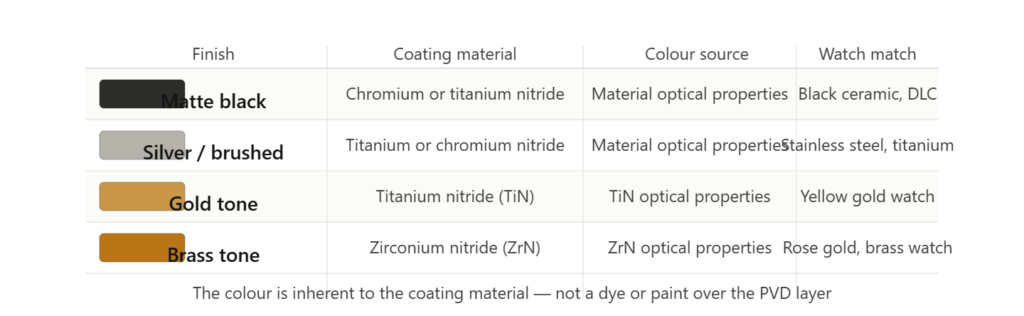
PVD coating is not limited to one colour. The colour of the deposited finish depends on the material used:
Silver/brushed steel appearance: Titanium nitride or chromium nitride coatings in specific process conditions produce cool silver tones that match stainless steel watch hardware.
Matte black or gunmetal: Chromium nitride or titanium aluminium nitride produces dark finish tones without the reflective surface of polished plating. Matte black PVD has become the most common application for contemporary ratchet belt hardware.
Gold tone: Titanium nitride under specific process conditions produces a warm gold tone. This is distinct from gold electroplating — the gold tone comes from the optical properties of the titanium nitride rather than from deposited gold.
Brass tone: Zirconium nitride produces a warm yellow-gold appearance closer to natural brass than titanium nitride gold.
The finish colour is a product of the coating material and the deposition conditions — not a paint or dye applied over the PVD layer. This is why PVD finishes cannot chip or peel in the same way that electroplated colour finishes can — the colour is inherent to the coating material rather than a surface application.
Product listings that specify “PVD coating” or “PVD finish” are directly identifying the process. Listings that say “alloy buckle,” “metal buckle,” “premium alloy,” or “zinc alloy” without specifying the finish process are almost certainly electroplated — brands that use PVD coating typically specify it because it is a differentiating quality claim.
Physical identification is more difficult because PVD and high-quality electroplating can look similar in new condition. The difference appears over time: PVD finishes hold their appearance at friction points while electroplated finishes degrade there first.
On a new buckle, one indicator of PVD is surface hardness at edges and recessed areas. Electroplated finishes often show slightly thinner coverage at edges — look at the buckle edge under direct light. Uniform finish coverage to the very edge of the metal indicates PVD or high-quality process control; slight variation or a duller appearance at edges suggests electroplating.
The most reliable identification method is the supplier specification. If a buckle is listed with PVD coating, ask specifically: what substrate (zinc alloy, stainless steel, titanium), what coating material (titanium nitride, chromium nitride, zirconium nitride), and what coating thickness in microns. A supplier who can answer these questions has process knowledge that indicates genuine PVD production.
PVD coating is applied to different substrate metals depending on the application:
Zinc alloy with PVD: The most common combination for ratchet belt buckles. The zinc alloy die-casting process allows the tight tolerances required for ratchet mechanism geometry. PVD coating provides the finish durability that the soft zinc alloy surface cannot provide on its own.
Stainless steel with PVD: Used for high-end watch cases and some premium buckle hardware. Stainless steel is already corrosion-resistant — the PVD coating adds colour and additional surface hardness rather than providing the primary corrosion protection.
Titanium with PVD: Less common on belt hardware but used in some premium applications. Titanium is already extremely hard and corrosion-resistant — PVD on titanium is primarily for colour rather than durability.
For belt buckles specifically, zinc alloy with PVD coating is the practical standard — it combines the manufacturability of zinc alloy with the finish durability that daily professional wear requires.
PVD stands for Physical Vapor Deposition — a vacuum coating process that bonds a hard wear-resistant layer onto the buckle surface at the atomic level. It produces a finish 10–15 times harder than standard electroplating, which is why it lasts significantly longer at friction points under daily use.
For daily wear longevity: yes, significantly. PVD achieves 2,000–3,000 Vickers hardness versus 150–200 HV for electroplating — it resists scratching and abrasion at friction points where electroplated finishes typically fail within 12–18 months of daily professional wear. PVD finishes on belt buckles typically last 5–10 years under the same conditions.
All coatings degrade eventually under sustained friction. PVD coatings degrade much more slowly than electroplated finishes because of their significantly higher hardness and chemical bond to the base metal. At typical daily belt wear friction levels, PVD coatings last years longer than electroplated alternatives before showing visible degradation.
Yes. PVD coatings — typically titanium nitride, chromium nitride, or zirconium nitride — are chemically inert and do not contain nickel. The coating also acts as a barrier preventing the zinc alloy substrate from contacting skin. For buyers with nickel sensitivity, PVD-coated zinc alloy buckles are appropriate, though solid brass or titanium hardware eliminates the coating-dependency entirely.
Listings that say “alloy buckle” or “premium alloy” without specifying the finish process are almost certainly using electroplated zinc alloy — the most common and least expensive finishing method. Brands that use PVD coating typically specify it because it is a genuine quality differentiator. Absence of PVD specification in a listing is a reliable indicator of electroplating.
HoldForm ratchet belt buckles use PVD-coated zinc alloy — coating material and specification are listed on every product page.
[Belt buckle materials: zinc alloy, brass and steel compared →] [Types of belt buckles: ratchet, pin, roller and plate →] [Nickel-free belt buckles: why buckles cause skin rash →] [What is a ratchet belt: how it works and who it suits →]


Practical belt guides, sizing tips, and exclusive offers — straight to your inbox.

Leave a comment