The horizontal versus vertical knife carry debate gets framed as a personal preference question. It isn’t — or at least, preference isn’t where the decision should start.
Each orientation produces a different mechanical relationship between the knife, the sheath, and the belt. That relationship determines seated comfort, draw mechanics, carry stability, and how the setup performs under the specific conditions of your daily routine. Once you understand what each orientation actually does, the choice for your situation is usually straightforward.
This covers both orientations mechanically — not just which is “more comfortable,” but why, under what conditions, and where each one fails.
The orientation of a knife on the belt determines three things:
Where the sheath mass sits relative to the hip. A vertical sheath hangs below the belt line — the knife’s weight creates a downward moment arm that pulls on the belt attachment point. A horizontal sheath sits at the belt line — the weight acts laterally against the body rather than pulling downward.
The draw path. Vertical carry produces a straight upward draw — the hand drops to the hip, grips the handle, and pulls straight up. Horizontal carry produces a rotational draw — the hand approaches from above at an angle, grips, and rotates the wrist to clear the blade from the sheath before lifting.
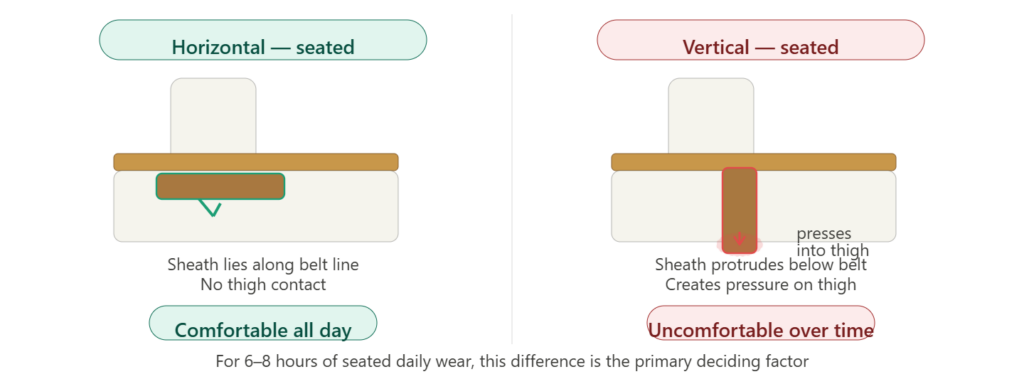
Interference with seated posture. A vertical sheath at the hip creates a fixed protrusion below the belt line. When seated, this protrudes into the thigh or against the seat surface. A horizontal sheath sits flush along the belt line and doesn’t create the same protrusion, regardless of seated position.
None of these are preference — they’re mechanical outcomes of orientation choice.
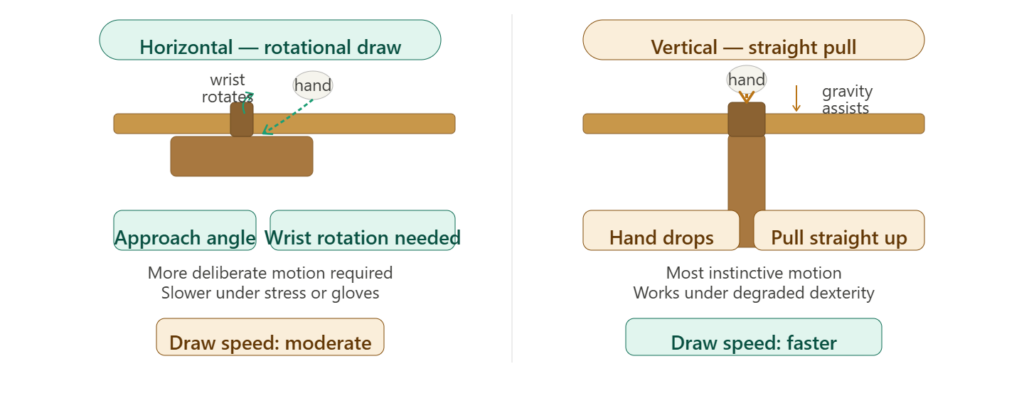
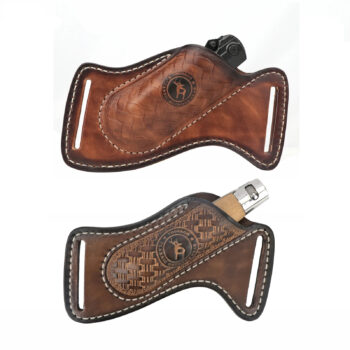
In horizontal carry, the sheath sits parallel to the belt, with the knife blade running along the waistline. The attachment point — a loop or pancake back panel — sits at the same height as the belt, and the sheath body extends horizontally from that point.
Why it works for seated daily carry:
The belt line is roughly at the level of the hip crease. A sheath sitting along that line doesn’t interfere with the seated position — there’s no protrusion into the thigh and no pressure point against the seat. For anyone spending 6–8 hours a day seated at a desk, in a vehicle, or at a workstation, this is a significant functional advantage. Vertical carry in the same context creates a persistent pressure point that compounds over a full day of wear.
This advantage compounds with the carry position. Horizontal carry at the 3 o’clock position (hip) or slightly behind (4–5 o’clock) lies flat against the body when seated and stays there through sit-stand cycles. A horizontal sheath at 3 o’clock in a desk-based daily routine becomes essentially invisible after the first hour — you stop noticing it. Vertical carry in the same position rarely achieves this.
Profile and concealment:
A horizontal sheath produces a lower visual profile because nothing extends below the belt line. Under an untucked shirt or jacket, a horizontal setup is effectively hidden — there’s no telltale vertical bulge at the hip. For carry contexts where knife visibility matters — professional environments, public carry — horizontal orientation provides the cleanest profile.
Where horizontal carry has limitations:
Draw speed is the primary limitation. The rotational draw motion required for horizontal carry — hand in from above, wrist rotation, then lift — takes longer and requires more deliberate hand placement than vertical carry’s straight pull. For a knife carried as a daily tool that’s accessed multiple times per day, this is usually acceptable. For a knife that needs to be deployed quickly under pressure, the draw overhead matters.
The draw also requires clear access from above. Under certain clothing combinations — a tucked shirt with a jacket — horizontal access can be awkward. This is a function of carry position and clothing choice, not a fundamental limitation of the orientation, but it needs to be considered at the point of setup rather than discovered after purchase.
Sheath stability on horizontal carry:
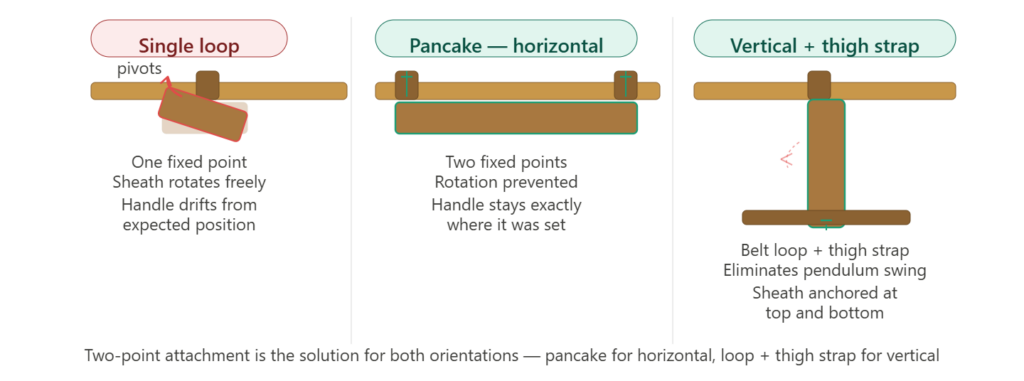
A single-loop horizontal sheath can rotate along the belt during movement — the sheath pivots at the attachment point, and over the course of a day the blade orientation changes. Pancake-style sheaths with two belt loops spaced apart prevent this by providing two fixed attachment points. For horizontal carry on any knife above compact folding size, pancake construction is the more stable choice.
For a detailed breakdown of how sheath attachment geometry affects stability, see our [leather knife sheaths for belt carry guide →]
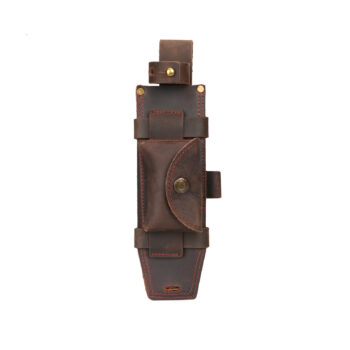
In vertical carry, the sheath hangs perpendicular to the belt, with the blade pointing downward. The attachment loop sits at the belt line, and the sheath body extends below it.
Why it works for active outdoor and field use:
The straight upward draw is the most natural hand motion for most people. The hand drops to the hip, the grip naturally aligns with the handle, and the pull is straight up — with gravity assisting release rather than working against it. There’s no wrist rotation required, no deliberate approach angle. For a knife that’s accessed repeatedly throughout the day — a field blade used for food prep, cordage work, or camp tasks — the draw simplicity adds up.
Under outdoor conditions, draw mechanics matter more. Working with gloves, cold hands, or under physical stress makes fine motor control less reliable. Vertical carry’s straight-pull draw works adequately under degraded dexterity in a way that horizontal carry’s rotational draw doesn’t always achieve.
The movement stability problem:
A vertical sheath with a single loop attachment creates a pendulum — the sheath swings forward and backward with each step. This isn’t a problem at rest, but under active movement it’s persistent enough to be distracting, and under more aggressive physical activity the swing can cause the sheath to strike the thigh. The solution is a thigh strap that anchors the sheath body below the belt loop, preventing swing by constraining both the top and bottom of the sheath. Many fixed blade vertical sheaths include a thigh strap attachment for exactly this reason.
Without a thigh strap, vertical carry of a fixed blade is better suited to intermittent movement than sustained active movement. With a thigh strap, it handles both.
The seated comfort problem:
This is the most significant practical limitation of vertical carry in daily contexts. When seated, a vertical sheath protrudes into the hip-thigh area. The degree of interference depends on blade length: a compact folding knife in a vertical sheath is a minor annoyance. A 10cm fixed blade in a vertical sheath at 3 o’clock is genuinely uncomfortable for extended sitting and actively interferes with vehicle seat positioning.
For anyone whose daily routine involves more than occasional sitting, this is the determining factor. The comfort advantage of vertical carry in active use is real — but it comes at the cost of seated comfort that a horizontal setup provides automatically.
| Use case | Horizontal | Vertical | Why |
|---|---|---|---|
| Desk-based daily work | Strong advantage | Significant problem | Seated comfort difference is immediate and cumulative |
| Driving or commuting | Strong advantage | Interferes with seat | Vertical sheath conflicts with seat position |
| Outdoor / fieldwork | Adequate | Strong advantage | Draw speed under physical conditions |
| Bushcraft / camp tasks | Adequate | Strong advantage | Repeated draw all day without fumble |
| Urban concealed carry | Strong advantage | Problematic | Profile below belt line compromises concealment |
| Active physical work | Adequate with pancake | Adequate with thigh strap | Both require secondary stabilisation |
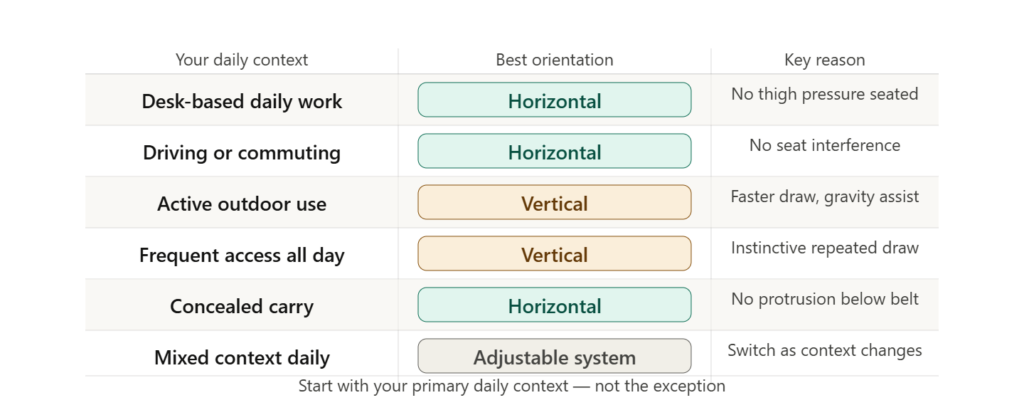
No orientation wins across all use cases. The question is which one matches the majority of your daily context.
Regardless of orientation, the attachment geometry between sheath and belt determines carry stability. This is often treated as a minor detail — it isn’t.
Single-loop attachment gives the sheath one fixed point on the belt. The sheath can pivot forward and backward around that point during movement. On horizontal sheaths, this means the blade orientation drifts — the sheath slowly rotates so the handle is no longer where you expect it. On vertical sheaths without a thigh strap, it contributes to pendulum swing.
Two-point attachment — whether a pancake back panel, two separate loops, or a loop plus thigh strap — constrains rotation by providing two fixed points. The sheath can’t pivot because both ends are anchored. For knives above compact folding size, two-point attachment is the more functional choice in either orientation.
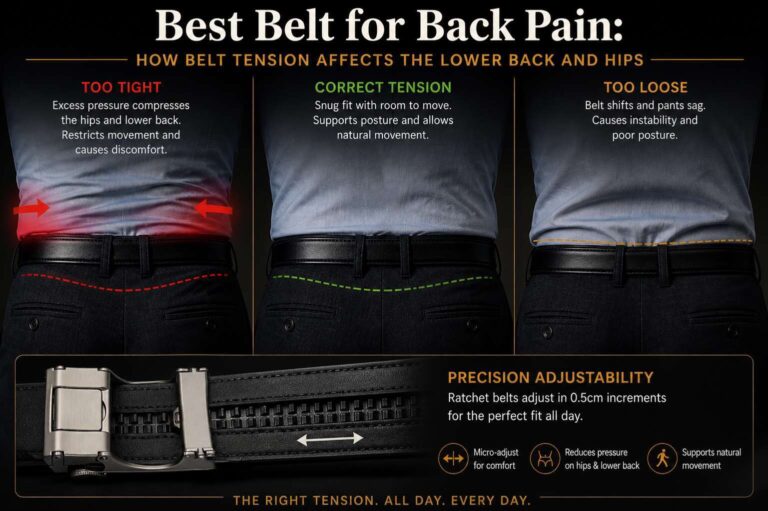
The belt itself is also a constraint. A soft, thin belt allows the sheath to tilt even when the attachment is two-point, because the belt bends at the attachment location. A structurally adequate belt — 4mm full-grain minimum for most knife sizes — maintains consistent sheath position because it doesn’t deform under the attachment load.
For a full technical breakdown of how belt construction affects carry system stability, see our [guide to why belts fail with knife carry →]
Some carry contexts genuinely require both orientations depending on the activity. A user who drives to a worksite (horizontal preferred for the commute) and does active outdoor work on site (vertical preferred for field access) has a real conflict that a fixed-orientation sheath doesn’t solve.
Adjustable-orientation sheaths address this by allowing the carry angle to be changed without removing the sheath from the belt. The construction consideration is the adjustment mechanism itself: a poorly made adjuster introduces play into the sheath-to-belt connection, which produces the stability problems of single-loop attachment even when the sheath is nominally two-point. Evaluate the rigidity of the adjustment mechanism specifically — not just whether dual orientation is advertised.
Start with your primary daily context, not your secondary one.
Choose horizontal if:
Choose vertical if:
Choose an adjustable system if:
Don’t choose based on:
No. Vertical carry is faster for most people. The straight upward draw is a more instinctive motion than horizontal carry’s rotational draw. This is one of vertical carry’s genuine advantages and the primary reason it remains the standard for field and outdoor use. If draw speed is a real priority in your carry context, vertical is the correct choice.
Less, not more. A horizontal sheath produces no protrusion below the belt line — the setup is entirely within the belt-waist zone where clothing naturally breaks. A vertical sheath creates a protrusion below the belt line that pushes outward against clothing. For concealment purposes, horizontal carry is generally lower-profile.
Yes. Horizontal fixed blade carry is a legitimate carry style. The construction requirements are more demanding than horizontal folding knife carry — the sheath needs two-point attachment (pancake or equivalent) and the leather needs to be heavier gauge to handle the blade weight at the horizontal position. A pancake-style sheath with a wide back panel is the standard construction for horizontal fixed blade carry.
Single-loop attachment without a thigh strap. The sheath has one fixed point at the belt and nothing constraining the lower end, so it swings as a pendulum. Adding a thigh strap that anchors the lower sheath body eliminates swing by turning the single-point into a two-point attachment. For fixed blades carried vertically with any regularity of movement, a thigh strap is a functional requirement, not an optional accessory.
Approximately 10–12cm blade length for seated daily carry. Below that, vertical carry creates minor discomfort when seated that most people adapt to. Above that, the protrusion into the thigh area becomes persistent enough to be genuinely uncomfortable for extended seated periods. For fixed blades above 10cm blade length intended for daily carry in mixed seated/active contexts, horizontal or adjustable carry is the more practical choice.
A weak belt compounds the problems of whichever orientation you choose. On horizontal carry, a belt that sags allows the sheath to tilt outward at the attachment point — the blade drifts away from the body and the draw path changes. On vertical carry, a belt that twists allows the sheath to rotate — the handle moves from its expected position. A structurally adequate belt is the baseline that makes either orientation work correctly. Without it, orientation choice is largely irrelevant.
HoldForm leather knife sheaths are available in horizontal, vertical, and pancake formats. Construction type and belt loop specifications are listed on every product page.
[View knife sheath range →] [Leather knife sheaths: construction guide and how to choose →] [Why belt construction determines carry performance →] [How to build a structured EDC system →]

Practical belt guides, sizing tips, and exclusive offers — straight to your inbox.

Leave a comment