Most knife carry problems are diagnosed as sheath problems or knife problems. They’re almost never either.
A knife that tilts, shifts, or creates pressure after an hour of wear is failing at the system level — not the component level. The sheath might be well-made. The knife might be exactly the right size. But if the components aren’t chosen to work together, and if the belt providing the foundation isn’t structurally adequate for the load, the system fails regardless of individual component quality.
This guide covers what a knife carry system actually consists of, how each component affects the others, and how to build a setup that stays in position and functions consistently across a full day of use.
A knife carry system is not a sheath. It’s the combination of three interdependent components:
The belt — the foundation. Every other component attaches to it, loads it, and depends on it to hold position. Belt stiffness, thickness, and buckle mechanism determine whether the system maintains consistent position throughout the day or gradually drifts.
The sheath or holster — the interface between knife and belt. Sheath construction determines retention quality, draw consistency, and how the attachment load transfers to the belt.
The carry orientation — horizontal, vertical, or adjustable. Orientation determines seated comfort, draw mechanics, and what secondary stabilisation (pancake back panel, thigh strap) the setup requires.
These three components form a load path: the knife loads the sheath, the sheath loads the belt, the belt transfers load to the body. Every decision in the system affects every other decision. A high-quality sheath on a marginal belt produces the same carry problems as a cheap sheath on an adequate belt. The weakest component determines overall system performance.
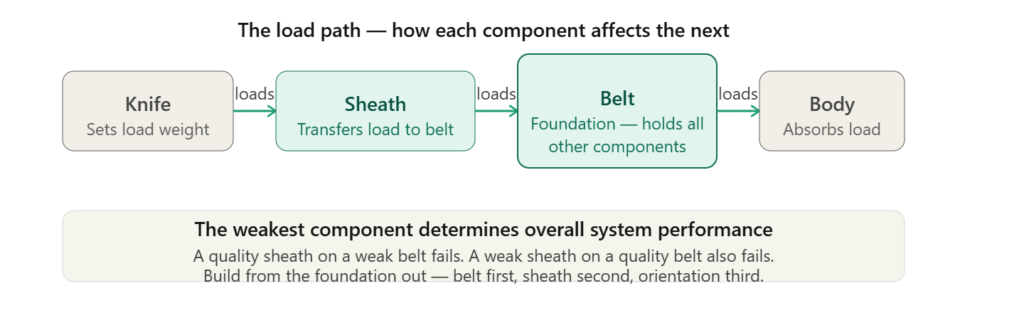
The most common reason knife carry setups fail is that they’re assembled as a sequence of independent purchases rather than as a system.
The buyer selects a knife. Then they buy a sheath that fits it. Then they run the sheath on whatever belt they already own. Three separate decisions made independently, with no consideration of how each component affects the others.
This assembly sequence almost always produces one of three failure patterns:
The belt is inadequate for the load. A sheath chosen for its retention and construction quality still sags, tilts, and shifts if the belt underneath it can’t support the attachment load without bending. The sheath holds the knife perfectly. The belt fails to hold the sheath.
The attachment geometry is wrong. A single-loop sheath on a knife above compact folding size produces a pivot point — the sheath rotates at the attachment during movement. The knife ends up at a different angle than it was positioned, draw consistency disappears, and the setup requires constant repositioning.
The carry orientation conflicts with the daily context. A vertical sheath chosen for draw speed is worn by someone who spends eight hours a day at a desk. The knife creates persistent thigh pressure that accumulates through the day, and the user eventually stops carrying rather than fixing the system.
Each of these failures is a system design failure, not a product failure.
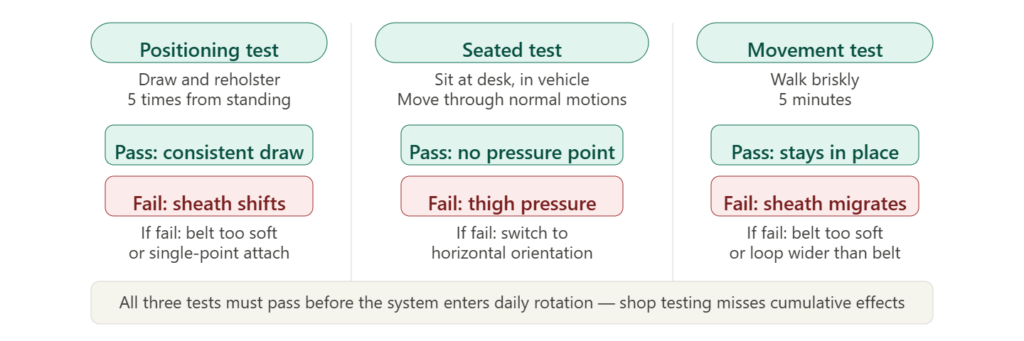
The correct build sequence is the reverse of the common one. Start with the foundation and work outward.
Before selecting any component, identify where you spend the majority of your time.
Predominantly seated — desk work, driving, long periods in a vehicle or meeting: this context demands horizontal carry or a compact vertical carry with a short blade. Seated comfort is the primary constraint. A carry setup that’s physically uncomfortable after an hour of desk work won’t be worn consistently, and a carry setup that isn’t worn consistently provides no value.
Predominantly active — on your feet, moving, outdoor or field use: this context suits vertical carry with two-point stabilisation. Draw speed and access under movement are the priorities. Seated discomfort is brief and manageable.
Mixed context — some desk, some active, transitions between both: this context calls for an adjustable orientation sheath or a horizontal setup that works adequately in both situations. Horizontal carry is the more versatile default because it works adequately in active contexts while performing well in seated ones.
This context definition drives every subsequent decision. Don’t choose a carry orientation you find aesthetically appealing. Choose the one that matches where you actually are.
The belt is the last thing most people think about and the first thing that determines whether the system works. Selecting it first forces the rest of the system to be built on an adequate foundation.
Minimum specifications by carry load:
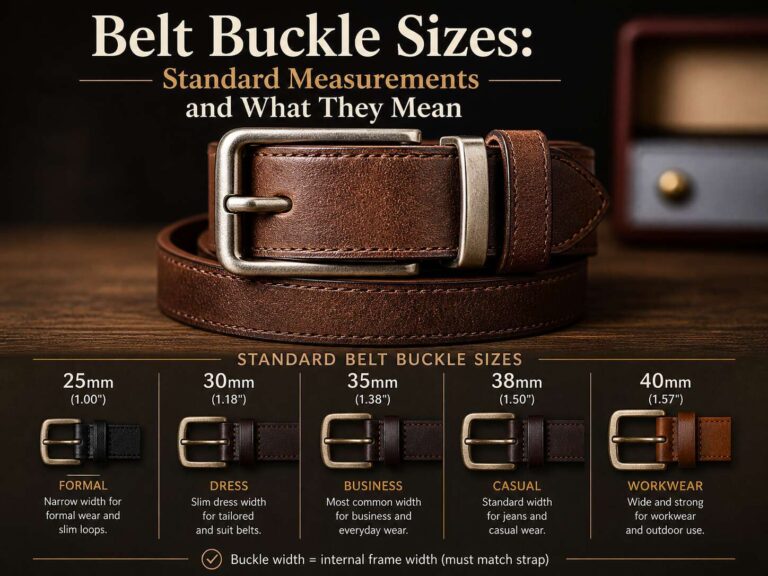
Under 500g total load (compact folding knife, light sheath): 3.5mm full-grain leather, 38mm width minimum. This handles light carry without over-engineering the belt.
500g–1kg (fixed blade or multi-item carry): 4mm full-grain single-layer leather, 38mm width minimum. This is the most common carry weight range for daily EDC with a knife.
Over 1kg (heavy fixed blade, multi-tool system): 4.5–5mm full-grain single-layer leather, 38mm width minimum. At this load, belt construction is the limiting factor. A belt inadequate for this range fails faster than any sheath or holster in the system.
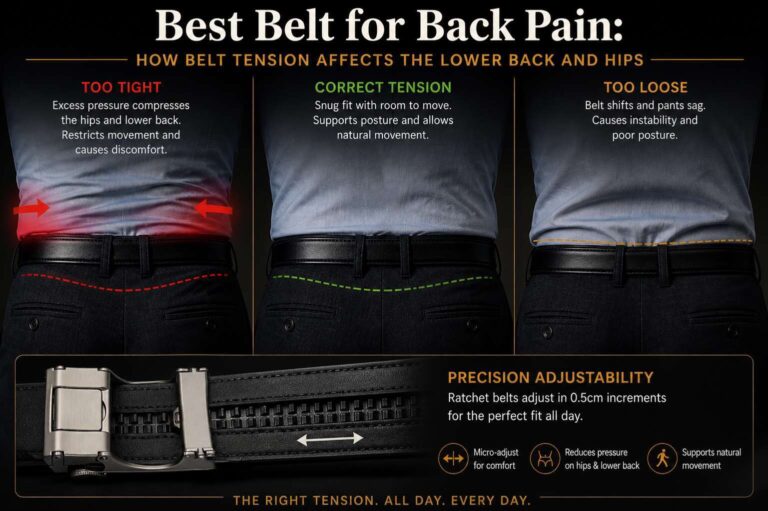
Beyond thickness and width, the buckle mechanism matters for carry use specifically. A ratchet mechanism with 0.5cm adjustment increments maintains consistent belt tension across a full day of movement — important for carry setups where belt tension affects sheath position and draw consistency. A pin buckle set at the closest fixed hole either over-tightens or under-tightens relative to the correct position, and that tension shifts further as the wear hole gradually enlarges with daily use.
For a full technical breakdown of how belt construction affects carry performance, see our [guide to why belts fail with knife carry →]
Once the belt specification is defined and the orientation is determined, sheath selection follows from those two constraints.
For horizontal carry:
The sheath needs two-point attachment — either a pancake back panel with two belt loops spaced apart, or a wide reinforced single loop that resists lateral rotation. Single-loop horizontal sheaths with narrow loops pivot at the attachment point during movement. This is the most common single cause of horizontal carry dissatisfaction — the sheath is blamed when the attachment geometry is the problem.
Leather thickness of 3.5–4mm minimum at the sheath body. The horizontal sheath bears the knife weight as a lateral load rather than a downward one — the sheath body needs enough rigidity to resist lateral flex at the attachment point.
For vertical carry:
The sheath needs either a thigh strap attachment point (for fixed blades or any carry involving significant movement) or a wide loop that resists forward-backward swing. A single narrow loop on a vertical sheath creates the pendulum problem — the sheath swings forward and backward with each step.
For compact folding knives in vertical carry, a narrow loop is adequate because the knife weight is low enough that swing is minor. For fixed blades or larger folders, two-point attachment is the functional requirement.
For either orientation:
Welt construction for fixed blades — the welt is the strip of leather between the front and back panels that defines the blade channel. Sheaths without welt construction rely on mouth tension alone, which is adequate for some folding knives but marginal for fixed blades. Verify that the sheath has visible welt construction at the edges before purchasing.
Saddle stitch over machine lock stitch wherever the listing specifies. The difference in seam durability under daily flexing is significant over a year of carry.
For a detailed breakdown of sheath construction variables and what to check before buying, see our [leather knife sheaths for belt carry guide →]
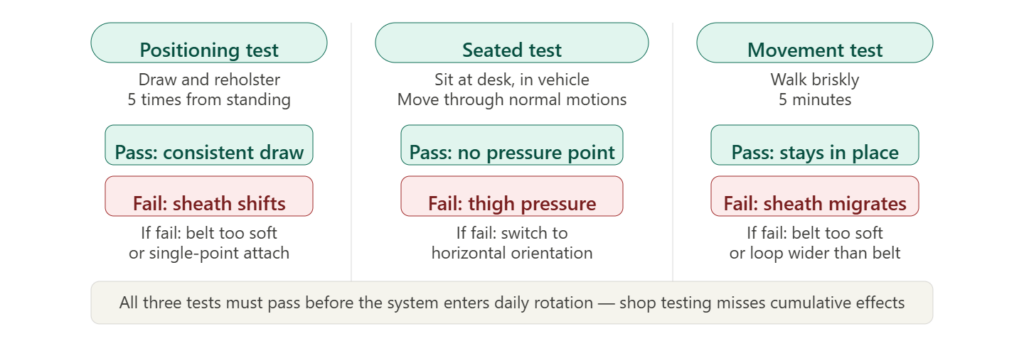
Before wearing the completed system for a full day, do three verification tests.
The positioning test: Mount the sheath on the belt at your intended carry position. Draw the knife five times from a standing position. Reholster five times. The knife should draw and reholster consistently with the same hand position and the same effort each time. If the sheath shifts during this test, the belt is either too soft to hold the attachment position or the attachment geometry is wrong.
The seated test: Sit at a desk or in a vehicle seat with the complete system in position. Move through normal seated motions — leaning forward, crossing legs, entering and exiting the seat. Any persistent pressure point indicates either a vertical sheath that needs horizontal adjustment, or a horizontal sheath positioned too far forward. Reposition before the full day wear test.
The movement test: Walk briskly for five minutes. The sheath should stay in the position it started in. Any migration — forward, backward, or rotational — indicates the belt is too soft, the attachment geometry is single-point and needs two-point, or the belt loop is wider than the belt and introducing play.
If the system passes all three tests, it’s ready for full daily wear. If it fails any of them, identify which component is causing the failure and address it before the system goes into daily rotation.
A standalone knife carry is a two-component system: knife-sheath-belt. When additional items are added — a multitool holster, a flashlight, a phone holster — the system complexity increases and the belt requirements increase with it.
The primary consideration for multi-item belt carry is load distribution. Multiple items attached to the same belt section create compounding load at the belt attachment zone. A knife sheath and a multitool holster both attached at the 3 o’clock position create twice the lateral load on a single belt section, which accelerates the sag and twist failure modes.
Spread items along the belt. The most stable multi-item setups distribute items at different positions: knife at 3 o’clock, multitool at 4–5 o’clock, or knife on the dominant side and secondary tools on the non-dominant side. This distributes load across a longer section of belt and prevents the compounding failure that close-grouped items create.
Upgrade the belt spec for the combined load. Two items totalling 600g require a belt specification built for 600g, not for each individual item. Calculate total combined load and select the belt accordingly.
Consider a combined holster for frequent pairs. If a knife and multitool are always carried together, a combined knife-and-multitool holster produces a lower profile and more stable attachment than two separate items. The trade-off is that combined holsters provide less retention specialisation for each individual tool.
For a full breakdown of how to structure a multi-item carry system, see our [belt holsters for multitool carry guide →]
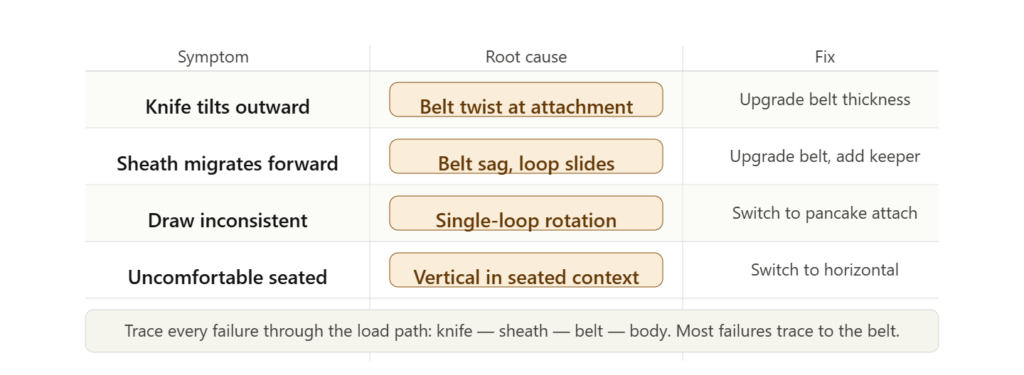
The knife tilts outward: Belt twist at the attachment point. The belt is rotating along its axis under the lateral load of the sheath. Fix: upgrade belt thickness, or verify the belt is full-grain single-layer construction rather than bonded or layered.
The sheath migrates forward or backward during the day: Belt sag causing the attachment loop to slide along the softened belt surface. Fix: upgrade belt construction, or add a secondary keeper that anchors the sheath loop to the belt at two points rather than one.
Draw consistency is poor: Sheath is rotating at a single-loop attachment point. Each draw from a slightly different sheath angle requires a slightly different hand position. Fix: move to pancake or two-point attachment.
The system is comfortable standing but uncomfortable seated: Vertical carry in a predominantly seated context. Fix: switch to horizontal orientation, or reduce blade length to a compact folder that doesn’t protrude significantly into the thigh area.
The system was comfortable in the shop but fails in daily use: Shop testing misses cumulative effects. A belt that holds position for five minutes may drift over eight hours. A sheath that doesn’t print under a light jacket may print under a fitted shirt. Full-day wear testing is the only reliable evaluation method.
The most useful reframe for knife carry is treating it as an engineering problem rather than a product selection problem.
A carry setup has a load requirement, a spatial constraint (body geometry and clothing), a retention requirement (the knife needs to stay where it’s positioned until deliberately drawn), and a consistency requirement (the system needs to perform the same way at hour eight as it does at hour one).
These requirements map to specific component specifications. The belt spec follows from the load requirement. The sheath attachment geometry follows from the stability requirement. The orientation follows from the spatial and comfort constraints of the daily context.
When a carry setup fails, tracing the failure back through the load path — knife to sheath to belt to body — identifies which component is failing and why. Most failures trace back to the belt. Some trace back to attachment geometry. Very few trace back to the sheath itself.
Getting the foundation right makes everything else work. Getting it wrong means the system fails regardless of what’s attached to it.
Run the two physical tests described in our belt carry guide: hold the belt horizontally at one end with the sheath loaded and check for visible deflection under the sheath weight. Then try to rotate the belt along its axis at the sheath attachment point. A belt that deflects noticeably or rotates easily under hand pressure will fail under daily carry load. For the full test procedure and specification thresholds, see our [guide to why belts fail with knife carry →]
Within a blade length and width range, yes. A sheath built for a 10cm fixed blade will work for other knives of similar dimensions. Outside that range — a sheath designed for a compact folder used with a full fixed blade — retention, coverage, and fit will all be compromised. Sheath construction is optimized for specific blade geometry ranges, not for universal compatibility.
Yes, significantly. The 3 o’clock position (at the hip) is the standard for most carry configurations — the attachment point is at the strongest belt position and the draw path is natural. Further forward (1–2 o’clock) suits appendix-style carry for compact knives. Further back (4–5 o’clock) reduces draw speed but improves seated comfort and concealment for IWB-adjacent setups. Whatever position is chosen, the belt needs to be structurally adequate at that specific point — not just on average.
Clothing changes the access path and the concealment profile. A horizontal sheath at 3 o’clock under an untucked shirt is effectively invisible. The same sheath under a tucked shirt requires either a shorter blade length or a different carry position. Testing the system with the clothing you actually wear daily is the only way to verify compatibility — what works under one clothing combination often doesn’t work under another.
When the knife is one of multiple tools being carried, rather than the only item. A dedicated knife sheath provides better blade retention and a lower profile for single-knife carry. A holster system distributes multiple tools across a managed carry footprint. If the knife is a secondary tool to a multitool or other primary EDC item, a combined holster is usually the more practical format. If the knife is the primary carry item, a dedicated sheath is the better choice.
HoldForm carry belts, knife sheaths, and holster systems are specified with full construction details on every product page — leather grade, thickness, attachment type, and loop width.
[View carry belt range →] [Leather knife sheaths for belt carry: construction guide →] [Belt holsters for multitool carry →] [How to build a structured EDC system →]

Practical belt guides, sizing tips, and exclusive offers — straight to your inbox.

Leave a comment