An everyday belt is worn five days a week, 50 weeks a year. Over three years that’s 750 wearing days. The belt that looks adequate in a shop or in product photos will behave very differently under 750 days of real use than one built to the correct specification for sustained daily wear.
This guide covers what the correct specification actually is, why it matters, and what to look for when evaluating options.
An everyday belt sits in a specific middle ground. It needs to be thick enough to hold a flat profile under daily tension, flexible enough to wear comfortably for 8–10 hours, and built from materials that age rather than degrade. It is not a dress belt — too narrow and thin. It is not a workwear belt — too stiff and heavy.
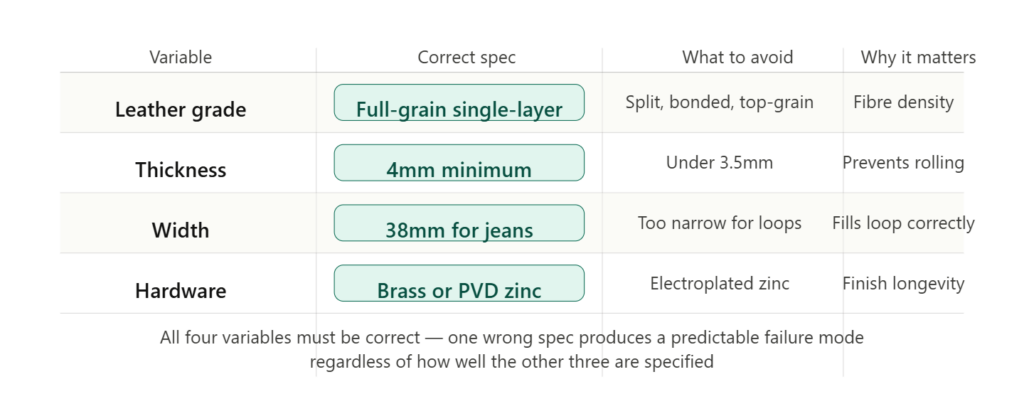
The four variables that determine whether a belt survives daily wear:
Leather grade: Full-grain single-layer. The dense fibre structure at the outermost hide layer resists the daily tension and fold cycling of everyday wear. Top-grain, split, and bonded leather are processed in ways that reduce this density — they feel softer initially but fail faster under sustained use. Single-layer means the strap is one uninterrupted piece of hide rather than two or more thinner layers bonded together. Layered construction fails at the bond line.
Leather thickness: 4mm for everyday casual wear including jeans and chinos. At 4mm, the belt has enough bending stiffness to hold a flat profile under the lateral tension of daily waistband wear without rolling at the front. At 3.5mm the belt is adequate for lighter use but shows rolling faster under sustained daily load. Below 3mm, rolling and profile deformation are likely within months of daily wear.
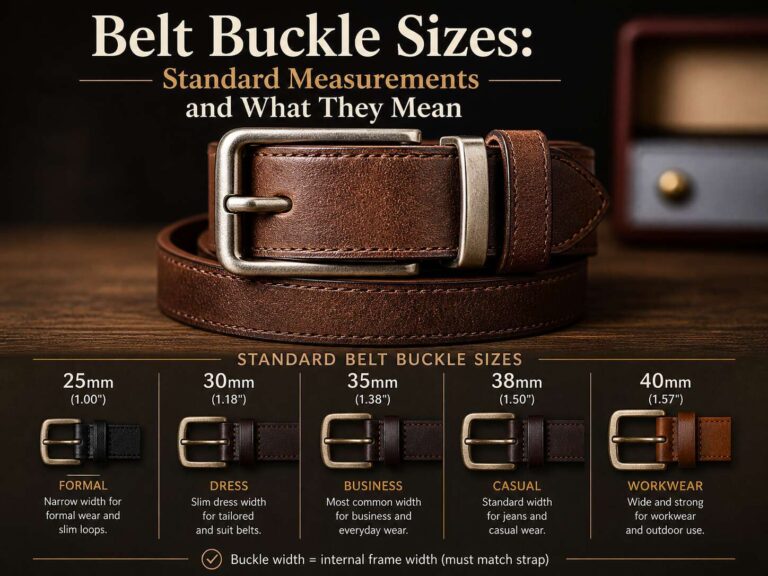
Belt width: 38mm for everyday casual and denim wear. Most jeans loops are 38–42mm — a belt at 38mm fills the loop correctly with 1–2mm clearance, distributes load evenly across the waistband, and resists lateral migration during movement. A 35mm belt in a 42mm denim loop has excess play and migrates throughout the day.
Hardware: Solid brass for pin-buckle designs, PVD-coated zinc alloy for ratchet designs. These are the two specifications that hold up under daily use. Electroplated zinc alloy — the most common hardware in mid-range belts — typically shows finish failure at friction points within 6–18 months of daily professional or casual wear.
When these four variables are correct, a belt functions without requiring attention for years. When any one is wrong, the belt fails in a predictable and consistent way.
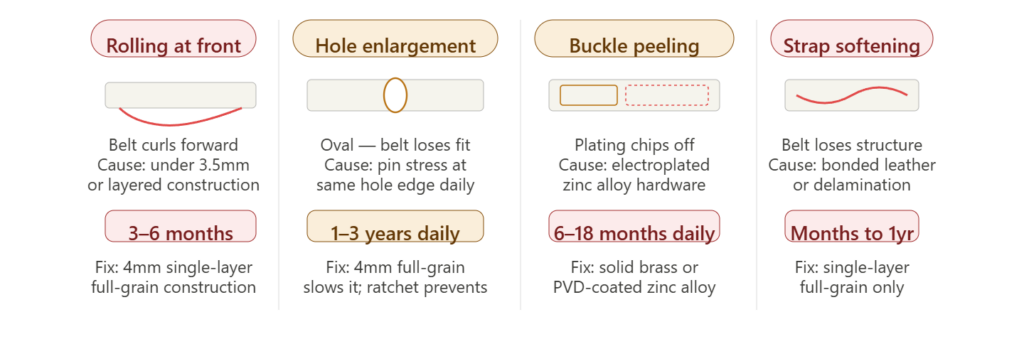
Most belts marketed for everyday wear fail in one of four ways. Knowing which failure mode to look for helps identify whether a belt is actually built for daily use before buying.
Rolling at the front buckle area. The leather folds forward rather than maintaining a flat profile. Caused by insufficient thickness — typically under 3.5mm — or layered construction where the layers have begun to separate. Visible within 3–6 months of daily wear on underspecified belts.
Hole enlargement on pin-buckle designs. The hole used most often deforms from round to oval under repeated pin stress. Slows significantly on full-grain leather at 4mm. Eliminated entirely on ratchet belt designs. The most common reason buyers replace a belt that still looks intact — it no longer holds the correct position.
Buckle finish failure. The silver, gold, or black finish on the buckle chips or peels at the prong tip, frame contact points, or release mechanism. Almost always caused by electroplated zinc alloy — the plating wears through at friction points within 12–18 months of daily wear. PVD coating over zinc alloy resists this significantly better. Solid brass has no plating to fail.
Strap softening and loss of structure. The belt stops holding its profile and becomes limp and flexible where it used to be stiff. Caused by bonded or split leather losing structural integrity under sustained load, or by layered construction delaminating. Cannot be reversed with conditioning — the structural failure is in the fibre matrix or the bond.
Both work correctly at the right specification. The choice depends on preference and context.
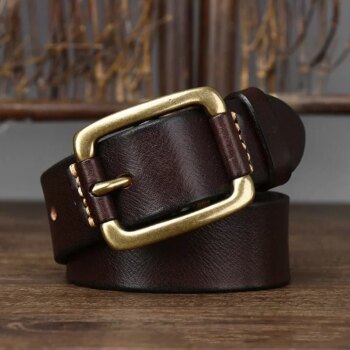
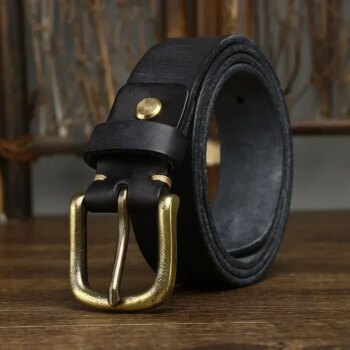
Pin-buckle for everyday casual and denim: A solid brass pin buckle on 4mm full-grain leather is a reliable everyday specification. Simple mechanism, no components to fail, ages consistently. The limitation is hole deformation over time and fixed-hole adjustment spacing — if the correct tension falls between holes, you accept a compromise.
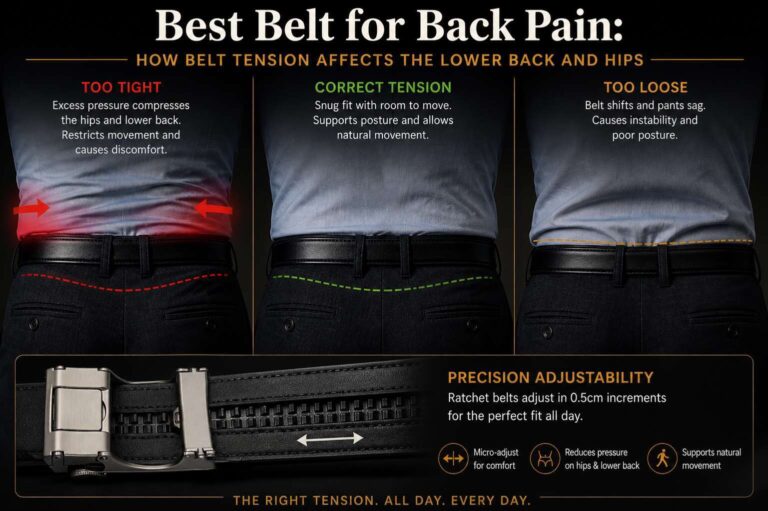
Ratchet for office-to-casual daily wear: A ratchet mechanism with PVD-coated zinc alloy housing on 4mm full-grain leather provides adjustment precision that a pin buckle can’t match. Tension can be set exactly for different activities — desk work, walking, post-meal — and hole deformation is eliminated as a failure mode. The ratchet mechanism housing adds some depth to the buckle rear — less important for casual wear, worth considering for suit contexts.
For a full mechanism comparison, see our [ratchet vs traditional belt guide →]
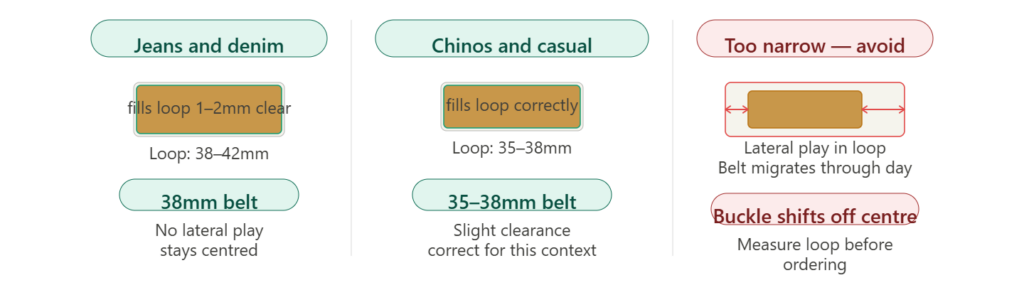
The most common width mistake is wearing a 35mm dress belt with 40mm denim loops. The belt has too much lateral play, migrates through the day, and the buckle shifts off centre.
For everyday wear across jeans and casual trousers:
Jeans and denim: 38–40mm. Matches the standard denim loop width.
Chinos and casual trousers: 35–38mm. Slightly narrower loops than denim, wider than formal.
Mixed wardrobe — one belt for most contexts: 38mm. Fits most jeans loops correctly with clearance, and works in casual trouser loops in the 35–40mm range. This is the width that makes a single everyday belt genuinely versatile.
Measure your most-worn trouser loops before ordering. The belt should fit through with 1–2mm clearance — not tight, not loose.
For an everyday casual belt, the colour follows the shoes worn most often.
Black — for wardrobes where black shoes and boots dominate, or for minimalist wardrobes where a single neutral colour covers the widest range of outfits.
Dark brown — the most versatile warm tone. Works with brown leather shoes, tan and cognac shoes, and blue or grey casual trousers. Dark brown with dark indigo denim is one of the cleanest casual pairings.
Tan or cognac — for wardrobes built around warm neutral tones. Works with tan chinos, lighter denim, and the warmer end of casual wear. Less versatile than dark brown but the right choice when warm tones dominate.
For a full colour matching guide, see our [black belt or brown belt guide →]
Most belt listings provide insufficient specification detail. These are the questions worth asking — and the answers that indicate a correctly specified everyday belt.
What is the leather grade? Full-grain is the correct answer. “Genuine leather,” “premium leather,” or “real leather” without specifying full-grain indicates a lower grade. “Top-grain” is acceptable for lighter use but not the first choice for sustained daily wear.
What is the leather thickness? Should be stated in millimetres. 4mm is the target for everyday casual. If not stated, ask — a brand that doesn’t know or won’t state the thickness likely has reason not to.
Is it single-layer construction? Single-layer full-grain is the correct specification. “Layered,” “padded,” or “reinforced” construction indicates multiple bonded layers — a construction method that fails at the adhesive bond.
What is the buckle material and finish? Solid brass or PVD-coated zinc alloy for everyday use. “Alloy buckle” or “metal buckle” without specifying finish type almost always means electroplated zinc — adequate for occasional wear, not for daily use.
What is the width? Should match your trouser loop width with 1–2mm clearance. The listing should state the width in mm.
A correctly specified everyday belt at 4mm full-grain leather with solid or PVD-coated hardware should last 8–12 years of daily wear before the leather reaches end of life. This assumes conditioning applied every 3–6 months and normal handling.
Year 1: The leather breaks in. The initial stiffness of full-grain leather softens gradually as the fibre structure aligns to the wearer’s movement. The belt begins to hold the slight curve of the waistline. The hardware remains consistent.
Years 2–4: The leather develops visible character — a patina specific to the wearer’s habits and environment. The surface darkens at contact points, the edges smooth, the texture becomes more consistent. The structure is fully broken in and stable.
Years 5–10: The belt continues to function correctly with regular conditioning. The patina deepens. The leather is at peak character — broken in but structurally intact.
End of life indicators: Cracking at the buckle fold that penetrates more than the surface layer. Significant hole enlargement that prevents correct pin positioning (pin-buckle only). Visible surface separation or peeling indicating the leather grade was lower than full-grain despite specification claims.
| Variable | Correct spec | What to avoid |
|---|---|---|
| Leather grade | Full-grain single-layer | Top-grain, split, bonded |
| Thickness | 4mm | Under 3.5mm |
| Width | 38mm for jeans, 35–38mm for chinos | More than 2mm play in the loop |
| Buckle | Solid brass or PVD zinc alloy | Electroplated zinc alloy |
| Mechanism | Pin-buckle or ratchet — either correct | Fashion buckles with no rated load |
A single-layer full-grain leather belt at 4mm thickness and 38mm width, with solid brass or PVD-coated zinc alloy hardware. This specification handles the sustained daily tension of jeans and casual wear, resists rolling and hole deformation, and ages consistently over years of use. The mechanism — pin-buckle or ratchet — is a secondary choice based on whether adjustment precision matters for your daily routine.
4mm for everyday jeans and casual wear. This is the minimum thickness that maintains a flat profile under the lateral tension of daily denim wear without rolling at the front. At 3.5mm the belt is adequate for lighter professional and casual use. Below 3mm, rolling and profile deformation are likely under daily load.
A correctly specified everyday belt — full-grain at 4mm, solid hardware, properly conditioned — should last 8–12 years of daily wear. Most belts fail significantly before this timeline due to insufficient thickness, lower leather grades, or electroplated hardware that fails within 12–18 months. For a full breakdown of what determines belt longevity, see our [how long should a belt last guide →]
Yes. For mixed office-to-casual daily wear, a ratchet belt provides adjustment precision that a pin-buckle can’t — the correct tension for desk work and physical activity can be set separately in seconds. The mechanism also eliminates hole deformation as a failure mode. For purely casual and denim wear, a solid brass pin-buckle at 4mm is equally adequate and simpler.
38mm for everyday denim and casual. This fills standard jeans loops correctly and distributes waistband load evenly. For chinos and more casual trousers with narrower loops, 35–38mm. Measure your most-worn trouser loop before ordering.
HoldForm everyday belts are specified with leather grade, strap thickness, and hardware finish listed on every product page.
[View everyday belt range →] [How thick should a leather belt be: specs by use case →] [Ratchet belt vs traditional belt: mechanism comparison →] [Black belt or brown belt: the full matching guide →]

Practical belt guides, sizing tips, and exclusive offers — straight to your inbox.

Leave a comment