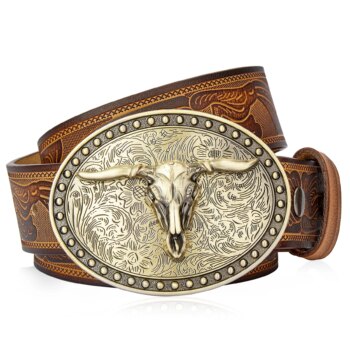
A statement belt buckle is any buckle where the hardware itself is a deliberate visual element of the outfit — sized, shaped, or decorated beyond what is required for functional closure. The buckle is not trying to disappear. It is intended to be seen.
This distinguishes it from restrained hardware — the low-profile, flat-faced buckles used in professional and formal wear, where the correct buckle is one that goes unnoticed. Statement hardware is the opposite intention: it registers as part of the outfit’s visual identity.
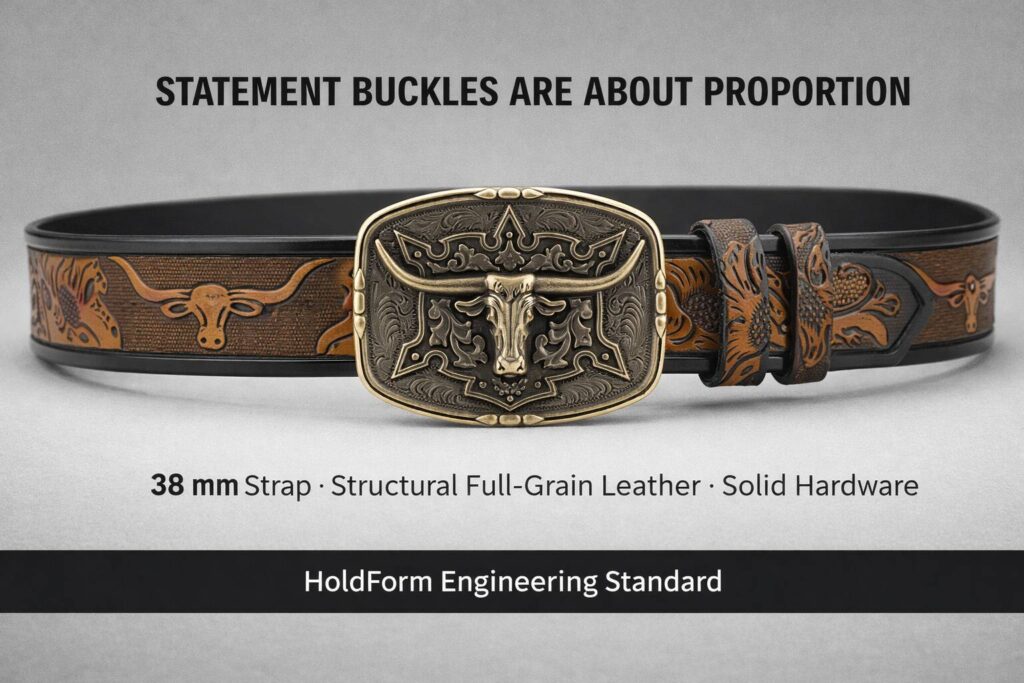
The category includes Western and heritage buckles with engraved or cast decorative faces, oversized rectangular or oval frames, figurative hardware (animals, emblems, geometric motifs), and any buckle with face dimensions significantly larger than the strap width. A 40mm strap with a 90mm buckle face is statement hardware. A 38mm strap with a 38mm low-profile frame is not.
Understanding the category matters because the rules for when statement hardware works — and when it fails — follow directly from what statement hardware is trying to do.
The reason statement buckles work in some outfit contexts and fail in others is not a style convention. It is a visual proportion principle with a mechanical basis.
Every fabric has a visual density — the weight per unit area that translates into how the material reads to the eye. Heavy fabrics like raw denim at 13–14oz per square yard, thick canvas, or stiff workwear cotton have high visual density. They read as substantial. Lightweight fabrics like fine wool suiting, linen, or lightweight cotton have low visual density. They read as fine.
Hardware scale needs to match fabric density for the outfit to look proportionally resolved. A 30mm flat buckle on a 38mm heavy denim strap looks inadequate — the buckle face is smaller than the strap it sits on, and the visual weight of the hardware is completely overwhelmed by the weight of the fabric. The eye reads this as an unresolved proportion, even if the viewer can’t name the specific problem.
The inverse is equally true. A 90mm engraved buckle on a lightweight wool trouser looks aggressive — the hardware scale is too large relative to the fabric weight, and the buckle pulls all visual attention to the waist in a way that suits with fine fabrics are designed to prevent.
Statement buckles belong on heavy fabrics because heavy fabrics need hardware with equivalent visual weight to achieve proportion. This is not fashion preference. It is the same proportion logic that governs why a chunky-soled boot looks correct with heavy denim and incorrect with a slim suit trouser.
The outfit contexts where statement hardware functions correctly share a common characteristic: heavy, structured, or visually dense fabrics that need equivalent hardware weight at the waistline.
Raw and heavy denim. Denim is the primary context for statement buckles. Heavy denim has enough visual weight to absorb large buckle hardware without the buckle dominating the outfit. The waistline of a denim outfit — already structured by the denim’s weight and the trouser construction — benefits from a buckle that anchors the visual centre with equivalent force. A heritage buckle at 38mm strap width with a 60–90mm decorative face creates a stable, resolved waistline on heavy denim. A small restrained buckle creates a weak one.
Heritage and workwear outfits. Work jackets, canvas trousers, heavy flannel, and structured outerwear are all high-density fabrics that accept statement hardware. The visual language of workwear and heritage clothing includes robust hardware — rivets, heavy stitching, thick leather — and a statement buckle fits within that language. It reads as appropriate rather than incongruous.
Western and country contexts. Western dress has its own proportion logic that’s built around statement hardware. The wide strap, the decorative buckle, and the boot form a visual system in which the buckle is intentionally the centrepiece. Within this context, a large engraved or figured buckle is structurally correct, not decorative excess.
Leather jackets and heavy outerwear. The same principle applies. The visual density of heavy leather or technical outerwear fabric supports statement hardware at the waist without the buckle looking disproportionate.
The failure cases follow the same logic in reverse. Fine or structured fabrics cannot absorb large hardware without the buckle dominating the outfit in a way that reads as wrong.
Suits and tailored trousers. A tailored suit is constructed to produce a specific silhouette — clean vertical lines, controlled waistline, uninterrupted front. The hardware elements in formal tailoring are deliberately small and recessive: narrow tie bars, small cufflinks, flat belt buckles. A statement buckle disrupts the front of the suit at the waistline — it pushes the jacket outward slightly, draws the eye to a single point, and creates visual noise that works against everything the suit silhouette is designed to achieve. This is not a style opinion. The buckle’s physical depth protrudes against the jacket lining, and the visual weight of large hardware conflicts with fine fabric weight.
Dress trousers and business casual. The same applies to any tailored or semi-tailored trouser in lightweight fabric. The waistband construction of dress trousers is engineered for restraint — the belt loop widths, the waistband height, and the fabric weight all assume low-profile hardware. A large buckle sits incorrectly in the loops, stresses the waistband seam, and reads as the wrong register for the clothing.
Lightweight summer fabrics. Linen, lightweight cotton, and summer-weight fabrics have low visual density. Even in casual contexts, large hardware overwhelms these fabrics because there is no visual weight in the fabric to balance against the buckle. A medium-sized hardware choice in brushed or matte finish is the correct call for lightweight casual fabrics.
A statement buckle only holds its intended appearance if the belt it sits on can support it structurally. A heavy decorative buckle on an inadequate strap produces three failure modes: the strap twists under the buckle weight, the strap rolls forward at the front, or the leather deforms permanently at the buckle fold. All three make the outfit look worse than a restrained buckle on the same outfit would.
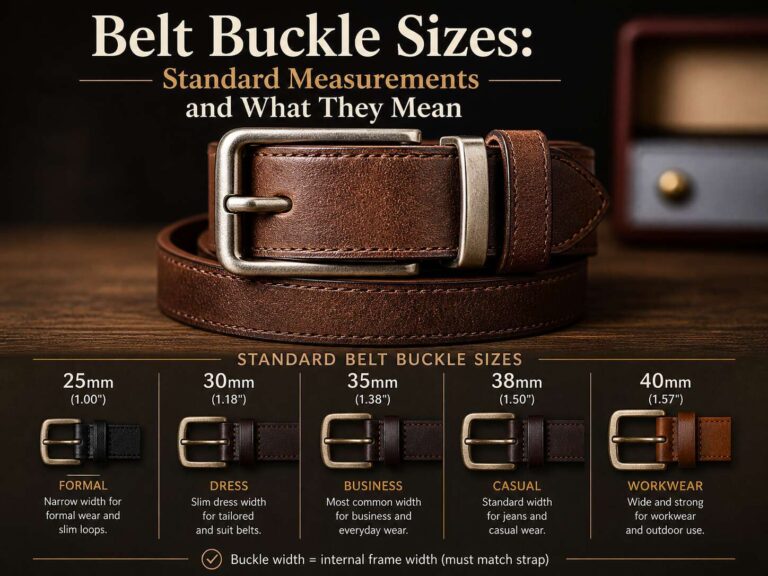
Strap width: 38–40mm minimum for statement hardware. The buckle face-to-strap width relationship is a proportion problem within the belt itself — a 90mm decorative buckle face on a 30mm strap looks like it’s about to fall off. At 38mm, the strap width provides enough physical and visual foundation for the buckle to sit correctly. At 40mm, the strap has equivalent visual weight to the heaviest denim and workwear contexts where statement buckles belong.
Leather grade and thickness: Full-grain at 4–4.5mm minimum. Statement buckles are heavier than restrained hardware — the additional mass creates a downward pull on the strap at the buckle attachment point. A strap under 3.5mm bends and sags under this load, which rotates the buckle forward and away from the body. At 4mm full-grain, the leather has enough stiffness to hold the buckle vertical against the body without sagging. At 4.5mm, the strap is rigid enough for the heaviest hardware without requiring a carry-spec belt.
Stitching at the buckle fold: The fold where the leather attaches to the buckle frame is the highest-stress point on the belt. On a statement belt worn daily, this fold cycles through compression and extension every time the buckle is fastened and released. Saddle stitch through the fold — two threads passing through each hole from opposite sides — holds under this cycling stress because if one thread fails, the other holds the seam. A machine-stitched fold relies on a single interlocked thread that unravels completely if broken. For a heavy buckle with a long expected service life, saddle stitch at the fold is the correct construction.
Reinforced stitching along the strap edge: The lateral edges of the strap bear the most abrasion from daily wear and from contact with denim’s heavy selvedge edges. Stitching that runs close to the edge and uses heavy thread holds the strap profile over years. Thin-thread machine stitching frays at the edges within months of heavy casual wear.
The material distinction matters more for statement buckles than for restrained hardware, because decorative buckles typically have more surface area, more complex geometry, and more varied surface treatments — all of which amplify the failure modes of inadequate material.
Solid brass: The best material for heritage and Western statement buckles. Brass has high density — it produces the weight and feel appropriate to a premium statement piece — and it develops a warm patina over years of wear that suits the heritage aesthetic. Solid brass doesn’t chip or plate because there is no coating to fail — the surface is the material. It can be polished, brushed, or antiqued as a finish treatment rather than a plating.
Cast zinc alloy with PVD coating: The correct material for contemporary statement designs where colour consistency matters. PVD coating bonds at a molecular level rather than as a surface layer — the finish resists the chipping and flaking that electroplating produces under the mechanical stress of daily buckle removal and replacement. For black or dark finishes specifically, PVD is the only coating that holds under the wear conditions of a daily-use statement belt.
What to avoid: Thin electroplated zinc alloy. The plating on cheap statement buckles is essentially paint — it looks correct in the shop and fails within months of daily wear. The failure is visible at the edges and protrusions of the decorative face first, where the plating is thinnest and mechanical stress is highest. A statement buckle with chipped or flaking plating looks worse than no statement buckle at all.
Choose statement hardware when:
Choose restrained hardware when:
One statement belt in a wardrobe is usually enough. The outfit contexts where statement hardware is correct — heavy denim and casual wear — are often served by a single well-chosen piece. Most wardrobes need one statement belt and one restrained belt. More than two statement belts tends to produce a collection of pieces that each work only in specific narrow contexts, rather than a small number of belts that each cover broad ground.t hardware at the waist without the buckle looking disproportionate.
A statement belt buckle is hardware sized, shaped, or decorated beyond functional requirements — intended to be a visible part of the outfit’s visual identity rather than a recessive functional element. The category includes Western and heritage designs, oversized frames, figurative or engraved faces, and any buckle where the hardware scale significantly exceeds the strap width.
Western and heritage buckles are not trend-based in the way that fashion accessories are. They have a consistent context — denim, boots, workwear, country and heritage clothing — where they’ve been appropriate for decades and continue to be. Whether a specific decorative motif is currently fashionable is a trend question. Whether large hardware on heavy denim works visually is a proportion question, and the answer doesn’t change with seasons.
No. The proportion mismatch between large decorative hardware and fine suit fabric produces a visual conflict the outfit can’t resolve. More practically, a large buckle’s physical depth pushes against the suit jacket lining, disrupting the front silhouette the jacket was cut to produce.
38–40mm minimum. The strap width needs to provide physical and visual foundation for the buckle to sit correctly. A decorative buckle face significantly wider than the strap looks like it’s about to separate from the belt — the proportion within the belt itself is wrong.
The strap sags under the buckle weight, rotating the buckle face forward and away from the body. On thin leather, this deformation becomes permanent within weeks of daily wear. At 4mm full-grain and 38mm width minimum, the strap is stiff enough to hold the buckle upright without sagging.
One, possibly two. One statement belt in the correct specification — 38–40mm, full-grain leather, solid brass or PVD-coated hardware — covers all the outfit contexts where statement hardware works. A second is justified if the first is highly specific in aesthetic (a pure Western piece, for instance) and your wardrobe includes casual contexts that suit a different statement register.
HoldForm statement belts are built to 38–40mm full-grain cowhide with solid brass or PVD-coated hardware. Strap thickness and buckle construction are listed on every product page.
[View statement belt range →] [Best belt for office wear: when restrained hardware is correct →] [Silver, gold and black buckle finishes: how construction determines longevity →] [Full-grain vs top-grain leather: what the grades mean structurally →]

Practical belt guides, sizing tips, and exclusive offers — straight to your inbox.

Leave a comment