The belt-watch relationship is one of the most frequently misunderstood coordination rules in men’s dress. Most style guides reduce it to “match metals” — which is correct but incomplete. The full picture involves buckle finish, leather colour, strap texture, and belt width, each of which has a specific relationship to the watch being worn.
This covers each variable in order of importance, with the reasoning behind each rule.
Pair a matched-finish dress belt with your watch strap for a coordinated look.
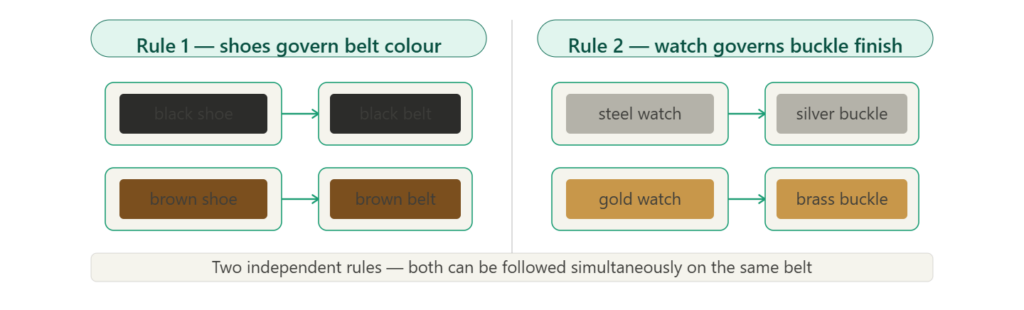
Rule 1: Match belt leather colour to shoe leather colour. This is the primary rule and it operates independently of the watch. The belt and shoes are the two leather accessories in most outfits — their colour alignment is the foundation that everything else builds on. The watch doesn’t determine belt colour. The shoes do.
Rule 2: Match buckle finish to watch case metal. Once the belt leather colour is determined by the shoes, the buckle finish is determined by the watch. A steel watch case takes a silver-tone buckle. A gold watch takes a gold-tone or brass buckle. A black or PVD-coated watch takes a matte black or gunmetal buckle.
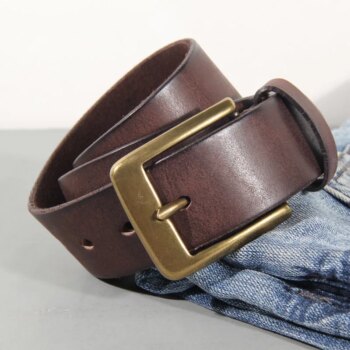
These two rules operate on different components of the belt — leather colour and buckle finish — which means they can be followed simultaneously without conflict. A dark brown leather belt with a brushed silver buckle is correct for both brown shoes and a steel watch. A dark brown belt with a brass buckle is correct for both brown shoes and a gold watch.
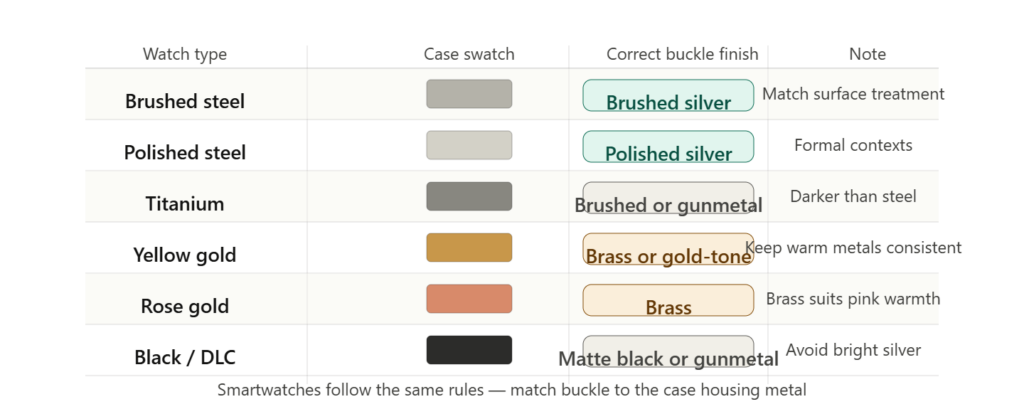
Stainless steel is the most common watch case material in everyday and business wear. It takes a silver-tone buckle — brushed, polished, or satin finish depending on the watch’s own surface treatment.
The finish weight matters. A watch with a heavily brushed case reads as more restrained than a mirror-polished case. Pairing a brushed steel watch with a high-polish mirror buckle creates a finish mismatch within the metal family — both are silver-tone, but one is matte and one is reflective. Match the surface treatment as well as the colour family where possible.
Brushed steel watch: Brushed silver or satin silver buckle. Matte black can also work in contemporary casual contexts where a monochromatic metal approach suits the outfit.
Polished steel watch: Polished silver buckle. The formality of a mirror-polished watch case corresponds to more formal occasions where polished hardware is appropriate.
Titanium watch: Brushed silver or gunmetal. Titanium has a slightly darker, more matte tone than stainless — gunmetal reads as more consistent with the material character of titanium than bright silver.
Gold case watches require consistency in the warm metal family. A gold watch with a silver buckle creates a warm-cool metal conflict that reads as unresolved — both are visible hardware elements and their difference is immediately apparent.
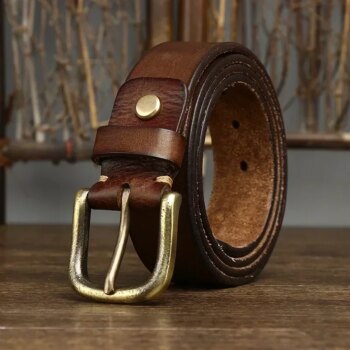
Yellow gold watch: Brass buckle or gold-tone buckle. Solid brass develops a natural warm patina over time that ages consistently with a gold watch. Gold-tone PVD coating is appropriate for contemporary belt designs where solid brass isn’t available.
Rose gold watch: Brass or warm gold-tone buckle. Rose gold has a pinker, warmer tone than yellow gold — a standard yellow-gold buckle can clash slightly. Brass, which has warm undertones, is typically a better match than a bright yellow-gold finish.
Gold-plated watch: Treat the same as solid gold for matching purposes — the visible metal colour is the reference point, not the base material.
Black watches — whether ceramic, carbon fibre, DLC-coated, or PVD-coated steel — suit matte black or gunmetal buckles. The monochromatic dark-metal approach of a black watch is completed by dark hardware rather than contrasted by bright silver.
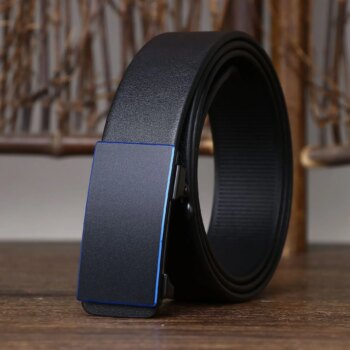
Matte black buckle: The closest match for ceramic and carbon fibre watches. Creates a consistent matte-dark palette across the outfit’s hardware.
Gunmetal buckle: Works for both black watches and dark grey or anthracite watches where a pure matte black would be too stark. Gunmetal sits between silver and black and has enough warmth to avoid looking purely tactical.
Avoid: Bright silver or gold buckles with black watches. The contrast is too sharp and draws attention to the mismatch rather than creating a coherent hardware palette.
Once metal is matched, leather texture is the secondary coordination opportunity. It’s less critical than metal matching — mismatched textures are less visible than mismatched metals — but it’s the detail that moves an outfit from adequate to considered.
Smooth leather strap on the watch: Smooth leather belt. Consistency of leather texture across the two leather accessories creates a coherent, clean look. This is the default correct pairing for professional and formal contexts.
Crocodile or embossed strap on the watch: Crocodile or embossed belt in the same pattern. A crocodile watch strap paired with a smooth belt creates a textural mismatch that’s more visible at close range than a colour mismatch would be. Matching the emboss pattern is the considered choice.
Rubber or NATO strap on the watch: The texture matching rule relaxes in casual contexts where sport or military-style straps are worn. A smooth or slightly textured leather belt reads correctly alongside a rubber or fabric strap — no expectation of material consistency applies here.
Fabric or mesh bracelet: No texture matching required. Metal and fabric watch components don’t create a leather texture reference — the metal case is the relevant element, and buckle finish matching applies.
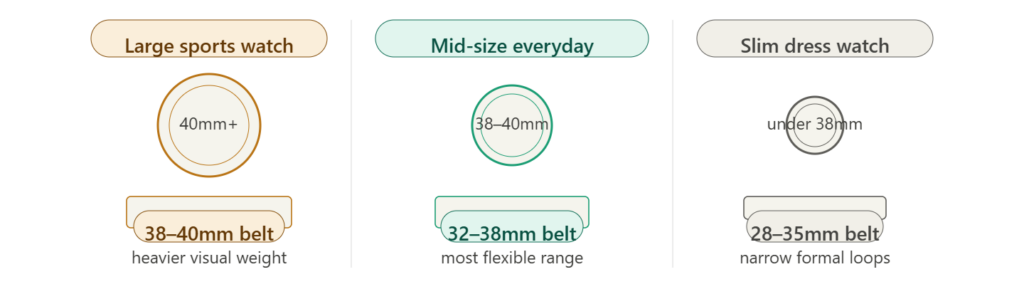
Belt width and watch size are both proportion variables — they’re read relative to the wearer’s build and the outfit’s overall weight. When they’re significantly mismatched, the outfit looks like it can’t decide what register it’s in.
Large sports or diver’s watch (40mm+ case): A wider belt — 38–40mm — suits the visual weight of a substantial watch. A narrow dress belt at 30mm under a large sports watch looks like two different outfits assembled together.
Dress and thin-profile watch (under 38mm case): A narrower belt — 28–35mm — is proportionally correct. Formal and dressy contexts that suit thin watches also suit narrow belts. A 40mm belt under a slim dress watch looks heavy and casual relative to the outfit’s intent.
Mid-size everyday watch (38–40mm): The most common watch size, and the one with the most flexibility. 32–38mm belt width works correctly across most everyday and business casual contexts. This is the range where the “one belt for most occasions” is most practical.
Blue dials — particularly in navy, slate, and mid-blue — behave as neutrals in metal matching because blue sits between warm and cool on the tonal spectrum. A blue dial with a steel case reads as cool but not starkly so, and the belt coordination follows the case metal rule: silver buckle for steel, gold/brass for gold.
Where the blue dial affects belt colour (not buckle finish): a strong navy blue dial can justify a navy or dark blue leather belt as an accent that ties the dial colour into the outfit. This is a deliberate choice rather than a rule — it works when the outfit is specifically built around the blue accent, not as a general pairing principle.
| Watch type | Buckle finish | Belt leather | Notes |
|---|---|---|---|
| Brushed steel | Brushed silver | Match shoes | Most common combination |
| Polished steel | Polished silver | Match shoes | Formal contexts |
| Titanium | Brushed silver or gunmetal | Match shoes | Match matte tone |
| Yellow gold | Brass or gold-tone | Match shoes | Keep warm metals consistent |
| Rose gold | Brass | Match shoes | Brass suits rose gold better than yellow gold |
| Black / DLC | Matte black or gunmetal | Match shoes | Avoid bright silver |
| Smartwatch | Match case metal | Match shoes | Same rules apply |
Smartwatches follow the same buckle-matching logic as traditional watches. The case housing — whether aluminium, stainless, or titanium — is the metal reference point. Apple Watch aluminium cases in silver take a silver buckle; gold aluminium cases take a gold or brass buckle; graphite or space black cases take a gunmetal or matte black buckle.
The rubber or silicone sport band changes the texture rule — no leather texture matching is expected. But the case metal match to buckle finish remains correct.
Both — but they govern different components. Shoes determine belt leather colour. Watch determines buckle finish. These are independent rules applied to different parts of the belt, so both can be followed simultaneously.
Yes. The brown leather matches your brown shoes (leather-to-leather rule). The buckle on the brown belt should be silver to match the steel watch case (metal-to-metal rule). Brown leather with a silver buckle is a clean, coherent combination for everyday and business casual wear.
Yes, with the right buckle. A black leather belt with a brass or gold-tone buckle is correct for a gold watch — the leather matches black shoes, and the brass buckle matches the gold case. A black leather belt with a silver buckle paired with a gold watch creates a metal mismatch.
Not as a strict rule, but as a considered detail. Smooth-to-smooth and textured-to-textured create more coherent outfits. The metal matching rule (buckle to case) takes priority — get that right first, then address texture as a secondary refinement.
This is the practical argument for modular belt design — a detachable buckle system allows one strap to be used with multiple buckle finishes. One dark brown strap with a silver buckle for steel watch days and the same strap with a brass buckle for gold watch days covers most combinations without owning multiple complete belts.
HoldForm buckles are available in brushed silver, polished silver, matte black, and brass finishes — designed so one strap can be paired with multiple buckle finishes depending on the watch being worn.
[View buckle finish options →] [Silver, gold and black buckle: how to choose and why →] [Black belt or brown belt: the full leather colour matching guide →] [Best belt for office wear: fit system and finish →]

Practical belt guides, sizing tips, and exclusive offers — straight to your inbox.


Leave a comment